Page 405 of 651

STARTING AND DRIVING
384
ENGINE EXHAUST CAUTION
CAUTION
�Avoid inhaling the engine exhaust. It contains
carbon monoxide, which is a colorless and odorless
gas. It can cause unconsciousness or even death.
� Make sure the exhaust system has no holes or loose
connections. The system should be checked from
time to time. If you hit something, or notice a change
in the sound of the exhaust, have the system checked
immediately.
� Do not run the engine in a garage or enclosed area
except for the time needed to drive the vehicle in or
out. The exhaust gases cannot escape, making this
a particularly dangerous situation.
� Do not remain for a long time in a parked vehicle with
the engine running. If it is unavoidable, however, do
so only in an unconfined area and adjust the heating
or cooling system to force outside air into the vehicle.
� Keep the back door closed while driving. An open or
unsealed back door may cause exhaust gases to be
drawn into the vehicle.
� To allow proper operation of your vehicle’s
ventilation system, keep the inlet grilles in front of the
windshield clear of snow, leaves, or other
obstructions.
� If you smell exhaust fumes in the vehicle, drive with
the windows open and the back door closed. Have
the cause immediately located and corrected.
Page 408 of 651
STARTING AND DRIVING
387
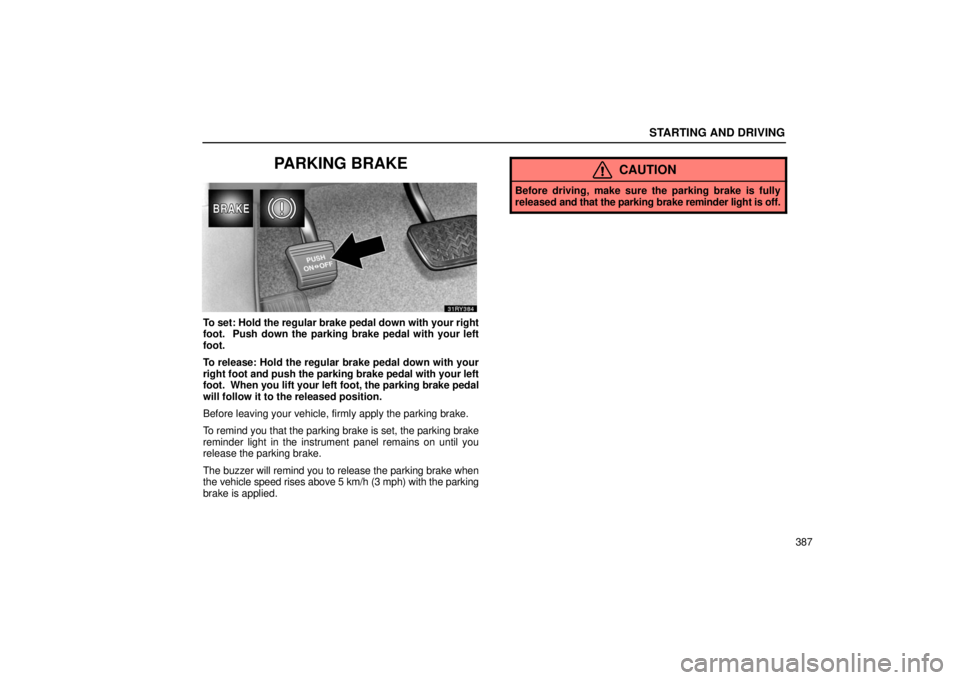
PARKING BRAKE
To set: Hold the regular brake pedal down with your right
foot. Push down the parking brake pedal with your left
foot.
To release: Hold the regular brake pedal down with your
right foot and push the parking brake pedal with your left
foot. When you lift your left foot, the parking brake pedal
will follow it to the released position.
Before leaving your vehicle, firmly apply the parking brake.
To remind you that the parking brake is set, the parking brake
reminder light in the instrument panel remains on until you
release the parking brake.
The buzzer will remind you to release the parking brake when
the vehicle speed rises above 5 km/h (3 mph) with the parking
brake is applied.
CAUTION
Before driving, make sure the parking brake is fully
released and that the parking brake reminder light is off.
Page 409 of 651

STARTING AND DRIVING
388
HOW TO START THE ENGINE
Before cranking
1. Apply the parking brake firmly.
2. Turn off unnecessary lights and accessories.
3. Put the selector lever in “P”. If you need to restart the engine
while the vehicle is moving, put the selector lever in “N”. A
starter safety device will prevent the starter from operating if
the selector lever is in any drive position.
4. Depress the brake pedal and hold it to the floor until driving
off.
Starting the engine
Before starting the engine, be sure to follow the instructions in
“Before cranking”.
Normal starting procedure
The multiport fuel injection system/sequential multiport fuel
injection system in your engine automatically controls the
proper air −fuel mixture for starting. You can start a cold or hot
engine as follows:
With your foot off the accelerator pedal, crank the engine by
turning the key to “START”. Release it when the engine starts.
Engine should be warmed up by driving, not in idle. For
warming up, drive with the engine turning smoothly until engine
coolant temperature is within normal range.
Page 411 of 651

STARTING AND DRIVING
390�
The shift position is displayed on the instrument
cluster.
P: Parking, engine starting and key removal position
R: Reverse position
N: Neutral position
D: Normal driving position (Shifting into overdrive possible)
4: Position for engine braking (Shifting into overdrive not
possible)
Vehicle with the cruise control —
When the cruise control is being used, even if you
downshift from “D” to “4”, engine braking will not be
enabled because the cruise control is not cancelled. For
vehicle speed reduction, see page 415.
Vehicle with the dynamic laser cruise control —
When the cruise control is being used in the
conventional (fixed speed) cruise control mode or in the
vehicle −to−vehicle distance control mode, even if you
downshift from “D” to “4”, engine braking will not be
enabled because the cruise control is not cancelled. For
vehicle speed reduction, see pages 427 and 436.
3, 2: Position for more powerful engine braking
L: Position for maximum engine braking Correct
use of the automatic transmission is explained in
the following parts.
(a) Normal driving
(b) Using engine braking
(c) Using the “3”, “2” and “L” positions
(d) Backing up
(e) Parking
(f) Good driving practice
(g) If you cannot shift the selector lever
(h) Driving in snow mode
Page 412 of 651
STARTING AND DRIVING
391
(a) Normal driving
�1“P” (Park) position2 “N” (Neutral) position
1. Start the engine as instructed in “How to start the
engine” on page 388.
The transmission must be in “P” or “N”. The engine will not st\
art
in any drive position even if the ignition key is turned to
“START”.
�1Brake pedal2“D” (Drive) position
2. With your foot holding down the brake pedal, shift the
selector lever to “D”.
Always use the “D” position to improve fuel economy and quiet
driving. Only in this position, shifting into the overdrive gear is
possible. However, while the engine coolant temperature is
low, the transmission will not shift into the overdrive gear even
in the “D” position. (See “(b) Using engine braking” and\
“(f)
Good driving practice” for exceptions.)
CAUTION
Never put your foot on the accelerator pedal while
shifting.
Page 413 of 651

STARTING AND DRIVING
3923. Release the parking brake and brake pedal. Depress
the accelerator pedal slowly for smooth starting.
In normal cruising, the vehicle will start in first gear and
automatically shift up to the most suitable gear. On inclines,
declines
or winding roads, etc., the vehicle shifts up and down
automatically according to the running conditions to obtain the
suitable driving power and engine braking.
When the lever is in the “4” position, the automatic
transmission system will select the most suitable gear for the
running conditions such as hill climbing, hard towing, etc.
If you need to accelerate rapidly while driving, depress the
accelerator pedal to the full throttle position. This provides
more acceleration by automatically downshifting the
transmission to the next lower gear or beyond, depending on
the vehicle speed.
If engine braking is needed, such as in descending a long hill,
see “(b) Using engine braking”.
(b) Using engine braking
To use the braking power of the engine, downshift the
transmission in the way described below:
1Shift into the “4” position. The transmission will downshift
to fourth gear and engine braking will be enabled.
Vehicle with the cruise control —
When the cruise control is being used, even if you
downshift from “D” to “4”, engine braking will not be
enabled because the cruise control is not cancelled. For
vehicle speed reduction, see page 415.
Page 416 of 651
STARTING AND DRIVING
395
Vehicles with rear view monitor system —
When the selector lever is shifted into “R” position with the
ignition switch in the “ON” position, rear view monitor system
will
activate. For instructions, see “Rear view monitor system”
on page 408.
(e) Parking
�1Brake pedal
2Parking brake pedal
3“P” (Park) position
1. Bring the vehicle to a complete stop.
2. Depress the parking brake fully to securely apply the
parking brake.
3. With the brake pedal held down with your foot, shift the
selector lever to the “P” position.
Page 417 of 651
STARTING AND DRIVING
396
CAUTION
Never attempt to move the selector lever into “P” under
any circumstances while the vehicle is moving. Serious
mechanical damage and loss of vehicle control may
result.
(f) Good driving practice
� If the transmission repeatedly shifts up and down between
fourth and overdrive gears when climbing a gentle slope,
shift the selector lever to the “4” position. Be sure to shift the
selector lever to the “D” position after climbing the slope.
� When towing a trailer, in order to maintain efficient engine
braking and electrical charging performance, do not use
overdrive.
CAUTION
Always keep your foot on the brake pedal while stopped
with the engine running. This prevents the vehicle from
creeping.
NOTICE
Always use the brake pedal or parking brake to hold the
vehicle on an upgrade. Do not attempt to hold the
vehicle using the accelerator pedal, as this can cause
the transmission to overheat.