Page 534 of 651
IN CASE OF AN EMERGENCY
513
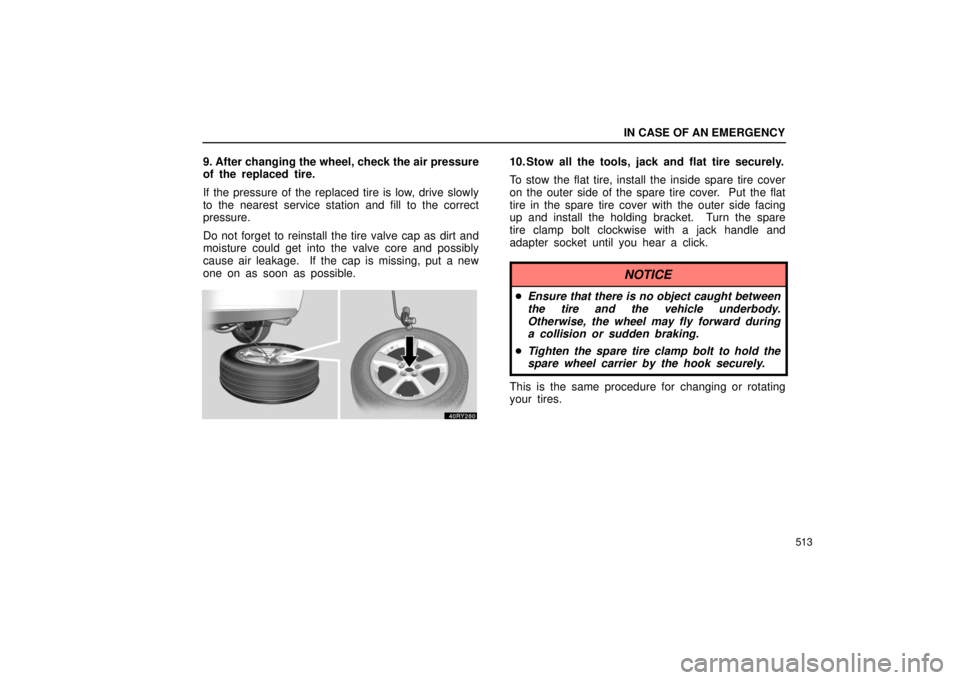
9. After changing the wheel, check the air pressure
of the replaced tire.
If the pressure of the replaced tire is low, drive slowly
to the nearest service station and fill to the correct
pressure.
Do not forget to reinstall the tire valve cap as dirt and
moisture could get into the valve core and possibly
cause air leakage. If the cap is missing, put a new
one on as soon as possible.10. Stow all the tools, jack and flat tire securely.
To stow the flat tire, install the inside spare tire cover
on the outer side of the spare tire cover. Put the flat
tire in the spare tire cover with the outer side facing
up and install the holding bracket. Turn the spare
tire clamp bolt clockwise with a jack handle and
adapter socket until you hear a click.
NOTICE
�Ensure that there is no object caught between
the tire and the vehicle underbody.
Otherwise, the wheel may fly forward during
a collision or sudden braking.
� Tighten the spare tire clamp bolt to hold the
spare wheel carrier by the hook securely.
This is the same procedure for changing or rotating
your tires.
Page 544 of 651
IN CASE OF AN EMERGENCY
523
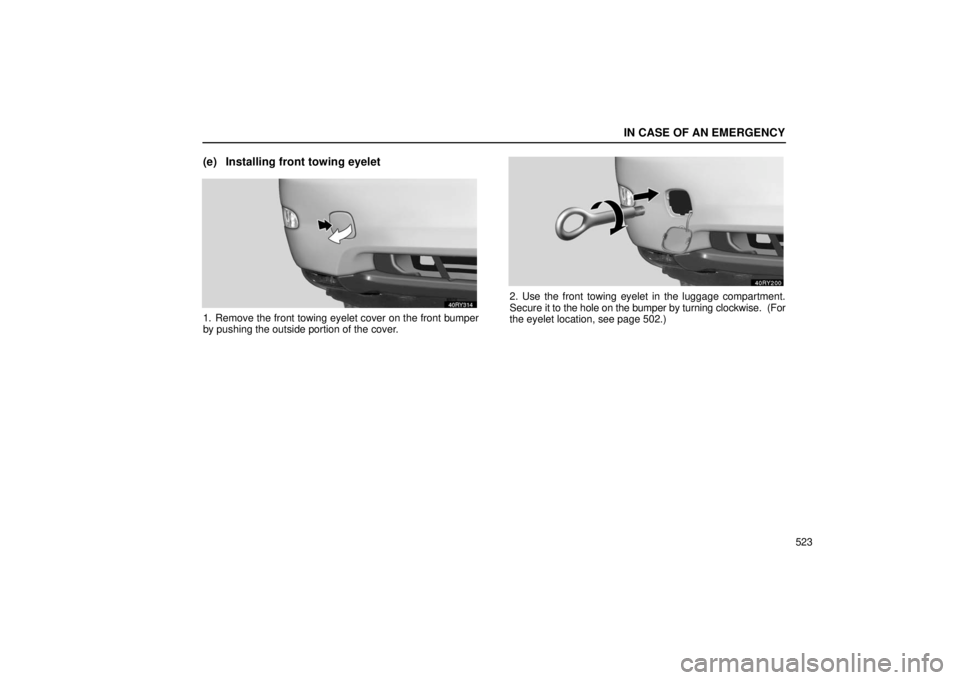
(e) Installing front towing eyelet
1. Remove the front towing eyelet cover on the front bumper
by pushing the outside portion of the cover.
2. Use the front towing eyelet in the luggage compartment.
Secure it to the hole on the bumper by turning clockwise. (For
the eyelet location, see page 502.)
Page 578 of 651
ENGINE
557
If the oil level is below or only slightly above the low mark,
add engine oil of the same type as already in the engine.
Remove the oil filler cap and add engine oil a little at a time,
checking the dipstick. We recommend that you use a funnel
when adding oil. The approximate quantity of oil needed to
raise the level between low mark and full mark on the dipstick
is indicated as follows:
1.5 L (1.6 qt., 1.3 Imp. qt.)
For the engine oil capacity, see “Specifications” on page 548.
When the level reaches within the correct range, return the filler
cap and turn the cap clockwise until you hear a click.
NOTICE
� Be careful not to spill engine oil on the vehicle
components.
� Avoid overfilling, or the engine could be damaged.
Check the oil level on the dipstick once again after
adding the oil.
Page 590 of 651
CHASSIS
569
CHECKING POWER STEERINGFLUID
The power steering fluid reservoir is located under the
engine compartment cover. Before checking the power
steering fluid, remove the cover. (For details, see
“Removing the e ngine compartment cover” on page 540.)
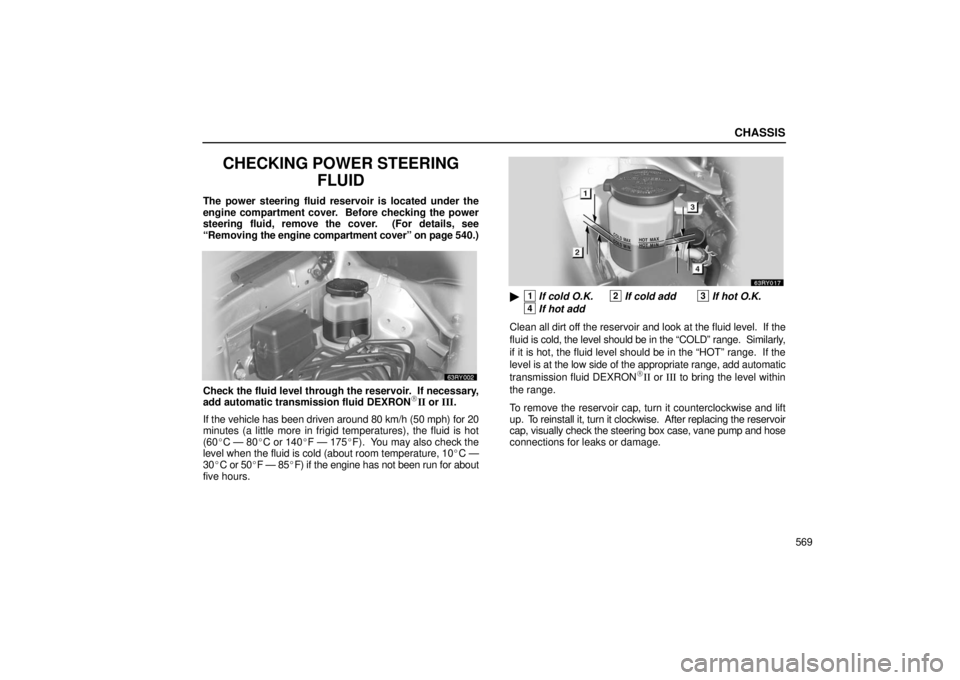
Check the fluid level through the reservoir. If necessary,
add automatic transmission fluid DEXRON�II or III .
If the vehicle has been driven around 80 km/h (50 mph) for 20
minutes (a little more in frigid temperatures), the fluid is hot
(60 �C — 80�C or 140�F — 175�F). You may also check the
level when the fluid is cold (about room temperature, 10 �C —
30 �C or 50�F — 85�F) if the engine has not been run for about
five hours.
�1If cold O.K.2If cold add3If hot O.K.
4If hot add
Clean all dirt off the reservoir and look at the fluid level. If the
fluid is cold, the level should be in the “COLD” range. Similarly,
if it is hot, the fluid level should be in the “HOT” range. If th\
e
level is at the low side of the appropriate range, add automatic
transmission fluid DEXRON
�II or III to bring the level within
the range.
To remove the reservoir cap, turn it counterclockwise and lift
up. To reinstall it, turn it clockwise. After replacing the reservoir
cap, visually check the steering box case, vane pump and hose
connections for leaks or damage.
Page:
< prev 1-8 9-16 17-24