Page 368 of 419

352
5-2. Steps to take in an emergency
CAUTION
■Using the tire jack
Improper use of the tire jack may lead to death or injuries due to the vehicle sud-
denly falling off the jack.
Observe the following precautions to prevent accidents.
• Do not use the tire jack for any purpose other than replacing tires or installing and
removing tire chains.
• Only use the tire jack that comes with this vehicle for replacing a flat tire.
Do not use this tire jack on other vehicl
es, and do not use other tire jacks for
replacing tires on this vehicle.
• Always check that the tire jack is securely set to the jack point.
• Do not raise the vehicle while someone is in it.
• When raising the vehicle, do not put an object on or under the jack.
• Do not raise the vehicle to a height greate r than
that required to replace the tire.
• Do not put any part of your body under the vehicle supported by a jack.
• Do not start or run the engine while your vehicle is supported by the jack.
• Use a jack stand if it is necessary to get under the vehicle.
• Take particular care when lowering the vehicle to ensure that no one working on or
near the vehicle may be injured.
■Replacing a flat tire
Observe the following precautions to reduce
the risk of death or serious injury.
• Never use oil or grease on the wheel bolts or wheel nuts.
The oil or grease can cause the wheel nuts to loosen, causing a serious accident.
R
emove any oil or grease on the wheel bolts or wheel nuts.
• Have the wheel nuts tightene d with a tor
que wrench to 76 f t•lbf (105 N•m, 10.5
kgf
•m) as soon as possible after changing wheels.
Failure to follow these pre-cautions could cause, the wheel nuts to loosen and the
w
heels may fall off, which could lead to an accident causing death or serious injury.
NOTICE
■Do not drive the vehicle with a flat tire.
Do not continue driving with a flat tire.
Driving even a short distance can damage a tire and wheel beyond repair.
Page 377 of 419

5
When trouble arises
361
5-2. Steps to take in an emergency
If the vehicle becomes stuck
CAUTION
■When removing the stuck vehicle
If you choose to rock the vehicle back and forth to free it, make sure the surround-
ing area is clear, to avoid striking other vehicles, objects or persons. The vehicle
may
also lunge forward or lunge back suddenly as it becomes free, use extreme
caution.
NOTICE
■To avoid damaging the transmission and other components
●Do not operate the selector lever while depressing the accelerator pedal.
●Avoid spinning the wheels and do not rev the engine.
●If the vehicle remains stuck after trying these procedures the vehicle may require
towing to be freed.
Carry out the following procedures if the tires spin or the vehicle becomes
stuck in mud, dirt, or snow to the extent that it cannot move.
• Stop the engine. Set the parking brake and put the transmission
selector lever in “P”.
• Remove the mud, snow, or sand from around the stuck tire.
• Place wood, stones or some other ma terial to help pr
ovide traction
under the tires.
• Restart the engine.
• Turn off the traction control system. ( P.141)
• Carefully apply the accelerator to free the vehicle.
Page 380 of 419
364
6-1. Specifications
Maintenance data
Dimensions and weight
*Unladen vehicle
Overall length197.4 in. (5015 mm)
Overall width72.0 in. (1830 mm)
Overall height
- with electronically modulated air suspension
- without electronically modulated air suspension
57.9 in. (1470 mm)*
58.7 in. (1490 mm)*
Wheelbase115.2 in. (2925 mm)
Tr e a d
-Front
with electronically modulated air
suspension
without electronically modulated
air suspension
-Rear
with electronically modulated air
suspension
without electronically modulated
air suspension
62.0 in. (1575 mm)
61.8 in. (1570 mm)
62.0 in. (1575 mm)
61.8 in. (1570 mm)
Vehicle capacity weight (occu -
pants + luggage)900 lb. (410 kg)
Towing capacity (trailer weight +
cargo weight)2000 lb. (907 kg)
Page 386 of 419
370
6-1. Specifications
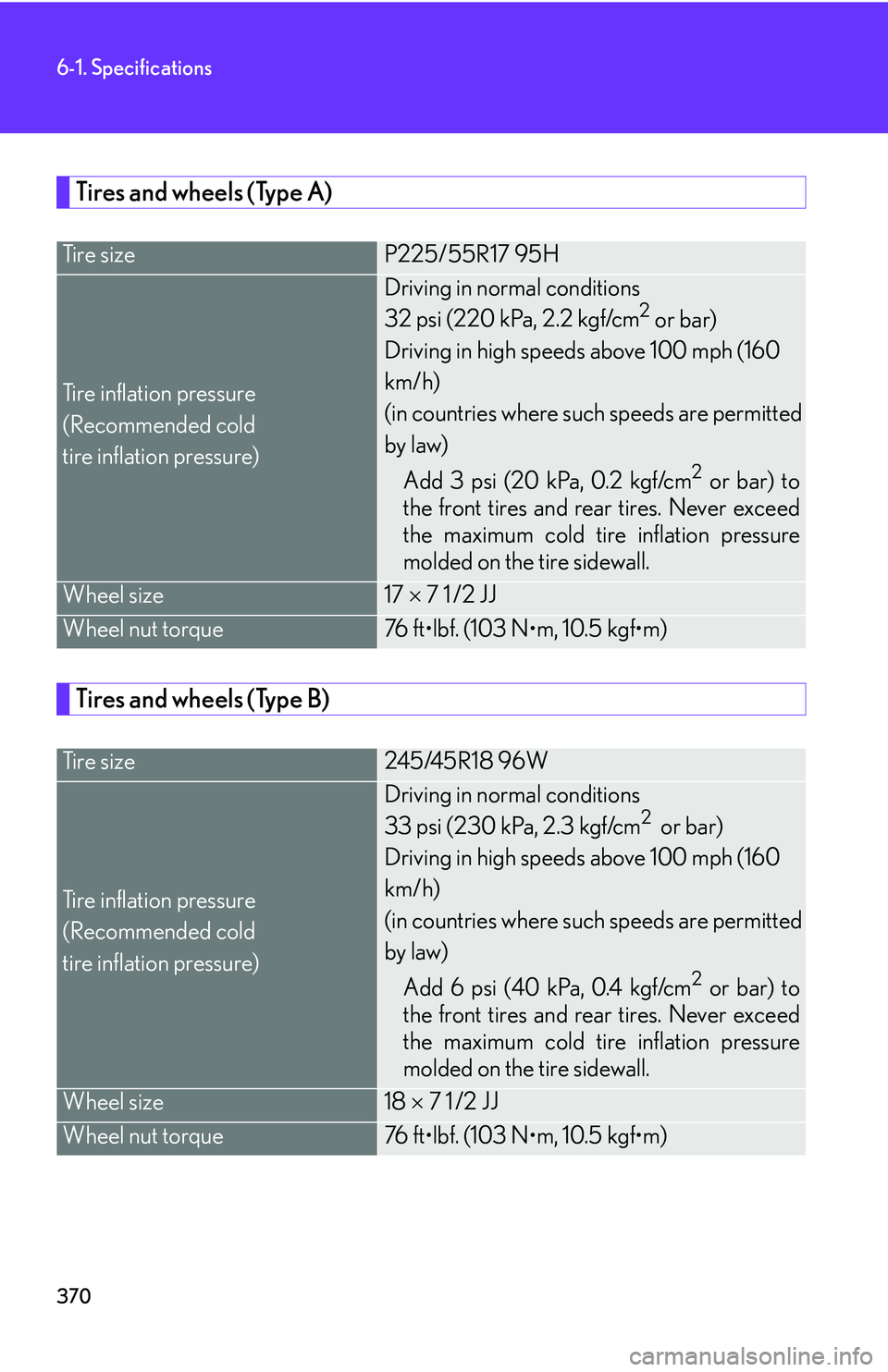
Tires and wheels (Type A)
Tires and wheels (Type B)
Ti r e s i z eP225/55R17 95H
Tire inflation pressure
(Recommended cold
tire inflation pressure)
Driving in normal conditions
32 psi (220 kPa, 2.2 kgf/cm2 or bar)
Driving in high speeds above 100 mph (160
km/
h)
(in countries where such speeds are permitted
b
y law)
Add 3 psi (20 kPa, 0.2 kgf/cm
2 or bar) to
the front tires and rear tires. Never exceed
the maximum cold tire inflation pressure
molded on the tire sidewall.
Wheel size17 7 1 /2 JJ
Wheel nut torque76 f t•lbf. (103 N•m, 10.5 kgf•m)
Ti r e s i z e245/45R18 96W
Tire inflation pressure
(Recommended cold
tire inflation pressure)
Driving in normal conditions
33 psi (230 kPa, 2.3 kgf/cm2 or bar)
Driving in high speeds above 100 mph (160
km/
h)
(in countries where such speeds are permitted
b
y law)
Add 6 psi (40 kPa, 0.4 kgf/cm
2 or bar) to
the front tires and rear tires. Never exceed
the maximum cold tire inflation pressure
molded on the tire sidewall.
Wheel size18 7 1 /2 JJ
Wheel nut torque76 f t•lbf. (103 N•m, 10.5 kgf•m)
Page 387 of 419
371
6-1. Specifications
6
Vehicle specifications
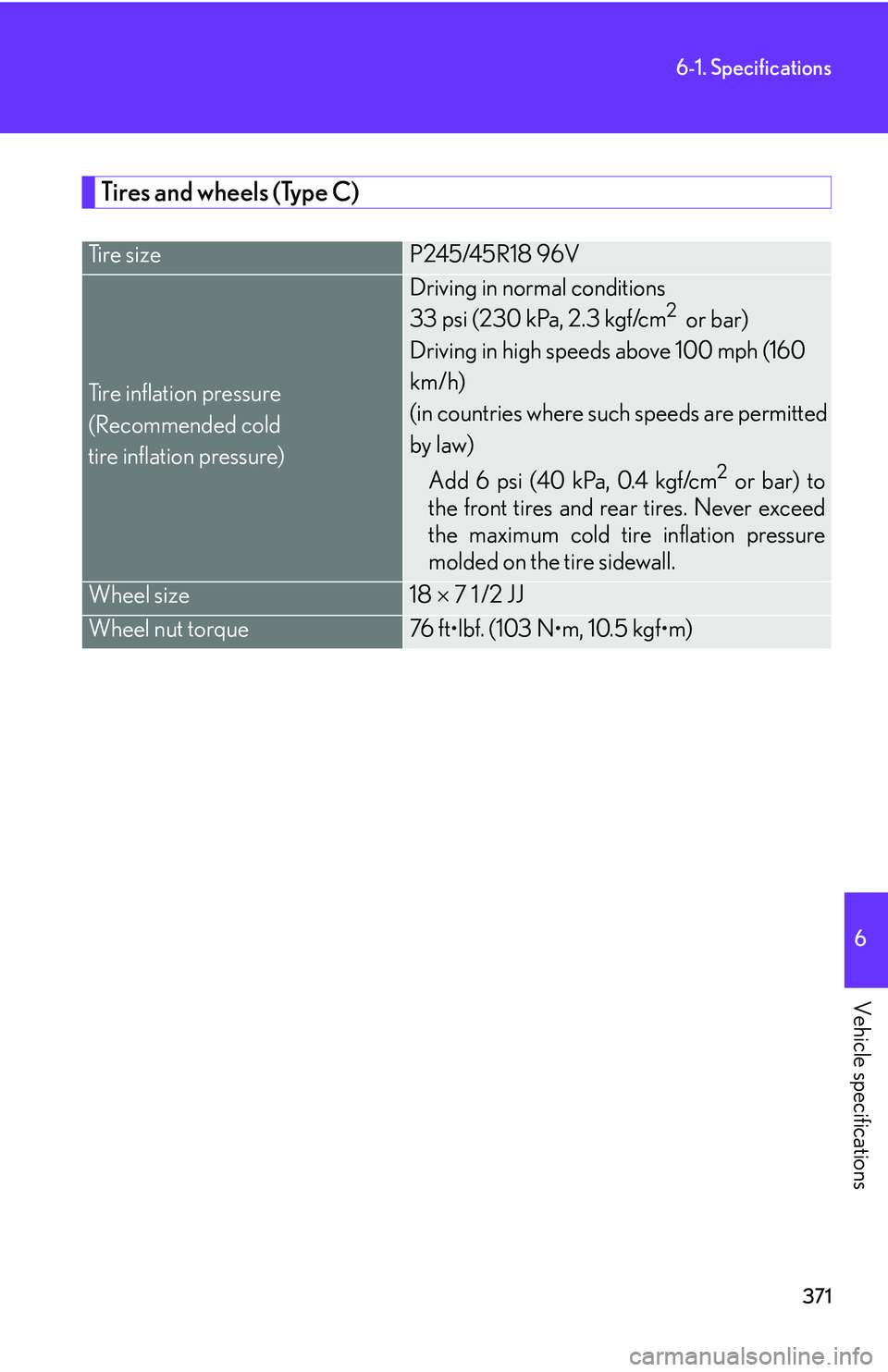
Tires and wheels (Type C)
Ti r e s i z eP245/45R18 96V
Tire inflation pressure
(Recommended cold
tire inflation pressure)
Driving in normal conditions
33 psi (230 kPa, 2.3 kgf/cm2 or bar)
Driving in high speeds above 100 mph (160
km/
h)
(in countries where such speeds are permitted
b
y law)
Add 6 psi (40 kPa, 0.4 kgf/cm
2 or bar) to
the front tires and rear tires. Never exceed
the maximum cold tire inflation pressure
molded on the tire sidewall.
Wheel size18 7 1 /2 JJ
Wheel nut torque76 f t•lbf. (103 N•m, 10.5 kgf•m)
Page 394 of 419
378
6-1. Specifications
Tire size
■Typical tire size information
The illustration indicates typical
tir
e size.
Tire use
(P = Passenger car, T = Tempo -
rary use)
Section width (in millimeters)
Aspect ratio
(tire height to section width)
Tire construction code
R = Radial, D = Diagonal
Wheel diameter (in inches)
Load index
(2 digits or 3 digits)
Speed symbol
(alphabet with one letter)
■ T
ire measurements
Section width
Ti r e h e i g h t
Wheel diameter
1
2
3
4
5
6
7
8
1
2
3
Page 397 of 419
381
6-1. Specifications
6
Vehicle specifications
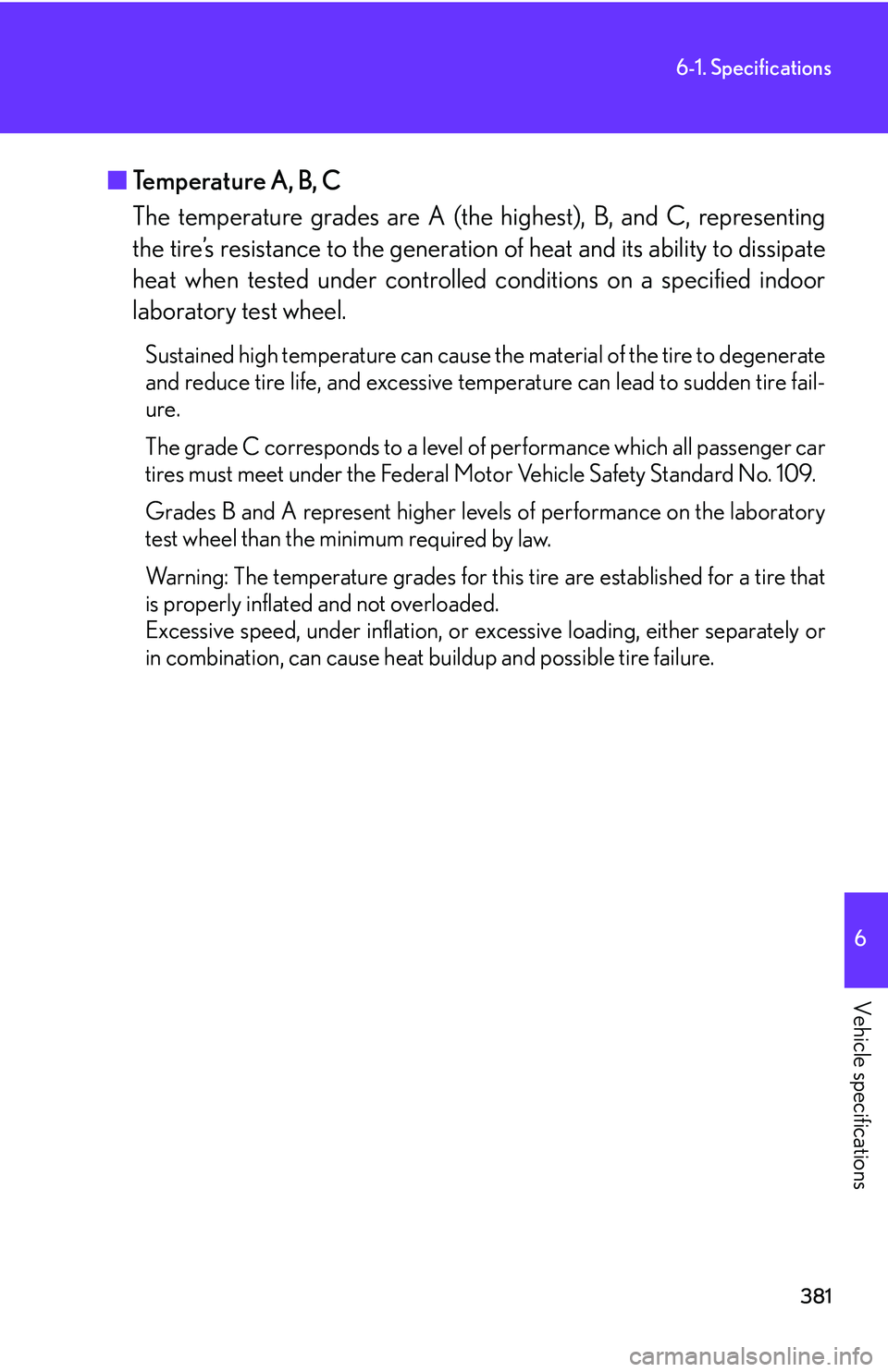
■Temperature A, B, C
The temperature grades are A (the hi ghest), B
, and C, representing
the tire’s resistance to the generation of heat and its ability to dissipate
heat when tested under controlled conditions on a specified indoor
laboratory test wheel.
Sustained high temperature can cause the material of the tire to degenerate
and reduce tire life, and excessive temperature can lead to sudden tire fail -
ure.
The grade C corresponds to a level of performance which all passenger car
tir
es must meet under the Federal Moto r Vehicle Safety Standard No. 109.
Grades B and A represent higher levels of performance on the laboratory
test wheel than the minimum r
equired by law.
Warning: The temperature grades for this tire are established for a tire that
is pr
operly inflated and not overloaded.
Excessive speed, under inflation, or ex ces
sive loading, either separately or
in combination, can cause heat buildup and possible tire failure.
Page 399 of 419
383
6-1. Specifications
6
Vehicle specifications
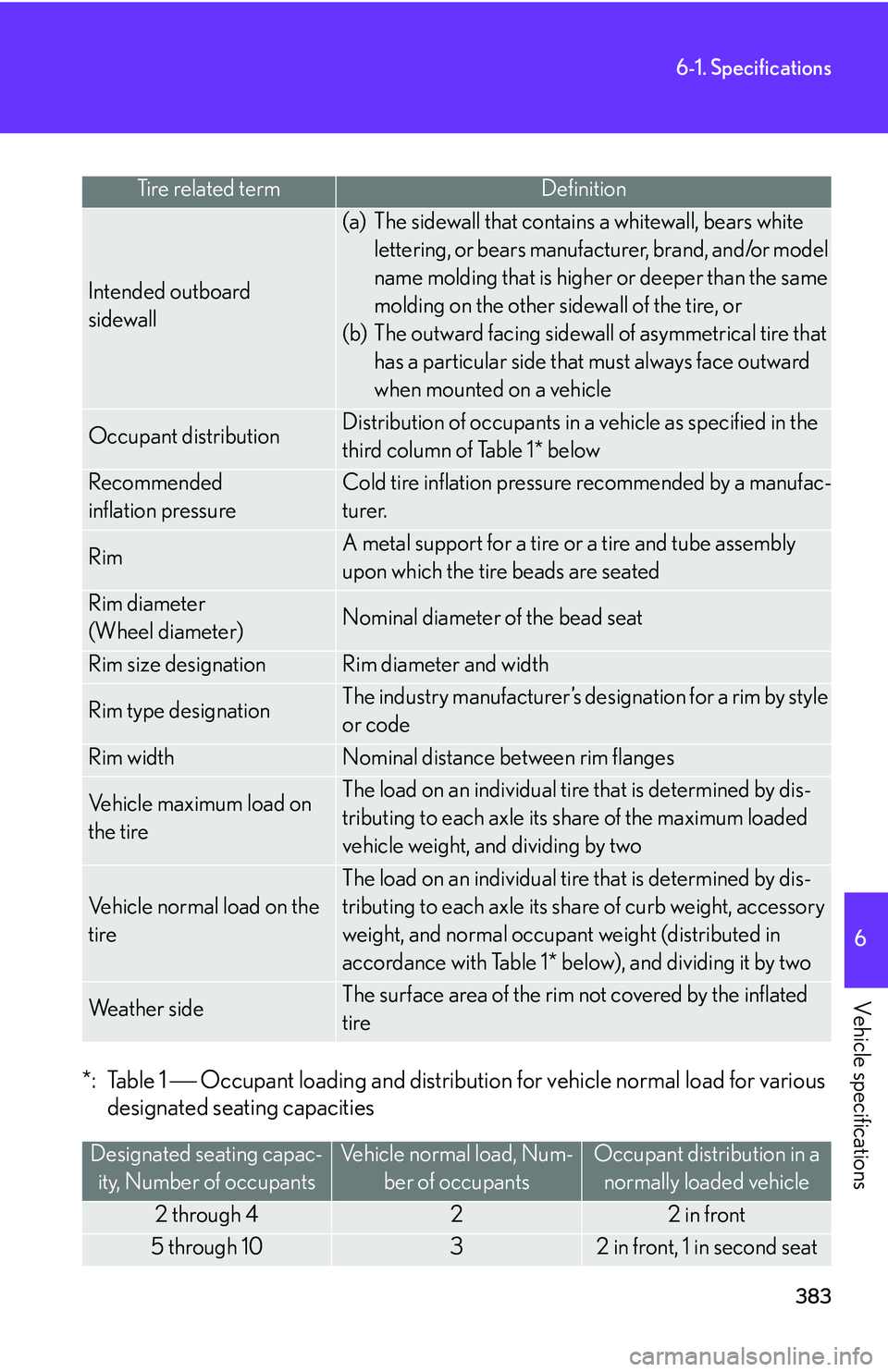
*: Table 1 Occupant loading and distribution for vehicle normal load for various
designated seating capacities
Tire related termDefinition
Intended outboard
sidewall
(a) The sidewall that contains a whitewall, bears white
lettering, or bears manufacturer, brand, and/or model
name molding that is higher or deeper than the same
molding on the other sidewall of the tire, or
(b) The outward facing sidewall of asymmetrical tire that
has a particular side that must always face outward
when mounted on a vehicle
Occupant distributionDistribution of occupants in a vehicle as specified in the
third column of Table 1* below
Recommended
inflation pressure
Cold tire inflation pressure recommended by a manufac -
turer.
RimA metal support for a tire or a tire and tube assembly
upon which the tire beads are seated
Rim diameter
(Wheel diameter)Nominal diameter of the bead seat
Rim size designationRim diameter and width
Rim type designationThe industry manufacturer’s designation for a rim by style
or code
Rim widthNominal distance between rim flanges
Vehicle maximum load on
the tireThe load on an individual tire that is determined by dis -
tributing to each axle its share of the maximum loaded
vehicle weight, and dividing by two
Vehicle normal load on the
tire
The load on an individual tire that is determined by dis-
tributing to each axle its share of curb weight, accessory
weight, and normal occupant weight (distributed in
accordance with Table 1* below), and dividing it by two
We a t h e r s i d eThe surface area of the rim not covered by the inflated
tire
Designated seating capac -
ity, Number of occupants
Vehicle normal load, Num -
ber of occupants
Occupant distribution in a
normally loaded vehicle
2 through 422 in front
5 through 1032 in front, 1 in second seat