Page 223 of 419
207
3-4. Storage
3
Interior features
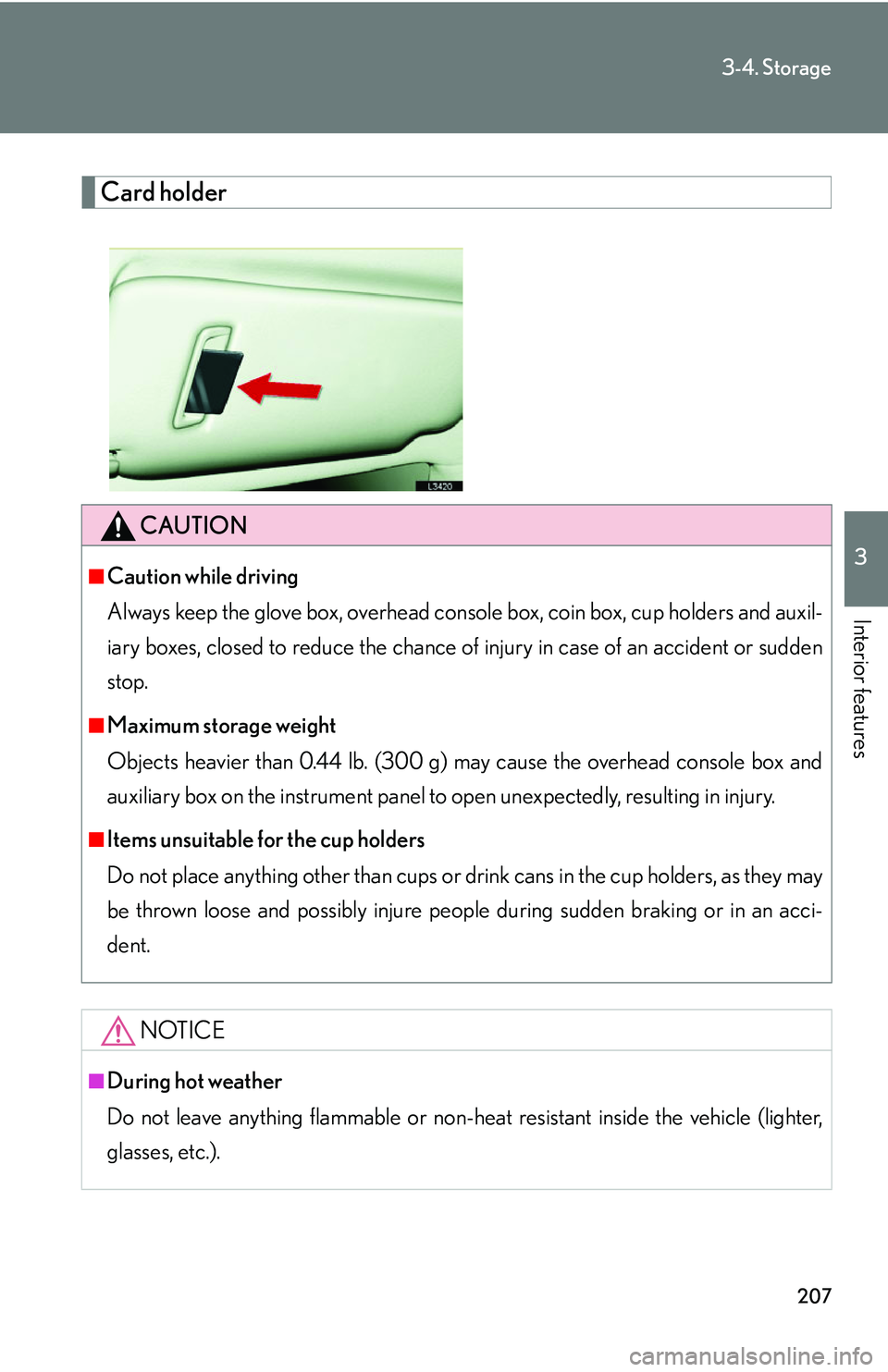
Card holder
CAUTION
■Caution while driving
Always keep the glove box, overhead console bo
x, coin box, cup holders and auxil-
iary boxes, closed to reduce the chance of injury in case of an accident or sudden
stop
.
■Maximum storage weight
Objects heavier than 0.44 lb. (300 g) may cause the overhead console box and
auxiliar
y box on the instrument panel to open unexpectedly, resulting in injury.
■Items unsuitable for the cup holders
Do not place anything other than cups or drink cans in the cup holders, as they may
be
thrown loose and possibly injure peop le during sudden braking or in an acci-
dent.
NOTICE
■During hot weather
Do not leave anything flammable or non-heat resistant inside the vehicle (lighter,
glas
ses, etc.).
Page 235 of 419
219
3-5. Other interior features
3
Interior features
CAUTION
■Burns
●Use caution when seating the following persons in a heated seat to avoid the pos-
sibility of burns:
• Babies, small children, elderly persons, sick per
sons or handicapped persons
• Persons who have delicate skin
• Persons who are exhausted
●Do not cover the seat with anything when using the seat heater.
The seat heaters may overheat if the seat is covered.
NOTICE
■To prevent seat heater damage
Do not put unevenly weighted objects on the
seat and do not stick sharp objects
(needles, nails, etc.) into the seat.
■To prevent battery discharged
Turn the switches off when the engine is not running.
Page 237 of 419
221
3-5. Other interior features
3
Interior features
CAUTION
■Burns/ excessive cooling
●The following passengers should take extra care to avoid burns:
• Babies, small children, elderly persons, si
ck or physically disabled persons.
• Persons who have sensitive skin.
• Exhausted persons.
• Persons who have taken alcohol or drug s whi
ch induce sleep (sleeping drugs,
cold remedies, etc.)
●Do not use a blanket or cushion on the seat. Using the climate control seat with
a blanket or cushion increases the temperature of the seat and may lead to over -
heating.
●Take care not to overuse the cooling function, as it may cool the above men -
tioned passengers excessively minor burns and overheating/ excessive cooling
NOTICE
■To prevent seat heater damage
Do not put unevenly weighted objects on the
seat and do not stick sharp objects
(needles, nails, etc.) into the seat.
■To prevent battery discharged
Turn the switches off when the engine is not running.
Page 296 of 419
280
4-3. Do-it-yourself maintenance
■When to replace your vehicle’s tires
If either of the following occurs, the tire should be replaced:
• Tire damage such as cuts, splits, cracks deep enough to expose the
fabric, or bulges indicating internal damage
• If a tire often goes flat or cannot be pr
operly repaired due to the size
or location of a cut or other damage
If you are not sure, see your Lexus dealer.
■Tire life
Any tire over 6 years old must be checked by a qualified technician even if it has
ne
ver or seldom been used or damage is not obvious.
■If the tread wears down below 0.16 in. (4 mm) on snow tires
The effectiveness of snow tires is lost.
■Tire selection
When replacing a tire, use a tire of the sa me siz
e and construction, and the same or
greater maximum load as the originally installed tires.
Check that the maximum load of the replaced t
ire is greater than 1 /2 of the Gross
Axle Weight Ratings (GAWR) of either the front axle or the rear axle, whichever is
greater.
As for the maximum load of the tire, see the load limit a
t maximum cold tire inflation
pressure mentioned on the sidewall of the tire.
As for the Gross Axle Weight Ratings (GAWR), see the Certification Label.
( P.283 )
Page 301 of 419
285
4-3. Do-it-yourself maintenance
4
Maintenance and care
■Tire inflation pressure check interval
You should check the tire inflation pressur
e every two weeks, or at least once a
month.
Do not forget the spare. The inflation pressure for the spare tire should be the same
as
that for the standard tire. ( P.364 )
■Effects of incorrect tire inflation pressure
Driving with incorrect tire inflation pressure may result in the following:
•Wasting fuel
• Reducing driving comfort and tire life
• Making your vehicle less safe to drive
If a tire needs frequent refilling, have it checked by your Lexus dealer.
■Instructions for checking tire inflation pressure
When checking tire inflation pressure, observing the following;
• Check only when the tires are cold.
If your vehicle has been parked for at least 3 hours and has not been driven for
mor
e than 1 mile or 1.5 km since, you will get an accurate cold tire inflation pres -
sure reading.
• Always use a tire pressure gauge.
The appearance of the tire can be misleadi n
g. In addition, tire inflation pressures
that are even just a few pounds off can degrade ride and handling.
• Do not bleed or reduce tire inflation pressure after driving.
It is normal for the tire inflation pressure to be higher after driving.
• Never exceed the vehicle weight capacity.
Passengers and luggage weight should be pla
ced so that the vehicle is bal-
anced.
Page 303 of 419

287
4-3. Do-it-yourself maintenance
4
Maintenance and care
Wheels
If your wheel is bent, cracked or heavily corroded, the wheel should be
replaced.
Otherwise, the tire may separate from t
he wheel or cause loss of handling
control.
■ Wheel selection
When replacing wheels, care should be tak
en to ensure that they are
equivalent to those removed in lo ad capacity, diameter, rim width,
and offset.
Replacement wheels are available at your Lexus dealer.
Lexus does not recommend using:
• A wheel of a different size or type;
• Used wheels; or
• Bent wheels that have been straightened.
■ Aluminum wheel precautions
●Use only Lexus wheel nuts and a wrench designed for your alumi-
num wheels if you have rotated, repaired or changed your tires.
●Check that the wheel nuts are st ill tight after driving 1000 miles
(1600 km).
●Be careful not to damage the aluminum wheels when using tire
chains.
●Use only Lexus balance weights or equivalent and a plastic or rub-
ber hammer when balancing your wheels.
Page 380 of 419
364
6-1. Specifications
Maintenance data
Dimensions and weight
*Unladen vehicle
Overall length197.4 in. (5015 mm)
Overall width72.0 in. (1830 mm)
Overall height
- with electronically modulated air suspension
- without electronically modulated air suspension
57.9 in. (1470 mm)*
58.7 in. (1490 mm)*
Wheelbase115.2 in. (2925 mm)
Tr e a d
-Front
with electronically modulated air
suspension
without electronically modulated
air suspension
-Rear
with electronically modulated air
suspension
without electronically modulated
air suspension
62.0 in. (1575 mm)
61.8 in. (1570 mm)
62.0 in. (1575 mm)
61.8 in. (1570 mm)
Vehicle capacity weight (occu -
pants + luggage)900 lb. (410 kg)
Towing capacity (trailer weight +
cargo weight)2000 lb. (907 kg)
Page 398 of 419
382
6-1. Specifications
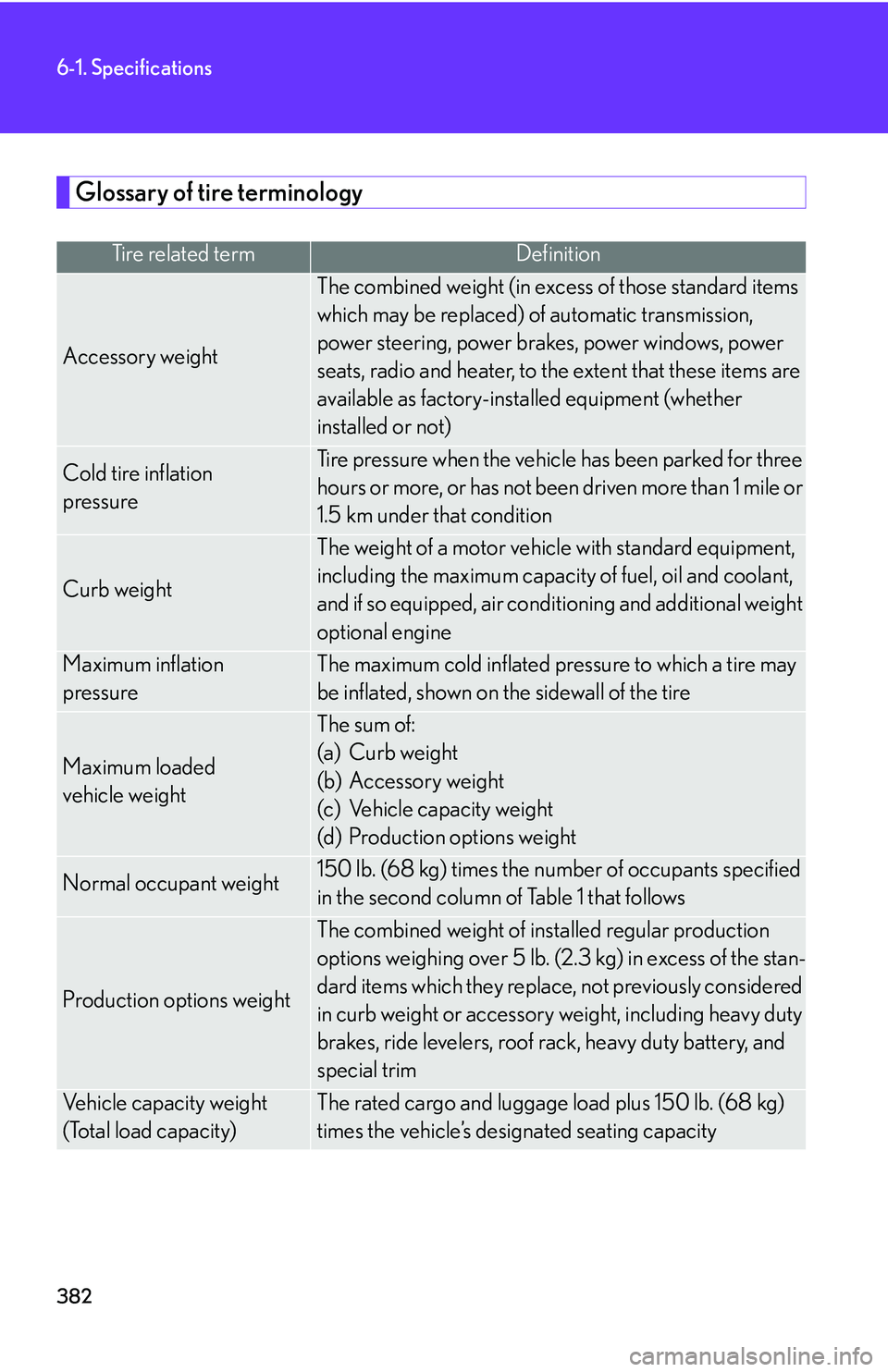
Glossary of tire terminology
Tire related termDefinition
Accessory weight
The combined weight (in excess of those standard items
which may be replaced) of automatic transmission,
power steering, power brakes, power windows, power
seats, radio and heater, to the extent that these items are
available as factory-installed equipment (whether
installed or not)
Cold tire inflation
pressure
Tire pressure when the vehicle has been parked for three
hours or more, or has not been driven more than 1 mile or
1.5 km under that condition
Curb weight
The weight of a motor vehicl e with standard equipment,
including the maximum capacity of fuel, oil and coolant,
and if so equipped, air conditioning and additional weight
optional engine
Maximum inflation
pressure
The maximum cold inflated pressure to which a tire may
be inflated, shown on the sidewall of the tire
Maximum loaded
vehicle weight
The sum of:
(a) Curb weight
(b) Accessory weight
(c) Vehicle capacity weight
(d) Production options weight
Normal occupant weight150 lb. (68 kg) times the numb er of occupants specified
in the second column of Table 1 that follows
Production options weight
The combined weight of installed regular production
options weighing over 5 lb. (2.3 kg) in excess of the stan -
dard items which they replace, not previously considered
in curb weight or accessory weight, including heavy duty
brakes, ride levelers, roof rack, heavy duty battery, and
special trim
Vehicle capacity weight
(Total load capacity)The rated cargo and luggage load plus 150 lb. (68 kg)
times the vehicle’s designated seating capacity