Page 259 of 419
4Maintenance and care
243
4-1. Maintenance and care ........ 244
Cleaning and protecting the vehicle exterior ........................ 244
Cleaning and protecting the vehicle interior ......................... 247
4-2. Maintenance .......................... 250 Maintenance requirements.. 250
General maintenance............. 252
Emission inspection and
maintenance (I/M)
programs.................................... 255 4-3. Do-it-yourself
maintenance ......................... 256
Do-it-yourself service
precautions .............................. 256
Hood.............................................. 260
Positioning the jack .................... 261
Engine compartment ............... 262
Tires ................................................. 278
Tire inflation pressure .............. 283
Wheels ........................................... 287
Air conditioning filters
............ 289
Wireless remote control battery ......................................... 295
Blade fuses .................................. 298
Cartridge fuses ......................... 309
Headlight aim................................ 311
Light bulbs ..................................... 313
Page 270 of 419
254
4-2. Maintenance
Vehicle exterior
ItemsCheck points
Door/trunk• Do they operate smoothly?
• Do the locks work properly?
Engine hood• Does the hood latch and lock work properly?
Fluid leaks• Are there any leaks when the vehicle is parked?
Ti r e
• Is the inflation pressure correct? ( P. 2 8 3 )
• Are tire surfaces worn or damaged? ( P. 2 7 8 )
• Do the tires need to be rotated according to the mainte- nance schedule? ( P. 2 7 8 )
• Are the wheel nuts loose?
Page 294 of 419
278
4-3. Do-it-yourself maintenance
Tires
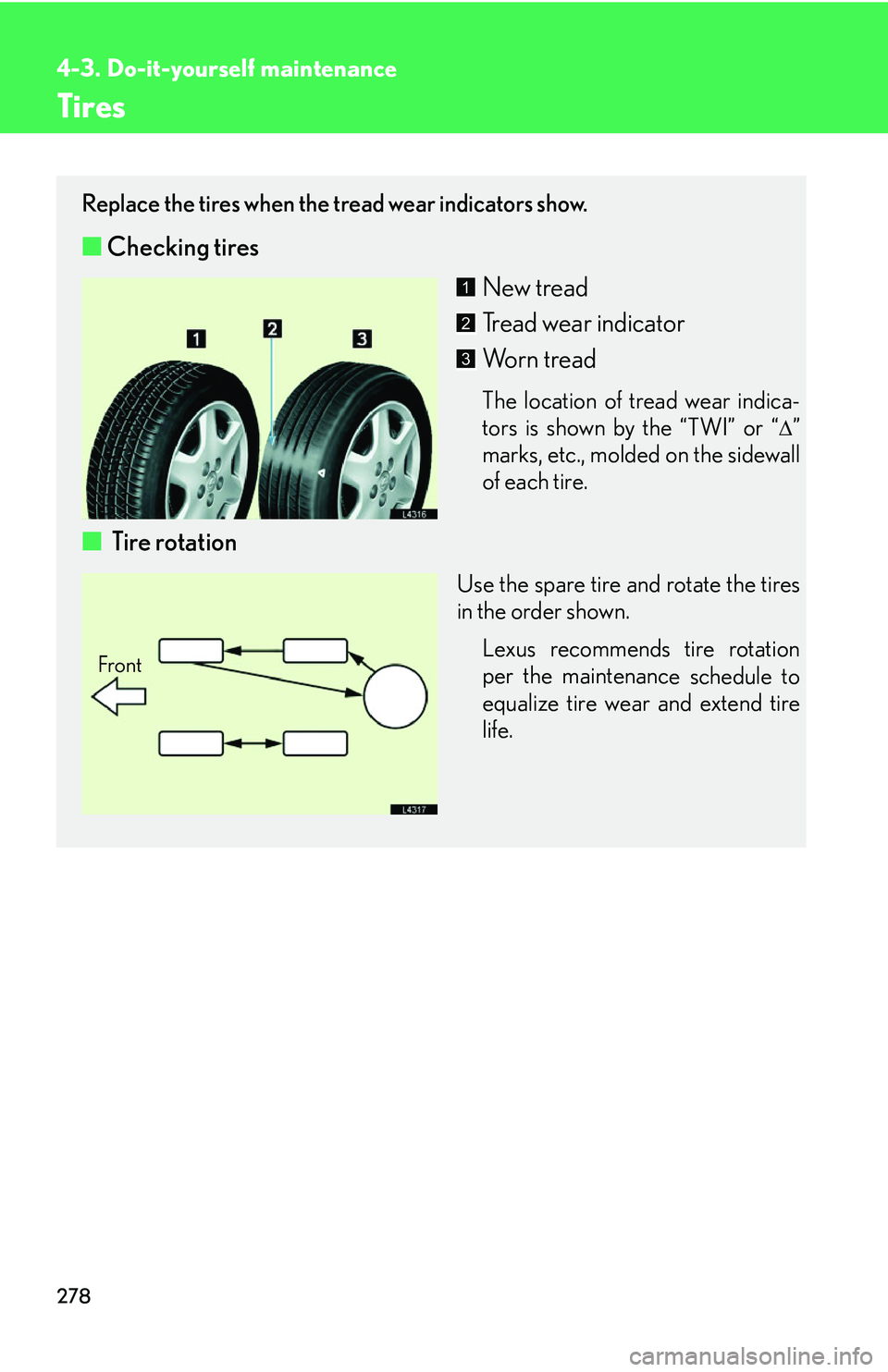
Replace the tires when the tread wear indicators show.
■Checking tires
New tread
Tread wear indicator
Worn tread
The location of tread wear indica-
tors is shown by the “TWI” or “
”
marks, etc., molded on the sidewall
of each tire.
■ Tire rotation
Use the spare tire and rotate the tires
in the order shown.
Lexus recommends tire rotation
per the maintenanc
e schedule to
equalize tire wear and extend tire
life.
1
2
3
Front
Page 295 of 419

279
4-3. Do-it-yourself maintenance
4
Maintenance and care
Initializing the tire pressure warning system
Tire pressure warning system must be initialized after tires or wheels have
been replaced or rotated, or after adjusting tire pressure.
Message
Reset switch
Park the vehicle with the parking br
ake applied and turn the igni-
tion switch to “LOCK”.
Adjust the pressure of all the tir
es to the specified level.
( P.283 )
Turn the ignition switch on.*
Push and hold the reset switch until “P
ressure Initial” appears in
the multi-information display.**
Drive your vehicle for more than one hour or at speeds of 1
9 mph
(30 km/h) or over.
If you make a mistake in the middle of initialization, per
form the operation
again from the beginning.
*: If “Low Tire” appears in the multi- information display
, push the “RESET”
switch for a few seconds and make sure the warning message disap-
pears.
**:If “Pressure Initial” does not appear when the r
eset switch is held down,
the system may be malfunctioning. Ha ve your vehicle checked by your
Lexus dealer as soon as possible
1
2
Page 296 of 419
280
4-3. Do-it-yourself maintenance
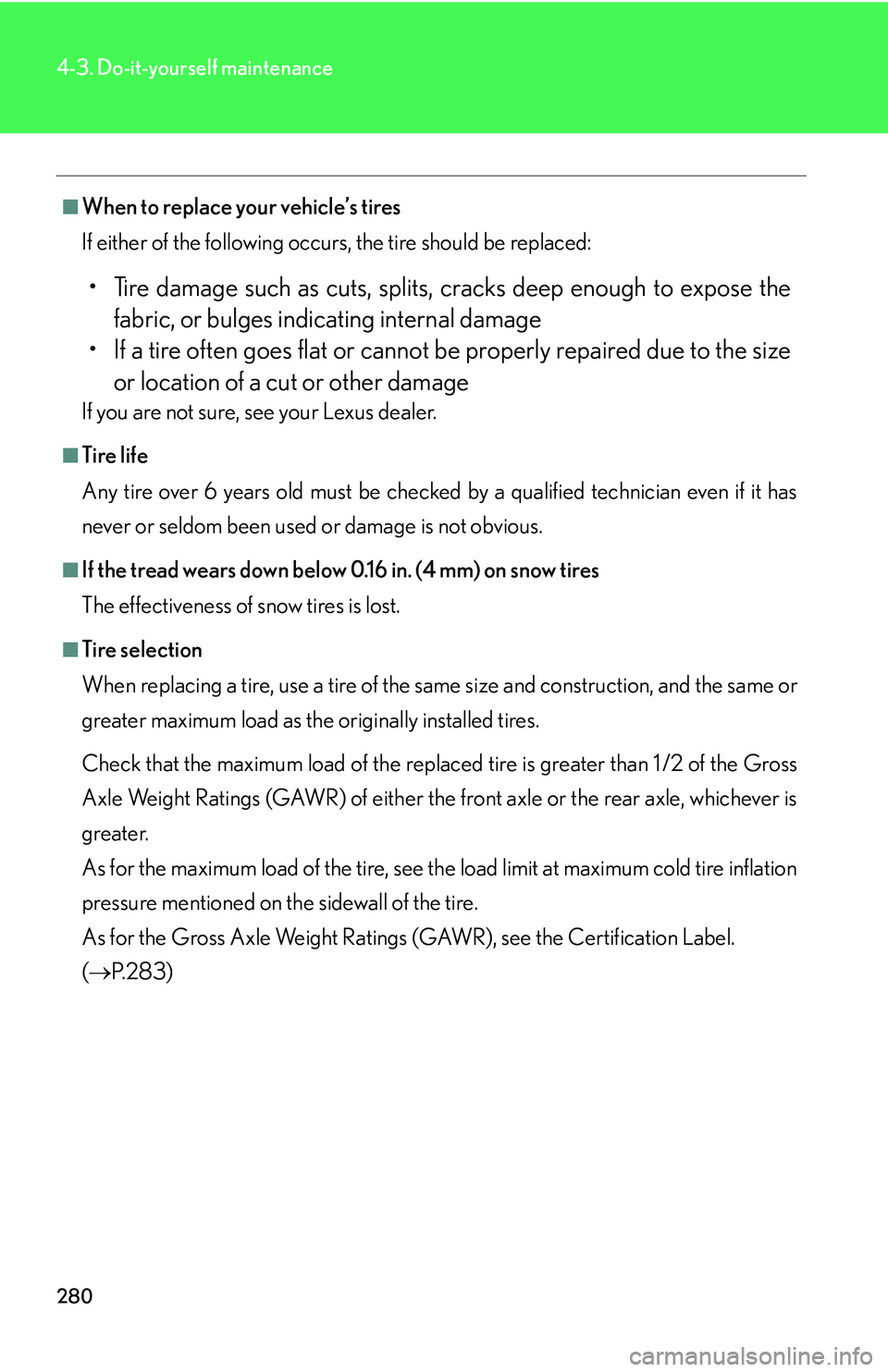
■When to replace your vehicle’s tires
If either of the following occurs, the tire should be replaced:
• Tire damage such as cuts, splits, cracks deep enough to expose the
fabric, or bulges indicating internal damage
• If a tire often goes flat or cannot be pr
operly repaired due to the size
or location of a cut or other damage
If you are not sure, see your Lexus dealer.
■Tire life
Any tire over 6 years old must be checked by a qualified technician even if it has
ne
ver or seldom been used or damage is not obvious.
■If the tread wears down below 0.16 in. (4 mm) on snow tires
The effectiveness of snow tires is lost.
■Tire selection
When replacing a tire, use a tire of the sa me siz
e and construction, and the same or
greater maximum load as the originally installed tires.
Check that the maximum load of the replaced t
ire is greater than 1 /2 of the Gross
Axle Weight Ratings (GAWR) of either the front axle or the rear axle, whichever is
greater.
As for the maximum load of the tire, see the load limit a
t maximum cold tire inflation
pressure mentioned on the sidewall of the tire.
As for the Gross Axle Weight Ratings (GAWR), see the Certification Label.
( P.283 )
Page 297 of 419
281
4-3. Do-it-yourself maintenance
4
Maintenance and care
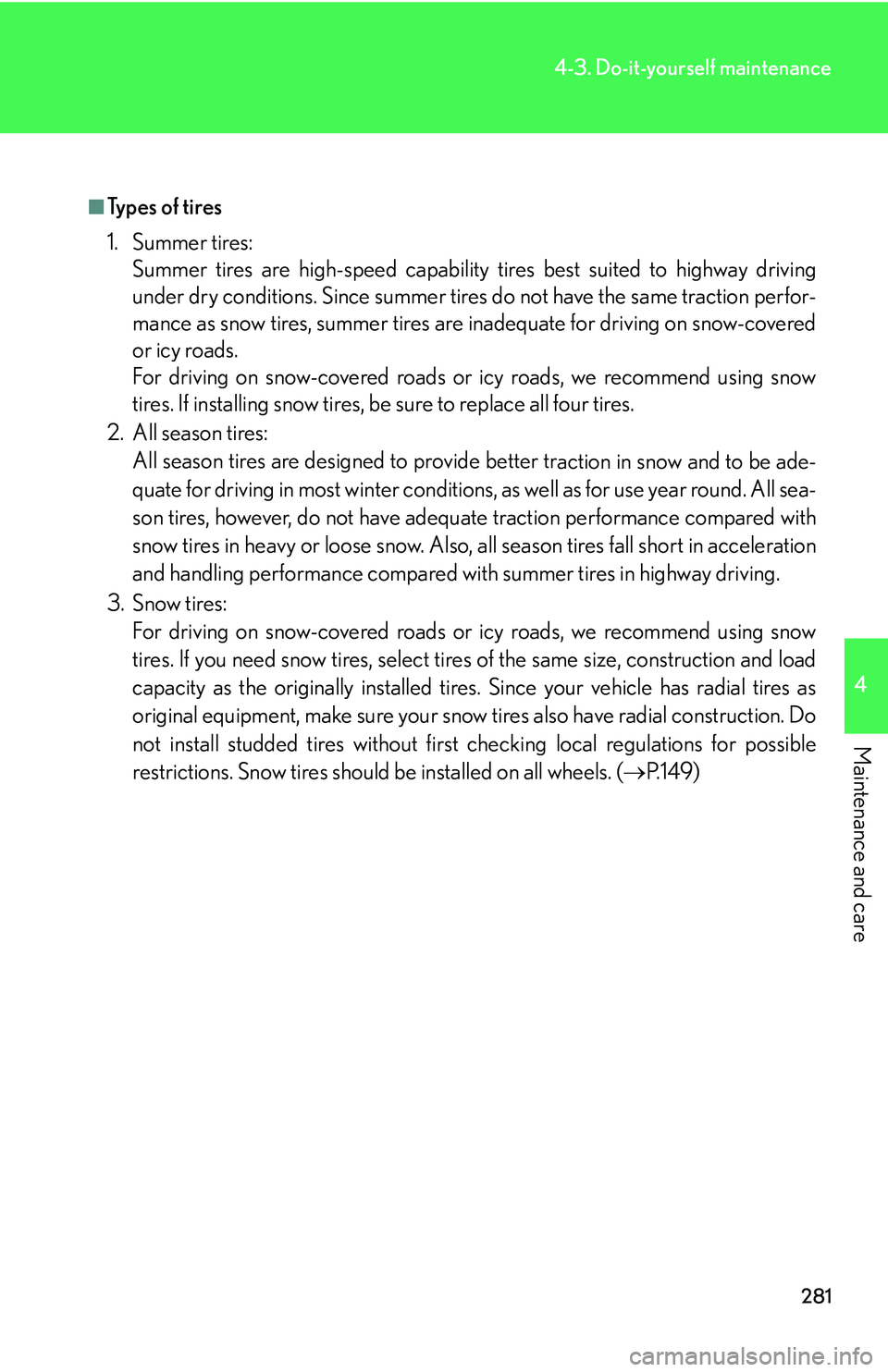
■Ty p e s o f t i r e s
1. Summer tires:
Summer tires are high-speed capability tires best suited to highway driving
un
der dry conditions. Since summer tires do not have the same traction perfor-
mance as snow tires, summer tires are in adequate f
or driving on snow-covered
or icy roads.
For driving on snow-covered roads or icy roads, we recommend using snow
t
ires. If installing snow tires, be sure to replace all four tires.
2. All season tires:
All season tires are designed to provid e better tr
action in snow and to be ade-
quate for driving in most winter conditions , as
well as for use year round. All sea-
son tires, however, do not have adequa te
traction performance compared with
snow tires in heavy or loose snow. Also, a ll season tires fall short in acceleration
and handling performance compared wi th summer tires in highway driving.
3. Snow tires:
For driving on snow-covered roads or icy roads, we recommend using snow
tir
es. If you need snow tires, select tire s of the same size, construction and load
capacity as the originally installed tires. Since your vehicle has radial tires as
original equipment, make sure your snow tires also have radial construction. Do
not install studded tires without first checking local regulations for possible
restrictions. Snow tires should be installed on all wheels. (P.149 )
Page 298 of 419
282
4-3. Do-it-yourself maintenance
+
CAUTION
■When inspecting or replacing tires
Observe the following instructions, as failure to do so may cause dangerous han-
dling characteristics resulting in loss of contr
ol and could cause death or serious
injury.
• Do not mix radial, bias belted, or bias-ply tir
es on your vehicle, or use tires other
than the manufacturer’s recommended size.
• Do not mix summer and all season tires on your vehicle.
• Do not use tires other than the manufact ur
er’s designated tires, and never mix
tires or wheels of different size to the originals.
NOTICE
■To prevent malfunction of the tire pressure warning system
Do not push the reset switch without adjusting the tire inflation pressure to the spec-
ified level. Otherwise, the low tire pressure warning may not function correctly.
( P.334 )
■If tire pressure becomes low while driving
Do not continue driving, your ti r
es and/or wheels may be ruined.
Page 300 of 419
284
4-3. Do-it-yourself maintenance
For sustained high speeds above 100 mph (160 km/h), in countries where such
speeds are permitted by law, add the below pressure to the front tires and rear
tires, but never exceed the maximum cold tire inflation pressure molded on the
tire sidewall.
• P225/55R17 95H: 3 psi (20 kPa, 0.2 kgf/cm2 or bar)
• 245/45R18 96W: 6 psi (40 kPa, 0.4 kgf/cm2 or bar)
• P245/45R18 96V: 6 psi (40 kPa, 0.4 kgf/cm2 or bar)
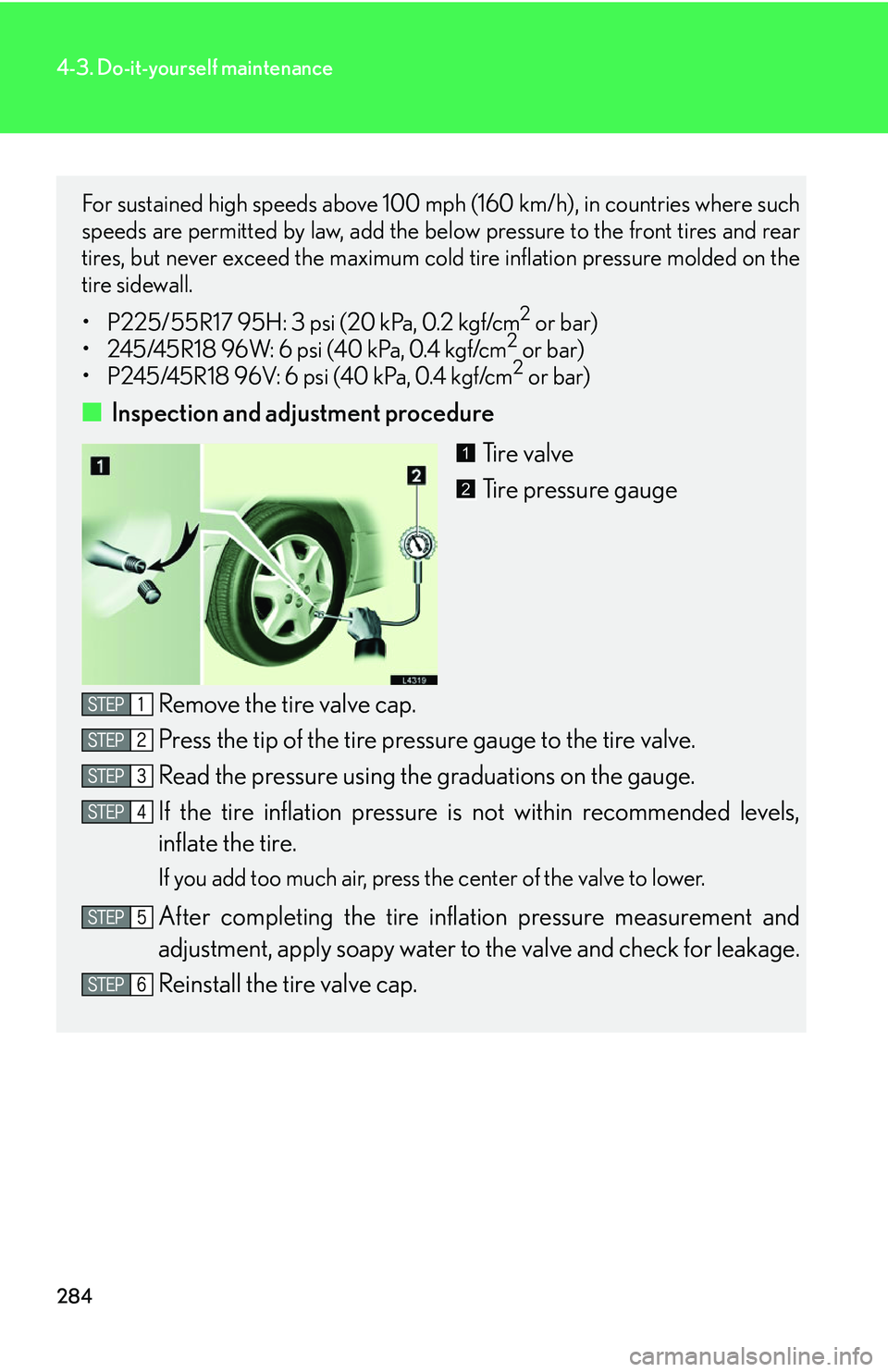
■ Inspection and adjustment procedure
Ti r e v a l v e
Tire pressure gauge
Remove the tire valve cap.
Press the tip of the tire pressure gauge to the tire valve.
Read the pressure using the graduations on the gauge.
If the tire inflation pressure is not within r
ecommended levels,
inflate the tire.
If you add too much air, press the center of the valve to lower.
After completing the tire inflation pressure measurement and
adjustment, apply soapy water to the v
alve and check for leakage.
Reinstall the tire valve cap.
1
2