2006 KIA Sorento ignition
[x] Cancel search: ignitionPage 192 of 312

TIPS ON DRIVING YOUR
VEHICLEBefore Entering Vehicle:
Be sure that all windows, outside
mirror(s), and outside lights are
clean.
Check the condition of the tires.
Check under the vehicle for any
sign of leaks.
Be sure there are no obstacles
behind you if you intend to back up.
Necessary Inspections
Fluid levels, such as engine oil,
engine coolant, brake/clutch fluid,
and washer fluid should be checked
on a regular basis, with the exact
interval depending on the fluid.
Further details are provided in the
“Maintenance” section.Before Starting
Close and lock all doors.
Position the seat so that all controls
are easily reached.
Adjust the inside and outside
rearview mirrors.
Be sure that all lights work.
Check all gauges.
Check the operation of warning
lights when the ignition switch is
turned to the ON position.
Release the parking brake and
make sure the brake warning light
goes out.
For safe operation, be sure you are
familiar with your vehicle and its
equipment.
DRIVING TIPS
5-5
WARNING- Driving Under the
Influence of Alcohol or
Drugs
Drinking and driving is danger-
ous. Drunk driving is the num-
ber one contributor to the high-
way death toll each year. Even
a small amount of alcohol will
affect your reflexes, percep-
tions and judgement.
You are much more likely to
have a serious accident if you
drink and drive.
If you are drinking or taking
drugs, don’t drive. Do not ride
with a driver who has been
drinking or taking drugs.
Choose a designated driver or
call a cab.
Driving while under the influ-
ence of drugs is as dangerous
or more dangerous than driving
drunk.
BL-ENG (CAN)-5.qxd 7/28/05 5:56 PM Page 5
Page 197 of 312

Driving in the Rain
Rain and wet roads can make driving
dangerous, especially if you’re not
prepared for the slick pavement. Here
are a few things to consider when
driving in the rain:
A heavy rainfall will make it harder
to see and will increase the dis-
tance needed to stop your vehicle,
so slow down.
Keep your windshield wiping equip-
ment in good shape. Replace your
windshield wiper blades when they
show signs of streaking or missing
areas on the windshield.
If your tires are not in good condi-
tion, making a quick stop on wet
pavement can cause a skid and
possibly lead to an accident. Be
sure your tires are in good shape. Turn on your headlights to make it
easier for others to see you.
Driving too fast through large pud-
dles can affect your brakes. If you
must go through puddles, try to
drive through them slowly.
If you believe your brakes may have
become wet, apply them lightly
while driving until normal braking
operation returns.Winter Driving
We recommend that you carry
emergency equipment, including
tire chains, a window scraper, wind-
shield de-icer, a bag of sand or salt,
flares, a small shovel and jumper
cables.
Make sure you have sufficient eth-
ylene-glycol coolant in the radiator.
Check the battery condition and
cables. Cold temperatures reduce
the capacity of any battery, so it
must be in excellent condition to
provide enough winter starting
power.
Make sure the engine oil viscosity
is suitable for cold weather.
Check the ignition system for loose
connections and damage.DRIVING TIPS5-10
BL-ENG (CAN)-5.qxd 7/28/05 5:56 PM Page 10
Page 217 of 312

Driving in Water
Light rain causes no special off-road
driving problems. However, heavy
rain can cause flash flooding, and
flood waters demand extreme cau-
tion.
Find out how deep the water is before
you drive through it. If it’s deep
enough to cover your wheel bearing
hubs, axles, or exhaust pipe, don’t try
it. You probably won’t get through.
Also, water that deep can damage
your axle and other vehicle parts.If the water isn’t too deep, then drive
through slowly. At fast speeds, water
can splash on your ignition system
and your vehicle can stall. Stalling
can also occur if your tailpipe goes
underwater. As long as your tailpipe
is underwater, you will not be able to
start your engine. When you go
through water, remember that it may
take you longer to stop when your
brakes are wet.
If you have driven through water that
was deep enough to cover your
wheel bearing hubs, it may be a good
idea to have an authorized Kia dealer
repack your front wheel bearings and
examine your rear-end fluid for evi-
dence of water.After Off-Road Driving
Remove any brush or debris that has
collected on the underbody, chassis
or under the hood. These accumula-
tions can be a fire hazard.
After driving in mud or sand, clean
and check the brake linings.
Accumulation of mud or sand can
cause glazing and uneven braking.
Check the body structure, steering,
suspension, wheels, tires, and
exhaust system for damage. Also,
check the fuel lines and cooling sys-
tem for any leakage. Your vehicle will
also require more frequent service
due to off-road use.DRIVING TIPS5-30
BL-ENG (CAN)-5.qxd 7/28/05 5:56 PM Page 30
Page 236 of 312

EMERGENCY STARTINGJump Starting
Jump starting can be dangerous if
done incorrectly. Therefore, to avoid
harm to yourself or damage to your
vehicle or battery, follow the jump
starting procedures on this page. If in
doubt, we strongly recommend that
you have a competent technician or
towing service jump start your vehi-
cle.Jump starting procedure
1. Make sure the booster battery is
12-volt and that its negative termi-
nal is grounded.
2. If the booster battery is in another
vehicle, do not allow the vehicles to
touch.IN CASE OF AN EMERGENCY6-4✽ ✽
NOTICEUse only a 12-volt jumper system.
You can damage a 12-volt starting
motor, ignition system, and other
electrical parts beyond repair by
use of a 24-volt power supply
(either two 12-volt batteries in
series or a 24-volt motor generator
set).
WARNING
- Battery
Never attempt to check the elec-
trolyte level of the battery as
this may cause the battery to
rupture or explode causing seri-
ous injury.
WARNING
- Battery
• Keep all flames or sparks
away from the battery. The
battery produces hydrogen
gas which may explode if
exposed to flame or sparks.
Do not attempt to jump start
the vehicle if the discharged
battery is frozen or if the elec-
trolyte level is low; the battery
may rupture or explode.
BL-ENG (CAN)-6.qxd 7/28/05 5:57 PM Page 4
Page 240 of 312

1. Turn the ignition switch and all
other switches off.
2. Pull the suspected fuse straight
out. Use the removal tool provided
on the main fuse box in the engine
compartment fuse relay box (if
equipped). Refer to the fuse panel
chart on the fuse panel cover to
identify the likely problem fuse or
electrical circuit.3. Check the removed fuse; replace it
if it is blown. The number of fuses
vary according to the vehicle
model. Check both the passenger
and engine compartment fuse box
covers.
4. Push in a new fuse of the same rat-
ing, and make sure it fits tightly in
the clips.
If it fits loosely, consult an authorized
Kia dealer.If you do not have a spare, use a fuse
of the same rating from a circuit you
may not need for operating the vehi-
cle, such as the radio or room lamp
fuse.
If the headlights or other electrical
components do not work and the
fuses are OK, check the fuse block in
the engine compartment. If a fuse is
blown, it must be replaced.
1. Turn the ignition switch and all
other switches off.
2. Remove the fuse block cover by
unhooking the tab on one end and
tilting the cover back toward the
other end.
3. Check the fuses. If one is blown,
replace it with a new one of the
same rating.IN CASE OF AN EMERGENCY6-8
FUSE
S2BLA604
BL-ENG (CAN)-6.qxd 7/28/05 5:57 PM Page 8
Page 243 of 312

Engine compartment
IN CASE OF AN EMERGENCY
6-11
( )MAIN 120A
HORN20A15A 15A 25A
15A10A 15A 10A 10A 25A 25A
15A 15A 15A 15A 10A
AUDIO
HEAD(HI)
HEAD(LO)
INJECTOR
DEF25A 20A 15A 10ASPARE
SPARE
SPARE
SPARE
MEMORY15A(F/FOG)
ILLUMIP/TRN
P/W(LH)O
2(DN)
O2(UP)
P/W(RH) ECU (EXT)
FUEL
FUSE
PULLER
START
RELAY
MAIN
RELAY
F/BLW
RELAY
P/WIN
RELAY
C/FAN (L)
RELAY A/CON
RELAY
USE THE DESIGNATED FUSES ONLY.
*( ) FOR OPTION.
K52Y
C/F (H)
RELAYC/FAN (2)
RELAY
FUEL
RELAYHORN
RELAY HEAD(LO)
RELAY HEAD(HI)
RELAYTNS
RELAYDEF
RELAY
F/FOG
RELAY
IGN 2
30ABTN 3
40A
ABS
40A
C /FAN (1)
40AF/BLW
30A
C/FAN (2)
30ABTN 1
40A
IGN 1
40ABTN 2
30A( )
( )
HORN 15 A Horm
P/TRN 10 A PCM, Main relay
INJECTOR 15 A PCM
AUDIO 20 A Audio
HEAD (HI) 15 A Head Light
ILLUMI 10 A Key hole illumination
O2(DN) 15 A PCM
HEAD (LO) 15 A Head light
EXT 15 A
DRL, License lamp, Tail lamp, Position lamp, Turn lamp
P/W (LH) 25 A Power window
O2(UP) 15 A PCM
DEF 25 A Defroster
FUEL 15 A Fuel pump relay
P/W (RH) 25 A Power window
ECU 10 A PCM, Cooling
MEMORY 10 A Front heater & aircon, Etwis, Keyless entry system
F/FOG 15 A Front fog lamp
IGN 2 30 A Ignition switch
BTN 3 40 A Turn & Hazard flasher unit, Power door lock
ABS 1 40 A ABS
C/FAN (1) 40 A Cooling system
F/BLW 30 A Front heater & Aircon
C/FAN (2) 30 A Cooling system
BTN 1 40 A Cigar lighter, Power socket
IGN 1 40 A Ignition switch
BTN 2 30 A Power seat, PCM
BL-ENG (CAN)-6.qxd 7/28/05 5:57 PM Page 11
Page 246 of 312
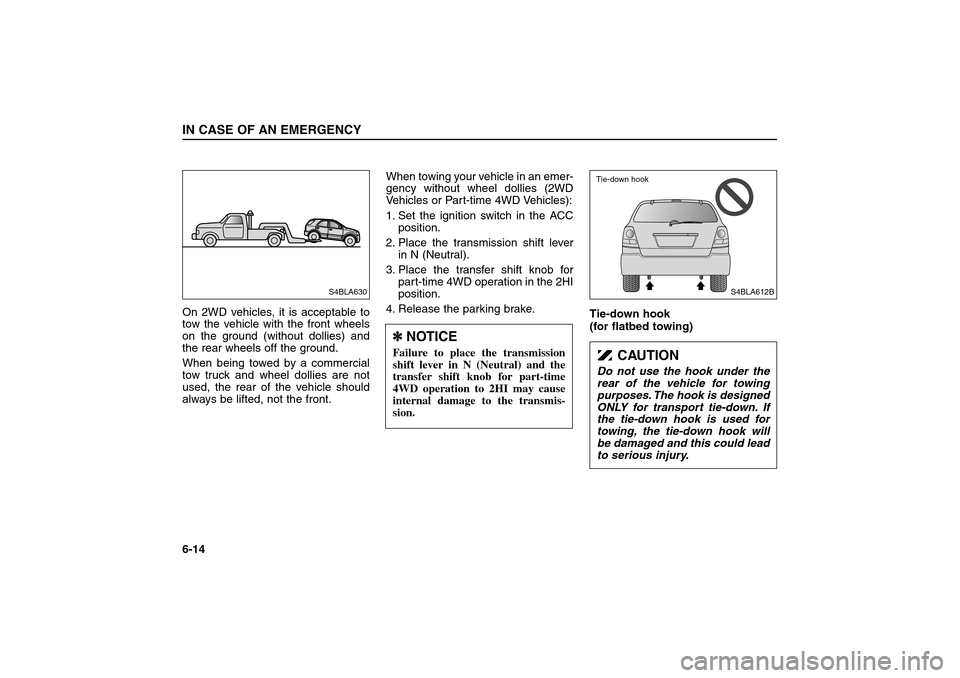
On 2WD vehicles, it is acceptable to
tow the vehicle with the front wheels
on the ground (without dollies) and
the rear wheels off the ground.
When being towed by a commercial
tow truck and wheel dollies are not
used, the rear of the vehicle should
always be lifted, not the front.When towing your vehicle in an emer-
gency without wheel dollies (2WD
Vehicles or Part-time 4WD Vehicles):
1. Set the ignition switch in the ACC
position.
2. Place the transmission shift lever
in N (Neutral).
3. Place the transfer shift knob for
part-time 4WD operation in the 2HI
position.
4. Release the parking brake.
Tie-down hook
(for flatbed towing)IN CASE OF AN EMERGENCY6-14
S4BLA630
S4BLA612B
✽ ✽
NOTICEFailure to place the transmission
shift lever in N (Neutral) and the
transfer shift knob for part-time
4WD operation to 2HI may cause
internal damage to the transmis-
sion.
CAUTION
Do not use the hook under the
rear of the vehicle for towing
purposes. The hook is designed
ONLY for transport tie-down. If
the tie-down hook is used for
towing, the tie-down hook will
be damaged and this could lead
to serious injury.Tie-down hook
BL-ENG (CAN)-6.qxd 7/28/05 5:57 PM Page 14
Page 249 of 312

Use a towing strap less than 5 m
(16 feet) long. Attach a white or red
cloth (about 30 cm (12 inches)
wide) in the middle of the strap for
easy visibility.
Drive carefully so that the towing
strap is not loosened during towing.When Your Vehicle is Being Towed
by Another Vehicle Other Than a
Tow Truck (In Case Of an
Emergency) (2WD Vehicles or
Part-time 4WD Vehicles)
Turn the ignition switch to ACC so
the steering wheel isn’t locked.
Place the transmission shift lever in
N (Neutral).
Place the transfer shift knob for
part-time 4WD operation in the 2HI
position.
Release the parking bake.
Vehicle equipped with automatic
transmissions should not exceed
45km/h (28 mph) and should not be
towed more than 80km (50 miles).
IN CASE OF AN EMERGENCY
6-17
S4BLA613
✽ ✽
NOTICERemove the rear drive shaft if it is
necessary to exceed 45km/h (28
mph) and/or 80km (50 miles). If the
drive shaft cannot be removed, stop
every 80km (50 miles) and start
the engine. Allow the engine to idle
for a few minutes. This will ensure
that the transmission is sufficiently
lubricated.
BL-ENG (CAN)-6.qxd 7/28/05 5:57 PM Page 17