2006 KIA Sorento warning
[x] Cancel search: warningPage 37 of 312

Safety belts provide the best restraint
when:
The seatback is upright
The occupant is sitting upright (not
slouched)
The lap belt is snug across the hips
The shoulder belt is snug across
the chest
The knees are straight forward
To help you remember to fasten your
safety belt, a warning light will come
on and a chime will sound. See
Safety Belt Warning Light and Chime
on page 3-29.KNOWING YOUR VEHICLE3-28
WARNING - After a Collision
Lap/shoulder belt assemblies
may be stretched or damaged
when subjected to the stress
and forces of a collision.
The entire restraint system
should be inspected following
any collision. All belts, retrac-
tors, anchors and hardware
damaged by a collision
should be replaced before the
vehicle is operated again.
WARNING
- Cargo Area
Passengers should never be
allowed to ride in the cargo area
of a vehicle. No safety belts are
provided for the cargo area.
Persons riding in the vehicle
without a fastened safety belt
are much more likely to suffer
serious bodily injury or death
during an accident.
WARNING
- Twisted Belts
A twisted or jammed safety belt
cannot restrain you properly. If
you cannot untwist or unjam
the safety belt, see your Kia
dealer immediately. Never drive
or ride with a twisted or jammed
safety belt.
WARNING
- Belt Use
Safety belts must be used cor-
rectly to work properly in an
accident. Each seating position
in your vehicle has a specific
safety belt assembly that
includes a buckle and tongue
designed to be used together.
For greatest effectiveness, fol-
low these guidelines in using
safety belts:
Use the shoulder portion of
the safety belt on the outside
shoulder only. Never wear the
shoulder portion under the
arm.
Never swing the safety belt
around your neck to fit over
the inside shoulder.
Never wear the shoulder por-
tion of the safety belt across
the neck or face.
(Continued)
BL-ENG (CAN)-3.qxd 7/28/05 5:52 PM Page 28
Page 38 of 312

Safety Belt Warning Light and
Chime
Type A
As a reminder to the driver and pas-
senger, safety belt warning light will
illuminate for approximately 6 sec-
onds each time you turn the ignition
switch ON regardless of belt fasten-
ing.
If the driver's safety belt is not fas-
tened when the ignition key is turned
ON, the safety belt warning chime will
sound for approximately 6 seconds.
KNOWING YOUR VEHICLE
3-29
(Continued)
Wear the lap portion as low as
possible. Be sure that the lap
belt fits snugly around the
hips. never wear a lap belt or
lap portion of a lap/shoulder
belt over your waist; it should
always go over the stronger
area of your hips.
Never use a single safety belt
for more than one person.
The seatbacks should always
remain in a comfortable,
upright position when the
vehicle is moving.
(Continued)
Inspect the safety belts peri-
odically for excessive wear or
damage. Pull out each belt
fully and look for fraying, cuts,
burns or other damage. Pull
the safety belt out and let it
retract a number of times.
Make sure that the lap/shoul-
der belts return smoothly and
easily into the retractor.
Check the latches to make
sure they latch and release
without interference or delay.
Never close the doors on any
part of the lap or shoulder
belt.
Any belt not in good condition
or in good working order
should be promptly replaced.
CAUTION
Never close the doors on any part
of the lap or shoulder belt. It can
damage the safety belt or buckle
which could increase the risk of
injury in case of an accident.
WARNING- Safety Belt Care
A damaged belt may not give
you the protection you need in
an accident.
(Continued)
W-29
BL-ENG (CAN)-3.qxd 7/28/05 5:52 PM Page 29
Page 39 of 312

Type B
As a reminder to the driver and pas-
senger, safety belt warning light will
blink for approximately 6 seconds
each time you turn the ignition switch
ON regardless of belt fastening.
If the driver's safety belt is unfastened
after the ignition switch is ON, the
safety belt warning light will blink for
approximately 6 seconds.
If the driver's safety belt is not fas-
tened when the ignition key is turned
ON, the safety belt warning chime will
sound for approximately 6 seconds.Front and Rear Outboard
Lap/Shoulder Belt
To fasten the lap/shoulder belt:
1. Grasp the buckle and tongue plate.
2. Slowly pull the lap/shoulder belt
out from the retractor.3. Insert the tongue plate into the
open end of the buckle until an
audible “click”is heard, indicating
the belt is locked in the buckle.KNOWING YOUR VEHICLE3-30
S2BLA371
S2BLA372
BL-ENG (CAN)-3.qxd 7/28/05 5:52 PM Page 30
Page 41 of 312
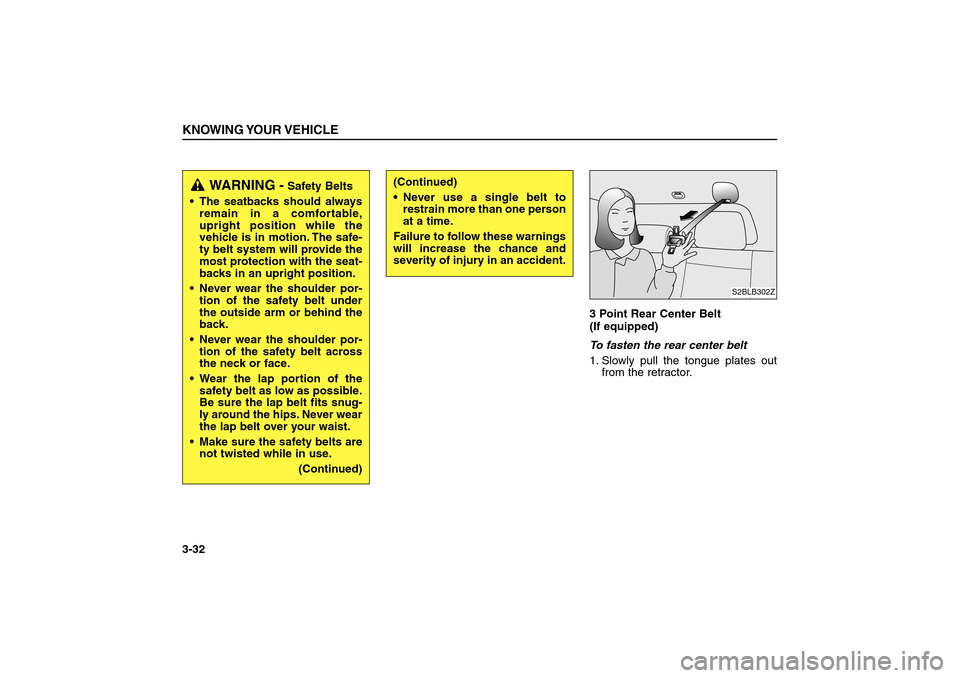
3 Point Rear Center Belt
(If equipped)
To fasten the rear center belt
1. Slowly pull the tongue plates out
from the retractor.
KNOWING YOUR VEHICLE3-32
S2BLB302Z
WARNING -
Safety Belts
The seatbacks should always
remain in a comfortable,
upright position while the
vehicle is in motion. The safe-
ty belt system will provide the
most protection with the seat-
backs in an upright position.
Never wear the shoulder por-
tion of the safety belt under
the outside arm or behind the
back.
Never wear the shoulder por-
tion of the safety belt across
the neck or face.
Wear the lap portion of the
safety belt as low as possible.
Be sure the lap belt fits snug-
ly around the hips. Never wear
the lap belt over your waist.
Make sure the safety belts are
not twisted while in use.
(Continued)
(Continued)
Never use a single belt to
restrain more than one person
at a time.
Failure to follow these warnings
will increase the chance and
severity of injury in an accident.
BL-ENG (CAN)-3.qxd 7/28/05 5:52 PM Page 32
Page 42 of 312

2. Insert the tongue plate (A) into the
open end of the buckle (C) until an
audible “click" is heard, indicating
the latch is locked. Make sure the
belt is not twisted.3. Pull the tongue plate (B) and insert
the tongue plate into the open end
of the buckle (D) until an audible
“click”is heard, indicating the latch
is locked. Make sure the belt is not
twisted.There will be an audible “click”when
the tab locks in the buckle. The seat
belt automatically adjusts to the prop-
er length only after the lap belt is
adjusted manually so that it fits snug-
ly around your hips, if you lean for-
ward in a slow, easy motion, the belt
will extend and let you move around.
If there is a sudden stop or impact,
the belt will lock into position. It will
also lock if you try to lean forward too
quickly.
KNOWING YOUR VEHICLE
3-33
(D) (A)
(C)(B)
S2BLB303A
(D) (B)PRESS
S2BLC304
WARNING
When using the rear seat center
belt, you must lock all tongue
plates and buckles. If any
tongue plate or buckle is not
locked, it will increase the
chance of injury in the event of
collision.
BL-ENG (CAN)-3.qxd 7/28/05 5:52 PM Page 33
Page 44 of 312

Restraint of Pregnant Women
Pregnant women should wear
lap/shoulder belt assemblies when-
ever possible according to specific
recommendations by their doctors.
The lap portion of the belt should be
worn AS SNUGLY AND AS LOW AS
POSSIBLE.Restraint of Infants and Small
Children
To increase their safety, infants and
young children should always be
restrained by a restraint system
approved for their age and size.Many companies manufacture child-
restraint systems (often called child
seats) for infants and small children.
An acceptable child-restraint system
must always satisfy Motor Vehicle
Safety Standards of your country.
Make sure that any child-restraint
system you use in your vehicle is
labeled as complying with those safe-
ty standards.
The child restraint system should be
chosen to fit both the size of the child
and the size of the vehicle seat. Be
sure to follow any instructions provid-
ed by the child restraint system man-
ufacturer when installing the child-
restraint system.
KNOWING YOUR VEHICLE
3-35
WARNING- Pregnant Women
Pregnant women must never
place the lap portion of the
safety belt over the area of the
abdomen where the fetus is
located or above the abdomen.
WARNING- Children on Lap
Never hold a child on your lap
or in your arms in a moving
vehicle. Even a very strong per-
son cannot hold onto a child in
the event of even a minor colli-
sion.
BL-ENG (CAN)-3.qxd 7/28/05 5:52 PM Page 35
Page 45 of 312

KNOWING YOUR VEHICLE3-36
WARNING- Infants and Young
Children
Infants and young children
are at much greater risk of
serious injury or death in an
accident or sudden stop if
they are unrestrained or
restrained improperly. Follow
all instructions in this section
of your Kia manual and the
instructions that came on and
with an improved child safety
restraint system. The child
restraint must be correctly
installed in the vehicle, and
the child must be correctly
installed in the child restraint.
All children under 12 are
safest in the back seat. The
center rear position is best.
Never install a child or infant
seat in the front passenger
position. The baby will be
injured or killed by the airbag
if it deploys in an accident.
(Continued)
(Continued)
Never allow a child to stand or
kneel on the seat of a moving
vehicle. Insist the child sit
down in an approved restraint
system.
Never allow a safety belt to be
placed around both a child and
an adult or around two chil-
dren. In an accident they will
not be properly restrained and
may receive worse injuries
from being thrown forward or
crushed against one another.
Never allow a child to be held
on a lap or in anyone’s arms
while the vehicle is moving.
Even a very strong person can-
not hold onto a child in even a
minor collision.
A child too large for a child
restraint but too small for the
vehicle safety belts should use
an approved belt-positioning
booster seat. This is safer than
allowing a child to ride with a
shoulder belt that touches their
face or neck.
WARNING- Hot Metal Parts
Since a safety belt or child
restraint system can become
very hot in a closed vehicle dur-
ing warm sunny weather, be
sure to check the seat cover
and buckles before placing a
child anywhere near them.
BL-ENG (CAN)-3.qxd 7/28/05 5:52 PM Page 36
Page 46 of 312

Restraint of Large Children
As children grow, they may need to
use new child restraints, including
larger child seats or booster seats,
which are appropriate for their
increased size.
A child who has outgrown available
child restraint systems should use
the belts provided in the vehicle.
When seated, the child should be
restrained by the lap/shoulder belt.
If the shoulder belt slightly touches
the child’s neck or face, try placing
the child closer to the center of the
vehicle. If the shoulder belt still
touches their face or neck, they may
need to be returned to a child
restraint system. In addition, after-
market devices are available from
independent manufacturers which
help pull the shoulder belt lower and
away from the child’s face or neck.Placement of a Child Restraint
System
We recommend that, whenever pos-
sible, you put the child restraint in the
center position of the rear seat.
If the center rear seat is not available,
or you are using more than one child
restraint system in the vehicle at the
same time, the rear safety belts have
been designed to allow a child
restraint to be used in these posi-
tions. Since those safety belts nor-
mally lock only under extreme or
emergency conditions (emergency
lock mode) you must manually adjust
those belts to the auto lock mode.
KNOWING YOUR VEHICLE
3-37
WARNING
When a child restraint is not in
use, make sure that it is
secured by a safety belt. In a
sudden stop or accident, a
loose child restraint could be
thrown forward and injure
someone.
✽ ✽
NOTICEThe driver’s safety belt incorpo-
rates the emergency lock mode
only.
WARNING- Restraint Instructions
Failure to observe this manuals
instructions regarding child
restraint systems and the
instructions provided with the
child restraint system could
increase the chance and/or
severity of injury in an accident.
BL-ENG (CAN)-3.qxd 7/28/05 5:52 PM Page 37