Page 117 of 312

Moving up a Steep grade from a
Standing Start
To move up a steep grade from a
standing start, depress the brake
pedal, shift the shift lever to D (Drive).
Select the appropriate gear depend-
ing on load weight and steepness of
the grade, and release the parking
brake. Depress the accelerator grad-
ually while releasing the service
brakes.
When accelerating from a stop on
a steep hill, the vehicle may have a
tendency to roll backwards.
Shifting the shift lever into 2
(Second Gear) while in Sport mode
will help prevent the vehicle from
rolling backwards.Shift Lock System
For your safety, the Automatic
Transmission has a shift lock system
which prevents shifting the transmis-
sion out of P (Park) unless the brake
pedal is depressed.
To shift the transmission out of P
(Park):
1. Depress and hold the brake pedal.
2. Start the engine or turn the ignition
to the ON position.
3. Depress the lock release button
and move the shift lever.
When the ignition switch is in the
ACC or LOCK position, the transmis-
sion cannot be shifted from P (Park).
If the brake pedal is repeatedly
depressed and released with the shift
lever in the P (Park) position, a chat-
tering noise near the shift lever may
be heard. This is a normal condition.
Also, the ignition key cannot be
removed unless the shift lever is in
the P (Park) position. If the ignition
switch is in any other position, the key
cannot be removed.
DRIVING YOUR VEHICLE
4-19
(Continued)
In sports mode, when the engine
rpm approaches the red zone
shift points are varied to upshift
automatically.
To maintain the required levels of
vehicle performance and safety,
the system may not execute cer-
tain gearshifts when the shift
lever is operated.
When driving on a slippery road,
push the shift lever forward into
the +(up) position. This causes
the transmission to shift into the
2nd gear which is better for
smooth driving on a slippery
road. Push the shift lever to the -
(down) side to shift back to the
1st gear.
While the vehicle is driving in 5th
gear with the shift lever in the
"D" position, selecting the shift
lever to sports mode position
causes the transmission to down-
shift to 4th gear automatically to
secure driving performance. At
the time of shifting you can have a
shift feeling.
BL-ENG (CAN)-4.qxd 7/28/05 5:55 PM Page 19
Page 121 of 312
Transfer shift knob operation
AUTO ↔ ↔
LOW
1. Stop the vehicle.
2. Depress the clutch pedal (Manual
transmission) or put the shift lever
into N (Neutral) position (Automatic
transmission).
3.
AUTO ➝ ➝
LOW: Turn the transfer shift knob to
LOW mode.LOW ➝ ➝
AUTO: Turn the transfer shift knob to
AUTO mode.
4. Before releasing the clutch pedal
(Manual Transmission) or shifting
to other ranges from N (Automatic
Transmission), wait for the corre-
sponding indicator light in the
instrument cluster to go ON or
OFF.Part-Time 4WD Operation
(If equipped)
You can send your engine's driving
power to all front and rear wheels for
maximum power.
Four-wheel drive is useful when you
drive in snow, mud, ice or sand where
good traction is required, or when
your wheels lose traction using two-
wheel drive.
DRIVING YOUR VEHICLE
4-23
L
O
WAUTO
S2BLA412
CAUTION
If the vehicle moves while the
transfer shift is in process, the
gearbox may be damaged.
BL-ENG (CAN)-4.qxd 7/28/05 5:55 PM Page 23
Page 123 of 312

4LO(Low-range 4-wheel drive)
Use 4LO for climbing or descending
hills, off-roads driving and towing the
vehicle, especially when increased
power is required.
The 4WD LOW indicator light ( )
will be turned on to remind you that
you are in the 4LO mode.
Transfer shift knob operation
By turning the transfer knob (4HI,
4LO), both front and rear axles are
engaged.
This improves the traction character-
istic.2HI➝ ➝
4HI
Turn the transfer knob from the 2HI
mode to 4HI mode at speed below
80km/h.
It is not necessary to depress the
clutch pedal or put the shift lever into
N (Neutral) position (Manual
Transmission) or put the shift lever
into N (Neutral) position (Automatic
Transmission).
Perform this operation when driving
straight. There will be a few seconds
of time delay before come into 4HI
mode when you shift the knob to 4 HI
from 2HI.
4HI ➝ ➝
2HI
Turn the transfer knob from the 4HI
mode to the 2HI mode at speed
below 80km/h. It is not necessary to
depress the clutch pedal (manual
transmission) or put the shift lever
into N (Neutral) (automatic transmis-
sion). Perform this operation when
driving straight. Perform this opera-
tion when driving straight.
If the transfer mode does not shift
into 2HI mode when you turn the
transfer knob to 2HI, drive straight
ahead with accelerating or decelerat-
ing, or drive in reverse.4HI ↔ ↔
4LO
1. Stop the vehicle.
2. Depress the clutch pedal for the
manual transmission or put the
shift lever into N (Neutral) for the
automatic transmission.
3.
4HI ➝ ➝
4LO: Select the 4LO mode.4LO➝ ➝
4HI: Select the 4HI mode.
4. Before releasing the clutch pedal
(Manual transmission) or shifting
to other ranges from N range
(Automatic transmission) ,wait for
corresponding indicator light turns
on or off in the cluster.
4WD
LOW
DRIVING YOUR VEHICLE
4-25
CAUTION
If the vehicle moves while the
transfer shift is in process, the
gearbox may be damaged.
BL-ENG (CAN)-4.qxd 7/28/05 5:55 PM Page 25
Page 137 of 312

To Cancel Cruise Control, do one
of the following:
Depress the brake pedal.
Depress the clutch pedal with a
manual transmission, or shift into N
(Neutral) with an automatic trans-
mission.
Depress the CANCEL switch locat-
ed on the steering wheel.
Depress the COAST/SET and
RES/ACCEL switches at the same
time.
Each of these actions will cancel
cruise control operation, but it will not
turn the system off. If you wish to
resume cruise control operation,
depress the RES/ACCEL switch
located on your steering wheel. You
will return to your previously preset
speed.To turn cruise control off, do one
of the following:
Push the CRUISE switch to the
OFF position.
Turn the ignition off.
Both of these actions also cancel
cruise control operation. If you want
to resume cruise control operation,
repeat the steps provided in “To Set
Cruise Control Speed” on the previ-
ous page.
To Increase Cruise Control Set
Speed:
Follow either of these procedures:
Depress the RES/ACCEL switch
and hold it. Your vehicle will accel-
erate. Release the switch at the
speed you want.
Depress the RES/ACCEL switch
and release it immediately. The
cruising speed will increase 1mph
(1.6 km/h) by one touch and will be
memorized to the reset speed.
DRIVING YOUR VEHICLE
4-39
SRSAIRBAG
R
E
S
A
C
C
E
LCOAST
SET
P
W
RSEEK
C
A
N
C
E
L
S2BLA422A
BL-ENG (CAN)-4.qxd 7/28/05 5:55 PM Page 39
Page 139 of 312
DRIVING YOUR VEHICLE
4-41
ABS
CHECK
4WD
LOW
H
C
F
E
BRAKE
0 1 234567
8
0
0 10 203040506070
80
90
100
110
120
130
20406080100120
140
160
180
200
220
1000rpm
CRUISE
km/hMPH
IMMO
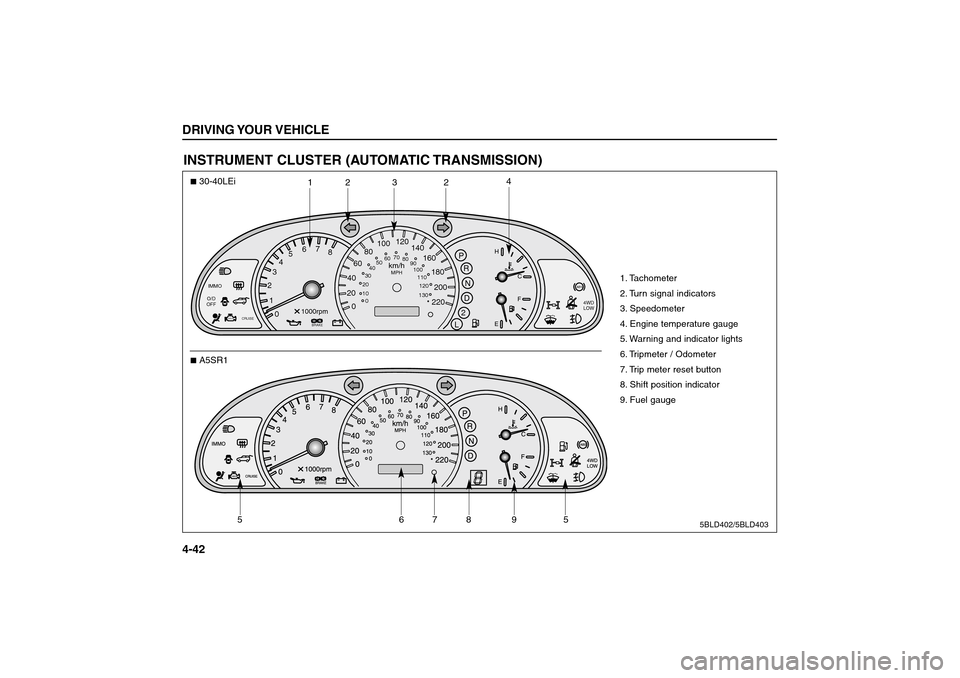
1. Tachometer
2. Turn signal indicators
3. Speedometer
4. Engine temperature gauge
5. Warning and indicator lights
6. Tripmeter / Odometer
7. Trip meter reset button
8. Fuel gauge
1
2
3
2
4
5
6
7
8
5
5BLD401
INSTRUMENT CLUSTER (MANUAL TRANSMISSION)
BL-ENG (CAN)-4.qxd 7/28/05 5:55 PM Page 41
Page 140 of 312
DRIVING YOUR VEHICLE4-42
ABS
CHECK
O/D
OFF4WD
LOW
PN R
D
2
L
H
C
F
E
BRAKE
0 1 234567
8
0
0 10 203040506070
80
90
100
110
120
130
20406080100120
140
160
180
200
220
1000rpm
CRUISE
km/hMPH
IMMO
1. Tachometer
2. Turn signal indicators
3. Speedometer
4. Engine temperature gauge
5. Warning and indicator lights
6. Tripmeter / Odometer
7. Trip meter reset button
8. Shift position indicator
9. Fuel gauge
1
2
3
2
4
5BLD402/5BLD403
INSTRUMENT CLUSTER (AUTOMATIC TRANSMISSION)
5
6
7
9
8
5
�30-40LEi�A5SR1
BL-ENG (CAN)-4.qxd 7/28/05 5:55 PM Page 42
Page 191 of 312
Operating Precautions for
Catalytic Converters
Your vehicle is equipped with a cat-
alytic converter emission control
device.
Therefore, the following precautions
must be observed:
Use only UNLEADED FUEL.
Do not operate the vehicle when
there are signs of engine malfunc-
tion, such as misfire or a noticeable
loss of performance.
Do not misuse or abuse the engine.
Examples of misuse are coasting
with the ignition off and descending
steep grades in gear with the igni-
tion off. Do not operate the engine at high
idle speed for extended periods (5
minutes or more).
Do not modify or tamper with any
part of the engine or emission con-
trol system. All inspections and
adjustments must be made by a
qualified technician.
Failure to observe these precautions
could result in damage to the catalyt-
ic converter and to your vehicle.
Additionally, such actions could void
your warranties.DRIVING TIPS5-4
WARNING
Your Full-time Four-Wheel Drive
vehicle must never be tested on
a two-wheel dynamometer.
Serious transmission damage
and uncontrolled vehicle move-
ment could result.
WARNING
- Fire
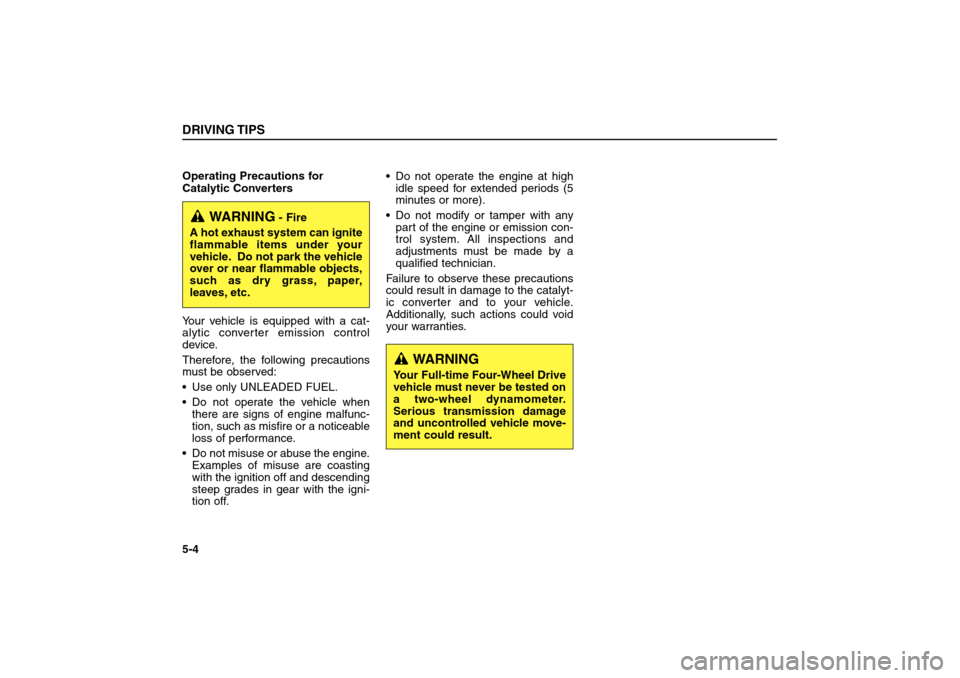
A hot exhaust system can ignite
flammable items under your
vehicle. Do not park the vehicle
over or near flammable objects,
such as dry grass, paper,
leaves, etc.
BL-ENG (CAN)-5.qxd 7/28/05 5:56 PM Page 4
Page 196 of 312

Rocking the Vehicle
If it is necessary to rock the vehicle to
free it from snow, sand, or mud, first
turn the steering wheel right and left
to clear the area around your front
wheels. Then, shift back and forth
between 1 (First) and R (Reverse) in
vehicles equipped with a manual
transmission or R (Reverse) and any
forward gear in vehicles equipped
with an automatic transmission. Do
not race the engine, and spin the
wheels as little as possible. If you are
still stuck after a few tries, have the
vehicle pulled out by a tow vehicle to
avoid engine overheating and possi-
ble damage to the transmission,
transfer case (if equipped), or differ-
ential.Driving at Night
Because night driving presents many
more hazards than driving in the day-
light, here are some important tips to
remember:
Slow down and keep more distance
between you and other vehicles, as
it may be more difficult to see at
night, especially in areas where
there may not be any street lights.
Adjust your mirrors to reduce the
glare from other driver’s headlights.
Keep your headlights clean and
properly aimed. Dirty or improperly
aimed headlights will make it much
more difficult to see at night.
Avoid staring directly at the head-
lights of oncoming vehicles. You
could be temporarily blinded, and it
will take several seconds for your
eyes to readjust to the darkness.
DRIVING TIPS
5-9
✽ ✽
NOTICEProlonged rocking may cause
engine over-heating, transmission
or transfer case (if equipped) dam-
age or failure, and tire damage.
WARNING- Spinning Tires
Do not spin the wheels, espe-
cially at speeds more than 35
mph (56 km/h). Spinning the
wheels at high speeds when the
vehicle is stationary could
cause a tire to overheat,
explode and injure bystanders.
BL-ENG (CAN)-5.qxd 7/28/05 5:56 PM Page 9