Page 226 of 312

Backing up
Hold the bottom of the steering wheel
with one hand. Then, to move the
trailer to the left, just move your hand
to the left. To move the trailer to the
right, move your hand to the right.
Always back up slowly and, if possi-
ble, have someone guide you.
Making turns
When you’re turning with a trailer,
make wider turns than normal. Do
this so your trailer won’t strike soft
shoulders, curbs, road signs, trees,
or other objects. Avoid jerky or sud-
den maneuvers. Signal well in
advance.Turn signals when towing a trailer
When you tow a trailer, your vehicle
has to have a different turn signal
flasher and extra wiring.
The green arrows on your instrument
panel will flash whenever you signal a
turn or lane change. Properly con-
nected, the trailer lights will also flash
to alert other drivers that you’re about
to turn, change lanes, or stop.
When towing a trailer, the green
arrows on your instrument panel will
flash for turns even if the bulbs on the
trailer are burned out. Thus, you may
think drivers behind you are seeing
your signals when, in fact, they are
not. It’s important to check occasion-
ally to be sure the trailer bulbs are still
working. You must also check the
lights every time you disconnect and
then reconnect the wires.Do not connect a trailer lighting sys-
tem directly to your vehicle’s lighting
system.
Use only an approved trailer wiring
harness. Your authorized Kia dealer
can assist you in installing the wiring
harness.
DRIVING TIPS
5-39
WARNING
Using an improper trailer wiring
harness could lead to malfunc-
tioning of your vehicles electri-
cal system and a possible acci-
dent.
BL-ENG (CAN)-5.qxd 7/28/05 5:56 PM Page 39
Page 227 of 312

You must check the capacity of the
lighting system and electrical equip-
ment for a trailer before connecting
the wires.
Trailer accessory : 120W and below
Turn signal lamp : 27W × 2EA and
below (Total : 4.2 A and below)
Stop lamp : 27W × 2EA and below
(Total : 4.2 A and below)
Position lamp : 5W × 8EA and
below (Total : 3.65 A and below)Driving on grades
Reduce speed and shift to a lower
gear before you start down a long or
steep downgrade. If you don’t shift
down, you might have to use your
brakes so much that they would get
hot and no longer operate efficiently.
On a long uphill grade, shift down
and reduce your speed to around 45
mph (70 km/h) to reduce the possibil-
ity of engine and transmission over-
heating.
If your trailer weighs more than 1650
lbs (750 kg) and you have an auto-
matic transmission, you should drive
in D (Drive) when towing a trailer.
Operating your vehicle in D (Drive)
when towing a trailer will minimize
heat buildup and extend the life of
your transmission. If you have a man-
ual transmission, drive in fourth gear
(or, as you need to, a lower gear).
DRIVING TIPS5-40
4
3
2
1
7
6
5
Trailer Connector� Back up lamp
� Position lamp
� Trailer accessory
� Turn signal lamp (LH)
� Turn siganl lamp (RH)
� Stop lamp
EarthTrailer Connector
S2BLA550
BL-ENG (CAN)-5.qxd 7/28/05 5:56 PM Page 40
Page 229 of 312

When You Are Ready to Leave
After Parking on a Hill
1. With the manual transmission in
Neutral or automatic transmission
in P (Park), apply your brakes and
hold the brake pedal down while
you:
Start your engine;
Shift into gear; and
Release the parking brake.
2. Slowly remove your foot from the
brake pedal.
3. Drive slowly until the trailer is clear
of the chocks.
4. Stop and have someone pick up
and store the chocks.Maintenance When Trailer Towing
Your vehicle will need service more
often when you regularly pull a trailer.
Important items to pay particular
attention to include engine oil, auto-
matic transmission fluid, axle lubri-
cant and cooling system fluid. Brake
condition is another important item to
frequently check. Each item is cov-
ered in this manual, and the Index will
help you find them quickly. If you’re
trailering, it’s a good idea to review
these sections before you start your
trip.
Don’t forget to also maintain your
trailer and hitch. Follow the mainte-
nance schedule that accompanied
your trailer and check it periodically.
Preferably, conduct the check at the
start of each day’s driving. Most
importantly, all hitch nuts and bolts
should be tight.DRIVING TIPS5-42
✽ ✽
NOTICEDue to higher load during trailer
usage, overheating might occur in
hot days or during uphill driving. If
the coolant gauge indicates over-
heating, switch off the A/C and stop
the vehicle in a safe area to cool
down the engine.
BL-ENG (CAN)-5.qxd 7/28/05 5:56 PM Page 42
Page 233 of 312
6-1
IN CASE OF AN EMERGENCYRoad Warning . . . . . . . . . . . . . . . . . . . . . . . . . . . . . . . . . . . . . 6-2
Overheating . . . . . . . . . . . . . . . . . . . . . . . . . . . . . . . . . . . . . . 6-3
Emergency Starting . . . . . . . . . . . . . . . . . . . . . . . . . . . . . . . . 6-4
Electrical Circuit Protection . . . . . . . . . . . . . . . . . . . . . . . . . . 6-7
Towing . . . . . . . . . . . . . . . . . . . . . . . . . . . . . . . . . . . . . . . . . 6-13
If You Have a Flat Tire . . . . . . . . . . . . . . . . . . . . . . . . . . . . . . 6-19
6
BL-ENG (CAN)-6.qxd 7/28/05 5:57 PM Page 1
Page 236 of 312

EMERGENCY STARTINGJump Starting
Jump starting can be dangerous if
done incorrectly. Therefore, to avoid
harm to yourself or damage to your
vehicle or battery, follow the jump
starting procedures on this page. If in
doubt, we strongly recommend that
you have a competent technician or
towing service jump start your vehi-
cle.Jump starting procedure
1. Make sure the booster battery is
12-volt and that its negative termi-
nal is grounded.
2. If the booster battery is in another
vehicle, do not allow the vehicles to
touch.IN CASE OF AN EMERGENCY6-4✽ ✽
NOTICEUse only a 12-volt jumper system.
You can damage a 12-volt starting
motor, ignition system, and other
electrical parts beyond repair by
use of a 24-volt power supply
(either two 12-volt batteries in
series or a 24-volt motor generator
set).
WARNING
- Battery
Never attempt to check the elec-
trolyte level of the battery as
this may cause the battery to
rupture or explode causing seri-
ous injury.
WARNING
- Battery
• Keep all flames or sparks
away from the battery. The
battery produces hydrogen
gas which may explode if
exposed to flame or sparks.
Do not attempt to jump start
the vehicle if the discharged
battery is frozen or if the elec-
trolyte level is low; the battery
may rupture or explode.
BL-ENG (CAN)-6.qxd 7/28/05 5:57 PM Page 4
Page 245 of 312
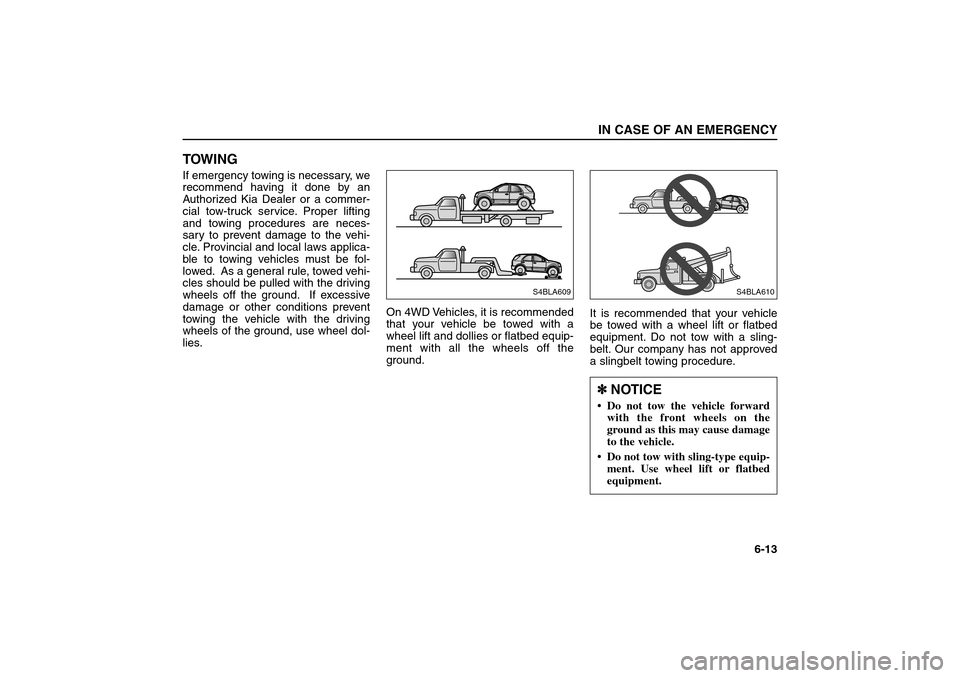
TOWING If emergency towing is necessary, we
recommend having it done by an
Authorized Kia Dealer or a commer-
cial tow-truck service. Proper lifting
and towing procedures are neces-
sary to prevent damage to the vehi-
cle. Provincial and local laws applica-
ble to towing vehicles must be fol-
lowed. As a general rule, towed vehi-
cles should be pulled with the driving
wheels off the ground. If excessive
damage or other conditions prevent
towing the vehicle with the driving
wheels of the ground, use wheel dol-
lies.On 4WD Vehicles, it is recommended
that your vehicle be towed with a
wheel lift and dollies or flatbed equip-
ment with all the wheels off the
ground.It is recommended that your vehicle
be towed with a wheel lift or flatbed
equipment. Do not tow with a sling-
belt. Our company has not approved
a slingbelt towing procedure.
IN CASE OF AN EMERGENCY
6-13
S4BLA609
S4BLA610
✽ ✽
NOTICE• Do not tow the vehicle forward
with the front wheels on the
ground as this may cause damage
to the vehicle.
Do not tow with sling-type equip-
ment. Use wheel lift or flatbed
equipment.
BL-ENG (CAN)-6.qxd 7/28/05 5:57 PM Page 13
Page 246 of 312
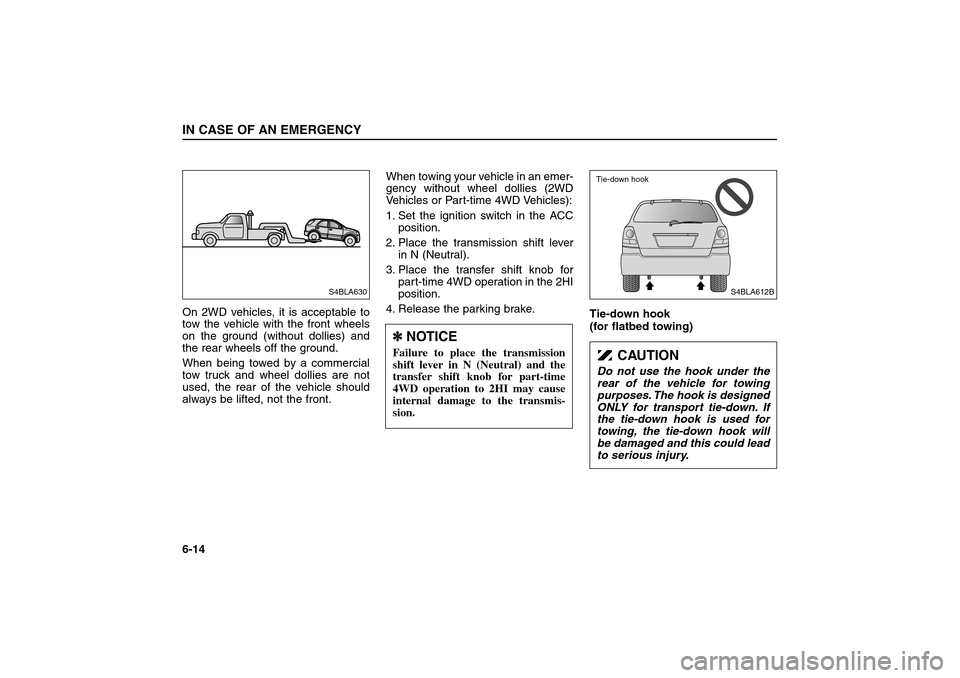
On 2WD vehicles, it is acceptable to
tow the vehicle with the front wheels
on the ground (without dollies) and
the rear wheels off the ground.
When being towed by a commercial
tow truck and wheel dollies are not
used, the rear of the vehicle should
always be lifted, not the front.When towing your vehicle in an emer-
gency without wheel dollies (2WD
Vehicles or Part-time 4WD Vehicles):
1. Set the ignition switch in the ACC
position.
2. Place the transmission shift lever
in N (Neutral).
3. Place the transfer shift knob for
part-time 4WD operation in the 2HI
position.
4. Release the parking brake.
Tie-down hook
(for flatbed towing)IN CASE OF AN EMERGENCY6-14
S4BLA630
S4BLA612B
✽ ✽
NOTICEFailure to place the transmission
shift lever in N (Neutral) and the
transfer shift knob for part-time
4WD operation to 2HI may cause
internal damage to the transmis-
sion.
CAUTION
Do not use the hook under the
rear of the vehicle for towing
purposes. The hook is designed
ONLY for transport tie-down. If
the tie-down hook is used for
towing, the tie-down hook will
be damaged and this could lead
to serious injury.Tie-down hook
BL-ENG (CAN)-6.qxd 7/28/05 5:57 PM Page 14
Page 247 of 312
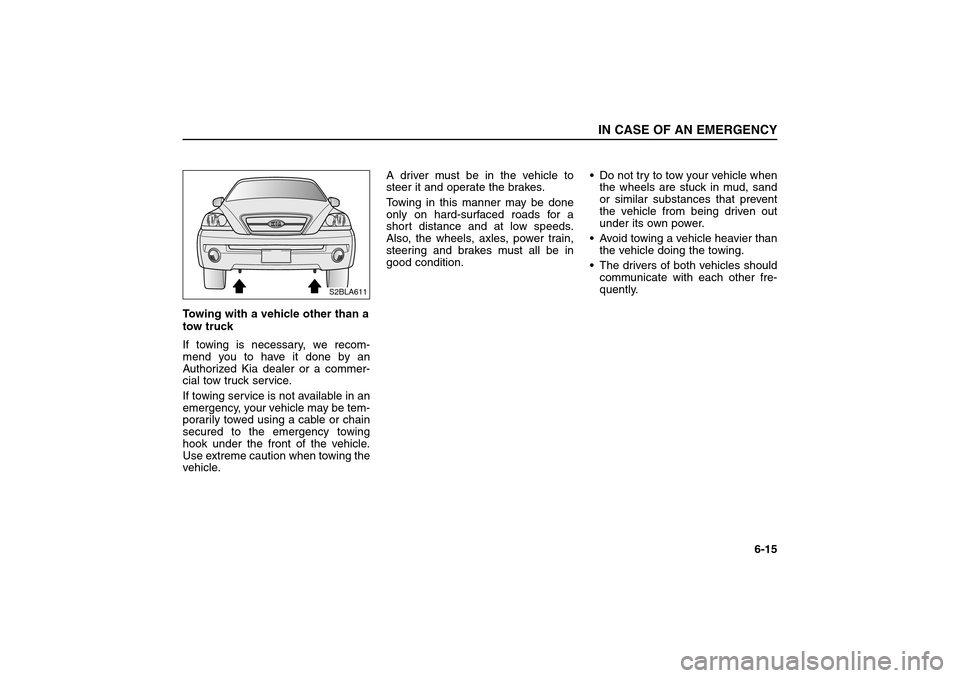
Towing with a vehicle other than a
tow truck
If towing is necessary, we recom-
mend you to have it done by an
Authorized Kia dealer or a commer-
cial tow truck service.
If towing service is not available in an
emergency, your vehicle may be tem-
porarily towed using a cable or chain
secured to the emergency towing
hook under the front of the vehicle.
Use extreme caution when towing the
vehicle.A driver must be in the vehicle to
steer it and operate the brakes.
Towing in this manner may be done
only on hard-surfaced roads for a
short distance and at low speeds.
Also, the wheels, axles, power train,
steering and brakes must all be in
good condition.Do not try to tow your vehicle when
the wheels are stuck in mud, sand
or similar substances that prevent
the vehicle from being driven out
under its own power.
Avoid towing a vehicle heavier than
the vehicle doing the towing.
The drivers of both vehicles should
communicate with each other fre-
quently.
IN CASE OF AN EMERGENCY
6-15
S2BLA611
BL-ENG (CAN)-6.qxd 7/28/05 5:57 PM Page 15