Page 251 of 312

IF YOU HAVE A FLAT TIRE Storing the Jack and Tools
Jack is stored in the compartment of
the cargo area.
Jack handle and wheel lug nut
wrench are located in the cargo area
floor.Removing the Spare Tire
Your spare tire is stored underneath
your vehicle, directly below the cargo
area.
1. Assemble the wheel lug nut
wrench to the jack handle.
2. Open the rear hatch.3. Insert the jack handle into the hole
just above the rear bumper. The
resistance to turning will be felt
when properly engaged.
4. Turn the jack handle counter-clock-
wise until the spare tire reaches
the ground. Turn the jack handle
10~13 revolutions counter-clock-
wise more after the spare tire
reaches the ground, and draw the
spare tire towards rear of vehicle.
Never rotate the jack handle more
than 17 revolutions, otherwise the
spare tire carrier may be damaged.
IN CASE OF AN EMERGENCY
6-19
S2BLA614C
S2BLA628
S2BLA615C
WARNING
Hold the handle firmly and turn
it slowly to lower the spare tire.
The separation of the wrench
from the handle could cause
loss the control and personal
injury.
BL-ENG (CAN)-6.qxd 7/28/05 5:57 PM Page 19
Page 253 of 312

Tire replacement
1. Park on a level surface and apply
the parking brake firmly.
2. Shift into R (Reverse) with manual
transmission or P (Park) with auto-
matic transmission.
3. Activate the hazard warning flash-
er.IN CASE OF AN EMERGENCY
6-21
S2BLA618
WARNING- Changing Tires
Never attempt vehicle repairs
in the traffic lanes of a public
road or highway.
Always move the vehicle com-
pletely off the road and onto
the shoulder before trying to
change a tire. If you cannot
find a firm, level place off the
road, call a towing service
company for assistance.
Be sure to use the correct
front and rear jacking posi-
tions on the vehicle; never
use the bumpers or any other
part of the vehicle for jack
support.
(Continued)
(Continued)
The vehicle can easily roll off
the jack causing serious
injury or death. Never allow
any portion of your body to
get beneath the vehicle while
using the jack.
Do not start or run the engine
while the vehicle is on the
jack.
Do not allow anyone to remain
in the vehicle while it is on the
jack.
Make sure any children pres-
ent are in a secure place away
from the road and from the
vehicle to be raised with the
jack.
BL-ENG (CAN)-6.qxd 7/28/05 5:57 PM Page 21
Page 254 of 312
4. Remove the wheel lug nut wrench,
jack, jack handle, and spare tire
from the vehicle.
5. Block both the front and rear of the
wheel that is diagonally opposite
the jack position.
6. Loosen the wheel lug nuts counter-
clockwise one turn each, but do
not remove any nut until the tire
has been raised off the ground.7. Place the jack at the front or rear
jacking position closest to the tire
you are changing.IN CASE OF AN EMERGENCY6-22
S2BLA619A
S2BLA620
WARNING - Changing Tires
To prevent vehicle movements
while changing a tire, always
set the parking brake fully, and
always block the wheel diago-
nally opposite the wheel being
changed.
BL-ENG (CAN)-6.qxd 7/28/05 5:57 PM Page 22
Page 255 of 312
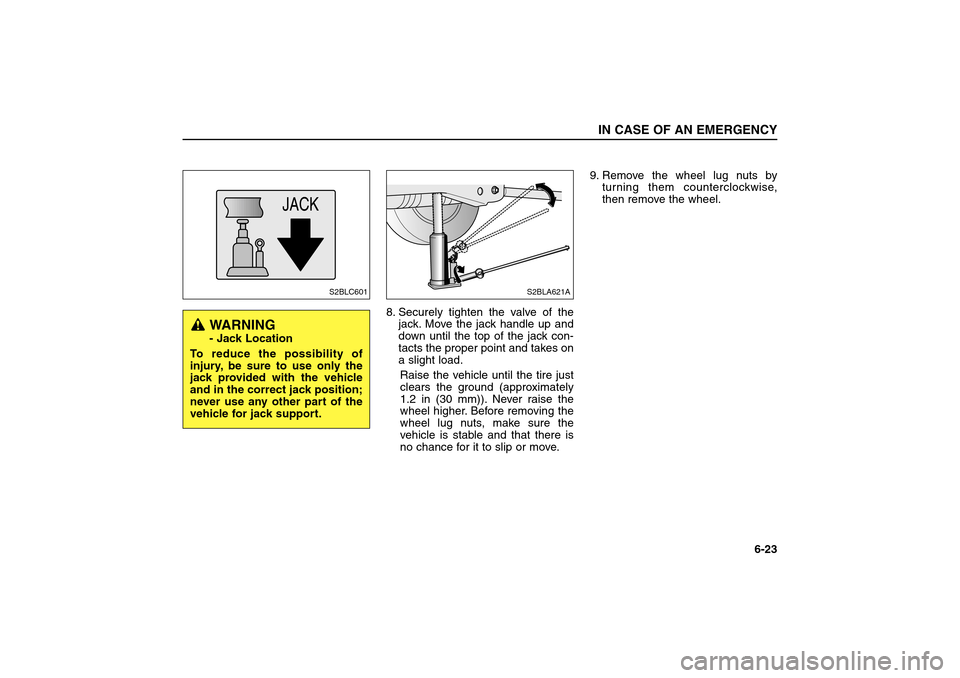
8. Securely tighten the valve of the
jack. Move the jack handle up and
down until the top of the jack con-
tacts the proper point and takes on
a slight load.
Raise the vehicle until the tire just
clears the ground (approximately
1.2 in (30 mm)). Never raise the
wheel higher. Before removing the
wheel lug nuts, make sure the
vehicle is stable and that there is
no chance for it to slip or move.9. Remove the wheel lug nuts by
turning them counterclockwise,
then remove the wheel.
IN CASE OF AN EMERGENCY
6-23
JACK
S2BLC601
S2BLA621A
WARNING - Jack Location
To reduce the possibility of
injury, be sure to use only the
jack provided with the vehicle
and in the correct jack position;
never use any other part of the
vehicle for jack support.
BL-ENG (CAN)-6.qxd 7/28/05 5:57 PM Page 23
Page 257 of 312
To prevent the jack, jack handle,
wheel lug nut, wrench and spare tire
from rattling while the vehicle is in
motion, store them properly. To store
the flat fire, refer to “Storing the spare
tire”in this section.
IN CASE OF AN EMERGENCY
6-25
CAUTION
Your vehicle has metric threads
on the wheel studs and nuts.
Make certain during wheel
removal that the same nuts
removed are reinstalled - or, if
replaced, that nuts with metric
threads and the same chamfer
configuration are used.
Installation of a non-metric
thread nut on a metric stud or
vice-versa will not secure the
wheel to the hub properly and
will damage the stud so that it
must be replaced.
Note that most lug nuts do not
have metric threads. Be sure to
use extreme care in checking
for thread style before installing
aftermarket lug nuts or wheels.
If in doubt, consult an
Authorized Kia Dealer.
WARNING
- Wheel Studs
If the studs are damaged, they
may lose their ability to retain
the wheel. This could lead to the
loss of the wheel and a colli-
sion.
✽ ✽
NOTICECheck the inflation pressures as
soon as possible after installing the
spare tire. Adjust it to the specified
pressure, if necessary. Refer to
Section 8, Specifications.
BL-ENG (CAN)-6.qxd 7/28/05 5:57 PM Page 25
Page 264 of 312
OWNER MAINTENANCEOwner Maintenance Schedule
The owner should perform these
vehicle inspections at the indicated
intervals to ensure safe and depend-
able operation.
Bring any problem to the attention of
an authorized Kia dealer as soon as
possible.When refueling, check the follow-
ing:
Engine oil level
Engine coolant level
Brake (and clutch, if equipped) fluid
level
Washer fluid levelEvery month, check:
Tire inflation pressures (cold)
Coolant level in reservoir (cold
engine)
Every 6 months (for example,
every spring and fall), check:
Power steering fluid level
Automatic transmission fluid level
MAINTENANCE
7-7
WARNING
Be careful when checking your
engine coolant level. The engine
compartment will be hot and
you could be burned.
WARNING- Engine Cooling Fans
Because your engine cooling
fans are electronically con-
trolled, they will run if the igni-
tion switch is ON, even if the
engine is not running. This
could cause serious injury. To
prevent this, be sure the igni-
tion is OFF, unless you must run
the engine while performing
maintenance or an inspection.
BL-ENG (CAN)-7.qxd 7/28/05 5:58 PM Page 7
Page 266 of 312

ENGINE OIL AND OIL
FILTERChecking the Engine Oil Level
1. Be sure the vehicle is on level
ground.
2. Start the engine and allow it to
reach normal operating tempera-
ture.
3. Turn the engine off and wait a few
minutes for the oil to return to the
oil pan.
4. Pull the dipstick out, wipe it clean,
and re-insert it fully.
5. Pull the dipstick out again and
check the level. The level should be
between F and L.
If the level is near or at L, add enough
oil to bring the level to F.Do not over-
fill.Use only the specified engine oil.
(Refer to “Recommended Lubricants’’
later in this section.)Changing the Engine Oil and
Filter
Change engine oil and filter accord-
ing to the Scheduled Maintenance at
the beginning of this section.
MAINTENANCE
7-9
OK
FL
S2BLC705A
WARNING
- Engine Oil
Continuous contact with USED
engine oil has caused skin can-
cer in laboratory mice. Protect
your skin by washing with soap
and water. Keep all engine oil
out of reach of children.
BL-ENG (CAN)-7.qxd 7/28/05 5:58 PM Page 9
Page 268 of 312

ENGINE COOLING SYSTEMThe high-pressure cooling system
has a reservoir filled with year-round
antifreeze coolant. The reservoir is
filled at the factory.
Check the antifreeze protection and
coolant level at least once a year, at
the beginning of the winter season,
and before traveling to a colder cli-
mate.Checking the Coolant Level
MAINTENANCE
7-11
WARNING- Removing Radiator Cap
Never attempt to remove the
radiator cap while the engine
is operating. Doing so might
lead to cooling system and
engine damage and could
result in serious personal
injury from escaping hot
coolant or steam. Turn the
engine off and wait until it has
cooled. Even then, use
extreme care when removing
the radiator cap. Wrap a thick
towel around it, and turn it
counterclockwise slowly to
the first stop. Step back while
the pressure is released from
the cooling system. When you
are sure all the pressure has
been released, press down on
the cap, using a thick towel,
and continue turning counter-
clockwise to remove it.
(Continued)
(Continued)
Even if the engine is not oper-
ating, do not remove the radi-
ator cap or the drain plug
while the engine and radiator
are hot. Hot coolant and
steam may still blow out
under pressure, causing seri-
ous injury.
BL-ENG (CAN)-7.qxd 7/28/05 5:58 PM Page 11