2006 KIA Sedona Seating
[x] Cancel search: SeatingPage 68 of 347
359
Features of your vehicle
WARNING
- Belt use
Safety belts must be used correctly
to work properly in an accident.
Each seating position in your vehi-
cle has a specific safety belt assem-
bly that includes a buckle and
tongue designed to be used togeth-
er.
Failure to heed these warnings and
follow these instructions will
increase the risk and severity of
injuries and the likelihood of death
in an accident.(Continued)
WARNING
- Twisted belts
A twisted or jammed safety belt
cannot restrain you properly. If you
cannot untwist or unjam the safety
belt, have an authorized Kia dealer
service it immediately. Never drive
or ride with a twisted or jammed
safety belt.
The rear (or front passenger) safety belts
use a special auto-lock feature designed
to allow a child restraint to be used in
these positions without an added locking
clip. They normally lock only under
extreme or emergency conditions (emer-
gency lock mode). However they can be
adjusted so that they remain fixed and
locked when a child restraint system is
placed in these positions. (Use this auto-
lock mode only to secure a child
restraint, never for passengers restrained
by the safety belts.)
The drivers safety belt can only operate
in the emergency lock mode.
Safety belts provide the best restraint
when:
The seatback is upright.
The occupant is sitting upright (notslouched).
The lap belt is snug across the hips.
The shoulder belt is snug across the chest.
The knees are straight forward.
WARNING
- After a colli- sion
Lap/shoulder belt assemblies
may be stretched or damaged
when subjected to the stress and
forces of a collision.
The entire restraint system should be inspected following
any collision. All belts, retractors,
anchors and hardware damaged
by a collision should be replaced
before the vehicle is operated
again.
WARNING -
Cargo area
Passengers should never be
allowed to ride in the cargo area of
a vehicle. No safety belts are pro-
vided for the cargo area. Persons
riding in the vehicle without a fas-
tened safety belt are much more
likely to suffer serious bodily injury
or death during an accident.
Page 82 of 347
373
Features of your vehicle
Child seat lower anchorsSome child seat manufacturers make
child restraint seats that are labeled as
International Standards Organization
Fixed (ISOFIX) or ISOFIX-compatible
child restraint seats. These seats include
two rigid or webbing mounted attach-
ments that connect to two ISOFIX
anchors at specific seating positions in
your vehicle. This type of child restraint
seat eliminates the need to use seat
belts to attach the child seat for forward-
facing child restraint seats in the rear
seats.ISOFIX anchors have been provided in
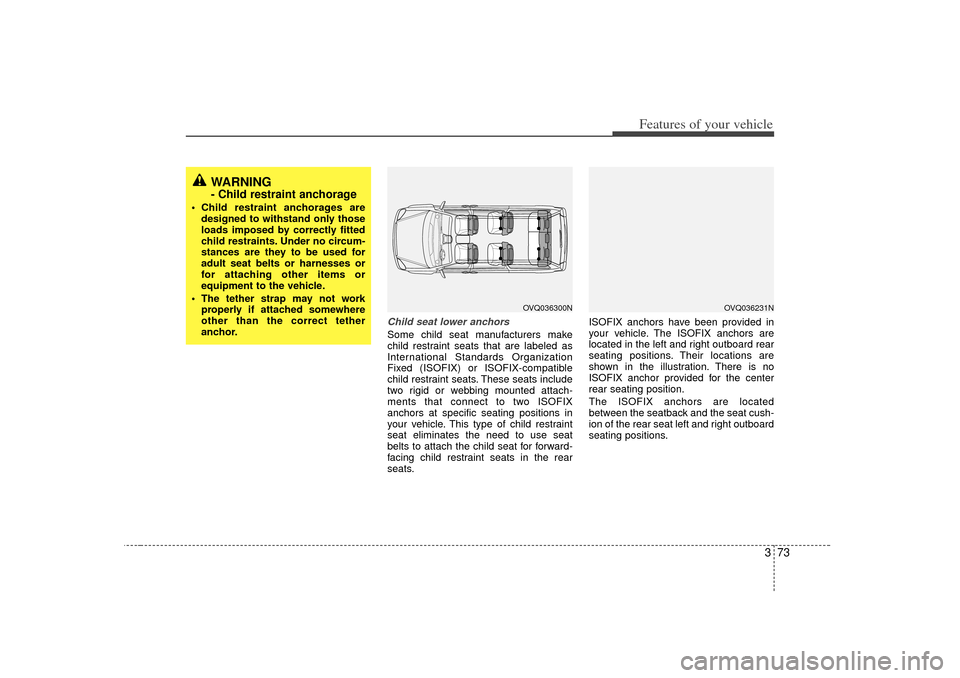
your vehicle. The ISOFIX anchors are
located in the left and right outboard rear
seating positions. Their locations are
shown in the illustration. There is no
ISOFIX anchor provided for the center
rear seating position.
The ISOFIX anchors are located
between the seatback and the seat cush-
ion of the rear seat left and right outboard
seating positions.
WARNING - Child restraint anchorage
Child restraint anchorages are
designed to withstand only those
loads imposed by correctly fitted
child restraints. Under no circum-
stances are they to be used for
adult seat belts or harnesses or
for attaching other items or
equipment to the vehicle.
The tether strap may not work properly if attached somewhere
other than the correct tether
anchor.
OVQ036300N
OVQ036231N
Page 83 of 347
Features of your vehicle74
3Follow the child seat manufacturer’s
instructions to properly install child
restraint seats with ISOFIX or ISOFIX-
compatible attachments.
Once you have installed the ISOFIX child
restraint, assure that the seat is properly
attached to the ISOFIX and tether
anchors. Also, test the child restraint seat
before you place the child in it. Tilt the
seat from side to side. Also try to tug the
seat forward. Check to see if the anchors
hold the seat in place.
Placing a passenger safety belt
into the auto lock mode The use of the auto lock mode will
ensure that the normal movement of the
child in the vehicle does not cause the
safety belt to be pulled out and loosen
the firmness of its hold on the child
restraint system. To secure a child
restraint system, use the following proce-
dure.
WARNING -
ISOFIX
Anchors
If the child restraint is not anchored
properly, there is a significant risk
of a child being seriously injured or
killed in a collision.
WARNING -
ISOFIX lower
anchors
ISOFIX lower anchors are only to be
used with the left and right rear out-
board seating positions. Never
attempt to attach an ISOFIX
equipped seat in the center seating
position. You may damage the
anchors or the anchors may fail and
break in a collision.
WARNING
Install the child restraint seat fully
rearward against the seatback with
the seatback in a vertical position,
not reclined.
WARNING
When using the vehicle's "ISOFIX"
system to install a child restraint
system in the rear seat, all unused
vehicle rear seat belt metal latch
plates or tabs must be latched
securely in their seat belt buckles
and the seat belt webbing must be
retracted behind the child restraint
to prevent the child from reaching
and taking hold of unretracted seat
belts. Unlatched metal latch plates
or tabs may allow the child to reach
the unretracted seat belts which
may result in strangulation and a
serious injury or death to the child
in the child restraint.
Page 90 of 347
381
Features of your vehicle
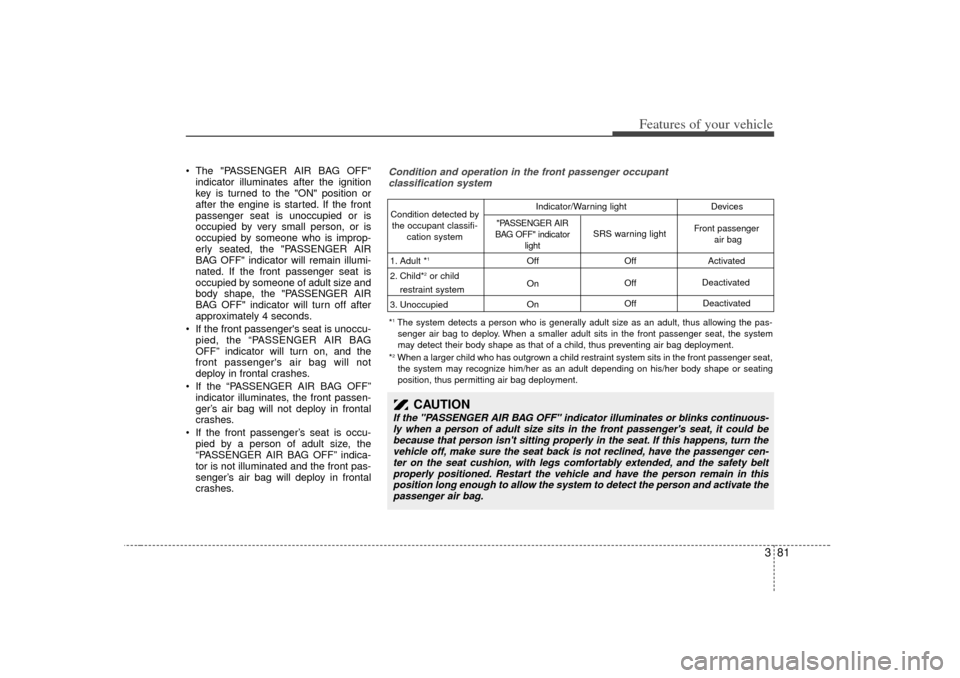
The "PASSENGER AIR BAG OFF"indicator illuminates after the ignition
key is turned to the "ON" position or
after the engine is started. If the front
passenger seat is unoccupied or is
occupied by very small person, or is
occupied by someone who is improp-
erly seated, the "PASSENGER AIR
BAG OFF" indicator will remain illumi-
nated. If the front passenger seat is
occupied by someone of adult size and
body shape, the "PASSENGER AIR
BAG OFF" indicator will turn off after
approximately 4 seconds.
If the front passenger's seat is unoccu- pied, the “PASSENGER AIR BAG
OFF” indicator will turn on, and the
front passenger's air bag will not
deploy in frontal crashes.
If the “PASSENGER AIR BAG OFF” indicator illuminates, the front passen-
ger’s air bag will not deploy in frontal
crashes.
If the front passenger’s seat is occu- pied by a person of adult size, the
“PASSENGER AIR BAG OFF” indica-
tor is not illuminated and the front pas-
senger’s air bag will deploy in frontal
crashes.
Condition and operation in the front passenger occupant classification systemCondition detected by
the occupant classifi- cation system
1. Adult *
1
2. Child*
2or child
restraint system
3. Unoccupied Off
On
On Off
Off
Off
Activated
Deactivated
"PASSENGER AIR
BAG OFF" indicator light
SRS warning light
Front passengerair bag Deactivated
Indicator/Warning light Devices
*1The system detects a person who is generally adult size as an adult, thus allowing the pas-
senger air bag to deploy. When a smaller adult sits in the front passenger seat, the system
may detect their body shape as that of a child, thus preventing air bag deployment.
*2When a larger child who has outgrown a child restraint system sits in the front passenger seat, the system may recognize him/her as an adult depending on his/her body shape or seating
position, thus permitting air bag deployment.
CAUTION
If the "PASSENGER AIR BAG OFF" indicator illuminates or blinks continuous- ly when a person of adult size sits in the front passenger's seat, it could bebecause that person isn't sitting properly in the seat. If this happens, turn the vehicle off, make sure the seat back is not reclined, have the passenger cen-ter on the seat cushion, with legs comfortably extended, and the safety beltproperly positioned. Restart the vehicle and have the person remain in thisposition long enough to allow the system to detect the person and activate the passenger air bag.
Page 91 of 347
Features of your vehicle82
3
WARNING
Even though your vehicle is
equipped with the occupant clas-
sification system, do not install a
child restraint system in the front
passenger seat. The child could
be severely injured or killed if the
air bag deploys. Children are
afforded the most protection in
the event of an accident when
they are restrained by the proper
restraint system in the rear seat.
If the "PASSENGER AIR BAG OFF" indicator is illuminated
when the front passenger's seat
is occupied by a person of adult
size who is seated properly, or if
the "PASSENGER AIR BAG OFF"
indicator" is not illuminated when
the front passenger's seat is
unoccupied or occupied by a very
small person, the occupant clas-
sification system is not working
properly. Have your vehicle imme-
diately inspected by your Kia
dealer if the occupant classifica-
tion system is not working prop-
erly.
(Continued)
(Continued)
If a very low weight adult is seat-ed in the front passenger seat, the
occupant classification system
may or may not turn off the right
front passenger air bag, depend-
ing upon the person's seating
position and body type. Everyone
in your vehicle should wear a
safety belt properly -- whether or
not there is an air bag for that per-
son.
If the front seat passenger changes their seating position
(for example, by not sitting
upright, by sitting on the edge of
the seat, or by otherwise being
out of position), the "PASSEN-
GER AIR BAG OFF" indicator may
be turned on, and the passenger
air bag may not deploy in a colli-
sion. Always be sure to sit prop-
erly in the front passenger seat
and wear the safety belt properly
and do not do any of the follow-
ing.
(Continued)
CAUTION
If the occupant classification sys-tem is not working properly, the air bag warning light on the instrumentpanel will illuminate because thepassenger’s air bag is connectedwith the occupant classification system. If there is a malfunction ofthe occupant classification system, the "PASSENGER AIR BAG OFF"indicator will not illuminate and thefront passenger's air bag will deployin either a side or frontal crashes even if there is child or no occupantin the front passenger's seat.
Have an authorized Kia dealerinspect the occupant classificationsystem with the SRS air bag systemas soon as possible if any of follow- ing occur;
The SRS air bag warning light does not illuminate when the igni-tion key is turned to "ON" posi- tion.
The SRS air bag warning light remains illuminated after illumi-nating or blinking for approxi-mately 6 seconds.
The SRS air bag warning light illu- minates while the vehicle is beingdriven.
Page 93 of 347

Features of your vehicle84
3
✽
✽
NOTICE• If luggage or other objects are placed
on the front passenger's seat or if the
temperature of the seat changes while
the seat is unoccupied, the "PASSEN-
GER AIR BAG OFF" indicator may
blink. These conditions do not indi-
cate a problem.
•Do not put heavy objects on the front
passenger's seat. This may cause front
passenger air bag deployment in the
event of an accident, thus increasing
your repair costs.
WARNING
The front seat passenger air bag
is much larger than the steering
wheel air bag and inflates with
considerably more force. It can
seriously hurt or kill a passenger
who is not in the proper position
and wearing the safety belt prop-
erly. The front passengers should
always move their seat as far
back as practical and sit back in
their seat.
It is essential that the front pas-
senger always wears their safety
belts, even when the vehicle is
moving in a parking lot or up a dri-
veway into garage.
(Continued)
(Continued) Any other such replacement or
modification could adversely
affect the operation of the occu-
pant classification system and
your advanced air bags. For the
same reason, do not attach any-
thing to the seat, dashboard or
door, even temporarily. If the sys-
tem is adversely affected, it could
cause severe personal injuries or
death in a collision.
Do not put a heavy load in the front
passenger seatback pocket or on
the front passenger seat. Do not
hang onto the front passenger
seat. Do not hang any items such
as seatback table on the front pas-
senger seatback. Do not place feet
on the front passenger seatback.
Do not place any items under the
front passenger seat. Any of these
could interfere with proper sensor
operation.
(Continued)
Kia does not endorse nor will it support any changes to any part
or structure of the vehicle that
could affect the advanced air bag
system, including the occupant
classification system.
Specifically, the front passenger
seat, dashboard or door should
not be replaced except by an
authorized Kia dealer using origi-
nal Kia parts designed for this
vehicle and model.
(Continued)
1KMN3666
- Always sit in a proper seatingposition.
Page 95 of 347

Features of your vehicle86
3The advanced SRS offers the ability to
control the air bag inflation with two lev-
els. A first stage level is provided for mod-
erate-severity impacts. A second stage
level is provided for more severe impacts.
According to the impact severity, seating
position and safety belt usage, the
SRSCM (SRS Control Module) controls
the air bag inflation. Failure to properly
wear safety belts can increase the risk
or severity of injury in an accident.
Additionally, your SRS is equipped with
an occupant classification system in the
front passenger’s seat. The occupant
classification system detects the pres-
ence of a passenger in the front passen-
ger’s seat and will turn off the front pas-
senger’s air bag under certain conditions.
For more detail, see “Occupant
Classification System” in this section.
CAUTION
If the seat position sensor is not working properly, the SRS air bag warning light on the instrumentpanel will illuminate even if there isno malfunction of the SRS air bagsystem, because the SRS air bag warning light is connected with theseat position sensor. If the SRS air bag warning light does not illumi-nate when the ignition key is turnedto the "ON" position, if it remains illuminated after illuminating orblinking for approximately 6 sec-onds, or if it illuminates while the vehicle is being driven, have anauthorized Kia dealer inspect the seat position sensor and theadvanced SRS air bag system as soon as possible.
WARNING
Modification to the seat structure can adversely affect the seat
position sensor and cause the air
bag to deploy at a different level
than should be provided.
Failure to properly wear safety belts can increase the risk or
severity of injury by causing the
air bags to deploy at a different
level than should be provided.
Do not place any objects under- neath the front seats which could
damage the seat position sensor
or interfere with the occupant
classification system.
Do not place any objects that may cause magnetic fields near the
front seat. These may cause a
malfunction of the seat position
sensor.
(Continued)
Page 96 of 347
387
Features of your vehicle
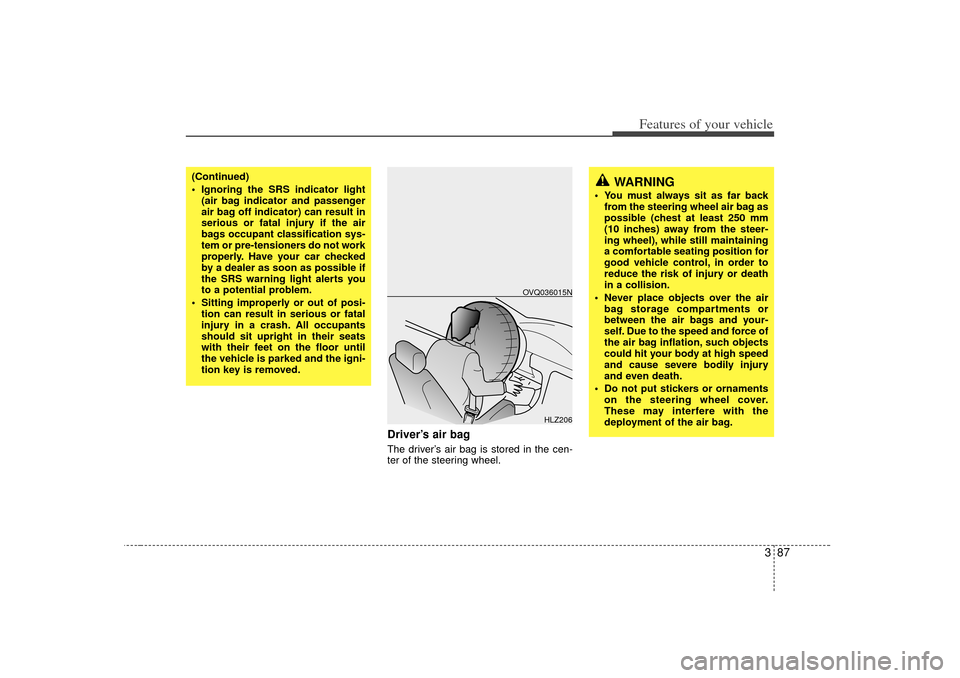
Driver’s air bagThe driver’s air bag is stored in the cen-
ter of the steering wheel.
HLZ206
OVQ036015N
(Continued)
Ignoring the SRS indicator light(air bag indicator and passenger
air bag off indicator) can result in
serious or fatal injury if the air
bags occupant classification sys-
tem or pre-tensioners do not work
properly. Have your car checked
by a dealer as soon as possible if
the SRS warning light alerts you
to a potential problem.
Sitting improperly or out of posi- tion can result in serious or fatal
injury in a crash. All occupants
should sit upright in their seats
with their feet on the floor until
the vehicle is parked and the igni-
tion key is removed.
WARNING
You must always sit as far backfrom the steering wheel air bag as
possible (chest at least 250 mm
(10 inches) away from the steer-
ing wheel), while still maintaining
a comfortable seating position for
good vehicle control, in order to
reduce the risk of injury or death
in a collision.
Never place objects over the air bag storage compartments or
between the air bags and your-
self. Due to the speed and force of
the air bag inflation, such objects
could hit your body at high speed
and cause severe bodily injury
and even death.
Do not put stickers or ornaments on the steering wheel cover.
These may interfere with the
deployment of the air bag.