2006 KIA Sedona engine
[x] Cancel search: enginePage 19 of 347
Features of your vehicle10
34. If all of the digits have been input suc-
cessfully, you have to start the engine
within 30 seconds. If you attempt to
start the engine after 30 seconds, the
engine will not start and you will have
to input your password again.
After performing the limp home proce-
dure, you have to see an authorized Kia
dealer immediately to inspect and repair
your ignition key or immobilizer system. This device complies with Industry
Canada Standard RSS-210.
Operation
is subject to the following two conditions:
1. This device may not cause interfer- ence, and
2. This device must accept any interfer- ence, including interference that may
cause undesired operation of the
device.
CAUTION
The transponder in your ignitionkey is an important part of the immobilizer system. It is designedto give years of trouble-free service,however you should avoid expo- sure to moisture, static electricityand rough handling. Immobilizer system malfunction could occur.
CAUTION
Do not change, alter or adjust theimmobilizer system because itcould cause the immobilizer sys- tem to malfunction and should onlybe serviced by an authorized Kia dealer.
Malfunctions caused by improperalterations, adjustments or modifi- cations to the immobilizer systemare not covered by your vehicle manufacturer warranty.
WARNING
Changes or modifications not
expressly approved by the party
responsible for compliance could
void the user's authority to operate
the equipment.
Page 27 of 347
Features of your vehicle18
3✽
✽
NOTICE• The power sliding door and power
tailgate can be operated when the
engine is not running. However the
power operation consumes large
amounts of vehicle electric power. To
prevent the battery from being dis-
charged, do not operate them exces-
sively e.g.: more than approximately
10 times repeatedly.
• To prevent the battery from being dis- charged, do not leave the power slid-
ing door and power tailgate at open
position for a long lime.
• Do not apply excessive force while operating the power sliding door or
power tailgate. This could cause dam-
age to the power sliding door or power
tailgate.
• Do not modify or repair any part of the power sliding door or power tail-
gate by yourself. This must be done by
an authorized Kia dealer.
• When jacking up the vehicle to change a tire or repair the vehicle, do
not operate the power sliding door or
power tailgate. This could cause the
power sliding door or power tailgate
to operate improperly.
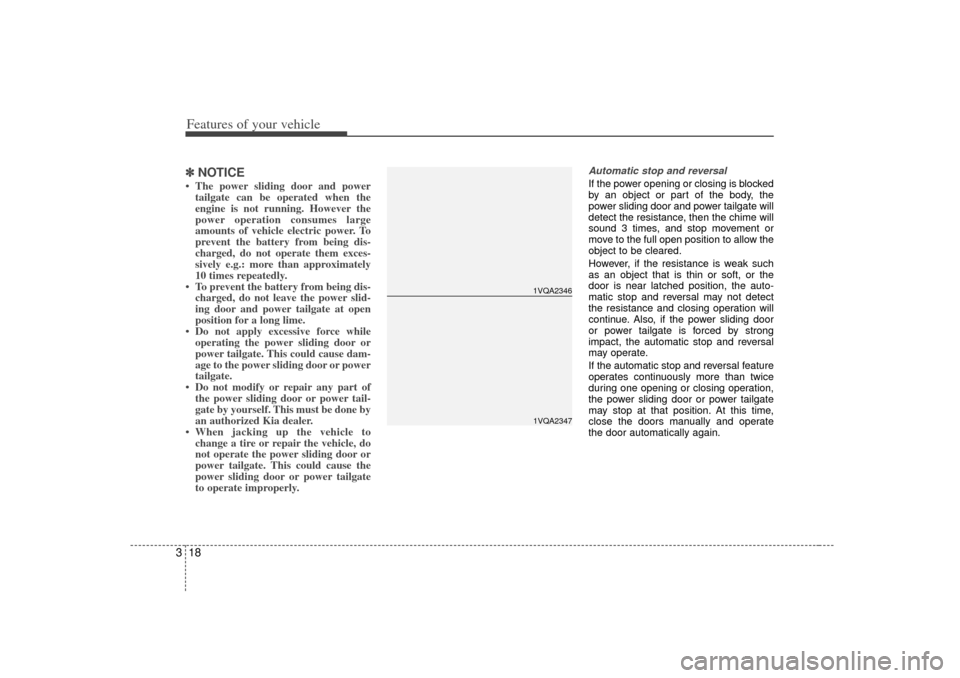
Automatic stop and reversalIf the power opening or closing is blocked
by an object or part of the body, the
power sliding door and power tailgate will
detect the resistance, then the chime will
sound 3 times, and stop movement or
move to the full open position to allow the
object to be cleared.
However, if the resistance is weak such
as an object that is thin or soft, or the
door is near latched position, the auto-
matic stop and reversal may not detect
the resistance and closing operation will
continue. Also, if the power sliding door
or power tailgate is forced by strong
impact, the automatic stop and reversal
may operate.
If the automatic stop and reversal feature
operates continuously more than twice
during one opening or closing operation,
the power sliding door or power tailgate
may stop at that position. At this time,
close the doors manually and operate
the door automatically again.
1VQA23461VQA2347
Page 38 of 347
329
Features of your vehicle
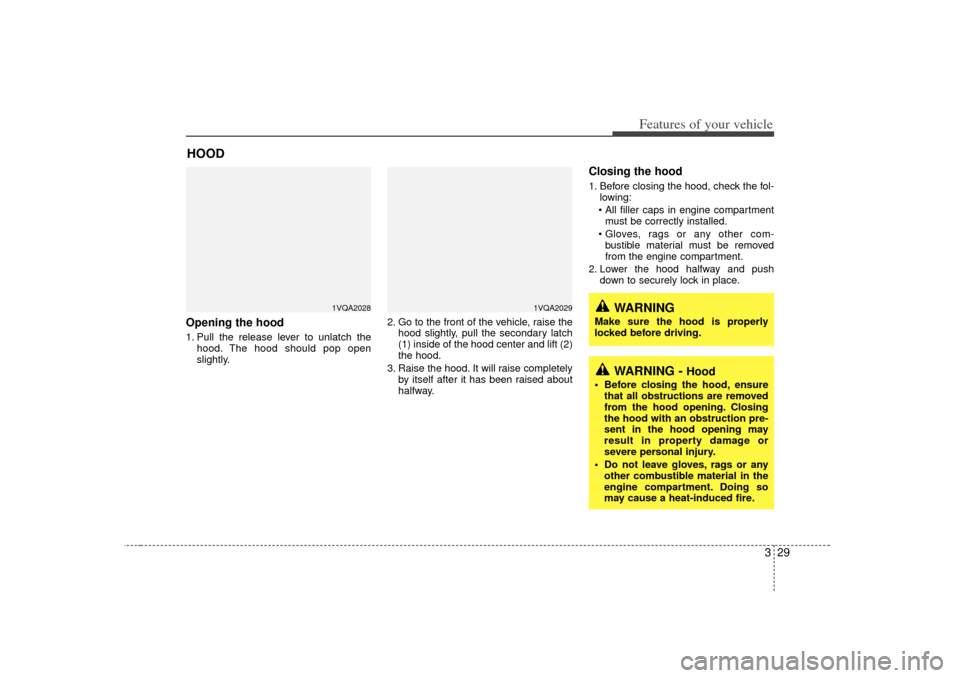
Opening the hood 1. Pull the release lever to unlatch thehood. The hood should pop open
slightly. 2. Go to the front of the vehicle, raise the
hood slightly, pull the secondary latch
(1) inside of the hood center and lift (2)
the hood.
3. Raise the hood. It will raise completely by itself after it has been raised about
halfway.
Closing the hood1. Before closing the hood, check the fol-lowing:
All filler caps in engine compartment must be correctly installed.
Gloves, rags or any other com- bustible material must be removed
from the engine compartment.
2. Lower the hood halfway and push down to securely lock in place.
HOOD
WARNING -
Hood
Before closing the hood, ensurethat all obstructions are removed
from the hood opening. Closing
the hood with an obstruction pre-
sent in the hood opening may
result in property damage or
severe personal injury.
Do not leave gloves, rags or any other combustible material in the
engine compartment. Doing so
may cause a heat-induced fire.
1VQA2028
1VQA2029
WARNING
Make sure the hood is properly
locked before driving.
Page 39 of 347
Features of your vehicle30
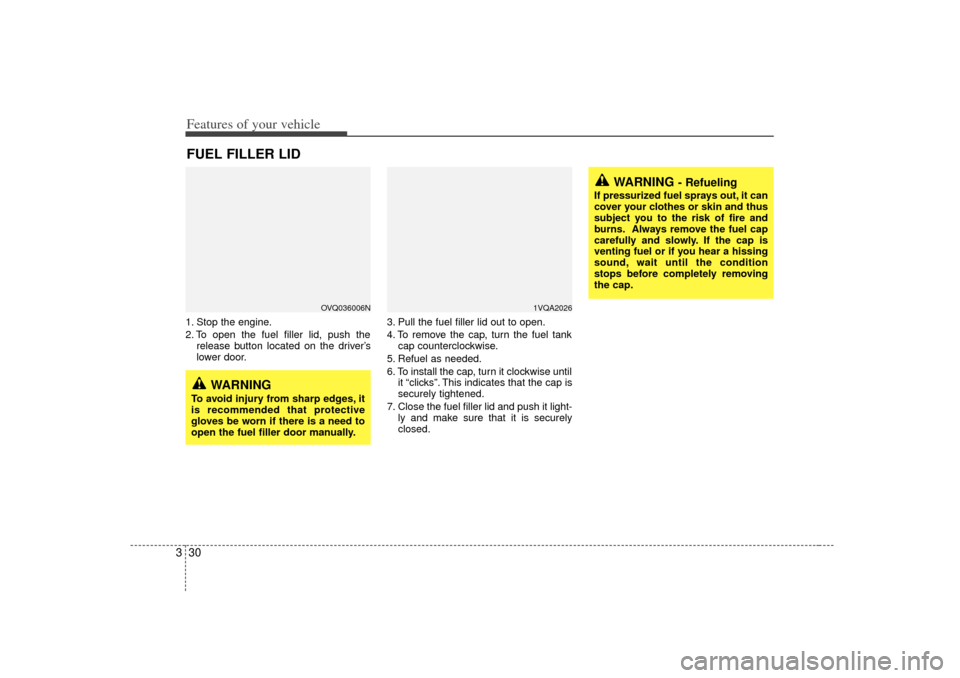
31. Stop the engine.
2. To open the fuel filler lid, push the
release button located on the driver’s
lower door. 3. Pull the fuel filler lid out to open.
4. To remove the cap, turn the fuel tank
cap counterclockwise.
5. Refuel as needed.
6. To install the cap, turn it clockwise until it “clicks”. This indicates that the cap is
securely tightened.
7. Close the fuel filler lid and push it light- ly and make sure that it is securely
closed.FUEL FILLER LID
OVQ036006N
1VQA2026
WARNING
To avoid injury from sharp edges, it
is recommended that protective
gloves be worn if there is a need to
open the fuel filler door manually.
WARNING
- Refueling
If pressurized fuel sprays out, it can
cover your clothes or skin and thus
subject you to the risk of fire and
burns. Always remove the fuel cap
carefully and slowly. If the cap is
venting fuel or if you hear a hissing
sound, wait until the condition
stops before completely removing
the cap.
Page 40 of 347

331
Features of your vehicle
WARNING -
Refueling dan-
gers
Automotive fuels are flammable
materials. When refueling, please
note the following guidelines care-
fully. Failure to follow these guide-
lines may result in severe personal
injury, severe burns or death by fire
or explosion.
Before refueling note the locationof the Emergency Gasoline Shut-
Off, if available, at the gas station
facility.
Before touching the fuel nozzle, you should eliminate potentially
dangerous static electricity dis-
charge by touching another metal
part of the vehicle, a safe distance
away from the fuel filler neck, noz-
zle, or other gas source.
(Continued)
(Continued)
Do not get back into a vehicleonce you have begun refueling
since you can generate static
electricity by touching, rubbing or
sliding against any item or fabric
(polyester, satin, nylon, etc.)
capable of producing static elec-
tricity. Static electricity discharge
can ignite fuel vapors resulting in
rapid burning. If you must re-
enter the vehicle, you should
once again eliminate potentially
dangerous static electricity dis-
charge by touching a metal part
of the vehicle, away from the fuel
filler neck, nozzle or other gaso-
line source.
When using a portable fuel con- tainer be sure to place the con-
tainer on the ground prior to refu-
eling. Static electricity discharge
from the container can ignite fuel
vapors causing a fire. Once refu-
eling has begun, contact with the
vehicle should be maintained
until the filling is complete.
(Continued)
(Continued)Use only portable plastic fuel
containers designed to carry and
store gasoline.
Do not use cellular phones while refueling. Electric current and/or
electronic interference from cellu-
lar phones can potentially ignite
fuel vapors causing a fire.
When refueling, always shut the engine off. Sparks produced by
electrical components related to
the engine can ignite fuel vapors
causing a fire. Once refueling is
complete, check to make sure the
filler cap and filler door are
securely closed, before starting
the engine.
DO NOT use matches or a lighter and DO NOT SMOKE or leave a lit
cigarette in your vehicle while at a
gas station especially during
refueling. Automotive fuel is high-
ly flammable and can, when ignit-
ed, result in fire.
(Continued)
Page 41 of 347
Features of your vehicle32
3
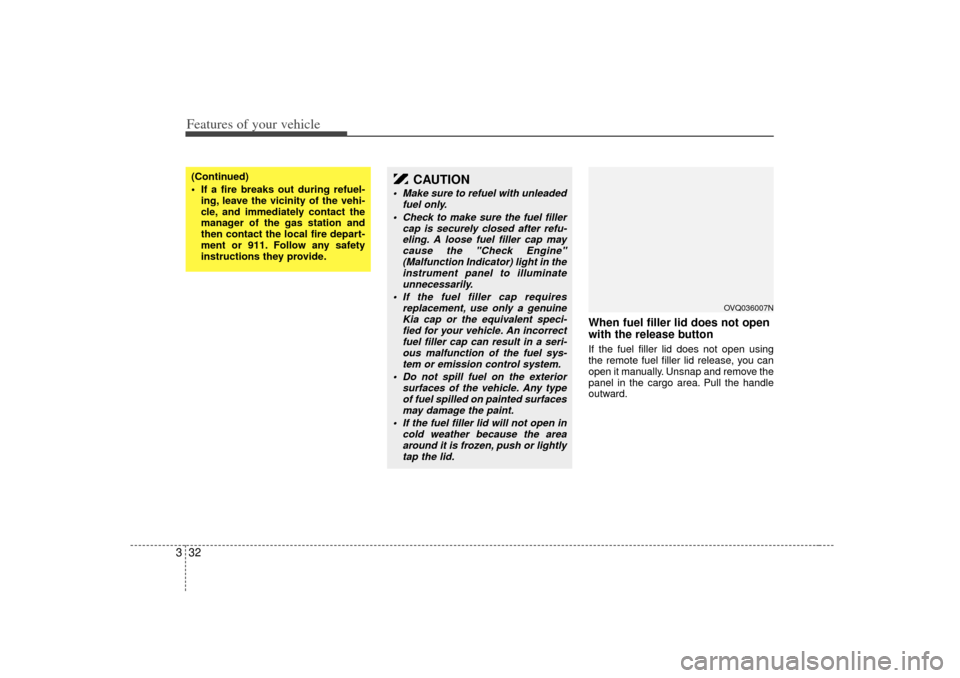
When fuel filler lid does not open
with the release buttonIf the fuel filler lid does not open using
the remote fuel filler lid release, you can
open it manually. Unsnap and remove the
panel in the cargo area. Pull the handle
outward.
(Continued)
If a fire breaks out during refuel-
ing, leave the vicinity of the vehi-
cle, and immediately contact the
manager of the gas station and
then contact the local fire depart-
ment or 911. Follow any safety
instructions they provide.
CAUTION
Make sure to refuel with unleaded fuel only.
Check to make sure the fuel filler cap is securely closed after refu-eling. A loose fuel filler cap maycause the "Check Engine" (Malfunction Indicator) light in theinstrument panel to illuminate unnecessarily.
If the fuel filler cap requires replacement, use only a genuineKia cap or the equivalent speci- fied for your vehicle. An incorrectfuel filler cap can result in a seri-ous malfunction of the fuel sys-tem or emission control system.
Do not spill fuel on the exterior surfaces of the vehicle. Any typeof fuel spilled on painted surfacesmay damage the paint.
If the fuel filler lid will not open in cold weather because the areaaround it is frozen, push or lightly tap the lid.
OVQ036007N
Page 49 of 347

Features of your vehicle40
3Seat cushion height (for driver’s seat)To change the height of the seat cushion,
push the lever up or down located on the
outside of the seat cushion.
To lower the seat cushion, push down
the lever several times.
To raise the seat cushion, pull up the lever several times.
Front seat adjustment - powerThe front seat can be adjusted by using
the control knob on the front door. Before
driving, adjust the seat to the proper
position so as to easily control the steer-
ing wheel, pedals and switches on the
instrument panel.
1VQA2328
WARNING
The power seats are operable with
the ignition OFF.
Therefore, children should never be
left unattended in the car.
CAUTION
Power seats are driven by an electric motor. Stop operatingonce the adjustment is complet-ed. Excessive operation may damage the electrical equipment.
When in operation, the power seats consume large amounts ofelectrical power. To prevent unnec-essary charging system drain,don’t adjust the power seats longer than necessary while theengine is not running.
Do not operate two or more power seat control buttons at the sametime. Doing so may result inpower seat motor or electrical component malfunction.
OVQ036008N
Page 64 of 347
355
Features of your vehicle
WARNING
- Cargo
Cargo should always be secured to
prevent it from being thrown about
the vehicle in a collision and caus-
ing injury to the vehicle occupants.
Special care should be taken of
objects placed in the rear seats,
since those may hit the front seat
occupants in a frontal collision.
CAUTION
- Rear safetybelts
When returning the rear seatbacks
to the upright position, rememberto return the rear shoulder belts to their proper position. Routing thesafety belt webbing through therear safety belt guides will help keep the belts from being trappedbehind or under the seats.
WARNING -
Cargo loading
Make sure the engine is off, the
transaxle is in P and the parking
brake is applied whenever loading
or unloading cargo. Failure to take
these steps may allow the vehicle to
move if shift lever is inadvertently
moved to another position.
CAUTION -
Avoid damag-
ing rear safety buckles
When you fold the rear seatback or
put luggage on the rear seat cush- ion, insert the buckle in the pocketbetween the rear seatback andcushion. Doing so can prevent the buckle from being damaged by therear seatback or luggage.
1VQA2074B1VQA2074C