Page 229 of 281
Maintenance
16
7
1 23456789
7. Install the oil filter and tighten it.
(Refer to the oil filter caution label
for tightening instructions.)
8. Install a new washer on the drain plug. Don’t use an old washer
repeatedly.
9. Replace the drain plug after the oil has thoroughly drained. Torque theplug to 3.5~4.5 kgm (25.3~32.5lbft, 34.3~44.1 Nm).
10. Refill the engine with new oil to the F mark on the dipstick. Do not
overfill.
11. Reinstall the oil filler cap secure- ly.
12. Start the engine and inspect around the oil filter seal for leaks.
Stop the engine.
13. Check the oil level and fill to the F mark as necessary.Oil capacity
With filter change : 3.0 liters (3.2 US qt.)Without filter change :2.8 liters (3.0 US qt.)
Use only the specified Service
Grade engine oil. (Refer to“Recommended Lubricants” later inthis section.)
✽✽ NOTICE
Page 251 of 281

Maintenance
38
7
1 23456789
For best battery service :
Keep the battery securely mount-
ed.
Keep the battery top clean and dry.
Keep the terminals and connec- tions clean, tight, and coated with
petroleum jelly or terminal grease.
Rinse any spilled electrolyte from the battery immediately with a
solution of water and baking soda.
If the vehicle is not going to be used for an extended time, discon-
nect the battery cables. Battery recharging
Your vehicle has a maintenance-free,
calcium-based battery.
If the battery becomes discharged
in a short time (because, for exam-
ple, the headlights or interior lights
were left on while the vehicle was
not in use), recharge it by slow
charging (trickle) for 10 hours.
If the battery gradually discharges because of high electric load while
the vehicle is being used, recharge
it at 20-30A for two hours.
Items to be reset after the battery
has been discharged or the bat-tery has been disconnected.
Clock (See page 3-89)
Audio (See the audio manual)
1SAA5028
Page 258 of 281

745
Maintenance
1 23456789
Uniform tire quality grading
Tread wear
The tread wear grade is a compara-
tive rating based on the wear rate ofthe tire when tested under controlled
conditions on a specified govern-
ment test course. For example, a tire
graded 150 would wear one-and-a-
half times as well on the government
course as a tire graded 100.The relative performance of tiresdepends upon the actual conditions
of their use. However, performance
may differ from the norm because of
variations in driving habits, service
practices and differences in road
characteristics and climate.
These grades are molded on the
side-walls of passenger vehicle tires.
The tires available as standard or
optional equipment on Kia vehicles
may vary with respect to grade.
Traction - A, B & C
The traction grades, from highest to
lowest, are A, B and C. The gradesrepresent the tires ability to stop on
wet pavement as measured undercontrolled conditions on specified
government test surfaces of asphalt
and concrete. A tire marked C may
have poor traction performance.
Temperature -A, B & C
The temperature grades are A (the
highest), B and C. The grades repre-
sent the tire’s resistance to the gener-ation of heat and its ability to dissipateheat when tested under controlledconditions on a specified indoor labo-
ratory test wheel.
Sustained high temperature can
cause the material of the tires to
degenerate and reduce tires life, and
excessive temperature can lead to
sudden tires failure. Grades A and B
represent higher levels of perform-
ance on the laboratory test wheel
than the minimum required by the
law.
1SAA5047
Type A
Type B
1SAA5048
Page 266 of 281
753
Maintenance
1 23456789
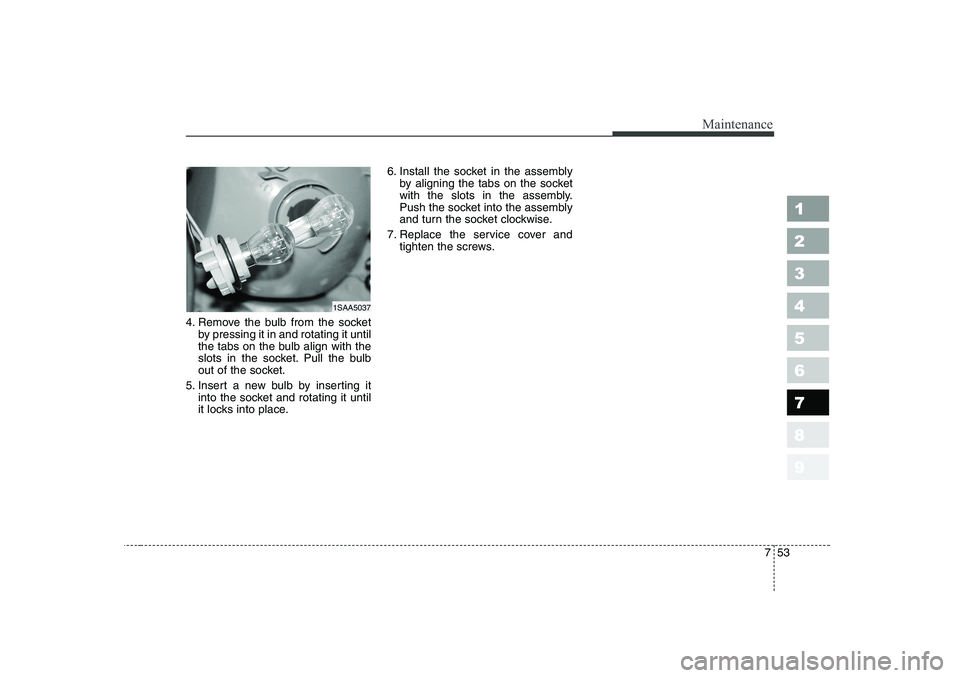
4. Remove the bulb from the socketby pressing it in and rotating it until
the tabs on the bulb align with the
slots in the socket. Pull the bulb
out of the socket.
5. Insert a new bulb by inserting it into the socket and rotating it until
it locks into place. 6. Install the socket in the assembly
by aligning the tabs on the socket
with the slots in the assembly.
Push the socket into the assembly
and turn the socket clockwise.
7. Replace the service cover and tighten the screws.
1SAA5037
Page 267 of 281

Maintenance
54
7
1 23456789
LUBRICANT SPECIFICATIONS
Recommended lubricants
To help achieve proper engine and
powertrain performance and durabil-
ity, use only lubricants of the proper
quality. The correct lubricants alsohelp promote engine efficiency that
results in improved fuel economy. Engine oils labeled Energy
Conserving Oil are now available.
Along with other additional benefits,
they contribute to fuel economy byreducing the amount of fuel neces-
sary to overcome engine friction.
Often, these improvements are diffi-
cult to measure in everyday driving,
but in a year’s time, they can offer
significant cost and energy savings.Recommended SAE viscosity
number
✽✽
NOTICE
Always be sure to clean the area
around any filler plug, drain plug,
or dipstick before checking or drain-
ing any lubricant. This is especially
important in dusty or sandy areasand when the vehicle is used on
unpaved roads. Cleaning the plug
and dipstick areas will prevent dirt
and grit from entering the engine
and other mechanisms that could bedamaged.
*¹ Refer to the recommended SAE viscosity numbers on the next page.
These lubricants and fluids are recommended for use in your vehicle.
Lubricant Classification
API Service SJ, SL or above,
ILSAC GF-3 or above
API Service CH-4 or above,
ACEA B4 or above
Manual transaxle fluid
API Service GL-4 (SAE 75W-85, fill-for-life)
Automatic transaxle fluid ESSO JWS 3314
Power steering fluid PSF-III
Brake/Clutch fluid FMVSS116 DOT-3 or DOT-4
Engine oil *¹
Gasoline Engine
Diesel Engine
Page 276 of 281
83
1 23456789
Specifications
Capacities
*1
Refer to the recommended SAE viscosity numbers on the page 7-55.
* 2
MT : Manual transaxle
* 3
AT : Automatic transaxle
Lubricant Volume Classification
Gasoline Engine 3.0
lAPI Service SJ, SL or above, ILSAC GF-3 or above
Engine oil *1
Diesel Engine 5.3
lAPI Service CH-4 or above,ACEA B4 or above
Manual transaxle fluid Gasoline Engine
1.9
lAPI SERVICE GL-4
Diesel Engine SAE75W-85 (fill for-life)
Automatic transaxle fluid Gasoline Engine
5.2
lESSO JWS 3314
Diesel Engine
Power steering 0.8
lPSF-III
Gasoline Engine MT
*2
3.76
l
AT *3
3.86 lEthylene glycol base for
Coolant
Diesel Engine MT *2
4.57
laluminum radiator
Brake/Clutch fluid 0.7~0.8
lFMVSS116 DOT-3
or DOT-4
Fuel 35
l-
Page 280 of 281

93
1 23456789
Index
Interior care ······························································· 7-60
Interior features ························································· 3-86
Interior lights ····························································· 3-82
Interior overview ························································· 2-4
Keys ··············································································· 3-2
Label information ······················································ 5-22
Lighting ······································································· 4-33
Lubricant specifications ············································ 7-54
Lubricants and fluids ················································ 7-30
Luggage net ································································ 3-90
Maintenance services ··················································· 7-3
Maintenance under severe usage conditions ············· 7-8
Manual climate control system ································ 4-43
Manual transaxle ················································ 4-6, 7-25
Mirrors ········································································ 3-79
Normal maintenance schedule ··································· 7-5
Overheating ·································································· 6-3Overloading ································································ 5-21
Owner maintenance ··················································· 7-10
Parking brake ···························································· 7-21
Power steering ···························································· 7-23
Remote keyless entry ··················································· 3-4
Road warning ······························································· 6-2
Safety belts ································································· 3-32
Seat ·············································································· 3-16
Special driving conditions ··········································· 5-7
Specifications ································································ 8-2
Starting the engine ······················································· 4-4
Steering wheel ··················································· 4-20, 7-24
Storage compartment ················································ 3-83
Suggestions for economical operation ······················· 5-6
Theft-alarm system ···················································· 4-53
Tires and wheels ························································ 7-40
Towing ········································································· 6-14
Trailer towing ····························································· 5-13
K
L
M
N
O
P
R
S
T