Page 107 of 281
Driving your vehicle
6
4
1 23456789
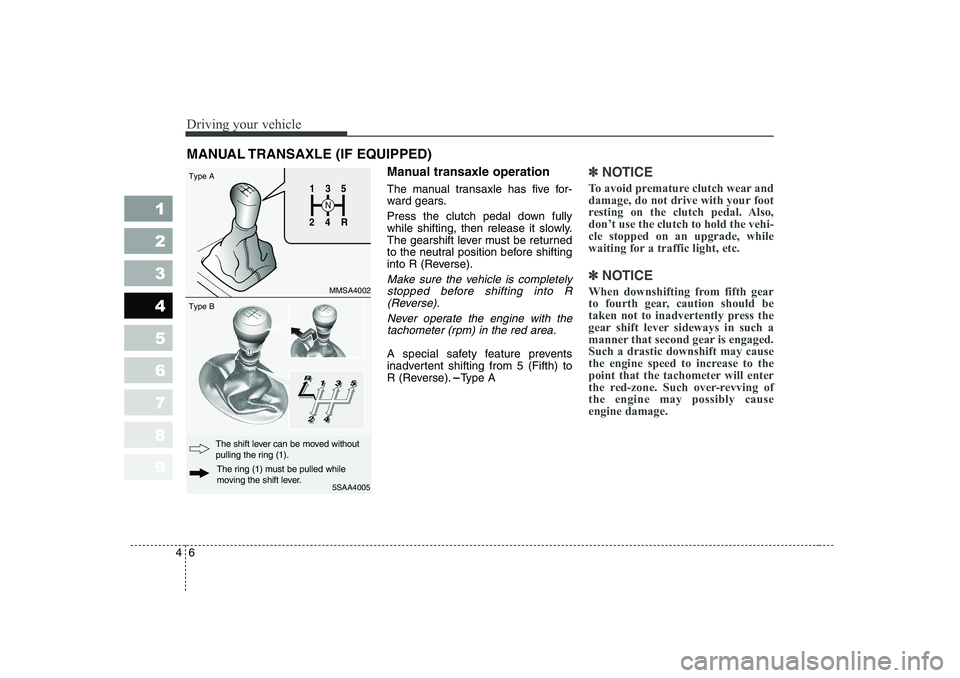
Manual transaxle operation
The manual transaxle has five for-
ward gears.
Press the clutch pedal down fully
while shifting, then release it slowly.
The gearshift lever must be returned
to the neutral position before shifting
into R (Reverse).
Make sure the vehicle is completely
stopped before shifting into R(Reverse).
Never operate the engine with thetachometer (rpm) in the red area.
A special safety feature prevents
inadvertent shifting from 5 (Fifth) to
R (Reverse). Type A
✽✽ NOTICE
To avoid premature clutch wear and
damage, do not drive with your foot
resting on the clutch pedal. Also,don’t use the clutch to hold the vehi-cle stopped on an upgrade, while
waiting for a traffic light, etc.
✽
✽ NOTICE
When downshifting from fifth gear
to fourth gear, caution should be
taken not to inadvertently press the
gear shift lever sideways in such a
manner that second gear is engaged.Such a drastic downshift may cause
the engine speed to increase to the
point that the tachometer will enter
the red-zone. Such over-revving ofthe engine may possibly causeengine damage.
MANUAL TRANSAXLE (IF EQUIPPED)
1
2 4
R
3
S
N
135
R
4
2
5SAA4005
Type A Type B
MMSA4002
The ring (1) must be pulled while
moving the shift lever.
The shift lever can be moved without
pulling the ring (1).
Page 108 of 281
47
1 23456789
Driving your vehicle
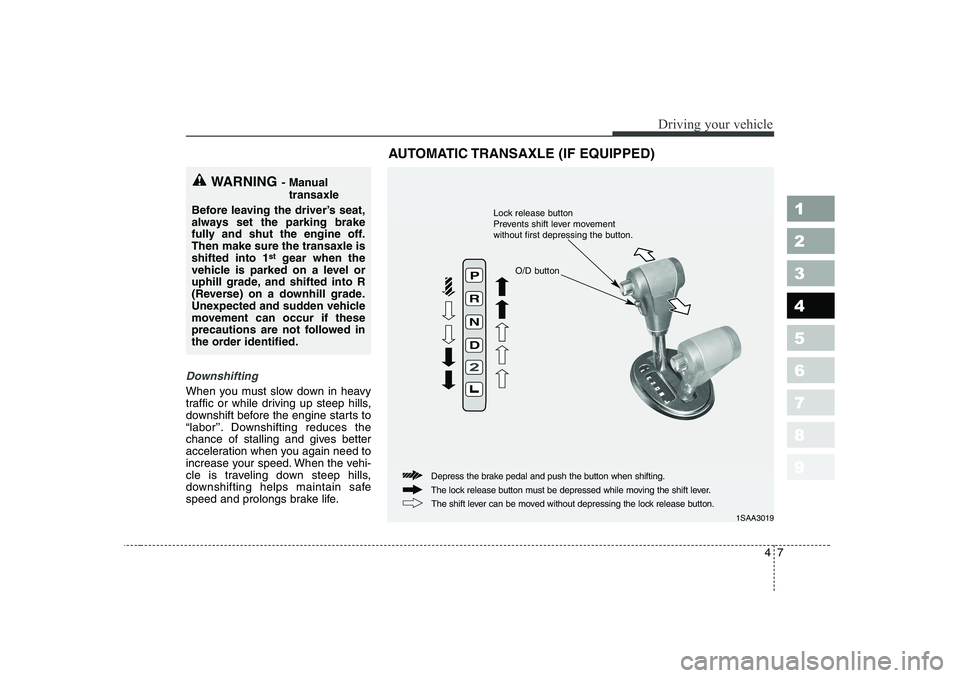
Downshifting
When you must slow down in heavy
traffic or while driving up steep hills,
downshift before the engine starts to“labor ’’. Downshifting reduces the
chance of stalling and gives better
acceleration when you again need to
increase your speed. When the vehi-
cle is traveling down steep hills,
downshifting helps maintain safe
speed and prolongs brake life.
1SAA3019
The lock release button must be depressed while moving the shift lever.
The shift lever can be moved without depressing the lock release button.
Depress the brake pedal and push the button when shifting. Lock release button
Prevents shift lever movement
without first depressing the button.
O/D button
WARNING - Manual
transaxle
Before leaving the driver ’s seat,
always set the parking brake
fully and shut the engine off.Then make sure the transaxle isshifted into 1 st
gear when the
vehicle is parked on a level or
uphill grade, and shifted into R
(Reverse) on a downhill grade.
Unexpected and sudden vehicle
movement can occur if these
precautions are not followed in
the order identified.
AUTOMATIC TRANSAXLE (IF EQUIPPED)
Page 110 of 281
49
1 23456789
Driving your vehicle
✽✽
NOTICE
The transaxle may be damaged if
you shift into P (Park) while thevehicle is in motion.
R (reverse)
Use this position to drive the vehicle
backward.
✽✽
NOTICE
Always come to a complete stop
before shifting into or out of R(Reverse); you may damage thetransaxle if you shift into R whilethe vehicle is in motion, except as
explained in “Rocking the Vehicle”,in this manual.
N (neutral)
With the gearshift in the N position,
the wheels and transaxle are not
locked. The vehicle will roll freely
even on the slightest incline unless
the parking brake or service brakesare applied.(Continued) Before leaving the driver ’s
seat, always make sure the
shift lever is in the P (PARK)
position. Set the parking
brake fully, shut the engine off
and take the key with you.
Unexpected and sudden vehi-
cle movement can occur if you
do not follow these precau-
tions in the order specified.
Never leave a child unattend-
ed in a vehicle.
Page 113 of 281

Driving your vehicle
12
4
1 23456789
Moving up a steep grade from
a standing start
To move up a steep grade from a
standing start, depress the brake
pedal, shift the shift lever to D
(Drive). Select the appropriate gear
depending on load weight and steep-
ness of the grade, and release the
parking brake. Depress the accelera-
tor gradually while releasing the
service brakes. Shift lock system (if equipped)
For your safety, the Automatic
Transaxle has a shift lock system
which prevents shifting the transaxle
out of P (Park) unless the brakepedal is depressed.
To shift the transaxle out of P (Park):
Type A
1. Depress and hold the brake pedal.
2. Depress the lock release button
and move the shift lever.
Type B (If the ignition key inter-
lock system is equipped)
1. Depress and hold the brake pedal.
2. Start the engine or turn the ignition to the ON position.
3. Depress the lock release button and move the shift lever.
If the brake pedal is repeatedly depressed and released with the
shift lever in the P (Park) position, a
chattering sound near the shift lever
may be heard. This is a normal con-dition. Ignition key interlock system(if equipped)
The ignition key cannot be removed
unless the shift lever is in the P
(Park) position. If the ignition switch
is in any other position, the key can-
not be removed.
Page 114 of 281

413
1 23456789
Driving your vehicle
Power brakes
Your vehicle has power-assisted
brakes that adjust automatically
through normal usage.
In the event that the power-assisted
brakes lose power because of astalled engine or some other reason,
you can still stop your vehicle by
applying greater force to the brake
pedal than you normally would. The
stopping distance, however, will be
longer.
When the engine is not running, the
reserve brake power is partially
depleted each time the brake pedal
is applied. Do not pump the brake
pedal when the power assist has
been interrupted.
Pump the brake pedal only when
necessary to maintain steering con-
trol on slippery surfaces.In the event of brake failure
If service brakes fail to operate while
the vehicle is in motion, you can
make an emergency stop with the
parking brake. The stopping dis-
tance, however, will be much greater
than normal.
BRAKE SYSTEM
WARNING
- Parking brake
Pulling the parking brake while
the vehicle is moving at normal
speeds can cause a sudden
loss of control of the vehicle. If
you must use the parking brake
to stop the vehicle, use great
caution in applying the brake.
WARNING - Brakes
Do not drive with your foot resting on the brake pedal.This will create abnormal high
brake temperatures, exces-sive brake lining and pad
wear, and increased stoppingdistances.
When descending a long or
steep hill, shift to a lower gear
and avoid continuous applica-
tion of the brakes. Continuousbrake application will cause
the brakes to overheat and
could result in a temporary
loss of braking performance.
(Continued)
Page 117 of 281

Driving your vehicle
16
4
1 23456789
Check the brake warning light by
turning the ignition switch ON (do not
start the engine). This light will be
illuminated when the parking brake is
applied with the ignition switch in the
START or ON position.
Before driving, be sure the parking
brake is fully released and the brake
warning light is off. If the brake warning light remains on
after the parking brake is released,
there may be a malfunction in the
brake system. Immediate attention is
necessary.
If at all possible, cease driving the
vehicle immediately. If that is not pos-
sible, use extreme caution while
operating the vehicle and only con-
tinue to drive the vehicle until you
can reach a safe location or repair
shop.
Parking on curbed streets
When parking your vehicle on an
uphill grade, park as close to the
curb as possible and turn the front
wheels away from the curb so thatthe front wheels will contact the
curb if the vehicle moves back-
ward.
When parking your vehicle on a
downhill grade, park as close to the
curb as possible and turn the front
wheels toward the curb so that thefront wheels will contact the curb if
the vehicle moves forward.
W-75
Page 120 of 281
419
1 23456789
Driving your vehicle
✽✽NOTICE
When you jump start your vehicle
because of a drained battery, theengine may not run as smoothly and
the ABS warning light may turn on
at the same time. This happensbecause of the low battery voltage. It
does not mean your ABS is malfunc-tioning.
Page 121 of 281
Driving your vehicle
20
4
1 23456789
Power steering (if equipped)
Power Steering uses energy from the
engine to assist you in steering the
vehicle. If the engine is off or if the
power steering system becomes
inoperative, the vehicle may still be
steered, but it will require increased
steering effort.
Should you notice any change in the
effort required to steer during normal
vehicle operation, have the power
steering checked by an Authorized
Kia Dealer.✽✽
NOTICE


