Page 24 of 281

Knowing your vehicle
14
3
1 23456789
Window opening and closing
The driver’s door has a master power
window switch that controls all the
windows in the vehicle. To open or
close a window, press down (
➄) or
pull up ( ➄) the front portion of the
corresponding switch. Automatic power window down
(driver’s window, if equipped)
Depressing the power window switch
momentarily to the second detentposition (
➅) completely lowers the
driver’s window even when the
switch is released. To stop the win-
dow at the desired position while the
window is in operation, pull up the
switch momentarily to the opposite
direction of the window movement.
If the battery has been discharged or disconnected, the automatic
power window system must be reset
as follows:
1. Turn the ignition key to ON posi- tion.
2. Close each window and continue pulling up on each power window
switch for at least 0.5 second after
the window is completely closed. Power window lock switch (if equipped)
The driver can disable the power
window switches on a passenger
door by depressing the power win-
dow lock switch located on the dri-
ver’s door to LOCK (pressed).
When the power window lock switch is ON, the driver’s master
control cannot operate the passen-
ger door power windows either.
1SAA2012
1SAA2011
Type A Type B
1SAA2013
Page 25 of 281

315
1 23456789
Knowing your vehicle
Power windows (if equipped)
The ignition switch must be in the ON
position for power windows to oper-
ate. Each door has a power window
switch that controls that door’s win-
dow. However, the driver has a power
window lock switch which can block
the operation of passenger windows.
If you notice buffeting and pulsation
(wind shock) with either side window
open, you should open the opposite
window slightly to reduce the condi-tion.
✽✽NOTICE
To prevent the power window sys-
tem from the possibility of damage,
do not open or close two windows at
the same time. This will also ensurethe longevity of the fuse.
Manual windows (if equipped)
Use the window crank to open and
close each window.
CAUTION
Make sure heads and hands are safely out of the waybefore closing a window.
Do not allow children to play with the power windows. Keepthe driver’s door power win-dow lock switch in the LOCK position (depressed). Seriousinjury can result from uninten-tional window operation by the child.
Do not extend face or arms outside through the windowopening while driving.
Always double check to make sure all arms, hands and otherobstructions are safely out of the way before closing a win-dow.
1SAA2014
Page 30 of 281
Knowing your vehicle
20
3
1 23456789
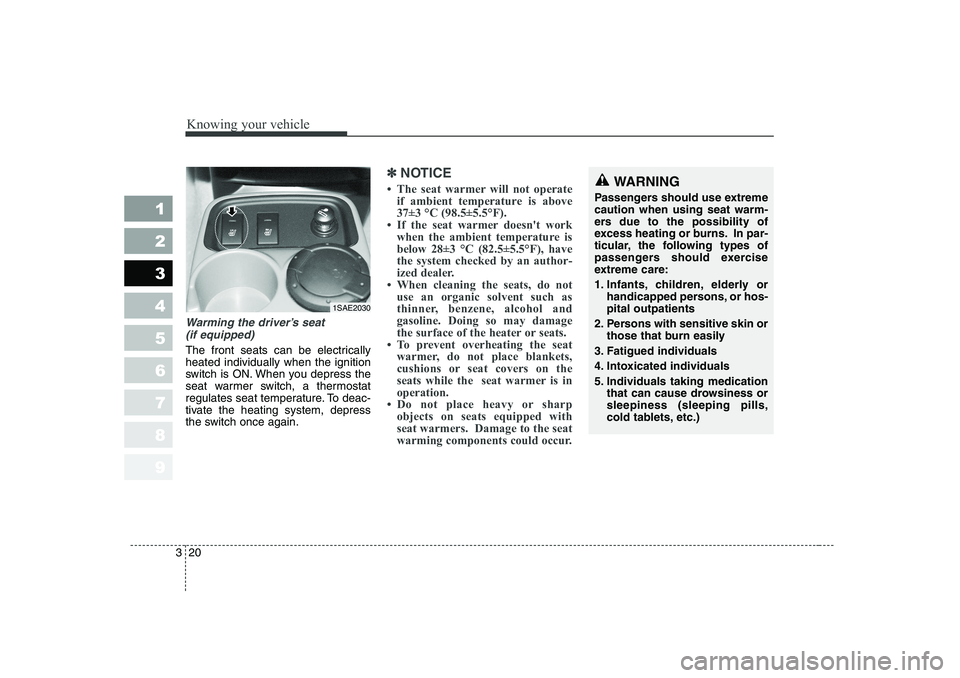
Warming the driver’s seat
(if equipped)
The front seats can be electrically heated individually when the ignition
switch is ON. When you depress the
seat warmer switch, a thermostat
regulates seat temperature. To deac-
tivate the heating system, depress
the switch once again.
✽✽ NOTICE
Page 34 of 281
Knowing your vehicle
24
3
1 23456789
Warming the front passenger
seats (if equipped)
The front seats can be electrically heated individually when the ignition
switch is ON.
When you depress the seat warmer
switch, a thermostat regulates seat
temperature. To deactivate the heat-
ing system, depress the switch onceagain.
✽✽ NOTICE
Page 43 of 281

333
1 23456789
Knowing your vehicle
WARNING
To obtain maximum benefit from a pre-tensioner seat belt:
The seat belt must be worn correctly.
The seat belt must be adjusted to the correct position.CAUTION
When the pre-tensioner seat
belts are activated, a loud noise may be heard and fine dust,which may appear to be smoke,may be visible in the passenger compartment and are not toxic.
Although, it is harmless, the finedust may cause skin irritationand should not be breathed forprolonged periods. Wash your hands and face thoroughly afteran accident in which the airbagsand/or pre-tensioner seat belts were activated.
CAUTION
Because the sensor that acti- vates the SRS airbag is con-nected with pre-tensioner seatbelt, the SRS airbag warninglight on the instrument panel will blink or illuminate forapproximately 6 seconds afterthe ignition key has beenturned to the “ON” position, then the light should go off.
If the pre-tensioner seat belt is not working properly, thiswarning light will illuminateeven if there is no malfunction of SRS airbag system. If theSRS airbag warning light doesnot illuminate when the igni- tion key is turned to “ON” , orif it remains illuminated afterblinking or illuminating for approximately 6 seconds, or ifit illuminates while the vehicleis being driven, please have an authorized Kia dealerinspect the pre-tensioner seatbelt or SRS airbag system as soon as possible.
Page 48 of 281

Knowing your vehicle
38
3
1 23456789
Safety belt warning light and
chime
Type A
As a reminder to the driver and pas-
senger, safety belt warning light will
blink for approximately 6 seconds
each time you turn the ignition switchON.
If the driver’s lap/shoulder belt is not
fastened when the key is turned ON,
the safety belt warning light blinks for
approximately 6 seconds.(if equipped) Type B (for Europe)
As a reminder to the driver and pas-
senger, safety belt warning light will
blink or illuminate for approximately 6
seconds each time you turn the igni-
tion switch ON.
If the driver's lap/shoulder belt is not
fastened when the key is turned ON
or if it is disconnected after the key is
turn ON, the safety belt warning light
will blink or illuminate until the belt is
fastened.
If the driver's lap/shoulder belt is not
fastened when the key is turned ON
and you drive over 9km/h, the safety
belt warning chime will sound for
approximately 100 seconds after the
warning light blinks for approximately
one minute.
If the driver's lap/shoulder belt is dis-
connected after the key is turn ON
and you drive over 9km/h, the safety
belt warning chime will sound for
approximately 100 seconds.
But, if the driver's lap/shoulder belt is connected and disconnected twice
within 9 seconds after the belt is fas-
tened, the safety belt warning light
and chime will not operate.Type C
If the driver's lap/shoulder belt is not
fastened when the key is turned ON
or if it is disconnected after the key is
turn ON, the safety belt warning light
illuminates until the belt is fastened.
1GQA2083
Page 68 of 281

Knowing your vehicle
58
3
1 23456789
Airbag system components
The main components of your SRS are:
To indicate that your vehicle is
equipped with airbags, the corre-
sponding airbag covers are
marked with “SRS AIRBAG”.
- Driver’s airbag
- Passenger’s airbag- Side airbag
A diagnostic system that continual- ly monitors the system operation.
An indicator light to warn you of a possible problem with the system.
Driver’s airbag (if equipped)
The driver’s airbag is stored in the
center of the steering wheel.(Continued)They will generally not provide
protection in side impacts
(vehicles not equipped with
side airbags) or rear impacts,
rollovers, less severe frontal
collisions. They will not pro-
vide protection from later
impacts in a multi-impact colli-sion.
If your vehicle has been sub- jected to flood conditions (e.g.soaked carpeting/standingwater on the floor of the vehi-
cle, etc.) or if your vehicle has
become flood damaged in any
way, do not attempt to start
the vehicle or put the key in
the ignition before discon-
necting the battery. This may
cause airbag deployment,
which could result in serious
personal injury or death. Ifflooded conditions are sub-
jected to your vehicle, before
starting the vehicle, have the
vehicle towed to an authorized
Kia dealer for inspection and
necessary repairs.
HLZ206
1SAA2048
Page 71 of 281

361
1 23456789
Knowing your vehicle
WARNING
The front seat passenger’s airbag is much larger than the
steering wheel airbag and
inflates with considerably
more force. It can seriously
hurt or kill a passenger who is
not in the proper position and
wearing the safety belt proper-
ly. The front passengers
should always move their seat
as far back as practical and sit
back in their seat.
It is essential that the front passengers always wear their
safety belts, even when the
vehicle is moving in a parking
lot or up a driveway into
garage. (Continued)(Continued)
Even though your vehicle isequipped with the front pas-
senger's air bag ON/OFF
switch, do not install a child
restraint system in the front
passenger's seat. A child
restraint system must never
be placed in the front seat.
Children who are too large for
child restraint systems should
always occupy the rear seat
and use the available
lap/shoulder belts. Children
are afforded the most safety in
the event of an accident when
they are restrained by a prop-er restraint system in the rearseat.
As soon as the child seat is no longer needed on the front
passenger's seat, reactivate
the front passenger's air bag.WARNING
The driver is responsible for the proper position of the
front passenger’s air bag
ON/OFF switch.
Deactivate the front passen- ger's air bag only when the
ignition switch is switched off,
or the malfunction may occur
in the SRS Control Module.
And there may be a danger
that the driver's and/or front
passenger’s and/or side and
curtain air bag may fail to trig-
ger, or not trigger correctlyduring a collision.
Never install a rearward facing child seat on the front passen-
ger's seat unless the front
passenger's air bag has been
deactivated. The infant or child
could be severely injured or
killed by an air bag deploy-ment in case of an accident. (Continued)