Page 85 of 225

MANUAL TRANSAXLEMANUAL TRANSAXLE
OPERATIONThe shift pattern is conventional for five
forward gears, as shown below.Press the clutch pedal down fully while
shifting, then release it slowly.
A special safety feature prevents
inadvertent shifting from 5 (Fifth) to R
(Reverse). The gearshift lever must be
returned to the Neutral position before
shifting into R (Reverse).
DRIVING YOUR VEHICLE
4-6
1
24
R 3
S
N
135
R 4 2
MMSA4002
✻
NOTICE
Make sure the vehicle is completely
stopped before shifting into R
(Reverse).✻
NOTICE
To avoid premature clutch wear
and damage, do not drive with your
foot resting on the clutch pedal.
Also, don’t use the clutch to hold
the vehicle stopped on an upgrade
(while waiting for a traffic light,
etc).
WARNING - Manual
Transaxle
Before leaving the driver’s seat,
always set the parking brake
fully and shut the engine off,
then make sure the transaxle is
shifted into 1st gear.
Unexpected and sudden vehicle
movement can occur if these
precautions are not followed in
the order identified.
MS-CNA-Eng 4(~39).QXD 7/25/2005 5:16 PM Page 6
Page 87 of 225
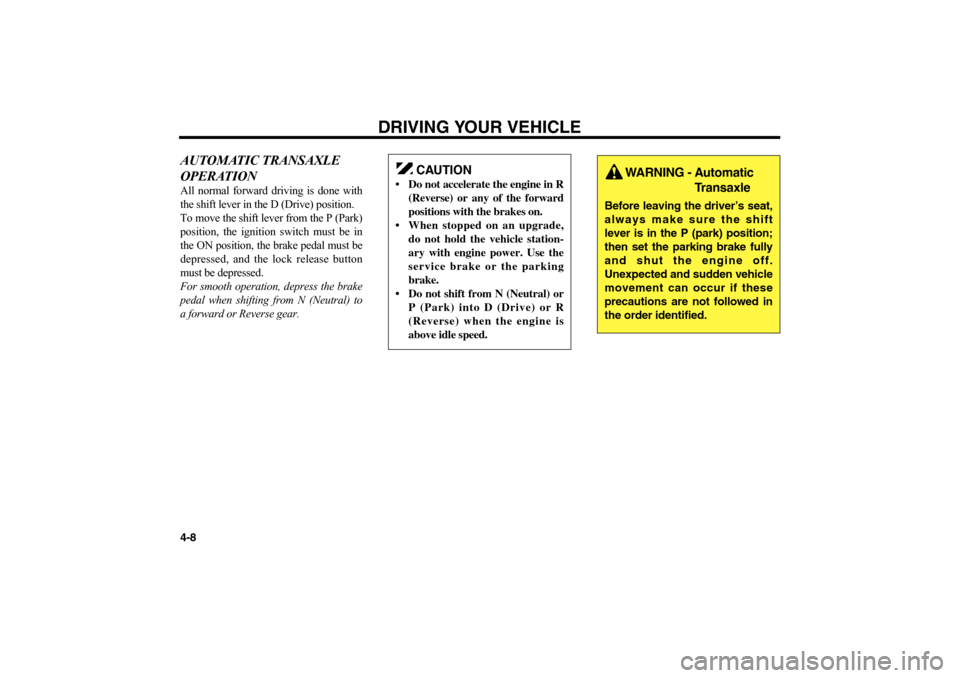
AUTOMATIC TRANSAXLE
OPERATIONAll normal forward driving is done with
the shift lever in the D (Drive) position.
To move the shift lever from the P (Park)
position, the ignition switch must be in
the ON position, the brake pedal must be
depressed, and the lock release button
must be depressed.
For smooth operation, depress the brake
pedal when shifting from N (Neutral) to
a forward or Reverse gear.
DRIVING YOUR VEHICLE
4-8
CAUTION
• Do not accelerate the engine in R
(Reverse) or any of the forward
positions with the brakes on.
When stopped on an upgrade,
do not hold the vehicle station-
ary with engine power. Use the
service brake or the parking
brake.
Do not shift from N (Neutral) or
P (Park) into D (Drive) or R
(Reverse) when the engine is
above idle speed.
WARNING - Automatic
Transaxle
Before leaving the driver’s seat,
always make sure the shift
lever is in the P (park) position;
then set the parking brake fully
and shut the engine off.
Unexpected and sudden vehicle
movement can occur if these
precautions are not followed in
the order identified.
MS-CNA-Eng 4(~39).QXD 7/25/2005 5:16 PM Page 8
Page 88 of 225

NORMAL OPERATIONP (Park)This position locks the transaxle and
prevents the front wheels from rotating.
Always come to a complete stop before
shifting into this position.
R (Reverse)Use this position to drive the vehicle
backward.N (Neutral)In this position, the wheels and transaxle
are not locked. The vehicle will roll
freely even on the slightest incline unless
the parking brake or service brakes are
applied.D (Drive)This is the normal forward driving
position. The transaxle will auto-
matically shift through a four-gear
sequence, providing the best fuel
economy and power.
4-9
WARNING
Shifting into P (Park) while the
vehicle is in motion will cause
the front wheels to lock and you
will lose driving control of the
vehicle.✻
NOTICE
The transaxle may be damaged if
you shift into P (Park) while the
vehicle is in motion.
WARNING
Do not use the P (Park)
position in place of the
parking brake when leaving
the vehicle. Always make
sure the shift lever is latched
in the P (Park) position so
that it cannot be moved
unless the lock release
button is pushed in AND the
parking brake is fully set.
Turn the ignition switch OFF
whenever you leave the
vehicle unattended. Never
leave the vehicle unattended
while the engine is running.
Unexpected and sudden
vehicle movement may occur
if these precautions are not
taken.
Never leave a child
unattended in a vehicle.
CAUTION
Always come to a complete stop
before shifting into or out of R
(Reverse). You may damage the
transaxle if you shift into R while
the vehicle is in motion, except as
explained in “Rocking the Vehicle”.
MS-CNA-Eng 4(~39).QXD 7/25/2005 5:16 PM Page 9
Page 91 of 225

BRAKE SYSTEMPOWER BRAKESYour vehicle has power-assisted brakes
that adjust automatically through normal
usage.
In the event that brake system power
assist is lost because of a stalled engine
or some other reason, you can still stop
your vehicle by applying greater force to
the brake pedal than you normally
would. The stopping distance, however,
will be longer than usual.
When the engine is not running, the
reserve brake power is partially depleted
each time the brake pedal is depressed.
Do not pump the brake pedal when the
power assist has been interrupted, except
when necessary to maintain steering
control on slippery surfaces.
ANTI LOCK BRAKES (ABS)
(IF EQUIPPED)The anti-lock brake system is designed
to prevent lock-up of the wheels during
sudden braking or braking on slippery
surfaces. Compared to a conventional
brake system, the anti-lock brake system
provides greater steering control during
braking in such situations.DRIVING YOUR VEHICLE
4-12
WARNING - ABS Brakes
The anti-lock brake system
(ABS) cannot compensate for
bad road conditions, for
unsafe or reckless driving or
for bad judgement.
The ABS is designed to
improve maximum braking
effectiveness on typical
highways and roads in good
condition.
On road surfaces which are
in poor condition, the ABS
may actually reduce braking
effectiveness.
Always operate your vehicle
at reasonable speeds that are
safe for weather and traffic
conditions.
MS-CNA-Eng 4(~39).QXD 7/25/2005 5:16 PM Page 12
Page 92 of 225

During normal driving conditions, the
anti-lock brake system operates the same
as a conventional brake system. When
the anti-lock brake system is engaged
due to imminent loss of traction, a
pulsation of the brake pedal will result
and you may hear or feel “chattering”.
This is a normal condition and indicates
the system is functioning properly.
When driving a vehicle equipped with
anti-lock brakes, adjust your driving
according to the road and traffic conditions
and keep the following in mind.
• Do not pump the brakes as you would
when driving a vehicle not equipped
with an anti-lock brake system (ABS).
In order for the ABS to function
normally, press the brake pedal firmly,
without pumping the pedal.
• Even with the anti-lock brake system,
your vehicle still requires a sufficient
stopping distance. Always maintain a
safe distance from the vehicle in
front of you.• Always slow down when cornering.
The anti-lock brake system cannot
prevent accidents resulting from
excessive speeds.
• On loose or uneven road surfaces,
operation of the anti-lock brake
system may result in a longer stopping
distance than for vehicles equipped
with a conventional brake system.
• Avoid high speeds on wet roads. The
anti-lock brake system cannot
eliminate the risk of hydroplaning.
If the anti-lock brake system should fail,
the brake system will function as a
conventional brake system. Have your
vehicle checked by an Authorized Kia
Dealer as soon as possible.
4-13
✻
NOTICE
• If the ABS warning light is on
and stays on, you may have a
problem with the ABS system.
In this case, however, your regu-
lar brakes will work normally.
• The ABS warning light will stay
on for 2-3 seconds after the igni-
tion “ON”. During that time, the
ABS will go through self-diagno-
sis and the light will go off if
everything is normal. If the light
stays on you may have a problem
with your ABS.
Contact an Authorized Kia
Dealer for service as soon as pos-
sible.
MS-CNA-Eng 4(~39).QXD 7/25/2005 5:16 PM Page 13
Page 93 of 225

IN THE EVENT OF BRAKE
FAILUREIf the service brakes should fail to operate
while the vehicle is in motion, you can
make an emergency stop with the parking
brake. The stopping distance, however,
will be much greater than normal.DRIVING YOUR VEHICLE
4-14✻
NOTICE
• If the battery is discharged and
the engine is jump started, the
ABS warning light may come on.
This condition occurs because of
a discharged battery and not
because there is an anti-lock
brake system malfunction.
• Have the battery recharged
before driving the vehicle.
WARNING -
Parking Brake
Pulling on the parking brake
while the vehicle is moving at
normal speed can cause a
sudden loss of control of the
vehicle. If you must use the
parking brake to stop the
vehicle, use great caution in
applying the brake.
WARNING
Do not drive with your foot
resting on the brake pedal.
This will create abnormally
high brake temperatures,
excessive brake lining and
pad wear, and increased
stopping distances.
When descending a long or
steep hill, shift to a lower gear
and avoid continuous applica-
tion of the brakes.
Continuous brake application
will cause the brakes to
overheat and could result in a
temporary loss of braking
performance.
MS-CNA-Eng 4(~39).QXD 7/25/2005 5:16 PM Page 14
Page 94 of 225

DISC BRAKE WEAR
INDICATORSYour vehicle has front disc brakes.
When your front brake pads are worn
and it’s time for new pads, you will hear
a high-pitched warning sound from your
front brakes. You may hear this sound
intermittently or constantly.Some driving conditions or climates may
cause a brake squeal when you first
apply, or lightly apply, the brakes. This
is normal and does not indicate a
problem with your brakes.
4-15
Wet brakes may result in the
vehicle not slowing down at
the usual rate and/or
pulling to one side when the
brakes are applied. Applying
the brakes lightly will
indicate whether they have
been affected in this way.
Always test your brakes in
this fashion after driving
through deep water.
To dry the brakes, apply
them lightly while
maintaining a safe forward
speed until brake
performance returns to
normal.
WARNING - Brake Wear
This brake-wear warning sound
means your vehicle needs
service. If you ignore this
audible warning, you will
eventually lose braking
performance, which could lead
to a serious accident.
✻
NOTICE
To avoid costly brake repairs, do not
continue to drive with worn brake
pads.
MS-CNA-Eng 4(~39).QXD 7/25/2005 5:16 PM Page 15
Page 96 of 225

Check the brake warning light each time
you start the engine. The light is located
in the instrument panel. This warning
light will be illuminated when the engine
is running and the parking brake is set.
Before driving, be sure the parking brake
is fully released and the brake warning
light is off.
If the brake warning light remains on
after the parking brake is released, there
may be a malfunction in the brake
system. Immediate attention is
necessary.
If at all possible, cease driving the
vehicle immediately. If that is not
possible, use extreme caution in
operating the vehicle and only drive it
until you reach the first safe location or a
repair shop.
4-17
AN7B04014
CAUTION
When stopped, do not use the
gearshift lever in place of the park-
ing brake. Always set the parking
brake fully AND make sure the
gearshift lever is securely positioned
in P (Park) with an automatic
transaxle or in 1st (First) or R
(Reverse) gear with a manual
transaxle.
MS-CNA-Eng 4(~39).QXD 7/25/2005 5:16 PM Page 17