Page 277 of 315
Maintenance
32
7
FUEL FILTER (FOR DIESEL)
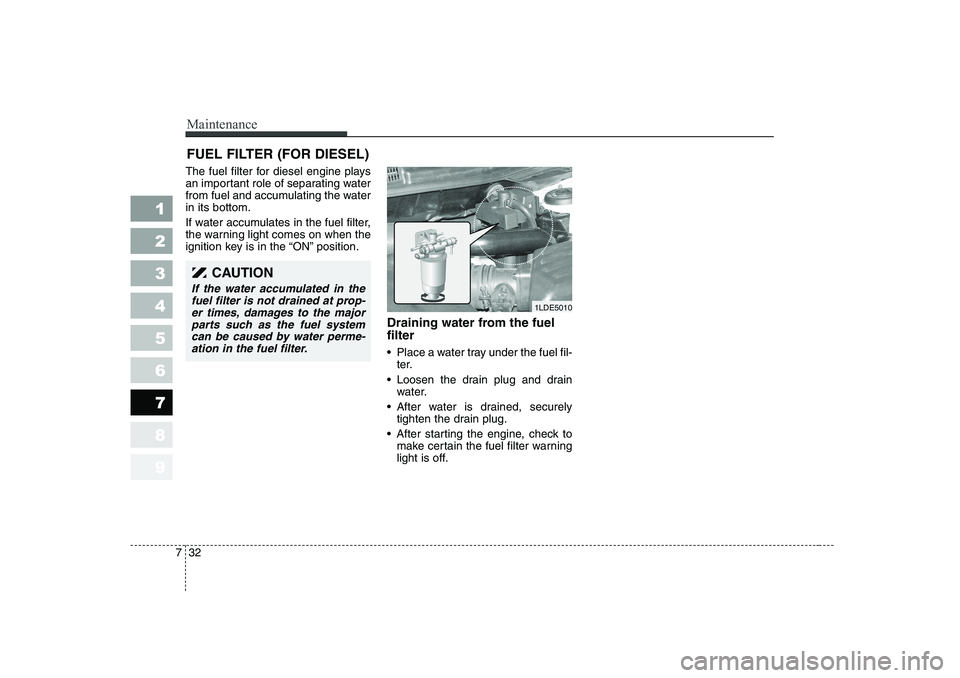
The fuel filter for diesel engine plays
an important role of separating water
from fuel and accumulating the waterin its bottom.
If water accumulates in the fuel filter,
the warning light comes on when the
ignition key is in the “ON” position.
Draining water from the fuel filter
Place a water tray under the fuel fil-ter.
Loosen the drain plug and drain water.
After water is drained, securely tighten the drain plug.
After starting the engine, check to make certain the fuel filter warning
light is off.
1 23456789
1LDE5010
CAUTION
If the water accumulated in the
fuel filter is not drained at prop-er times, damages to the majorparts such as the fuel system can be caused by water perme-ation in the fuel filter.
Page 279 of 315
Maintenance
34
7
1 23456789
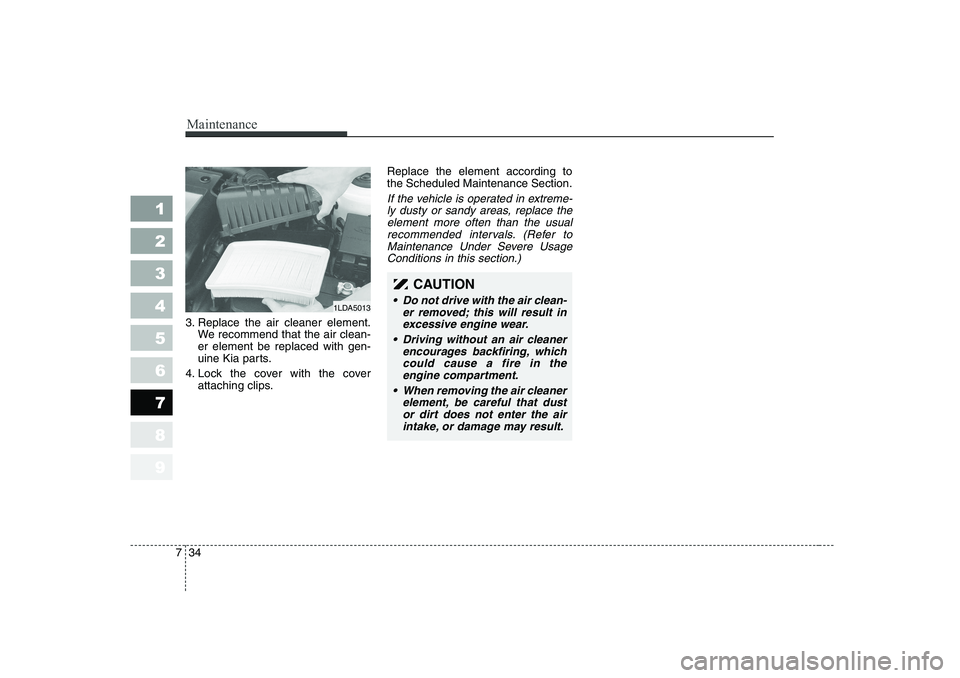
3. Replace the air cleaner element.
We recommend that the air clean- er element be replaced with gen-
uine Kia parts.
4. Lock the cover with the cover attaching clips. Replace the element according tothe Scheduled Maintenance Section.
If the vehicle is operated in extreme-
ly dusty or sandy areas, replace theelement more often than the usualrecommended intervals. (Refer to Maintenance Under Severe UsageConditions in this section.)
1LDA5013
CAUTION
Do not drive with the air clean- er removed; this will result inexcessive engine wear.
Driving without an air cleaner encourages backfiring, whichcould cause a fire in theengine compartment.
When removing the air cleaner element, be careful that dustor dirt does not enter the air intake, or damage may result.
Page 284 of 315
739
Maintenance
1 23456789
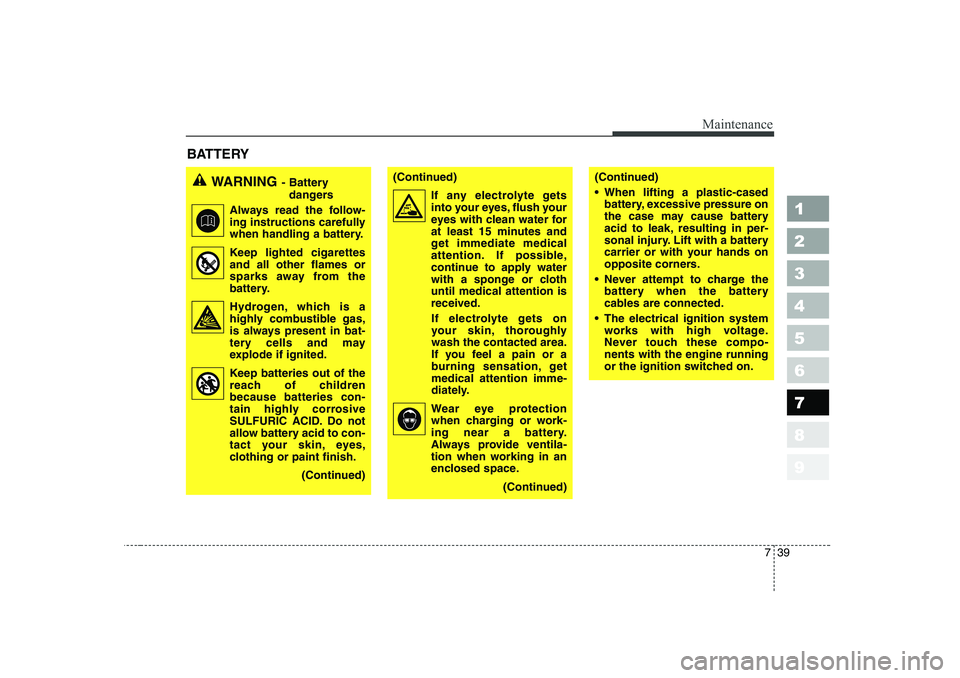
BATTERY
WARNING- Battery
dangers
Always read the follow-
ing instructions carefully
when handling a battery.
Keep lighted cigarettes and all other flames or
sparks away from the
battery.
Hydrogen, which is a highly combustible gas,
is always present in bat-
tery cells and may
explode if ignited.
Keep batteries out of the reach of children because batteries con-
tain highly corrosive
SULFURIC ACID. Do not
allow battery acid to con-
tact your skin, eyes,
clothing or paint finish.
(Continued)(Continued)If any electrolyte getsinto your eyes, flush your
eyes with clean water for
at least 15 minutes and
get immediate medical
attention. If possible,
continue to apply water
with a sponge or clothuntil medical attention isreceived.
If electrolyte gets on
your skin, thoroughlywash the contacted area.
If you feel a pain or a
burning sensation, getmedical attention imme-
diately.
Wear eye protection when charging or work-
ing near a battery.
Always provide ventila-
tion when working in an
enclosed space.
(Continued)(Continued)
When lifting a plastic-casedbattery, excessive pressure on
the case may cause battery
acid to leak, resulting in per-
sonal injury. Lift with a battery
carrier or with your hands on
opposite corners.
Never attempt to charge the battery when the battery
cables are connected.
The electrical ignition system works with high voltage.
Never touch these compo-nents with the engine running
or the ignition switched on.
Page 301 of 315
Maintenance
56
7
1 23456789
LUBRICANT SPECIFICATIONS
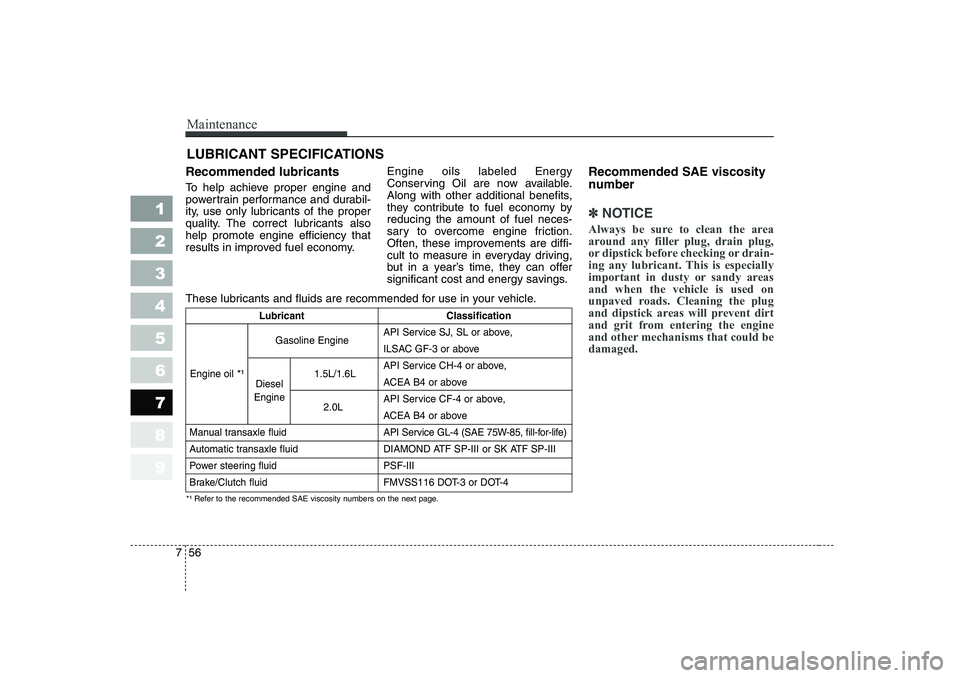
Recommended lubricants
To help achieve proper engine and
powertrain performance and durabil-
ity, use only lubricants of the proper
quality. The correct lubricants alsohelp promote engine efficiency that
results in improved fuel economy. Engine oils labeled Energy
Conserving Oil are now available.
Along with other additional benefits,
they contribute to fuel economy byreducing the amount of fuel neces-
sary to overcome engine friction.
Often, these improvements are diffi-
cult to measure in everyday driving,
but in a year’s time, they can offer
significant cost and energy savings.Recommended SAE viscosity
number
✽✽
NOTICE
Always be sure to clean the area
around any filler plug, drain plug,
or dipstick before checking or drain-
ing any lubricant. This is especially
important in dusty or sandy areasand when the vehicle is used on
unpaved roads. Cleaning the plug
and dipstick areas will prevent dirt
and grit from entering the engine
and other mechanisms that could bedamaged.
*¹ Refer to the recommended SAE viscosity numbers on the next page.
These lubricants and fluids are recommended for use in your vehicle.
Lubricant Classification
API Service SJ, SL or above, ILSAC GF-3 or above
1.5L/1.6L API Service CH-4 or above,
ACEA B4 or above
2.0L API Service CF-4 or above,
ACEA B4 or above
Manual transaxle fluid API Service GL-4 (SAE 75W-85, fill-for-life)
Automatic transaxle fluid DIAMOND ATF SP-III or SK ATF SP-III
Power steering fluid PSF-III
Brake/Clutch fluid FMVSS116 DOT-3 or DOT-4
Engine oil *¹
Gasoline Engine
Diesel
Engine
Page 302 of 315
757
Maintenance
1 23456789
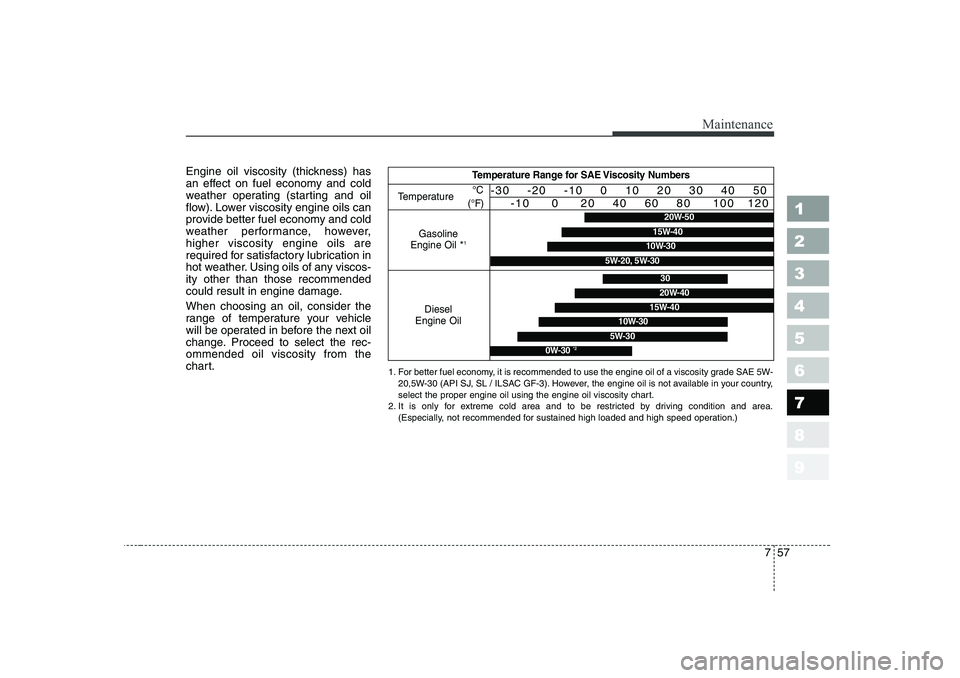
Engine oil viscosity (thickness) has
an effect on fuel economy and cold
weather operating (starting and oil
flow). Lower viscosity engine oils can
provide better fuel economy and cold
weather performance, however,higher viscosity engine oils are
required for satisfactory lubrication in
hot weather. Using oils of any viscos-ity other than those recommended
could result in engine damage. When choosing an oil, consider the
range of temperature your vehicle
will be operated in before the next oil
change. Proceed to select the rec-ommended oil viscosity from the
chart.Temperature Range for SAE Viscosity Numbers
TemperatureGasoline
Engine Oil *
1
°C
(°F)-30 -20 -10 0 10 20 30 40 50 -10 0 20 40 60 80 100 120
Diesel
Engine Oil
10W-30
30
20W-40
15W-40
0W-30 *2
5W-30
1. For better fuel economy, it is recommended to use the engine oil of a viscosity grade SAE 5W-
20,5W-30 (API SJ, SL / ILSAC GF-3). However, the engine oil is not available in your country,
select the proper engine oil using the engine oil viscosity chart.
2. It is only for extreme cold area and to be restricted by driving condition and area. (Especially, not recommended for sustained high loaded and high speed operation.)
20W-50
10W-30
15W-40
5W-20, 5W-30
Page 303 of 315
Maintenance
58
7
1 23456789
EXTERIOR CARE
Exterior general caution
It is very important to follow the label
directions when using any chemical
cleaner or polish. Read all warningand caution statements that appearon the label. Finish maintenance
Washing
To help protect your vehicle’s finish
from rust and deterioration, wash itthoroughly and frequently at least
once a month with lukewarm or cold
water.
If you use your vehicle for off-road
driving, you should wash it after each
off-road trip. Pay special attention to
the removal of any accumulation of
salt, dirt, mud, and other foreign
materials. Make sure the drain holes
in the lower edges of the doors and
rocker panels are kept clear andclean. Insects, tar, tree sap, bird droppings,
industrial pollution and similar
deposits can damage your vehicle’s
finish if not removed immediately.
Even prompt washing with plain
water may not completely remove all
these deposits. A mild soap, safe for
use on painted surfaces, may beused.
After washing, rinse the vehicle thor-
oughly with lukewarm or cold water.
Do not allow soap to dry on the fin-ish.
✽✽
NOTICE
Do not use strong soap, chemical
detergents or hot water, and do not
wash the vehicle in direct sunlight orwhen the body of the vehicle iswarm.
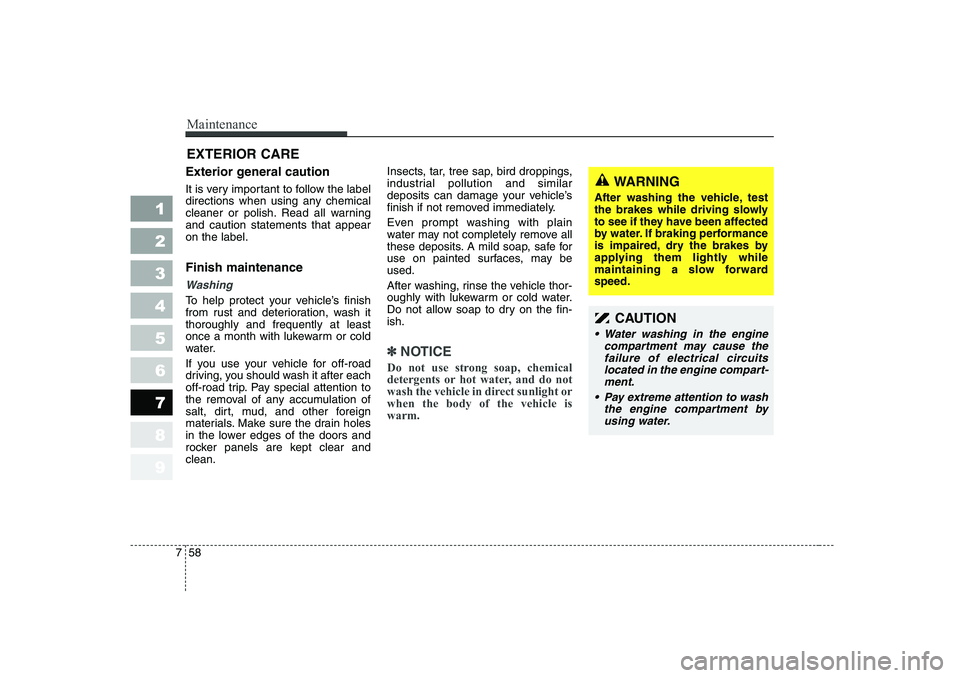
CAUTION
Water washing in the engine compartment may cause thefailure of electrical circuitslocated in the engine compart- ment.
Pay extreme attention to wash the engine compartment byusing water.
WARNING
After washing the vehicle, test
the brakes while driving slowly
to see if they have been affected
by water. If braking performance
is impaired, dry the brakes by
applying them lightly while
maintaining a slow forwardspeed.
Page 310 of 315
83
1 23456789
Specifications
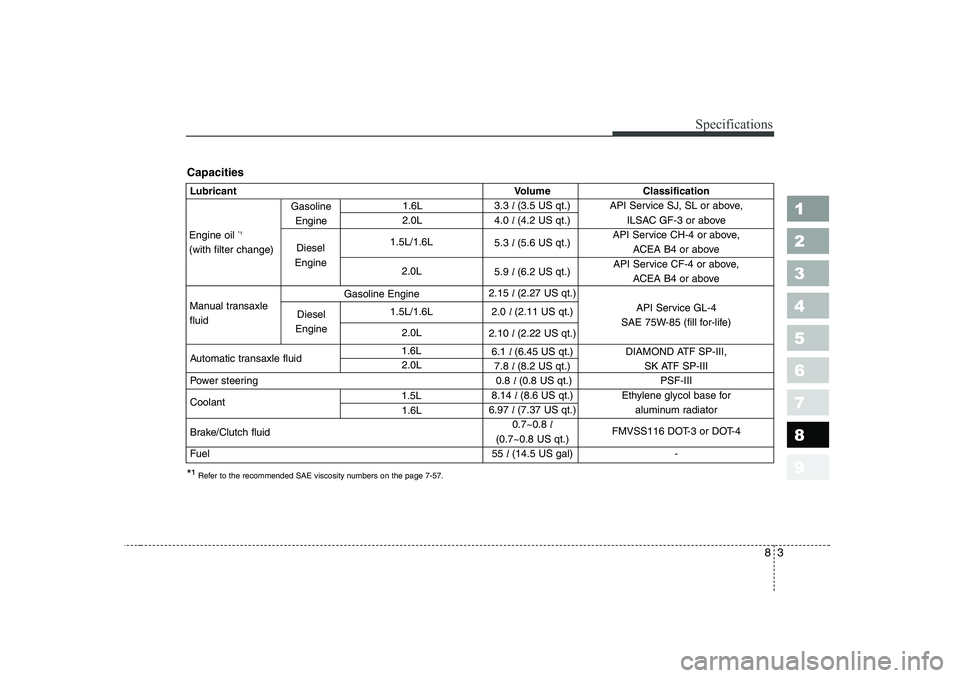
*¹Refer to the recommended SAE viscosity numbers on the page 7-57.
Lubricant Volume Classification
3.3 l (3.5 US qt.) API Service SJ, SL or above,
4.0 l (4.2 US qt.) ILSAC GF-3 or above
5.3 l (5.6 US qt.) API Service CH-4 or above,
ACEA B4 or above
API Service CF-4 or above,
5.9 l (6.2 US qt.)
ACEA B4 or above
2.15 l (2.27 US qt.)
2.0 l (2.11 US qt.) API Service GL-4
2.10 l (2.22 US qt.) SAE 75W-85 (fill for-life)
Automatic transaxle fluid 6.1
l (6.45 US qt.) DIAMOND ATF SP-III,
7.8 l (8.2 US qt.) SK ATF SP-III
Power steering 0.8 l (0.8 US qt.) PSF-III
Coolant 8.14
l (8.6 US qt.) Ethylene glycol base for
6.97 l (7.37 US qt.) aluminum radiator
Brake/Clutch fluid 0.7~0.8
l
FMVSS116 DOT-3 or DOT-4
(0.7~0.8 US qt.)
Fuel 55 l (14.5 US gal) -
Engine oil *1
(with filter change)
Manual transaxle fluid Gasoline
Engine
Gasoline Engine
Diesel
Engine Diesel
Engine 1.6L
2.0L
2.0L
1.5L/1.6L
2.0L
1.5L/1.6L
2.0L
1.6L
1.6L
1.5L
Capacities
Page 311 of 315
Specifications
4
8
1 23456789
Light Bulb 4 Door 5 Door
Headlights (Low/High) 55/60 55/60
Front turn signal lights 21 21
Position lights 5 5
Side repeater lights (if equipped) 5 5
Front fog lights Gasoline Engine 27 51
(if equipped) Diesel Engine 51 Stop and tail lights For Europe
21/5 21/5
Except Europe28/8 28/8
Rear turn signal lights 21 21
Back-up lights 16 16
Rear fog lights (if equipped) 21 21
High mounted stop light 21 or LED* 1
LED*1
License plate lights 5 5
Front map lamp 10 10
Center dome lamp 10 10
Door courtesy lamps 5 5
Trunk room lamp 5 5
Glove box lamp 5 5
Light bulbs
Wattage
*¹ LED : Light-emitting diode