Page 85 of 322
Knowing your vehicle74
3
1
2
3
4
5
6
7
8
910
Why didn’t my air bag go off in
a collision? (Inflation and non-inflation condi-
tions of the air bag)There are many types of accidents in
which the air bag would not be
expected to provide additional pro-
tection.
These include rear impacts, second
or third collisions in multiple impact
accidents, as well as low speed
impacts. In other words, just because
your vehicle is damaged and even if
it is totally unusable, don’t be sur-
prised that the air bags did not
inflate.
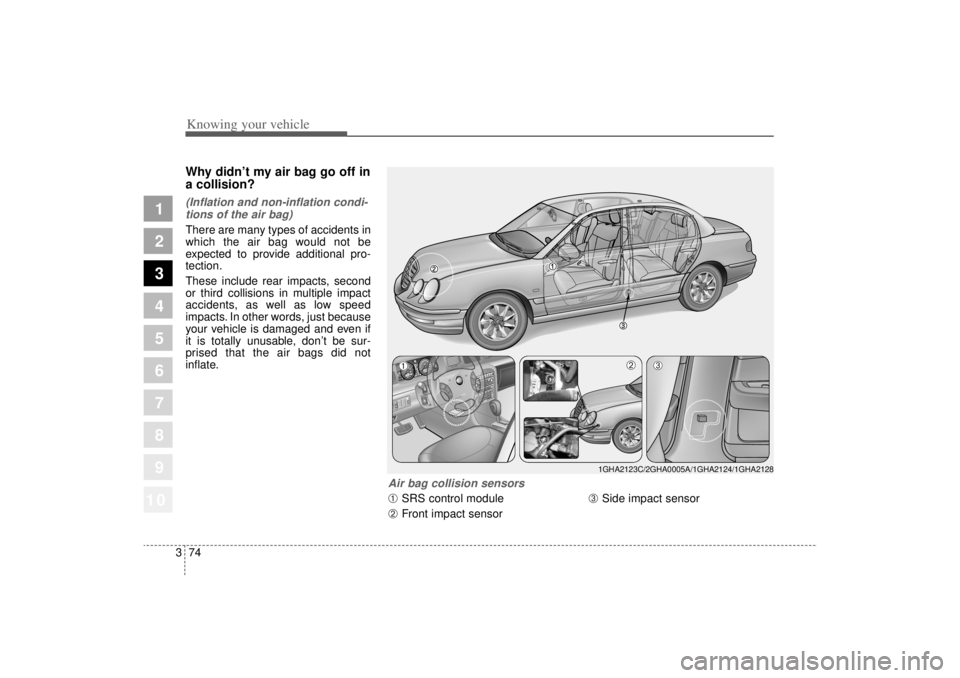
Air bag collision sensors➀
SRS control module
➁
Front impact sensor
➂
Side impact sensor
CRUISEON/OFFCANC EL
COO
ASTSTTCO
ACO
AT SE TETET S
E SRESAC CELAC
CELAC
CELC
CEL
1GHA2123C/2GHA0005A/1GHA2124/1GHA2128
➀
➁
➂
Page 86 of 322
375
1
2
3
4
5
6
7
8
910
Knowing your vehicle
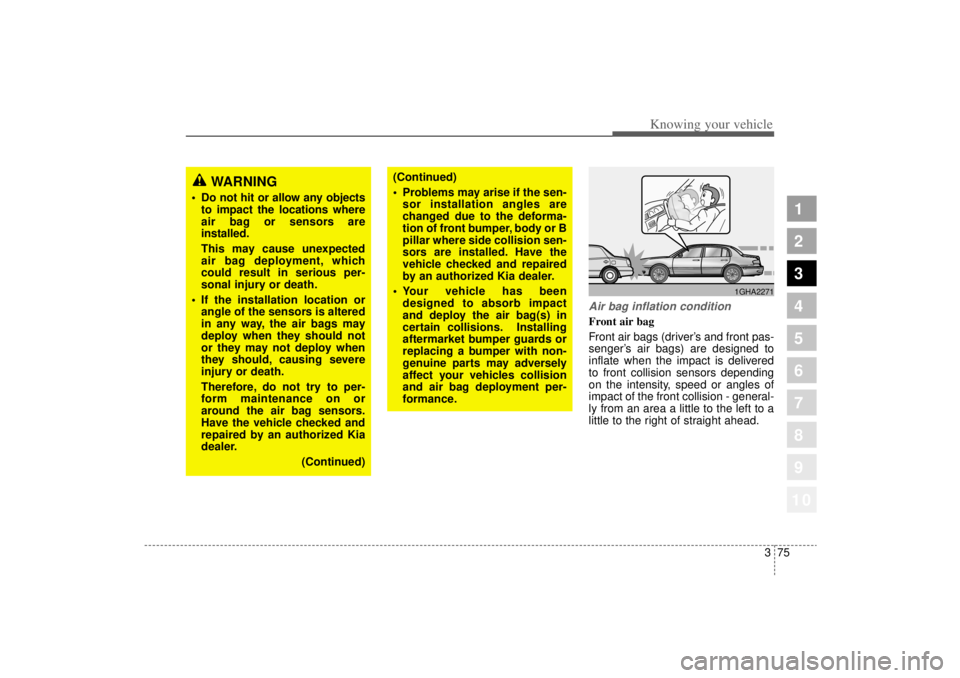
Air bag inflation conditionFront air bag
Front air bags (driver’s and front pas-
senger’ s air bags) are designed to
inflate when the impact is delivered
to front collision sensors depending
on the intensity, speed or angles of
impact of the front collision - general-
ly from an area a little to the left to a
little to the right of straight ahead.
WARNING
Do not hit or allow any objects
to impact the locations where
air bag or sensors are
installed.
This may cause unexpected
air bag deployment, which
could result in serious per-
sonal injury or death.
If the installation location or
angle of the sensors is altered
in any way, the air bags may
deploy when they should not
or they may not deploy when
they should, causing severe
injury or death.
Therefore, do not try to per-
form maintenance on or
around the air bag sensors.
Have the vehicle checked and
repaired by an authorized Kia
dealer.
(Continued)
(Continued)
Problems may arise if the sen-
sor installation angles are
changed due to the deforma-
tion of front bumper, body or B
pillar where side collision sen-
sors are installed. Have the
vehicle checked and repaired
by an authorized Kia dealer.
Your vehicle has been
designed to absorb impact
and deploy the air bag(s) in
certain collisions. Installing
aftermarket bumper guards or
replacing a bumper with non-
genuine parts may adversely
affect your vehicles collision
and air bag deployment per-
formance.
1GHA2271
Page 87 of 322
Knowing your vehicle76
3
1
2
3
4
5
6
7
8
910
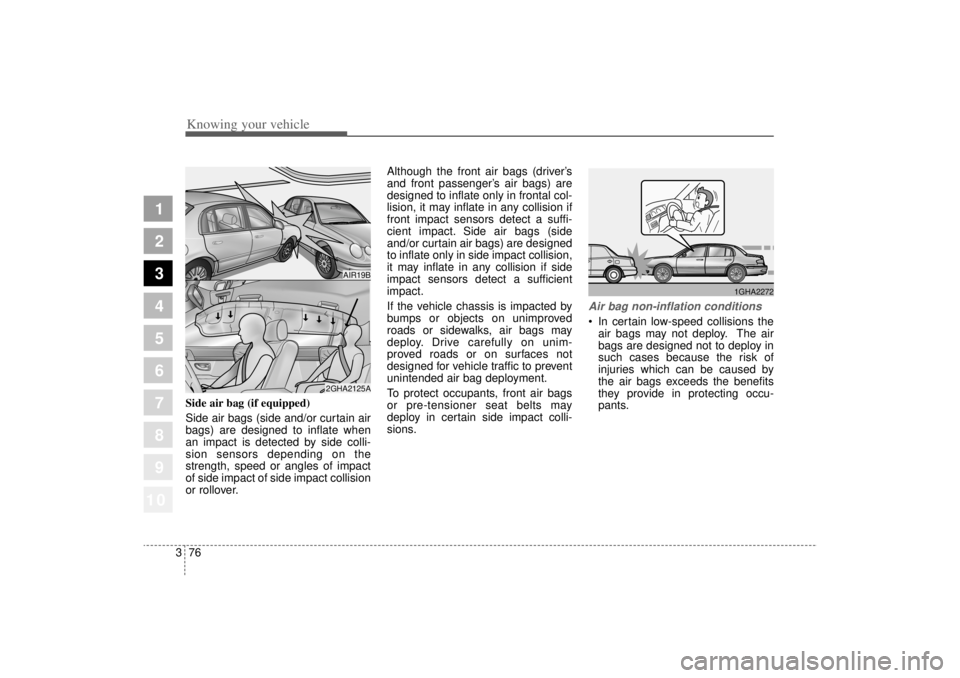
Side air bag (if equipped)
Side air bags (side and/or curtain air
bags) are designed to inflate when
an impact is detected by side colli-
sion sensors depending on the
strength, speed or angles of impact
of side impact of side impact collision
or rollover. Although the front air bags (driver’
s
and front passenger’ s air bags) are
designed to inflate only in frontal col-
lision, it may inflate in any collision if
front impact sensors detect a suffi-
cient impact. Side air bags (side
and/or curtain air bags) are designed
to inflate only in side impact collision,
it may inflate in any collision if side
impact sensors detect a sufficient
impact.
If the vehicle chassis is impacted by
bumps or objects on unimproved
roads or sidewalks, air bags may
deploy. Drive carefully on unim-
proved roads or on surfaces not
designed for vehicle traffic to prevent
unintended air bag deployment.
To protect occupants, front air bags
or pre-tensioner seat belts may
deploy in certain side impact colli-
sions.
Air bag non-inflation conditions In certain low-speed collisions the
air bags may not deploy. The air
bags are designed not to deploy in
such cases because the risk of
injuries which can be caused by
the air bags exceeds the benefits
they provide in protecting occu-
pants.
AIR19B
2GHA2125A
1GHA2272
Page 88 of 322
377
1
2
3
4
5
6
7
8
910
Knowing your vehicle
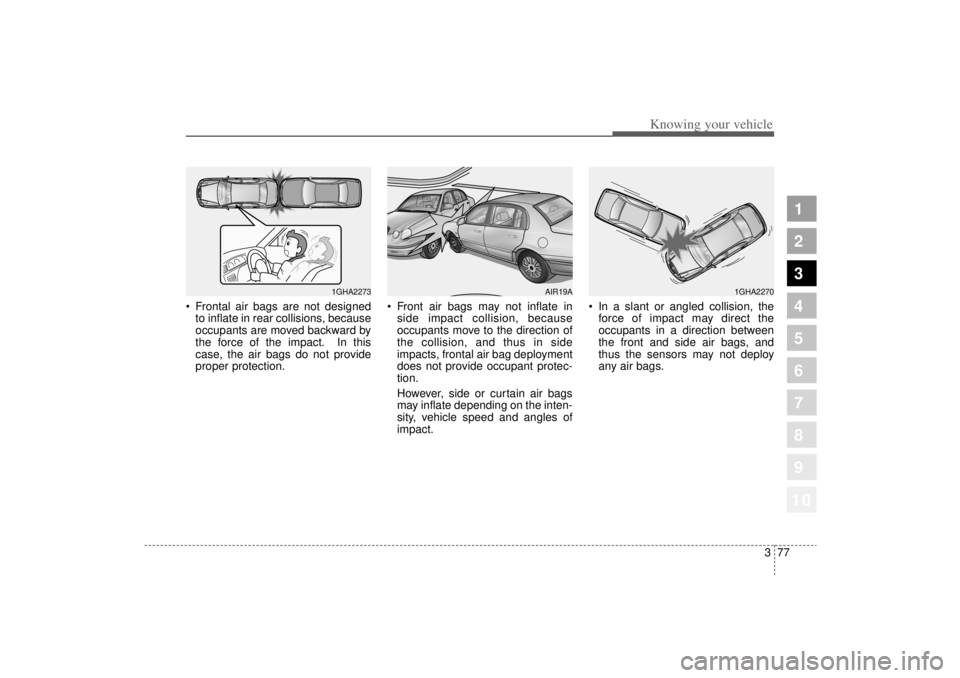
Frontal air bags are not designed
to inflate in rear collisions, because
occupants are moved backward by
the force of the impact. In this
case, the air bags do not provide
proper protection.
Front air bags may not inflate in
side impact collision, because
occupants move to the direction of
the collision, and thus in side
impacts, frontal air bag deployment
does not provide occupant protec-
tion.
However, side or curtain air bags
may inflate depending on the inten-
sity, vehicle speed and angles of
impact.
In a slant or angled collision, the
force of impact may direct the
occupants in a direction between
the front and side air bags, and
thus the sensors may not deploy
any air bags.
1GHA2273
AIR19A
1GHA2270
Page 89 of 322
Knowing your vehicle78
3
1
2
3
4
5
6
7
8
910
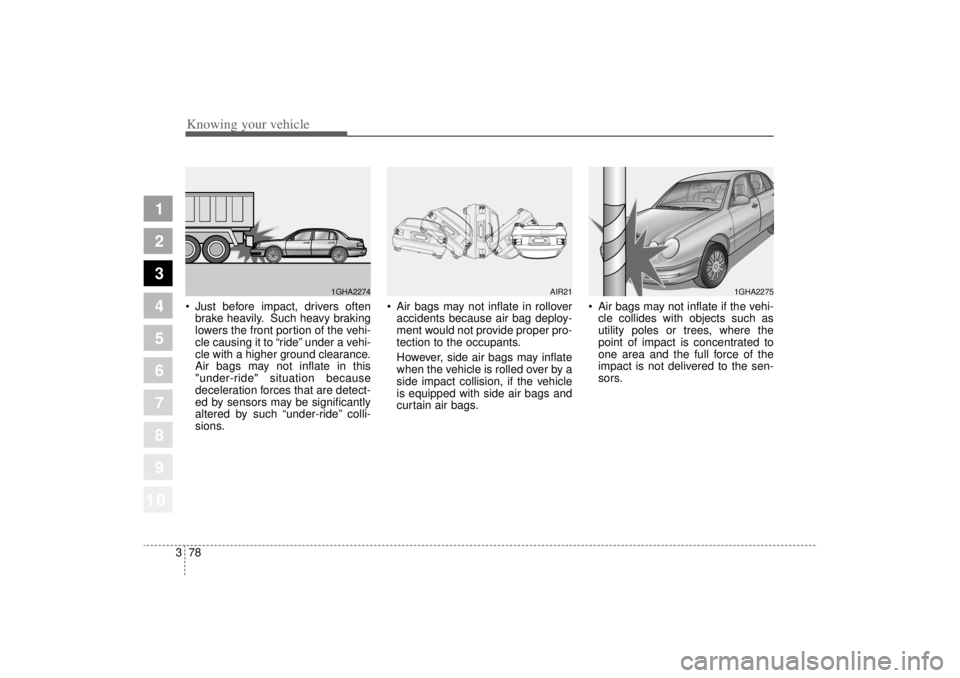
Just before impact, drivers often
brake heavily. Such heavy braking
lowers the front portion of the vehi-
cle causing it to “ride”under a vehi-
cle with a higher ground clearance.
Air bags may not inflate in this
"under-ride" situation because
deceleration forces that are detect-
ed by sensors may be significantly
altered by such “under-ride”colli-
sions.
Air bags may not inflate in rollover
accidents because air bag deploy-
ment would not provide proper pro-
tection to the occupants.
However, side air bags may inflate
when the vehicle is rolled over by a
side impact collision, if the vehicle
is equipped with side air bags and
curtain air bags.
Air bags may not inflate if the vehi-
cle collides with objects such as
utility poles or trees, where the
point of impact is concentrated to
one area and the full force of the
impact is not delivered to the sen-
sors.
1GHA2274
AIR21
1GHA2275
Page 90 of 322

379
1
2
3
4
5
6
7
8
910
Knowing your vehicle
How does the air bag system
operate Air bag only operates when the
ignition switch is turned to the ON
or START positions.
Air bags inflate instantly in the
event of serious frontal or side col-
lision (if equipped with side air bag
or curtain air bag) in order to help
protect the occupants from serious
physical injury.
There is no single speed at which
the air bags will inflate.
Generally, air bags are designed to
inflate by the severity of a collision
and its direction. These two factors
determine whether the sensors
send out an electronic deploy-
ment/inflation signal.
Air bag deployment depends on a
number of factors including vehicle
speed, angles of impact and the
density and stiffness of the vehi-
cles or objects which your vehicle
hits in the collision. However, fac-
tors are not limited to those men-
tioned above.
The front air bags will completely
inflate and deflate in an instant.
It is virtually impossible for you to
see the air bags inflate during an
accident. It is much more likely that
you will simply see the deflated air
bags hanging out of their storage
compartments after the collision.
In order to help provide protection
in a severe collision, the air bags
must inflate rapidly. The speed of
air bag inflation is a consequence
of the extremely short time in which
a collision occurs and the need to
get the air bag between the occu-
pant and the vehicle structures
before the occupant impacts those
structures. This speed of inflation
reduces the risk of serious or life-
threatening injuries in a severe col-
lision and is thus a necessary part
of air bag design.
However, air bag inflation can also
cause injuries which normally can
include facial abrasions, bruises
and broken bones, and sometimes
more serious injuries because that
inflation speed also causes the air
bags to expand with a great deal
force.
There are even circumstances
under which contact with the
steering wheel air bag can cause
fatal injuries, especially if the
occupant is positioned exces-
sively close to the steering
wheel.
Page 91 of 322
Knowing your vehicle80
3
1
2
3
4
5
6
7
8
910
Noise and smokeWhen the air bags inflate, they make
a loud noise and they leave smoke
and powder in the air inside of the
vehicle. This is normal and is a result
of the ignition of the air bag inflator.
After the air bag inflates, you may
feel substantial discomfort in breath-
ing due to the contact of your chest
to both the safety belt and the air
bag, as well as from breathing the
smoke and powder. We strongly
urge you to open your doors
and/or windows as soon as possi-
ble after impact in order to reduce
discomfort and prevent prolonged
exposure to the smoke and pow-
der.
Though smoke and powder are non-
toxic, it may cause irritation to the
skin (eyes, nose and throat etc). If
this is the case, wash and rinse with
the cold water immediately and con-
sult the doctor if the symptom per-
sists.
WARNING -
Seated
positioning
Driver should sit as far back
(at least 10 inches (250 mm)
away) from the steering wheel
air bag as possible to reduce
the risk of injury or death in a
collision. The front passenger
should always move their seat
as far back as possible and sit
back in their seat.
Air bag inflates instantly in an
event of collision, passengers
may be injured by the air bag
expansion force if they are not
in proper position.
Air bag inflation may cause
injuries which normally include
facial or bodily abrasions,
injuries by the broken glasses
or burns by the explosives.
WARNING
When the air bags deploy, the
air bag related parts in steering
wheel and/or instrument panel
and/or in both sides of the roof
rails above the front and rear
doors are very hot. To prevent
injury, do not touch the air bag
storage areas internal compo-
nents immediately after an air
bag has inflated.
Page 92 of 322
381
1
2
3
4
5
6
7
8
910
Knowing your vehicle
Installing a child restraint on a
front passenger’s seat is for-
bidden.Never place a rear-facing child
restraint in the front passenger ’s
seat. If the air bag deploys, it would
impact the rear-facing child restraint,
causing serious or fatal injury.
In addition, do not place front-facing
child restraint in the front passen-
ger ‘s seat either. If the front passen-
ger air bag inflates, it would cause
serious or fatal injuries to the improp-
erly positioned or improperly
restrained child.
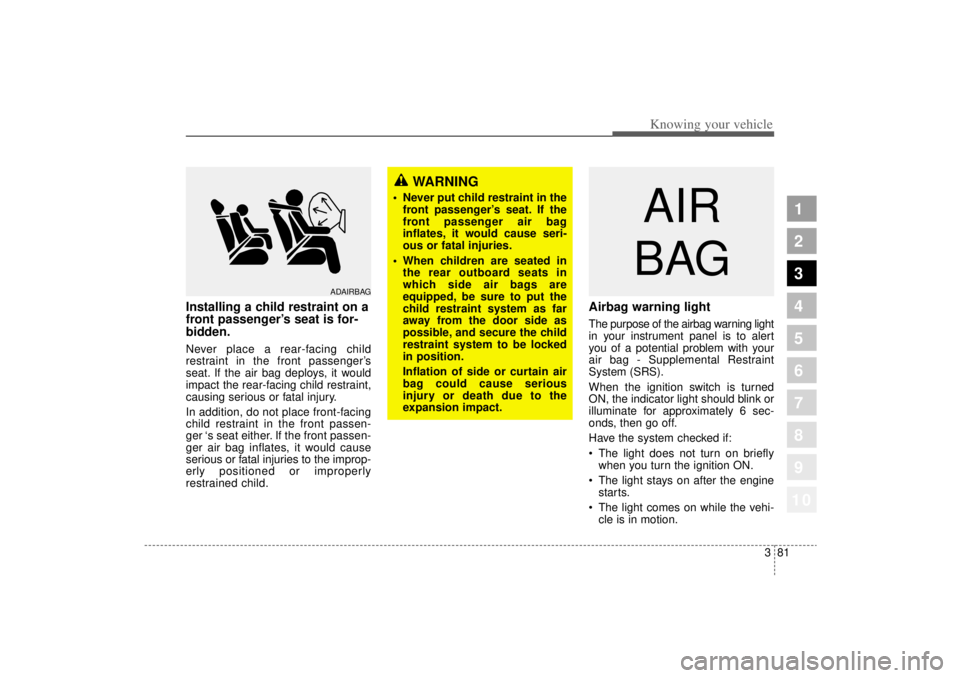
Airbag warning lightThe purpose of the airbag warning light
in your instrument panel is to alert
you of a potential problem with your
air bag - Supplemental Restraint
System (SRS).
When the ignition switch is turned
ON, the indicator light should blink or
illuminate for approximately 6 sec-
onds, then go off.
Have the system checked if:
The light does not turn on briefly
when you turn the ignition ON.
The light stays on after the engine
starts.
The light comes on while the vehi-
cle is in motion.
ADAIRBAG
AIR
BAG
WARNING
Never put child restraint in the
front passenger’ s seat. If the
front passenger air bag
inflates, it would cause seri-
ous or fatal injuries.
When children are seated in
the rear outboard seats in
which side air bags are
equipped, be sure to put the
child restraint system as far
away from the door side as
possible, and secure the child
restraint system to be locked
in position.
Inflation of side or curtain air
bag could cause serious
injury or death due to the
expansion impact.