Page 256 of 322
Maintenance12
7At least monthly: Check coolant level in the coolant
recovery reservoir.
Check the operation of all exterior lights, including the stoplights, turn
signals and hazard warning flash-
ers.
Check the inflation pressures of all tires including the spare.
At least twice a year
(i.e., every Spring and Fall) : Check radiator, heater and air con- ditioning hoses for leaks or da-
mage.
Check windshield washer spray and wiper operation. Clean wiper
blades with clean cloth dampened
with washer fluid.
Check headlight alignment.
Check muffler, exhaust pipes, shields and clamps.
Check the lap/shoulder belts for wear and function.
Check for worn tires and loose wheel lug nuts.
At least once a year : Clean body and door drain holes.
Lubricate door hinges and checks,and hood hinges.
Lubricate door and hood locks and latches.
Lubricate door rubber weather- strips.
Check the air conditioning system before the warm weather season.
Check the power steering fluid level.
Inspect and lubricate automatic transaxle linkage and controls.
Clean battery and terminals.
Check the brake fluid level.
1
2
3
4
5
6
7
8
910
Page 257 of 322
713
Maintenance
Owner maintenance precau-
tions Improper or incomplete service may
result in problems. This section gives
instructions only for the maintenance
items that are easy to perform.
As explained earlier in this section,
several procedures can be done only
by a qualified service technician with
special tools.✽ ✽NOTICEImproper owner maintenance dur-
ing the warranty period may affect
warranty coverage. For details, read
the separate Kia Warranty &
Consumer Information Manual pro-
vided with the vehicle. If you're
unsure about any servicing or main-
tenance procedure, have it done by
an Authorized Kia Dealer.
1
2
3
4
5
6
7
8
910
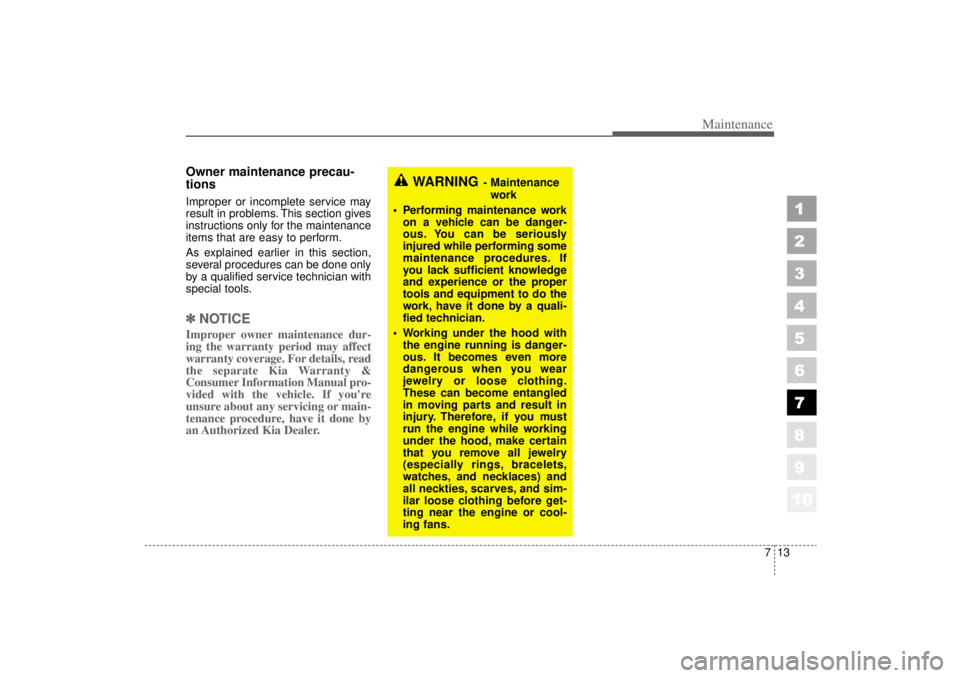
WARNING
- Maintenance
work
Performing maintenance work on a vehicle can be danger-
ous. You can be seriously
injured while performing some
maintenance procedures. If
you lack sufficient knowledge
and experience or the proper
tools and equipment to do the
work, have it done by a quali-
fied technician.
Working under the hood with the engine running is danger-
ous. It becomes even more
dangerous when you wear
jewelry or loose clothing.
These can become entangled
in moving parts and result in
injury. Therefore, if you must
run the engine while working
under the hood, make certain
that you remove all jewelry
(especially rings, bracelets,
watches, and necklaces) and
all neckties, scarves, and sim-
ilar loose clothing before get-
ting near the engine or cool-
ing fans.
Page 258 of 322
Maintenance14
7
1
2
3
4
5
6
7
8
910
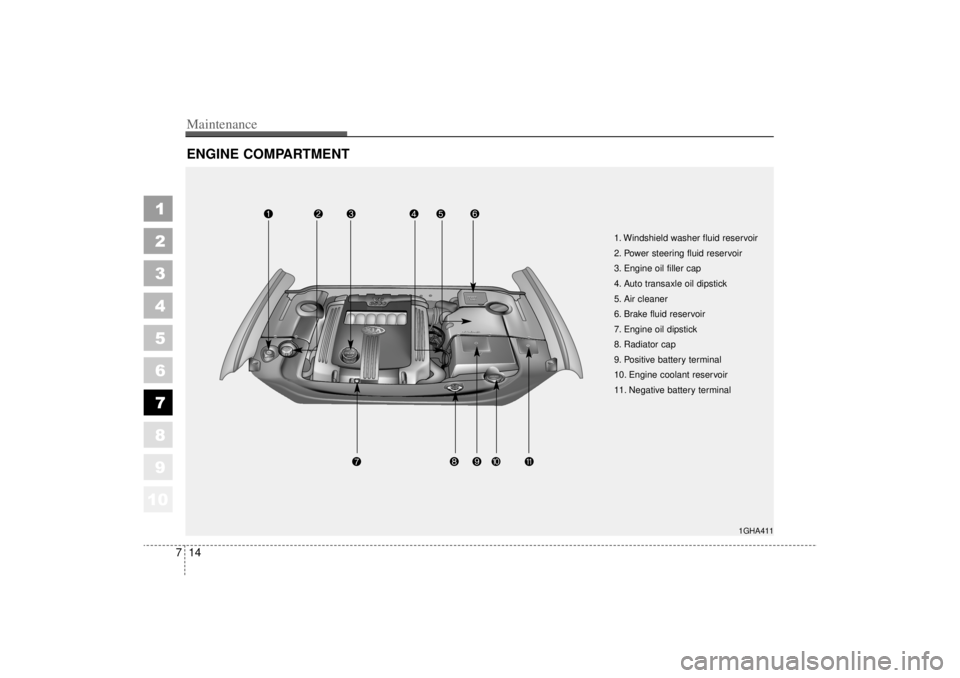
ENGINE COMPARTMENT
1GHA411
1. Windshield washer fluid reservoir
2. Power steering fluid reservoir
3. Engine oil filler cap
4. Auto transaxle oil dipstick
5. Air cleaner
6. Brake fluid reservoir
7. Engine oil dipstick
8. Radiator cap
9. Positive battery terminal
10. Engine coolant reservoir
11. Negative battery terminal
Page 259 of 322
715
Maintenance
1
2
3
4
5
6
7
8
910
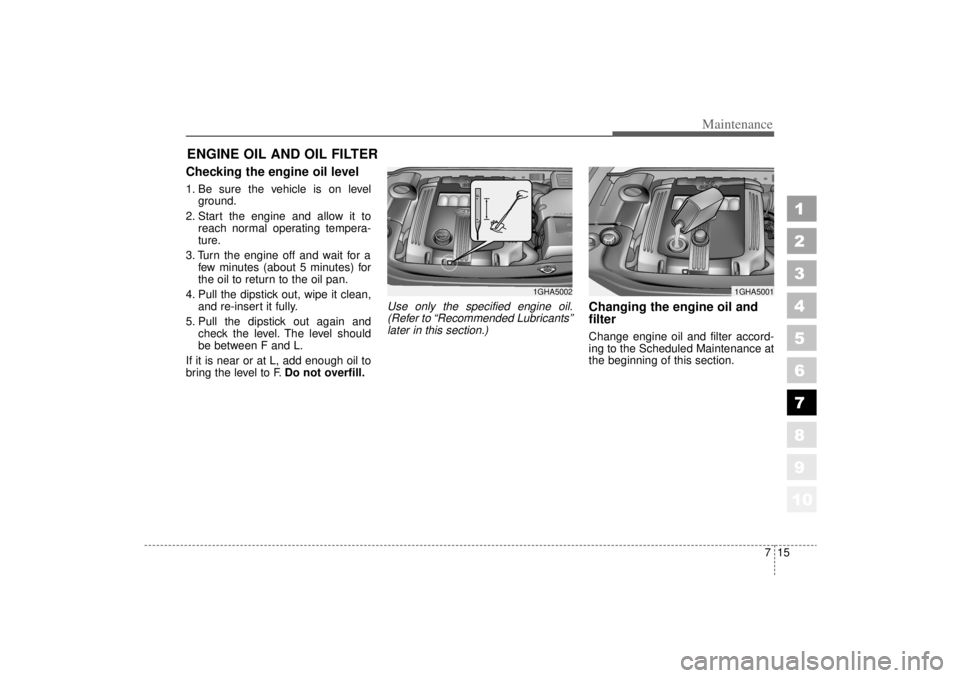
ENGINE OIL AND OIL FILTERChecking the engine oil level 1. Be sure the vehicle is on levelground.
2. Start the engine and allow it to reach normal operating tempera-
ture.
3. Turn the engine off and wait for a few minutes (about 5 minutes) for
the oil to return to the oil pan.
4. Pull the dipstick out, wipe it clean, and re-insert it fully.
5. Pull the dipstick out again and check the level. The level should
be between F and L.
If it is near or at L, add enough oil to
bring the level to F. Do not overfill.
Use only the specified engine oil.
(Refer to “Recommended Lubricants”later in this section.)
Changing the engine oil and
filterChange engine oil and filter accord-
ing to the Scheduled Maintenance at
the beginning of this section.
1GHA5001
1GHA5002
Page 260 of 322
Maintenance16
7
1
2
3
4
5
6
7
8
910
1. Warm the engine up for a few min-
utes and then turn it off. Remove
the oil filler cap.
2. Drain the oil into a suitable con- tainer by removing the oil drain
plug. 3. Remove the engine oil filter with
an oil filter wrench.
✽ ✽NOTICEDo not allow the oil filter gasket to
remain on the oil filter mounting
surface. This will cause oil leakage
and engine damage. Remove the old
gasket completely so that a new gas-
ket may be properly seated. 4. Use a clean rag to clean the oil fil-
ter mounting surface on the
engine.
5. Apply a small amount of engine oil to the new oil filter O-ring seal. 6. Install the oil filter and tighten it.
(Refer to the oil filter caution label
for tightening instructions.)
7. Install a new washer on the drain plug. Don’t use an old washer
repeatedly.
8. Replace the drain plug after the oil has thoroughly drained. Torque the
plug to 26~32 lbft (3.5~4.5 kgm,
35~44 Nm).
9. Refill the engine with new oil to the F mark on the dipstick. Do not
overfill.
10. Reinstall the oil filler cap secure- ly.
11. Start the engine and inspect around the oil filter seal for leaks.
Stop the engine.
12. Check the oil level and fill to the F mark as necessary.
PROPOSITION 65
WARNING
Used engine oil may cause irri-
tation or cancer of the skin if left
in contact with the skin for pro-
longed periods of time. Used
engine oil contains chemicals
that have caused cancer in lab-
oratory animals. Always protect
your skin by washing your
hands thoroughly with soap and
warm water as soon as possible
after handling used oil.
CAUTION
Both the oil and engine arehot. Do not burn yourself.
Keep all engine oil out of the reach of children.
Page 261 of 322
717
Maintenance
1
2
3
4
5
6
7
8
910
Oil capacity With filter change :
4.5 US qt. (4.3 liters)
Without filter change :
4.2 US qt. (4.0 liters)Use only the specified ServiceGrade engine oil. (Refer to“Recommended Lubricants” later inthis section.)
✽ ✽ NOTICE• Although oil filters may have the
same external appearance, their
internal designs differ significant-
ly. These filters are not inter-
changeable. To avoid potential
engine damage, use only the speci-
fied filter. Consult an Authorized
Kia Dealer.
• Follow these instructions careful- ly. An improper oil filter installa-
tion can cause oil leakage and
engine damage. Drained engine oil
should be disposed of properly,
according to local environmental
protection agency codes. It should
not be thrown down the drain or
in the trash.
Page 262 of 322
Maintenance18
7
1
2
3
4
5
6
7
8
910
ENGINE COOLING SYSTEM The high-pressure cooling system
has a reservoir filled with year-round
antifreeze coolant. The reservoir is
filled at the factory.
Check the antifreeze protection and
coolant level at least once a year, at
the beginning of the winter season,
and before traveling to a colder cli-
mate.
Checking the coolant level
WARNING
- Removing
radiator cap
Never attempt to remove the radiator cap while the engine
is operating or hot. Doing so
might lead to cooling system
and engine damage and could
result in serious personal
injury from escaping hot
coolant or steam.
Turn the engine off and wait until it cools down. Even then,
use extreme care when
removing the radiator cap.
Wrap a thick towel around it,
and turn it counterclockwise
slowly to the first stop. Step
back while the pressure is
released from the cooling sys-
tem. When you are sure all the
pressure has been released,
press down on the cap, using
a thick towel, and continue
turning counterclockwise to
remove it.
(Continued)
(Continued)
Even if the engine is not oper-ating, do not remove the radi-
ator cap or the drain plug
while the engine and radiator
are hot. Hot coolant and steam
may still blow out under pres-
sure, causing serious injury.
Page 263 of 322
719
Maintenance
1
2
3
4
5
6
7
8
910
Check the condition and connections
of all cooling system hoses and
heater hoses. Replace any swollen
or deteriorated hoses.
The coolant level should be filled
between F and L marks on the level
gauge attached to the coolant reser-
voir cap when the engine is cool.
If the coolant level is low, add enough
specified coolant to provide protec-
tion against freezing and corrosion.
Bring the level to F, but do not over-
fill. If frequent additions are required,
see an Authorized Kia Dealer for a
cooling system inspection.
Changing coolant Change coolant according to the
Maintenance Schedule.
Use only soft (de-mineralized)water in the coolant mixture.
The engine in your vehicle has alu- minum engine parts and must be
protected by an ethylene-glycol-
based coolant to prevent corrosion
and freezing.
DO NOT USE alcohol or methanol coolant or mix them with the spec-
ified coolant.
Do not use a solution that contains more than 60% antifreeze or less
than 35% antifreeze, which would
reduce the effectiveness of the
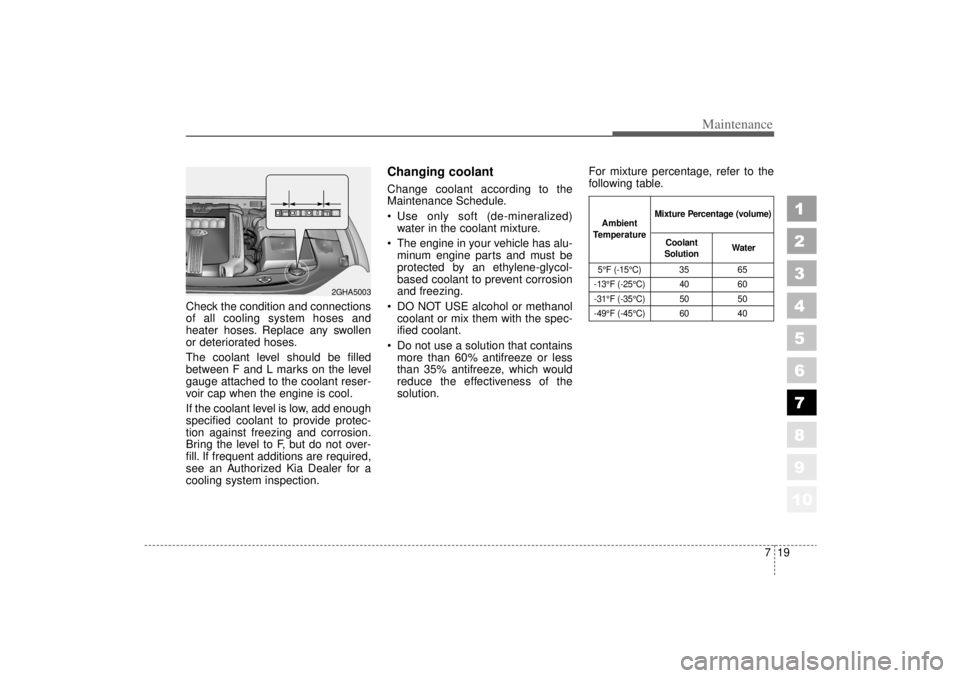
solution. For mixture percentage, refer to the
following table.
2GHA5003
5°F (-15°C) 35
65
-13°F (-25°C) 40 60
-31°F (-35°C) 50 50
-49°F (-45°C) 60 40Ambient
Temperature Mixture Percentage (volume)
Coolant
Solution Water