Page 33 of 368
WARNING!
Deployed airbags cannot protect you in another
collision. Have the airbags replaced by an autho-
rized dealer as soon as possible.
Maintaining Your Airbag System
WARNING!
•Modifications to any part of the airbag system
could cause it to fail when you need it. You could be
injured because the airbags are not there to protect
you. Do not modify the components or wiring,
including adding any kind of badges or stickers to
the steering wheel hub trim cover or the upper right
side of the instrument panel. Do not modify the
front bumper, vehicle body structure, or frame.
•You need proper knee impact protection in a
collision. Do not mount or locate any aftermarket
equipment on or behind the knee bolster.
•It is dangerous to try to repair any part of the
airbag system yourself. Be sure to tell anyone who
works on your vehicle that it has airbags.
THINGS TO KNOW BEFORE STARTING YOUR VEHICLE 33
2
Page 34 of 368

Airbag Warning Light
You will want to have the airbags ready to inflate for your
protection in an collision. While the airbag system is
designed to be maintenance free, if any of the following
occurs, have an authorized dealer service the system
immediately.
•The “Airbag Warning Light” does not come on or
flickers during the 6 to 8 seconds when the ignition
switch is first turned on.
•The “Airbag Warning Light” remains on or flickers
after the 6 to 8 second interval.
•The “Airbag Warning Light” flickers or comes on and
remains on while driving.
Child Restraint
Everyone in your vehicle needs to be buckled up all the
time-babies and children, too. Every state in the United
States and all Canadian provinces require that small
children ride in proper restraint systems. This is the law,
and you can be prosecuted for ignoring it.
Children 12 years and under should ride properly buck-
led up in a rear seat, if available. According to crash
statistics, children are safer when properly restrained in
the rear seats rather than in the front.
34 THINGS TO KNOW BEFORE STARTING YOUR VEHICLE
Page 35 of 368

WARNING!
In a collision, an unrestrained child, even a tiny
baby, can become a missile inside the vehicle. The
force required to hold even an infant on your lap can
become so great that you could not hold the child, no
matter how strong you are. The child and others
could be badly injured. Any child riding in your
vehicle should be in a proper restraint for the child’s
size.
Infants and Small Children
There are different sizes and types of restraints for
children from newborn size to the child almost large
enough for an adult safety belt. Always check the child
seat owner’s manual to ensure that you have the right
seat for your child. Use the restraint that is correct for
your child.
•The rearward-facing infant carrier is for babies weigh-
ing up to about 20 lbs (9 kg), and one year old or more.
The infant restraint must NEVERbe used in the front
seat of a vehicle with a front passenger airbag unless
the airbag is turned off. An airbag deployment could
cause severe injury or death to infants in this position.
The infant carrier is held in the vehicle by the lap belt,
lap/shoulder belt, or the LATCH child restraint an-
chorage system.
•Children under one year of age should continue to ride
in a rear-facing infant seat, even if they weigh more
than 20 lbs (9 kg). A “convertible” child seat, one that
is designed to be used either rearward-facing or
forward-facing, should be used for children who are
too heavy for the infant carrier, but who are too young
to face forward in the vehicle.
•The forward-facing child seat is for children from
about 20–40 lbs (9–18 kg), and more than one year old.
THINGS TO KNOW BEFORE STARTING YOUR VEHICLE 35
2
Page 36 of 368

The child seat is held in the vehicle by the lap belt,
lap/shoulder belt, or the LATCH child restraint an-
chorage system.
•The belt-positioning booster seat is for children weigh-
ing more than 40 lbs (18 kg), but who are still too small
to fit in the vehicle’s seat belts properly. If the child
cannot sit with knees bent over the seat cushion while
the child’s back is against the seat back, they should
use a belt-positioning booster seat. The child and
booster seat are held in the vehicle by lap/shoulder
belt. (Some booster seats are equipped with a front
shield and are held in the vehicle by the lap portion or
lap belt.)
•For additional information refer to www.seatcheck.org
or call 1-866-SEATCHECK.
WARNING!
•Improper installation can lead to failure of an
infant or child restraint. It could come loose in a
collision. The child could be badly injured or
killed. Follow the manufacturer’s directions ex-
actly when installing an infant or child restraint.
•A rearward facing infant restraint should only be
used in a rear seat unless the passenger frontal
airbag is turned off. If the airbag is left on, a
rearward facing infant restraint in the front seat
may be struck by a deploying passenger airbag
which may cause severe or fatal injury to the
infant.
36 THINGS TO KNOW BEFORE STARTING YOUR VEHICLE
Page 44 of 368

•Check belt fit periodically. A child’s squirming or
slouching can move the belt out of position.
•If the shoulder belt contacts the child’s face or neck,
move the child closer to the center of the vehicle.
Never allow a child to put the shoulder belt under an
arm or behind their back.
Transporting Pets
Airbags deploying in the front seat could harm your pet.
An unrestrained pet will be thrown about and possibly
injured, or injure a passenger during panic braking or in
a collision.
Pets should be restrained in the rear seat in pet harnesses
or pet carriers that are secured by seat belts.
ENGINE BREAK-IN RECOMMENDATIONS
A long break-in period is not required for the engine in
your new vehicle.
Drive moderately during the first 300 miles (500 km).
After the initial 60 miles (100 km), speeds up to 50 or 55
mph (80 or 90 km/h) are desirable.
While cruising, brief full-throttle acceleration, within the
limits of local traffic laws, contributes to a good break-in.
Wide open throttle acceleration in low gear can be
detrimental and should be avoided.
The engine oil installed in the engine at the factory is a
high quality energy conserving type lubricant. Oil
changes should be consistent with anticipated climate
conditions under which vehicle operations will occur.
The recommended viscosity and quality grades are
shown in Section 7 of this manual. NON-DETERGENT
OR STRAIGHT MINERAL OILS MUST NEVER BE
USED.
44 THINGS TO KNOW BEFORE STARTING YOUR VEHICLE
Page 46 of 368

•On hardtop models, keep the tailgate window closed
when driving your vehicle. On fabric top models, do
not drive with the rear window curtain up unless the
side curtains are also open. This will prevent carbon
monoxide and other poisonous exhaust gases from
entering the vehicle.
Safety Checks You Should Make Inside The
Vehicle
Seat Belts
Inspect the belt system periodically, checking for cuts,
frays and loose parts. Damaged parts must be replaced
immediately. Do not disassemble or modify the system.
Seat belt assemblies must be replaced after an accident if
they have been damaged (bent retractor, torn webbing,
etc.). If there is any question regarding belt or retractor
condition, replace the belt.
Airbag Warning Light
The light should come on and remain on for 6 to 8
seconds as a indicator check when the ignition switch is
first turned on. If the indicator is not lit during starting,
have it serviced. If the light stays on or comes on while
driving, have the system checked by an authorized
dealer.
Defrosters
Check operation by selecting the defrost mode and place
the blower control on high speed. You should feel the air
directed against the windshield.
46 THINGS TO KNOW BEFORE STARTING YOUR VEHICLE
Page 149 of 368
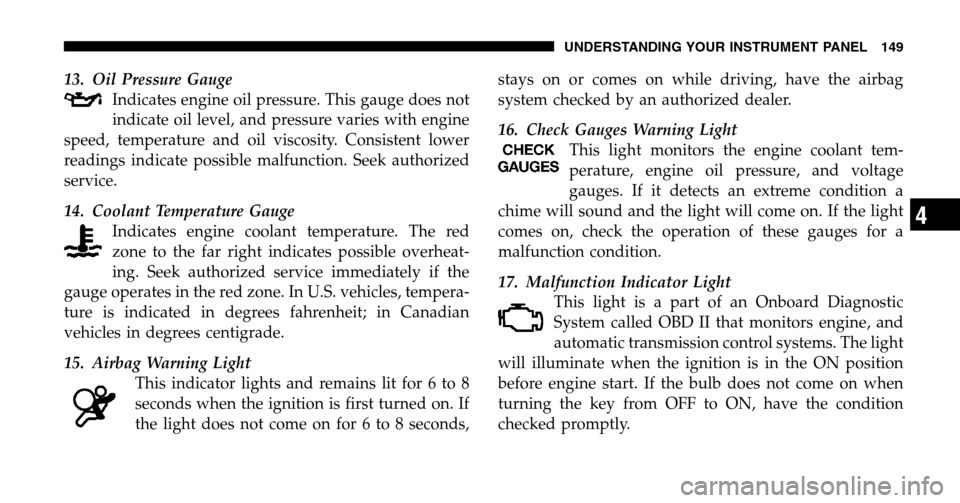
13. Oil Pressure Gauge Indicates engine oil pressure. This gauge does not
indicate oil level, and pressure varies with engine
speed, temperature and oil viscosity. Consistent lower
readings indicate possible malfunction. Seek authorized
service.
14. Coolant Temperature Gauge Indicates engine coolant temperature. The red
zone to the far right indicates possible overheat-
ing. Seek authorized service immediately if the
gauge operates in the red zone. In U.S. vehicles, tempera-
ture is indicated in degrees fahrenheit; in Canadian
vehicles in degrees centigrade.
15. Airbag Warning Light This indicator lights and remains lit for 6 to 8
seconds when the ignition is first turned on. If
the light does not come on for 6 to 8 seconds, stays on or comes on while driving, have the airbag
system checked by an authorized dealer.
16. Check Gauges Warning Light
This light monitors the engine coolant tem-
perature, engine oil pressure, and voltage
gauges. If it detects an extreme condition a
chime will sound and the light will come on. If the light
comes on, check the operation of these gauges for a
malfunction condition.
17. Malfunction Indicator Light This light is a part of an Onboard Diagnostic
System called OBD II that monitors engine, and
automatic transmission control systems. The light
will illuminate when the ignition is in the ON position
before engine start. If the bulb does not come on when
turning the key from OFF to ON, have the condition
checked promptly.
UNDERSTANDING YOUR INSTRUMENT PANEL 149
4
Page 306 of 368
Cavity Fuse Description 1 20 Amp Yellow Park Lights, Skim (Sentry Key)
2 20 Amp Yellow Stop Lights
3 20 Amp Yellow Subwoofer System
4 10 Amp Red Door Switch Defeat
5 10 Amp Red Airbag
6 20 Amp Yellow Rear Wiper
7 10 Amp Red Back-Up Lights, Rear Window Defroster Relay,
ABS
8 10 Amp Red HEVAC
9 10 Amp Red Airbag
10 10 Amp Red Instrument Cluster 11 10 Amp Red Solenoids, DRLCavity Fuse Description 12 10 Amp Red Power Distribution Re- lays, Skim (Sentry Key)
13 10 Amp Red Turn Signals
14 10 Amp Red Radio
15 10 Amp Red HBL (Rear Window De- froster) Switch
16 10 Amp Red Headlamp Aim (Export Only)
17 25 Amp Natu- ral Front Wiper
18 20 Amp Yellow Cigar Lighter
19 20 Amp Yellow Spare
20 20 Amp Yellow Spare
306 MAINTAINING YOUR VEHICLE

