2006 JEEP LIBERTY brake service
[x] Cancel search: brake servicePage 175 of 424

When the engine is running, the “Malfunction Indicator
Light” may flash to alert of serious conditions that could
lead to immediate loss of power or severe catalytic
converter damage. The vehicle should be serviced as
soon as possible if this occurs. (See page 316 for more
information.)
9. Anti-Lock Warning Light (ABS) — If Equipped This light monitors the Anti-Lock Brake System
(ABS) described elsewhere in this manual. This
light will come on when the ignition switch is turned to
the ON position and may stay on for as long as three
seconds.
If the light comes back on immediately or comes on
during driving, it indicates that the Anti-Lock portion of
the brake system is not functioning and that service is
required, however, the conventional brake system will continue to operate normally provided that the BRAKE
warning light is not on. Also, a chime will sound if the
light comes back on.
If the ABS light is on, the brake system should be serviced
as soon as possible to restore the benefit of Anti-Lock
Brakes.
The operation of the ABS light can be checked by turning
the ignition switch from the OFF position to the ON
position. The light should illuminate for approximately
four seconds. The light should then turn off unless a
brake fault is detected. If the light does not illuminate,
have the light inspected by an authorized dealer.
10. Charging System Warning Light
This light shows the status of the electrical charg-
ing system. The light should come on for three
seconds when the ignition is first turned ON. If the light
comes back on immediately or comes on while driving, it
means that there is a problem with the charging system
UNDERSTANDING YOUR INSTRUMENT PANEL 175
4
Page 181 of 424

the vehicle is safely and completely stopped and the gear
selector is placed in the P (Park) position. The light
should turn off. If the light remains on with the engine
running, your vehicle will usually be drivable, however,
see your dealer for service as soon as possible.
If the light continues to flash when the engine is running,
immediate service is required and you may experience
reduced performance, an elevated / rough idle, or engine
stall and your vehicle may require towing. The light will
come on when the ignition is first turned on and remain
on briefly as a bulb check. If the light does not come on
during starting, have the system checked by an autho-
rized dealer.
NOTE: “Two-footed” driving is not recommended. In-
advertently driving with the brake pedal depressed for
more than a few seconds when the accelerator pedal is
held in place can cause the ETC system to assume that a
stuck accelerator pedal has occurred. This will result in a loss of power. Returning the brake pedal to its normal
position or moving the accelerator pedal will cancel this
condition. If the depressed brake pedal and the constant
accelerator pedal position are maintained for an extended
period of time, the ETC warning light will begin to flash
and continue until the ignition switch is cycled in the
same manner as above.
29. Glow Plug Indicator Light — Diesel Models Only
This light will illuminate when the ignition
switch is first turned to the ON position. Wait
until the light turns off before starting the
vehicle. Refer to “Starting Procedures — Nor-
mal Starting Diesel Engines” in Section 5 of this manual.
UNDERSTANDING YOUR INSTRUMENT PANEL 181
4
Page 252 of 424

After Driving Off-Road
Off-road operation puts more stress on your vehicle than
does most on-road driving. After going off-road it is
always a good idea to check for damage. That way you
can get any problems taken care of right away and have
your vehicle ready when you need it.
•Completely inspect the underbody of your vehicle.
Check tires, body structure, steering, suspension, and
exhaust system for damage.
•Check threaded fasteners for looseness, particularly on
the chassis, drivetrain components, steering, and sus-
pension. Retighten them, if required, and torque to the
values specified in the Service Manual.
•Check for accumulations of plants or brush. These
things could be a fire hazard. They might hide damage
to fuel lines, brake hoses, axle pinion seals, and
propeller shafts.
•After extended operation in mud, sand, water, or
similar dirty conditions, have brake rotors, wheels,
brake linings, and axle yokes inspected and cleaned as
soon as possible.
WARNING!
Abrasive material in any part of the brakes may
cause excessive wear or unpredictable braking. You
might not have full braking power when you need it
to prevent an accident. If you have been operating
your vehicle in dirty conditions, get your brakes
checked and cleaned as necessary.
•If you experience unusual vibration after driving in
mud, slush or similar conditions, check the wheels for
impacted material. Impacted material can cause a
wheel imbalance and freeing the wheels of it will
correct the situation.
252 STARTING AND OPERATING
Page 337 of 424
ONLY the correct type thermostat. Other designs may
result in unsatisfactory cooling performance, poor gas
mileage, and increased emissions.
Hoses and Vacuum/Vapor Harnesses
Inspect surfaces of hoses and nylon tubing for evidence
of heat and mechanical damage. Hard or soft spots,
brittle rubber, cracking, tears, cuts, abrasions, and exces-
sive swelling indicate deterioration of the rubber.
Pay particular attention to the hoses nearest to high heat
sources such as the exhaust manifold. Inspect hose rout-
ing to be sure hoses do not touch any heat source or
moving component that may cause heat damage or
mechanical wear.
Insure nylon tubing in these areas has not melted or
collapsed. Inspect all hose connections such as clamps
and couplings to make sure they are secure and no leaks are present. Components should be replaced immedi-
ately if there is any evidence of degradation that could
cause failure.
Brake System
In order to assure brake system performance, all brake
system components should be inspected periodically.
Refer to the appropriate “Maintenance Schedule” in
Section 8 for suggested service intervals.
WARNING!
Riding the brakes can lead to brake failure and
possibly an accident. Driving with your foot resting
or riding on the brake pedal can result in abnormally
high brake temperatures, excessive lining wear, and
possible brake damage. You wouldn’t have your full
braking capacity in an emergency.
MAINTAINING YOUR VEHICLE 337
7
Page 338 of 424

Brake and Power Steering System Hoses
When servicing the vehicle for scheduled maintenance,
inspect surface of hoses for evidence of heat and me-
chanical damage. Hard and brittle rubber, cracking, tears,
cuts, abrasion, and excessive swelling suggest deteriora-
tion of the rubber. Particular attention should be made to
examining those hose surfaces nearest to high heat
sources, such as the exhaust manifold.
Inspect all hose clamps and couplings to make sure they
are secure and no leaks are present.
NOTE: Often fluids such as oil, power steering fluid,
and brake fluid are used during assembly plant opera-
tions to ease the assembly of hoses to couplings. There-
fore, oil wetness at the hose-coupling area is not neces-
sarily an indication of leakage. Actual dripping of hot
fluid when systems are under pressure (during vehicle
operation) should be noted before hose is replaced based
on leakage. NOTE:
Inspection of brake hoses should be done when-
ever the brake system is serviced and every engine oil
change.
WARNING!
Worn brake hoses can burst and cause brake failure.
You could have an accident. If you see any signs of
cracking, scuffing, or worn spots, have the brake
hoses replaced immediately.
Brake Master Cylinder
The fluid level in the master cylinder should be checked
when performing under hood services, or immediately if
the “Brake Warning Light” shows system failure.
338 MAINTAINING YOUR VEHICLE
Page 344 of 424

Adding Fluid
Add lubricant only at the fill hole and only to the level
specified above.
Selection of Lubricant
Use only manufacturer’s recommended fluid, refer to
Fluids, Lubricants, and Genuine Parts for correct fluid
type.
Maintenance After Off-Pavement Driving
After extended operation in mud, sand or water, or
similar dirty conditions, have your brake drums, brake
linings, and axle joints inspected and cleaned as soon as
possible. This will prevent any abrasive material from
causing excessive wear or unpredictable braking action.
Following off-pavement usage, completely inspect the
underbody of your vehicle. Check tires, body structure,
steering, suspension and exhaust system for damage.
Check threaded fasteners for looseness, particularly on the chassis, drivetrain components, steering and suspen-
sion. Retighten, if required, to torque values specified in
the Service Manual. Also check for accumulations of
vegetation or brush that could become a fire hazard, or
conceal damage to fuel lines, brake hoses, axle pinion
seals, and propeller shafts.
CAUTION!
Under frequent heavy-duty driving conditions,
change all lubricants and lubricate body compo-
nents, all driveline joints and steering linkage more
often than in normal service to prevent excessive
wear.
344 MAINTAINING YOUR VEHICLE
Page 383 of 424
![JEEP LIBERTY 2006 KJ / 1.G Owners Manual Miles 108,000 114,000 120,000
(Kilometers) (180 000) (190 000) (200 000)
[Months] [108] [114] [120]
Change the engine oil and engine oil filter. X X X
Rotate the tires. X X X
Inspect the engine air f](/manual-img/16/7120/w960_7120-382.png "JEEP LIBERTY 2006 KJ / 1.G Owners Manual Miles 108,000 114,000 120,000
(Kilometers) (180 000) (190 000) (200 000)
[Months] [108] [114] [120]
Change the engine oil and engine oil filter. X X X
Rotate the tires. X X X
Inspect the engine air f")
Miles 108,000 114,000 120,000
(Kilometers) (180 000) (190 000) (200 000)
[Months] [108] [114] [120]
Change the engine oil and engine oil filter. X X X
Rotate the tires. X X X
Inspect the engine air filter element, and replace if necessary. X
Replace the spark plugs. X
Inspect and replace the PCV valve, if necessary. X
Inspect the brake linings. X
Inspect the drive belt and replace as needed. Not required if pre-
viously replaced. XX
Flush and replace the engine coolant/anti-freeze if not done at
102,000 miles (170 000 km). X
Inspect the manual transmission fluid, add as necessary. X
Drain and refill the transfer case fluid. X
Inspection and service should be performed anytime a
malfunction is observed or suspected. Retain all receipts.
This maintenance is recommended by the manufac-
turer to the owner, but it is not required to maintain
emissions warranty.
SCHEDULE “A” — GASOLINE ENGINES 383
8
M A I
N T
E
N A
N C E
S
C
H E
D
U L
E
S
Page 390 of 424
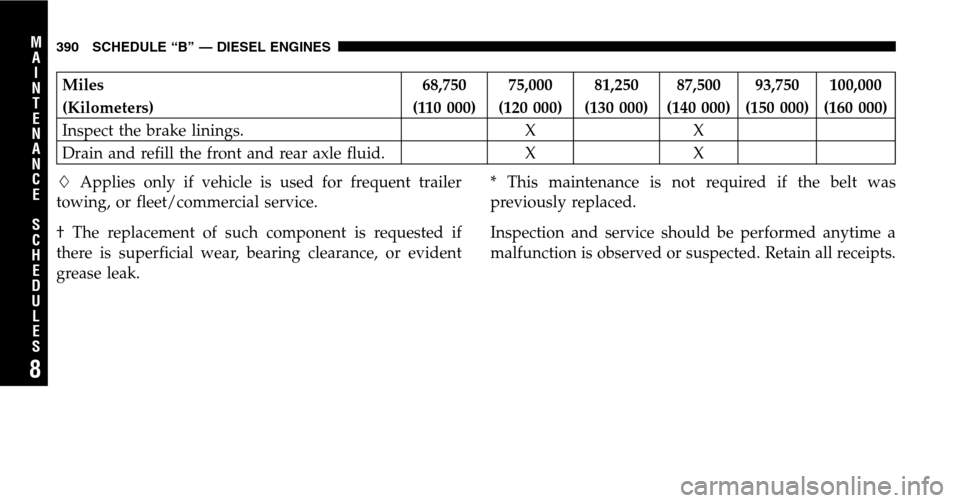
Miles 68,750 75,000 81,250 87,500 93,750 100,000
(Kilometers) (110 000) (120 000) (130 000) (140 000) (150 000) (160 000)
Inspect the brake linings. X X
Drain and refill the front and rear axle fluid. X X
Applies only if vehicle is used for frequent trailer
towing, or fleet/commercial service.
† The replacement of such component is requested if
there is superficial wear, bearing clearance, or evident
grease leak. * This maintenance is not required if the belt was
previously replaced.
Inspection and service should be performed anytime a
malfunction is observed or suspected. Retain all receipts.
390 SCHEDULE “B” — DIESEL ENGINES
8
M
A I
N T
E
N A
N C E
S
C
H E
D
U L
E
S