Page 367 of 448

The cap should be inspected and cleaned if there is any
accumulation of foreign material on the sealing surfaces.
WARNING!
The warning words DO NOT OPEN HOT on the
cooling system pressure cap are a safety precaution.
Never add antifreeze/coolant when the engine is
overheated. Do not loosen or remove the cap to cool
an overheated engine. Heat causes pressure to build
up in the cooling system. To prevent scalding or
injury, do not remove the pressure cap while the
system is hot or under pressure.
Disposal of Used Engine Coolant
Used ethylene glycol-based antifreeze/coolant is a regu-
lated substance requiring proper disposal. Check with
your local authorities to determine the disposal rules for
your community. To prevent ingestion by animals andchildren, do not store ethylene glycol-based antifreeze/
coolant in open containers or allow it to remain in
puddles on the ground. If ingested by a child, contact a
physician immediately. Clean up any ground spills im-
mediately.
Engine Coolant Level
The coolant bottle provides a quick visual method for
determining that the antifreeze/coolant level is adequate.
With the engine idling, and warm to normal operating
temperature, the level of the antifreeze/coolant in the
bottle should be between the ranges indicated on the
bottle.
The radiator normally remains completely full, so there is
not need to remove the radiator cap unless checking for
antifreeze/coolant freeze point or replacing antifreeze/
coolant. Advise your service attendant of this. As long as
the engine operating temperature is satisfactory, the
coolant bottle need only be checked once a month.
MAINTAINING YOUR VEHICLE 367
7
Page 368 of 448

When additional antifreeze/coolant is needed to main-
tain the proper level, it should be added to the coolant
bottle. Do not overfill.
Points To Remember
NOTE:When the vehicle is stopped after a few miles
(kilometers) of operation, you may observe vapor coming
from the front of the engine compartment. This is nor-
mally a result of moisture from rain, snow, or high
humidity accumulating on the radiator and being vapor-
ized when the thermostat opens, allowing hot antifreeze/
coolant to enter the radiator.
If an examination of your engine compartment shows no
evidence of radiator or hose leaks, the vehicle may be
safely driven. The vapor will soon dissipate.
•Do not overfill the coolant recovery bottle.
•Check antifreeze/coolant freeze point in the radiator
and in the coolant recovery bottle. If antifreeze/coolant needs to be added, contents of coolant recov-
ery bottle must also be protected against freezing.
•If frequent antifreeze/coolant additions are required,
or if the level in the coolant recovery bottle does not
drop when the engine cools, the cooling system should
be pressure tested for leaks.
•Maintain antifreeze/coolant concentration at 50%
HOAT antifreeze/coolant (minimum) and distilled
water for proper corrosion protection of your engine
which contains aluminum components.
•Make sure that the radiator and coolant recovery
bottle hoses are not kinked or obstructed.
•Keep the front of the radiator clean. If your vehicle is
equipped with air conditioning, keep the front of the
condenser clean, also.
•Do not change the thermostat for summer or winter
operation. If replacement is ever necessary, install
368 MAINTAINING YOUR VEHICLE
Page 370 of 448
Brake and Power Steering System Hoses
When servicing the vehicle for scheduled maintenance,
inspect surface of hoses for evidence of heat and me-
chanical damage. Hard and brittle rubber, cracking, tears,
cuts, abrasion, and excessive swelling suggest deteriora-
tion of the rubber. Particular attention should be made to
examining those hose surfaces nearest to high heat
sources, such as the exhaust manifold.
Inspect all hose clamps and couplings to make sure they
are secure and no leaks are present.
NOTE:Often fluids such as oil, power steering fluid,
and brake fluid are used during assembly plant opera-
tions to ease the assembly of hoses to couplings. There-
fore, oil wetness at the hose-coupling area is not neces-
sarily an indication of leakage. Actual dripping of hot
fluid when systems are under pressure (during vehicle
operation) should be noted before hose is replaced based
on leakage.NOTE:Inspection of brake hoses should be done when-
ever the brake system is serviced and every engine oil
change.
WARNING!
Worn brake hoses can burst and cause brake failure.
You could have an accident. If you see any signs of
cracking, scuffing, or worn spots, have the brake
hoses replaced immediately.
Brake Master Cylinder
The fluid level in the master cylinder should be checked
when performing under hood services, or immediately if
the brake system warning lamp shows system failure
370 MAINTAINING YOUR VEHICLE
Page 371 of 448
Be sure to clean the top of the master cylinder area before
removing the cap. If necessary, add fluid to bring the
fluid level up to the requirements described on the brake
fluid reservoir. With disc brakes, fluid level can be
expected to fall as the brake pads wear. However, low
fluid level may be caused by a leak and a checkup may be
needed.
Use only manufacturer’s recommended brake fluid, refer
to Fluids, Lubricants, and Genuine Parts for correct fluid
type.
WARNING!
Use of a brake fluid that may have a lower initial
boiling point or unidentified as to specification, may
result in sudden brake failure during hard pro-
longed braking. You could have an accident.
WARNING!
Overfilling the brake fluid reservoir can result in
spilling brake fluid on hot engine parts and the
brake fluid catching fire.
Use only brake fluid that has been in a tightly closed
container to avoid contamination from foreign matter. Do
not allow petroleum base fluid to contaminate the brake
fluid as seal damage will result.
Automatic Transmission
Selection of Lubricant
It is important that the proper lubricant is used in the
transmission to assure optimum transmission perfor-
mance. Use only manufacturer’s recommended transmis-
sion fluid, refer to Fluids, Lubricants, and Genuine Parts
for correct fluid type. It is important that the transmission
fluid be maintained at the prescribed level using the
recommended fluid.
MAINTAINING YOUR VEHICLE 371
7
Page 372 of 448

CAUTION!
Using a transmission fluid other than the manufac-
turer’s recommended fluid may cause deterioration
in transmission shift quality and/or torque converter
shudder. Using a transmission fluid other than the
manufacturer’s recommended fluid will result in
more frequent fluid and filter changes. Refer to
Fluids, Lubricants, and Genuine Parts for correct
fluid type.
Fluid Level Check
NOTE:If equipped with a dipstick, use the following
procedure. If your vehicle has a capped dipstick tube, it
is sealed and should not be tampered with. Your autho-
rized dealer has the proper tools to ensure that the fluid
level is set properly.Check the fluid level while the transmission is at normal
operating temperature. This occurs after at least 15 miles
(25 km) of driving. At normal operating temperature the
fluid cannot be held comfortably between the fingertips.
To check the automatic transmission fluid level properly,
the following procedure must be used:
1. Operate the engine at idle speed and normal operating
temperature.
2. The vehicle must be on level ground.
3. Fully apply the parking brake and press the brake
pedal.
4. Place the gear selector momentarily in each gear
position ending with the lever in P (Park).
5. Remove the dipstick, wipe it clean and reinsert it until
seated.
372 MAINTAINING YOUR VEHICLE
Page 397 of 448

•Taxi, police, or delivery service (commercial service)
•Off-road or desert driving
•If equipped for and operated with E-85 (ethanol)
fuel.
NOTE:Most vehicles are operated under the conditions
listed for Schedule“B.”
NOTE:IfANYof these apply to you, change your
engine oil every 3,000 miles (5 000 km) or 3 months,
whichever comes first, and follow the maintenance rec-
ommendations in“Maintenance Schedule B.”
NOTE:IfANYof these apply to you then flush and
replace your engine coolant every 102,000 miles (170 000
km) or 60 months, whichever comes first, and follow
“Schedule B”of the“Maintenance Schedules”section of
this manual.Second is Schedule“A”. It is for vehicles that are not
operated under any of the conditions listed under Sched-
ule“B.”
Use the schedule that best describes your driving condi-
tions. Where time and mileage are listed, follow the
interval that occurs first.
CAUTION!
Failure to perform the required maintenance items
may result in damage to the vehicle.
At Each Stop for Fuel
•Check the engine oil level about 5 minutes after a fully
warmed engine is shut off. Checking the oil level while
the vehicle is on level ground will improve the accu-
racy of the oil level reading. Add oil only when the
level is at or below the ADD or MIN mark.
MAINTENANCE SCHEDULES 397
8
M
A
I
N
T
E
N
A
N
C
E
S
C
H
E
D
U
L
E
S
Page 398 of 448
•Check the windshield washer solvent, add as required.
Once a Month
•Check the tire pressure and look for unusual wear or
damage.
•Inspect the battery and clean and tighten the terminals
as required.
•Check the fluid levels of the coolant reservoir, brake
master cylinder, and transmission, and add as needed.
•Check all lights and all other electrical items for correct
operation.At Each Oil Change
•Change the engine oil filter.
•Inspect the exhaust system.
•Inspect brake hoses.
•Check the engine coolant/anti-freeze level, hoses, and
clamps.
•After completion of off-road operation, the underside
of the vehicle should be thoroughly inspected. Exam-
ine threaded fasteners for looseness.
398 MAINTENANCE SCHEDULES
8
M
A
I
N
T
E
N
A
N
C
E
S
C
H
E
D
U
L
E
S
Page 400 of 448
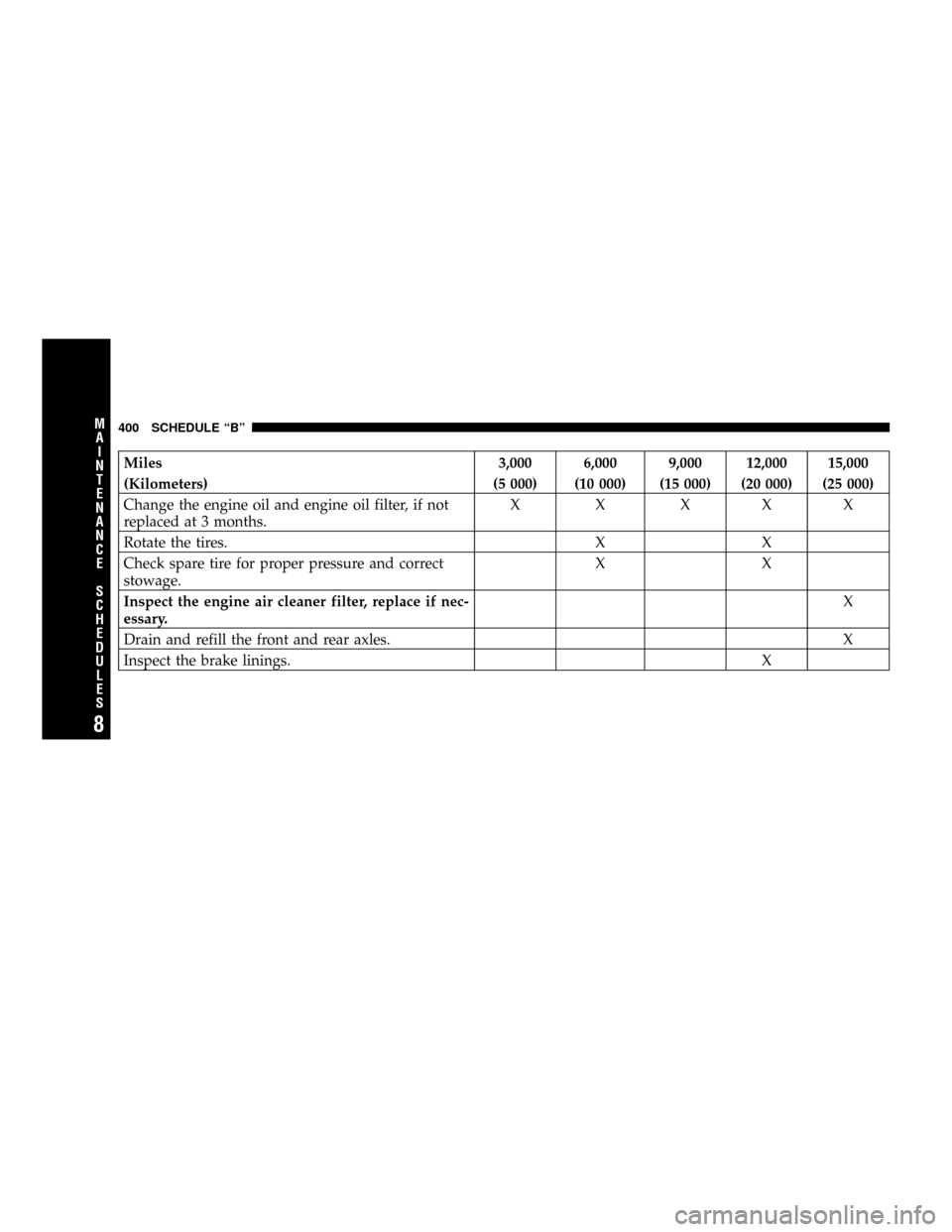
Miles 3,000 6,000 9,000 12,000 15,000
(Kilometers) (5 000) (10 000) (15 000) (20 000) (25 000)
Change the engine oil and engine oil filter, if not
replaced at 3 months.X X XXX
Rotate the tires. X X
Check spare tire for proper pressure and correct
stowage.XX
Inspect the engine air cleaner filter, replace if nec-
essary.X
Drain and refill the front and rear axles. X
Inspect the brake linings. X
400 SCHEDULE“B”
8
M
A
I
N
T
E
N
A
N
C
E
S
C
H
E
D
U
L
E
S