2006 INFINITI G35 flat tire
[x] Cancel search: flat tirePage 235 of 344

stalled according to the chain manu-
facturer's suggestions. However, some
provinces and states prohibit their
use. Check local state and provincial
laws before installing tire chains. Use
only SAE Class S chains. Class ªSº
chains are used on vehicles with re-
stricted tire to vehicle clearance. Ve-
hicles that can use Class ªSº chains
are designed to meet the SAE stan-
dard minimum clearances between the
tire and the closest vehicle suspen-
sion or body component required to
accommodate the use of a winter trac-
tion device (tire chains or cables). The
minimum clearances are determined
using the factory equipped tire size.
Other types may damage your vehicle.
Use chain tensioners when recom-
mended by the tire chain manufac-
turer to ensure a tight fit. Loose end
links of the tire chain must be secured
or removed to prevent the possibility
of damage to the fenders or under-
body. If possible, avoid fully loading
your vehicle when using tire chains. In
addition, drive at a reduced speed.
Otherwise, your vehicle may be dam-
aged and/or vehicle handling and per-
formance may be adversely affected. O Never install the tire chains on TEMPO-
RARY USE ONLY spare tires.
O Do not use the tire chains on dry roads.
O The tire chains must be installed only
on the rear wheels and not on the front
wheels.
Do not drive with tire chains on paved
roads which are clear of snow. Driving
with chains in such conditions can
cause damage to the various mecha-
nisms of the vehicle due to some over-
stress.
4. For all-wheel drive (AWD):
If you install snow tires, they must
also be the same size, brand, con-
struction and tread pattern on all four
wheels.
SPECIAL WINTER EQUIPMENT It is recommended that the following items
be carried in the vehicle during winter:
O a scraper and stiff-bristled brush to re-
move ice and snow from the windows
and wiper blades.
O a sturdy, flat board to be placed under
the jack to give it firm support. O a shovel to dig the vehicle out of
snow-drifts.
O extra window washer fluid to refill the
reservoir tank.
DRIVING ON SNOW OR ICE
WARNING O Wet ice (32ÉF, 0ÉC and freezing rain),
very cold snow or ice can be slick and
very hard to drive on. The vehicle will
have much less traction or ªgripº under
these conditions. Try to avoid driving on
wet ice until the road is salted or sanded.
O Whatever the condition, drive with cau-
tion. Accelerate and slow down with
care. If accelerating or downshifting too
fast, the drive wheels will lose even
more traction.
O Allow more stopping distance under
these conditions. Braking should be
started sooner than on dry pavement.
Starting and driving
5-31
w 06.1.4/V35-D/V5.0
X
Page 237 of 344

6 In case of emergency Roadside assistance program ........................... 6-2
Flat tire ............................................................ 6-2
Tire pressure monitoring system (TPMS) .... 6-2
Changing a flat tire ..................................... 6-2
Jump starting ................................................... 6-8
Push starting .................................................. 6-10 If your vehicle overheats ................................. 6-11
Towing your vehicle ........................................ 6-12
Towing recommended by INFINITI .............. 6-12
Vehicle recovery (Freeing a stuck
vehicle) ...................................................... 6-15
w 06.1.4/V35-D/V5.0
X
Page 238 of 344

Every new INFINITI comes with a 4 year,
unlimited mileage Roadside Assistance
plan. In the event of a roadside
emergency, Roadside Assistance Service
is available to you. Please refer to your
Warranty Booklet (U.S.) or Warranty &
Roadside assistance information booklet
(Canada) for details. Both the Warranty
Booklet and Roadside Assistance Calling
Card in your Owner's Literature Portfolio
provide the Toll-Free Number to call for
assistance. Roadside Assistance is
provided 24 hours a day, 365 days a year,
for 4 years from the date sold to give
emergency roadside help, in the event of
mechanical or nonmechanical trouble(s)
such as flat tires, out-of-gas, dead battery,
lost keys, mechanical breakdown,
accident, etc. TIRE PRESSURE MONITORING
SYSTEM (TPMS) This vehicle is equipped with the tire pres-
sure monitoring system (TPMS). It monitors
tire pressure of all tires except the spare.
When the low tire pressure warning light is
lit, or flashing continuously one or more of
your tires is significantly under-inflated. If
the vehicle is being driven with low tire
pressure, the TPMS will activate and warn
you of it by the low tire pressure warning
light. This system will activate only when
the vehicle is driven at speeds above 16
MPH (25 km/h). For more details, refer to
ªWarning/indicator lights and audible re-
mindersº in the ª2. Instruments and con-
trolsº section and ªTire pressure moni-
toring system (TPMS)º in the ª5. Starting
and drivingº section.
WARNING O If the low tire pressure warning light illu-
minates while driving, avoid sudden
steering maneuvers or abrupt braking,
reduce vehicle speed, pull off the road to
a safe location and stop the vehicle as
soon as possible. Serious vehicle damage could occur and may lead to an
accident and could result in serious per-
sonal injury. Check the tire pressure for all
four tires. Adjust the tire pressure to the
recommended COLD tire pressure shown
on the Tire and Loading Information label
to turn the low tire pressure warning light
OFF. If you have a flat tire, replace it with a
spare tire as soon as possible.
O When a spare tire is mounted or a wheel is
replaced, tire pressure will not be indi-
cated, the TPMS will not function and the
low tire pressure warning light will flash.
Contact your INFINITI dealer as soon as
possible for tire replacement and/or
system resetting.
O Replacing tires with those not originally
specified by INFINITI could affect the
proper operation of the TPMS.
O
Do not inject any tire liquid or aerosol tire
sealant into the tires, as this may cause a
malfunction of the tire pressure sensors.
CHANGING A FLAT TIRE If you have a flat tire, follow the instruc-
tions below.ROADSIDE ASSISTANCE PROGRAM FLAT TIRE
6-2 In case of emergency
w 06.1.13/V35-D/V5.0
X
Page 239 of 344
Stopping the vehicle 1. Safely move the vehicle off the road
away from traffic.
2. Turn on the hazard warning flashers.
3. Park on a level surface and apply the
parking brake. Shift the manual trans-
mission into the R (Reverse) position
(automatic transmission into the P
(Park) position).
4. Turn off the engine.
5. Raise the hood to warn other traffic,
and to signal professional road assis-
tance personnel that you need assis-
tance.
6. Have all passengers get out of the ve-
hicle and stand in a safe place, away
from traffic and clear of the vehicle.
WARNINGO Make sure the parking brake is securely
applied and the manual transmission is
shifted into R (Reverse), or the automatic
transmission into P (Park). O Never change tires when the vehicle is
on a slope, ice or slippery areas. This is
hazardous.
O Never change tires if oncoming traffic is
close to your vehicle. Wait for profes-
sional road assistance.
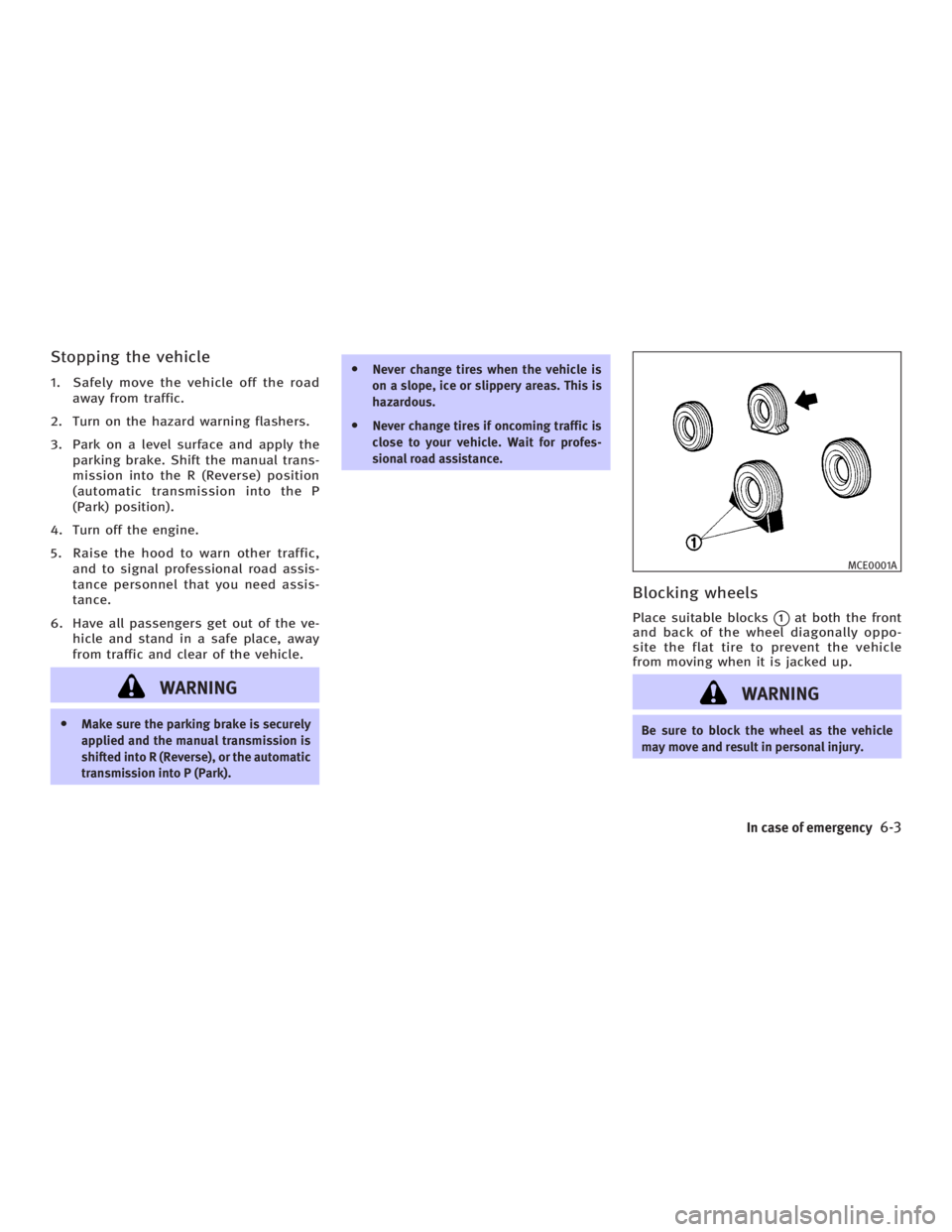
Blocking wheels Place suitable blocks
q 1
at both the front
and back of the wheel diagonally oppo-
site the flat tire to prevent the vehicle
from moving when it is jacked up.
WARNING Be sure to block the wheel as the vehicle
may move and result in personal injury. MCE0001A
In case of emergency
6-3
w 06.1.4/V35-D/V5.0
X
Page 243 of 344

Installing the spare tire The spare tire is designed emergency use.
See specific instructions under the
heading ªWheels and tiresº in the ª8.
Maintenance and do-it-yourselfº section.
1. Clean any mud or dirt from the surface
between the wheel and hub.
2. Carefully put the wheel on and tighten
the wheel nuts finger tight.
(Coupe models)
When replacing a front tire, make sure
the hole in the spare tire wheel is aligned with the pin on the brake
rotor.
3. With the wheel nut wrench, tighten
wheel nuts alternately and evenly until
they are tight.
4. Lower the vehicle slowly until the tire
touches the ground. Then, with the
wheel nut wrench, tighten the wheel
nuts securely in the sequence illus-
trated (
q 1
,
q 2
,
q 3
,
q 4
,
q 5
). Lower the
vehicle completely.
WARNING O Incorrect wheel nuts or improperly tight-
ened wheel nuts can cause the wheel to
become loose or come off. This could
cause an accident.
O Do not use oil or grease on the wheel
studs or nuts. This could cause the nuts
to become loose.
O Retighten the wheel nuts after the ve-
hicle has been driven for 600 miles
(1,000 km) (also in cases of a flat tire,
etc.). As soon as possible tighten the wheel nuts
to the specified torque with a torque
wrench.
Wheel nut tightening torque:
80 ft-lb (108 N z m)
The wheel nuts must be kept tightened to
specification at all times. It is recom-
mended that wheel nuts be tightened to
specification at each lubrication interval.
Adjust the tire pressure to the COLD pres-
sure.
COLD pressure:
After the vehicle has been parked for three
hours or more or driven less than 1 mile
(1.6 km) at moderate speeds.
COLD tire pressures are shown on the Tire
and Loading Information label affixed to
the driver side center pillar.SCE0039
In case of emergency
6-7
w 06.1.4/V35-D/V5.0
X
Page 244 of 344

5. Securely store the flat tire and jacking
equipment in the vehicle.
6. Place the spare tire cover and the
trunk floor carpeting over the dam-
aged tire.
7. Close the trunk.
WARNINGO Always make sure that the spare tire and
jacking equipment are properly secured
after use. Such items can become dangerous projectiles in an accident or
sudden stop.
O The T-type spare tire and small size
spare tire are designed for emergency
use. See ªWheels and tiresº in the ª8.
Maintenance and do-it-yourselfº sec-
tion.
If needed, Roadside Assistance is avail-
able. Please see your Warranty Information
Booklet or Roadside Assistance I.D. Card
for the toll-free number to call (U.S.) or War-
ranty Information Booklet (Canada). To start your engine with a booster bat-
tery, the instructions and precautions
below must be followed.
WARNING O If done incorrectly, jump starting can
lead to a battery explosion, resulting in
severe injury or death. It could also dam-
age your vehicle.
O Explosive hydrogen gas is always
present in the vicinity of the battery.
Keep all sparks and flames away from
the battery.
O Do not allow battery fluid to come into
contact with eyes, skin, clothing or
painted surfaces. Battery fluid is a corro-
sive sulfuric acid solution which can
cause severe burns. If the fluid should
come into contact with anything, imme-
diately flush the contacted area with wa-
ter.
O Keep battery out of the reach of children.SCE0384B
Sedan SCE0425A
Coupe JUMP STARTING
6-8 In case of emergency
w 06.1.4/V35-D/V5.0
X
Page 295 of 344
TIRE PRESSURE
Tire pressure monitoring system
(TPMS) This vehicle is equipped with the tire
pressure monitoring system (TPMS). It
monitors tire pressure of all tires except
the spare. When the low tire pressure
warning light is lit, one or more of your
tires is significantly under-inflated.
The TPMS will activate only when the ve-
hicle is driven at speeds above 16 MPH
(25 km/h). Also, this system may not de-
tect a sudden drop in tire pressure (for
example a flat tire while driving).
For more details, refer to ªLow tire pres-
sure warning lightº in the ª2. Instruments
and controlsº section, ªTire pressure
monitoring system (TPMS)º in the ª5.
Starting and drivingº section, and ªFlat
tireº in the ª6. In case of emergencyº sec-
tion. Tire inflation pressure Check the tire pressure of the tires (in-
cluding the spare) often and always
prior to long distance trips. The recom-
mended tire pressure specifications are
shown on the F.M.V.S.S./C.M.V.S.S.
label or the Tire and Loading Informa-
tion label under the ªCOLD TIRE PRES-
SUREº heading. The Tire and Loading
Information label is affixed to the driver
side center pillar. Tire pressures should
be checked regularly because:
O Most tires naturally lose air over
time.
O Tires can lose air suddenly when
driven over potholes or other objects
or if the vehicle strikes a curb while
parking.
The tire pressures should be check
when the tires are cold. The tires are
considered COLD after the vehicle has
been parked for 3 or more hours, or
driven less than 1 mile (1.6 km) at mod-
erate speeds.SDI1779A
Vanity mirror light
SDI1401B
License plate light WHEELS AND TIRES
Maintenance and do-it-yourself
8-37
w 06.1.5/V35-D/V5.0
X
Page 296 of 344

Incorrect tire pressure, including under
inflation, may adversely affect tire life
and vehicle handling.
WARNINGO Improperly inflated tires can fail
suddenly and cause an accident.
O The Gross Vehicle Weight Rating
(GVWR) is located on the
F.M.V.S.S./C.M.V.S.S. label. The
vehicle weight capacity is indi-
cated on the Tire and Loading In-
formation label. Do not load your
vehicle beyond this capacity.
Overloading your vehicle may re-
sult in reduced tire life, unsafe op-
erating conditions due to prema-
ture tire failure, or unfavorable
handling characteristics and could
also lead to a serious accident.
Loading beyond the specified capacity may also result in a mal-
function of other vehicle compo-
nents.
O Before taking a long trip, or when-
ever you heavily load your vehicle,
use a tire pressure gauge to en-
sure that the tire pressures are at
the specified level.
O Do not drive your vehicle over 85
MPH (137 km/h) unless it is
equipped with high speed rated
tires. Driving faster than 85 MPH
(137 km/h) may result in tire mal-
function, loss of control and pos-
sible injury.
O For additional information re-
garding tires, refer to ªImportant
Tire Safety Informationº (US) or
ªTire Safety Informationº (Canada)
in the Warranty Information
Booklet.
8-38 Maintenance and do-it-yourself
w 06.1.5/V35-D/V5.0
X