Page 224 of 289
6
DO-IT-YOURSELF MAINTENANCE
5
CHECKING THE ENGINE OILG030A01A-AATEngine oil is essential to the performance and
service of the engine. It is suggested that you
check the oil level at least once a week in normal
use and more often if you are on a trip or driving
in severe conditions.
G030C01JM-AATTo Check the Oil LevelBefore checking the oil, warm up the engine to
the normal operating temperature and be sure
your car is parked on level ground. Turn the
engine off.
Wait five minutes , then remove the dipstick,
wipe it off, fully reinsert the dipstick and withdraw
it again. Then note the highest level the oil has
reached on the dipstick. It should be between
the upper ("FULL") and lower ("LOW") range.
G030C01JM
DOHC V6
!
WARNING:
Be very careful not to touch the radiator
hose when checking the engine oil as it may
be hot enough to burn you.
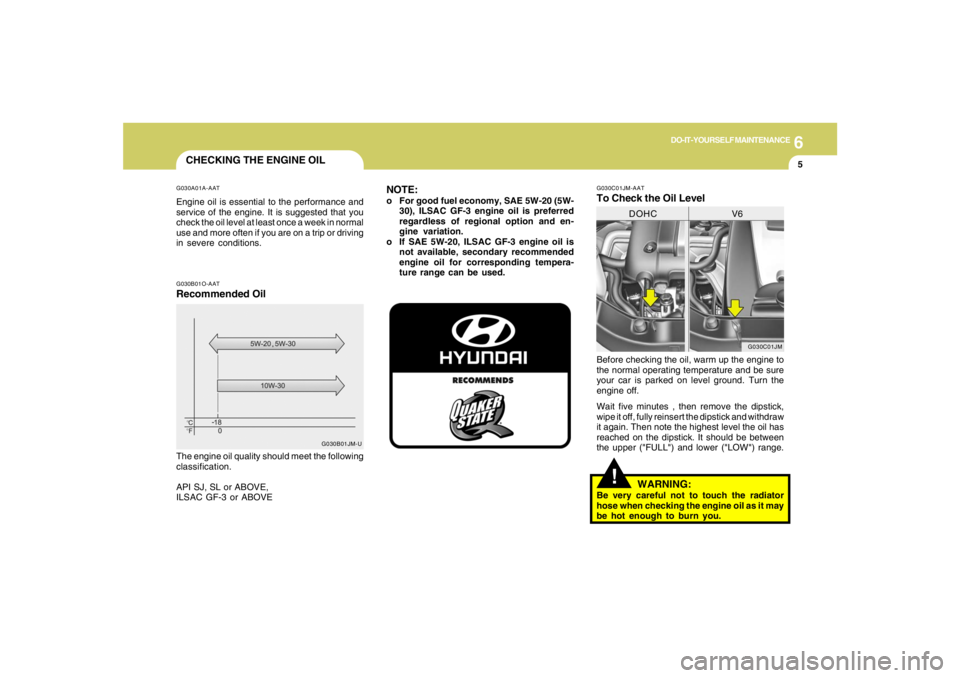
G030B01O-AATRecommended OilThe engine oil quality should meet the following
classification.
API SJ, SL or ABOVE,
ILSAC GF-3 or ABOVE
G030B01JM-U
NOTE:o For good fuel economy, SAE 5W-20 (5W-
30), ILSAC GF-3 engine oil is preferred
regardless of regional option and en-
gine variation.
o If SAE 5W-20, ILSAC GF-3 engine oil is
not available, secondary recommended
engine oil for corresponding tempera-
ture range can be used.
Page 281 of 289
9
VEHICLE SPECIFICATIONS4
Oil & Grease Standard
SAE 5W-20, 5W-30
API SJ, SL or ABOVE,
ILSAC GF-3 or ABOVE
SAE 10W-30 [ABOVE 0°F (-18°C)]
HYUNDAI GENUINE PARTS SAE MTF SAE 75W/85 (API GL-4)
HYUNDAI GENUINE ATF SP III, DIAMOND ATF SP III, SK ATF SP III or other
brands meeting the SP III specification approved by Hyundai Motor Co..
API GL-5, SAE 80W/90 (SHELL SPIRAX AX Equivalent)
API GL-5, SAE 80W/90 (SHELL SPIRAX AX Equivalent)
Ethylene glycol base for aluminum radiator
PSF-3 TYPE FLUID
DOT 3, DOT 4 or Equivalent Item
Engine Oil
Recommends
TransaxleManual
Automatic
Transfer case
Rear Axle
Coolant
Power steering gear
Brakes and clutch fluid
LUBRICATION CHARTJ080A03JM-AAT
Q'ty u.s.qts. (liter)
Drain and refill with oil filter
2.0 L : 4.23 (4.0)
2.7 L : 4.76 (4.5)
2.2 (2.1)
8.2 (7.8)
0.8 (0.8)
0.8 (0.75)
7.4 (7.0)
0.95 (0.9)
As required
Page 289 of 289

Seoul KoreaPrinting: MAR. 28, 2006
Publication No.: A2EO-EU63M
Printed in Korea
SERVICE STATION INFORMATION
FUEL:UNLEADED gasoline only
Pump Octane Rating of 87 (Research Octane Number 91) or higher.FUEL TANK CAPACITYUS.gal (Imp.gal., liter) 2.7L: 17 (14.3, 65), 2.0L: 15 (12.8, 58)TIRE PRESSURE:See the label on the driver's side of the center pillar outer panel.OTHER TIRE INFORMATION:See pages 8-3 through 8-14.HOOD RELEASE:Pull handle under left side of dash.ENGINE OIL:API grade SJ, SL or ABOVE / ILSAC grade GF-3 or ABOVE and fuel
efficient oil. Use SAE 5W-20, 5W-30 or 10W-30 if normal temperatures
are above 0°F (-18°C). For other viscosity recommendations, see page 6-
5 or 9-4.
MANUAL TRANSAXLE:HYUNDAI GENUINE PARTS MTF 75W/85 (API GL-4) Oil level
should be up to filler-bolt hole in housing beside differential.AUTOMATIC TRANSAXLE:Apply the parking brake, with the engine running, shift the selector lever
through all ranges and return to “N” (Neutral) position. Then check the level
of fluid on the dipstick. Use only HYUNDAI GENUINE ATF SP III,
DIAMOND ATF SP III, SK ATF SP III or other brands meeting the SP III
specification approved by Hyundai Motor Co..QUICK INDEXo Car will not start ....................................................................... 3-2
o Flat tire ..................................................................................... 3-6
o Warning light/chime comes on ...................................... 1-48 ~ 1-52
o Engine overheats....................................................................... 3-4
o Towing of your vehicle ........................................................... 3-16
o Starting the engine ..................................................................... 2-4
o Driving tips for first 1,200 miles (2,000 km) ............................ 1-3
o Scheduled maintenance ............................................................ 5-4
o Reporting safety defects ......................................................... 8-17
![HYUNDAI TUCSON 2006 Owners Manual 9
VEHICLE SPECIFICATIONS4
Oil & Grease Standard
SAE 5W-20, 5W-30
API SJ, SL or ABOVE,
ILSAC GF-3 or ABOVE
SAE 10W-30 [ABOVE 0°F (-18°C)]
HYUNDAI GENUINE PARTS SAE MTF SAE 75W/85 (API GL-4)
HYUNDAI G](/manual-img/35/41156/w960_41156-280.png "HYUNDAI TUCSON 2006 Owners Manual 9
VEHICLE SPECIFICATIONS4
Oil & Grease Standard
SAE 5W-20, 5W-30
API SJ, SL or ABOVE,
ILSAC GF-3 or ABOVE
SAE 10W-30 [ABOVE 0°F (-18°C)]
HYUNDAI GENUINE PARTS SAE MTF SAE 75W/85 (API GL-4)
HYUNDAI G")