2006 HYUNDAI TUCSON lock
[x] Cancel search: lockPage 141 of 289

1
FEATURES OF YOUR HYUNDAI
129129129129129
Mode Select KnobPressing the MODE button changes the BASS,
MIDDLE, TREBLE, FADER and BALANCE
mode.
The mode selected is shown on the display.
After selecting the each mode, rotate the mode
select knob clockwise or counterclockwise.BASS ControlTo increase the BASS, rotate the knob clock-
wise, while to decrease the BASS, rotate the
knob counterclockwise.MID ControlTo increase the MID, rotate the knob clockwise,
while to decrease the MID, rotate the knob
counterclockwise.TREBLE ControlTo increase the TREBLE, rotate the knob clock-
wise, while to decrease the TREBLE, rotate the
knob counterclockwise.
FAD (Fader Control)Rotate the control knob clockwise to empha-
size rear speaker sound (front speaker sound
will be attenuated). When the control knob is
turned counterclockwise, front speaker sound
will be emphasized (rear speaker sound will be
attenuated).BALANCE ControlRotate the knob clockwise to emphasize right
speaker sound (left speaker sound will be
attenuated). When the control knob is turned
counterclockwise, left speaker sound will be
emphasized (right speaker sound will be at-
tenuated).
!
CAUTION:
o Do not place beverages close to the
audio system. The audio system mecha-
nism may be damaged if you spill them.
o Do not impact on the audio system, or
the audio system mechanism could be
damaged.
Page 151 of 289
1
FEATURES OF YOUR HYUNDAI
139139139139139
CAUTION:
o Be sure to remove the antenna before
washing the car in an automatic car
wash or it may be damaged.
o Before entering a place with a low height
clearance, be sure to adjust the roof
antenna low.
o In some vehicles, the antenna can be
folded into only front position.
o When reinstalling your antenna, it is
important that it is fully tightened to
ensure proper reception.
!
ANTENNA
B870D02JM-U B870D02JM-AAT
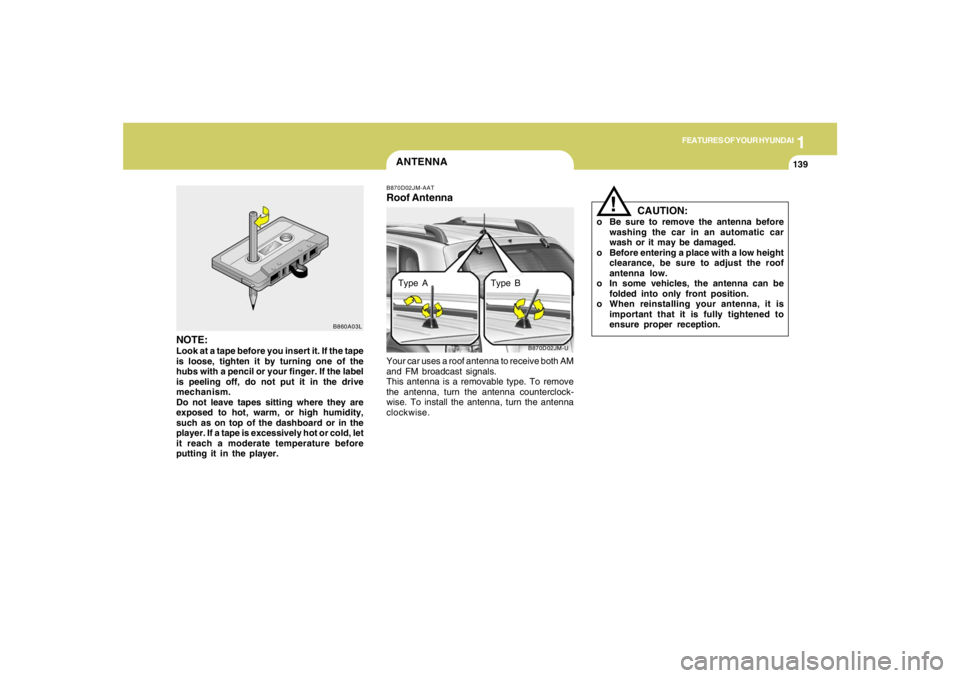
Roof AntennaYour car uses a roof antenna to receive both AM
and FM broadcast signals.
This antenna is a removable type. To remove
the antenna, turn the antenna counterclock-
wise. To install the antenna, turn the antenna
clockwise.
NOTE:Look at a tape before you insert it. If the tape
is loose, tighten it by turning one of the
hubs with a pencil or your finger. If the label
is peeling off, do not put it in the drive
mechanism.
Do not leave tapes sitting where they are
exposed to hot, warm, or high humidity,
such as on top of the dashboard or in the
player. If a tape is excessively hot or cold, let
it reach a moderate temperature before
putting it in the player.
B860A03L
Type A Type B
Page 152 of 289
DRIVING YOUR HYUNDAI
2
Engine Exhaust Can Be Dangerous! ............................ 2-2
Before Starting the Engine ............................................ 2-4
Key Positions ................................................................ 2-5
Starting ..........................................................................2-6
Manual Transaxle ......................................................... 2-7
Automatic Transaxle ..................................................... 2-9
Anti-Lock Brake System (ABS) ..................................2-13
Traction Control System (TCS) ..................................2-13
Electronic Stability Control (ESC)...............................2-15
Full-Time 4WD Operation...........................................2-16
4WD Lock System......................................................2-19
Good Braking Practices..............................................2-21
Driving for Economy...................................................2-22
Winter Driving.............................................................2-23
Trailer or Vehicle Towing ............................................2-26
Vehicle Load Limit.......................................................2-29
2
Page 155 of 289
2
DRIVING YOUR HYUNDAI
4
TO START THE ENGINEC030A01E-AATCOMBINATION IGNITION SWITCHo If your Hyundai is equipped with a manual
transaxle, place the shift lever in neutral and
depress the clutch pedal fully.
o If your Hyundai has an automatic transaxle,
place the shift lever in "P" (park).
o To start the engine, insert the ignition key and
turn it to the "START" position. Release it as
soon as the engine starts. Do not hold the
key in the "START" position for more that 15
seconds.NOTE:o For safety, the engine will not start if the
clutch pedal is not depressed fully
(Manual Transaxle) or the shift lever is
not in "P" or "N" Position (Automatic
Transaxle).
o The ignition key cannot be turned from
"ACC" position to "LOCK" position un-
less the shift lever is in the "P" (Park)
position or the negative battery terminal
is disconnected from the battery. To
remove the key, always confirm that the
shift lever is securely positioned in "P"
(Park) (For Automatic Transaxle).
o For additional information about start-
ing, see page 2-6.
BEFORE STARTING THE ENGINEC020A03A-AATBefore you start the engine, you should always:
1. Look around the vehicle to be sure there are
no flat tires, puddles of oil, water or other
indications of possible trouble.
2. After entering the car, check to be sure the
parking brake is engaged.
3. Check that all windows, and lights are clean.
4. Check that the interior and exterior mirrors
are clean and in position.
5. Check your seat, seatback and headrest to
be sure they are in their proper positions.
6. Lock all the doors.
7. Fasten your seat belt and be sure that all
other occupants have fastened theirs.
8. Turn off all lights and accessories that are
not needed.
9. When you turn the ignition switch to "ON",
check that all appropriate warning lights are
operating and that you have sufficient fuel.
10.Check the operation of warning lights and all
bulbs when key is in the "ON" position.
!
WARNING:
o All passengers must be properly belted
whenever the vehicle is moving. Refer to
pages: 1-18 through 1-24 for more infor-
mation on their proper use.
o Always check the surrounding areas near
your vehicle for people, especially chil-
dren, before putting a car into 'drive.'
!
WARNING:
Always wear appropriate shoes when oper-
ating your vehicle.
Unsuitable shoes (high heels, ski boots,
etc.) may interfere with your ability to use
the brake and accelerator pedal, and the
clutch (if installed).
Page 156 of 289
2
DRIVING YOUR HYUNDAI
5
KEY POSITIONSC040A02A-AAT
CAUTION:
The engine should not be turned off or the
key removed from the ignition key cylinder
while the car is in motion. The steering
wheel is locked by removing the key.
!
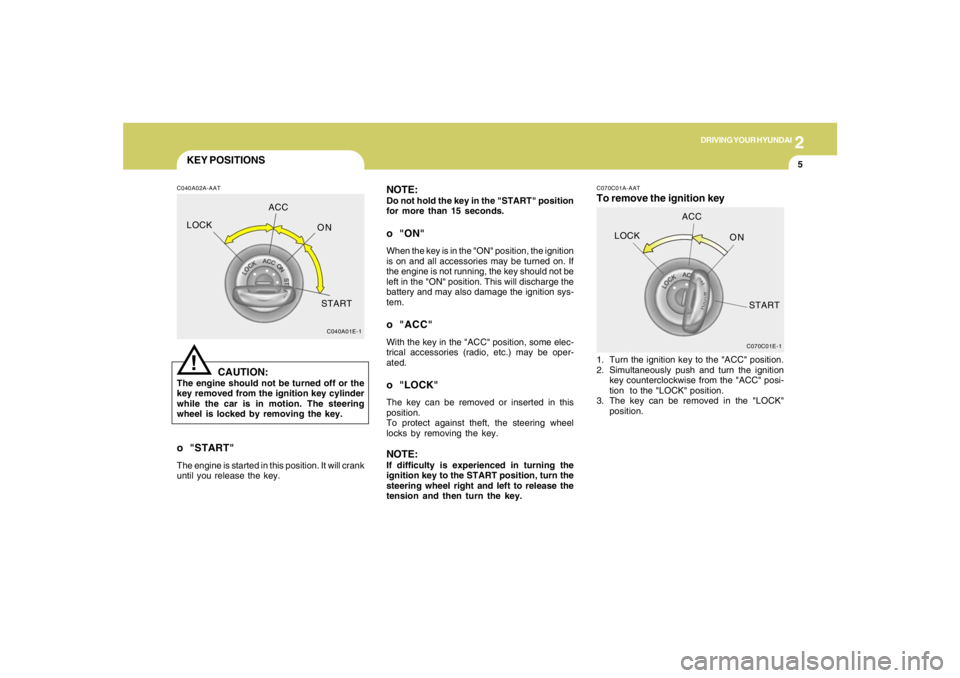
o "START"The engine is started in this position. It will crank
until you release the key.
C040A01E-1
LOCKACC
ON
START
NOTE:Do not hold the key in the "START" position
for more than 15 seconds.o "ON"When the key is in the "ON" position, the ignition
is on and all accessories may be turned on. If
the engine is not running, the key should not be
left in the "ON" position. This will discharge the
battery and may also damage the ignition sys-
tem.o "ACC"With the key in the "ACC" position, some elec-
trical accessories (radio, etc.) may be oper-
ated.o "LOCK"The key can be removed or inserted in this
position.
To protect against theft, the steering wheel
locks by removing the key.NOTE:If difficulty is experienced in turning the
ignition key to the START position, turn the
steering wheel right and left to release the
tension and then turn the key.
C070C01E-1
LOCKACC
ON
START
C070C01A-AATTo remove the ignition key1. Turn the ignition key to the "ACC" position.
2. Simultaneously push and turn the ignition
key counterclockwise from the "ACC" posi-
tion to the "LOCK" position.
3. The key can be removed in the "LOCK"
position.
Page 164 of 289
2
DRIVING YOUR HYUNDAI
13
!
WARNING:
ABS / TCS / ESC will not prevent accidents
due to improper or dangerous driving ma-
neuvers. Even though vehicle control is
improved during emergency braking, al-
ways maintain a safe distance between you
and objects ahead. Vehicle speeds should
always be reduced during extreme road
conditions.
The braking distance for cars equipped
with an anti-lock braking system / TCS / ESC
may be longer than for those without it in
the following road conditions. During these
conditions the vehicle should be driven at
reduced speeds:
o Rough, gravel or snow-covered roads.
o With tire chains installed.
o On roads where the road surface is pit-
ted or has different surface height.
The safety features of an ABS / TCS / ESC
equipped vehicle should not be tested by
high speed driving or cornering. This could
endanger the safety of yourself or others.
TRACTION CONTROL
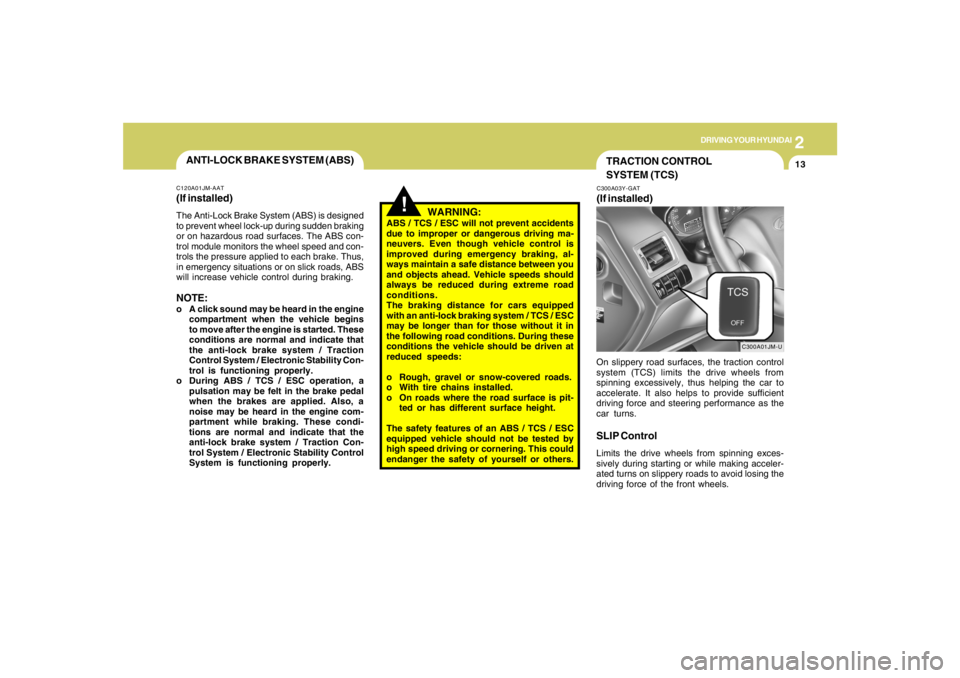
SYSTEM (TCS)C300A03Y-GAT(If installed)
C300A01JM-U
On slippery road surfaces, the traction control
system (TCS) limits the drive wheels from
spinning excessively, thus helping the car to
accelerate. It also helps to provide sufficient
driving force and steering performance as the
car turns.SLIP ControlLimits the drive wheels from spinning exces-
sively during starting or while making acceler-
ated turns on slippery roads to avoid losing the
driving force of the front wheels.
ANTI-LOCK BRAKE SYSTEM (ABS)C120A01JM-AAT(If installed)The Anti-Lock Brake System (ABS) is designed
to prevent wheel lock-up during sudden braking
or on hazardous road surfaces. The ABS con-
trol module monitors the wheel speed and con-
trols the pressure applied to each brake. Thus,
in emergency situations or on slick roads, ABS
will increase vehicle control during braking.NOTE:o A click sound may be heard in the engine
compartment when the vehicle begins
to move after the engine is started. These
conditions are normal and indicate that
the anti-lock brake system / Traction
Control System / Electronic Stability Con-
trol is functioning properly.
o During ABS / TCS / ESC operation, a
pulsation may be felt in the brake pedal
when the brakes are applied. Also, a
noise may be heard in the engine com-
partment while braking. These condi-
tions are normal and indicate that the
anti-lock brake system / Traction Con-
trol System / Electronic Stability Control
System is functioning properly.
Page 170 of 289
2
DRIVING YOUR HYUNDAI
19
4WD LOCK SYSTEMC360A01O-GAT(With Electronic Control 4WD)
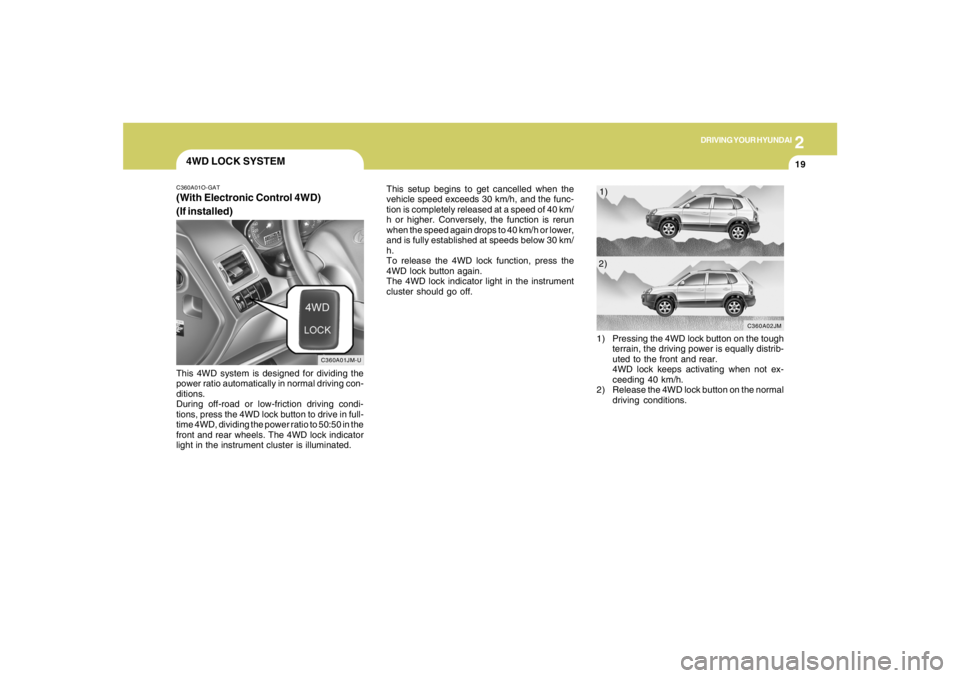
(If installed)This 4WD system is designed for dividing the
power ratio automatically in normal driving con-
ditions.
During off-road or low-friction driving condi-
tions, press the 4WD lock button to drive in full-
time 4WD, dividing the power ratio to 50:50 in the
front and rear wheels. The 4WD lock indicator
light in the instrument cluster is illuminated.This setup begins to get cancelled when the
vehicle speed exceeds 30 km/h, and the func-
tion is completely released at a speed of 40 km/
h or higher. Conversely, the function is rerun
when the speed again drops to 40 km/h or lower,
and is fully established at speeds below 30 km/
h.
To release the 4WD lock function, press the
4WD lock button again.
The 4WD lock indicator light in the instrument
cluster should go off.
C360A01JM-U
1) Pressing the 4WD lock button on the tough
terrain, the driving power is equally distrib-
uted to the front and rear.
4WD lock keeps activating when not ex-
ceeding 40 km/h.
2) Release the 4WD lock button on the normal
driving conditions.
C360A02JM
1)
2)
Page 171 of 289
2
DRIVING YOUR HYUNDAI
20
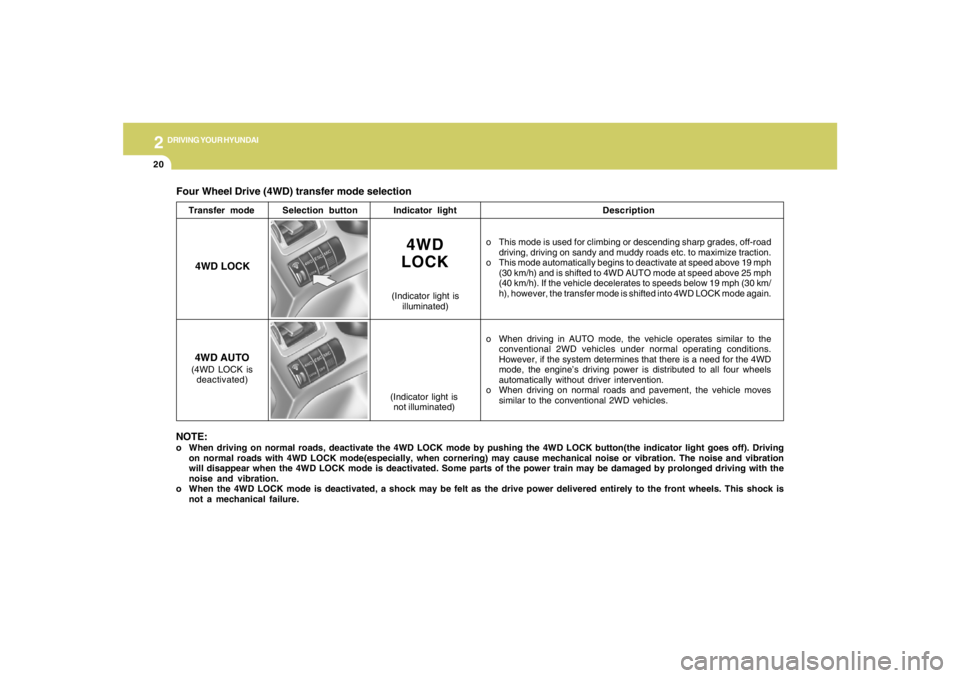
Four Wheel Drive (4WD) transfer mode selection
Transfer modeSelection buttonIndicator lightDescription
o This mode is used for climbing or descending sharp grades, off-road
driving, driving on sandy and muddy roads etc. to maximize traction.
o This mode automatically begins to deactivate at speed above 19 mph
(30 km/h) and is shifted to 4WD AUTO mode at speed above 25 mph
(40 km/h). If the vehicle decelerates to speeds below 19 mph (30 km/
h), however, the transfer mode is shifted into 4WD LOCK mode again.
o When driving in AUTO mode, the vehicle operates similar to the
conventional 2WD vehicles under normal operating conditions.
However, if the system determines that there is a need for the 4WD
mode, the engine’s driving power is distributed to all four wheels
automatically without driver intervention.
o When driving on normal roads and pavement, the vehicle moves
similar to the conventional 2WD vehicles.
4WD
LOCK
(Indicator light is
illuminated)
4WD LOCK
4WD AUTO(4WD LOCK is
deactivated)
(Indicator light is
not illuminated)
NOTE:o When driving on normal roads, deactivate the 4WD LOCK mode by pushing the 4WD LOCK button(the indicator light goes off). Driving
on normal roads with 4WD LOCK mode(especially, when cornering) may cause mechanical noise or vibration. The noise and vibration
will disappear when the 4WD LOCK mode is deactivated. Some parts of the power train may be damaged by prolonged driving with the
noise and vibration.
o When the 4WD LOCK mode is deactivated, a shock may be felt as the drive power delivered entirely to the front wheels. This shock is
not a mechanical failure.