2006 Hyundai Terracan open fuel cap
[x] Cancel search: open fuel capPage 110 of 539
1FEATURES OF YOUR HYUNDAI
96
!WARNING:
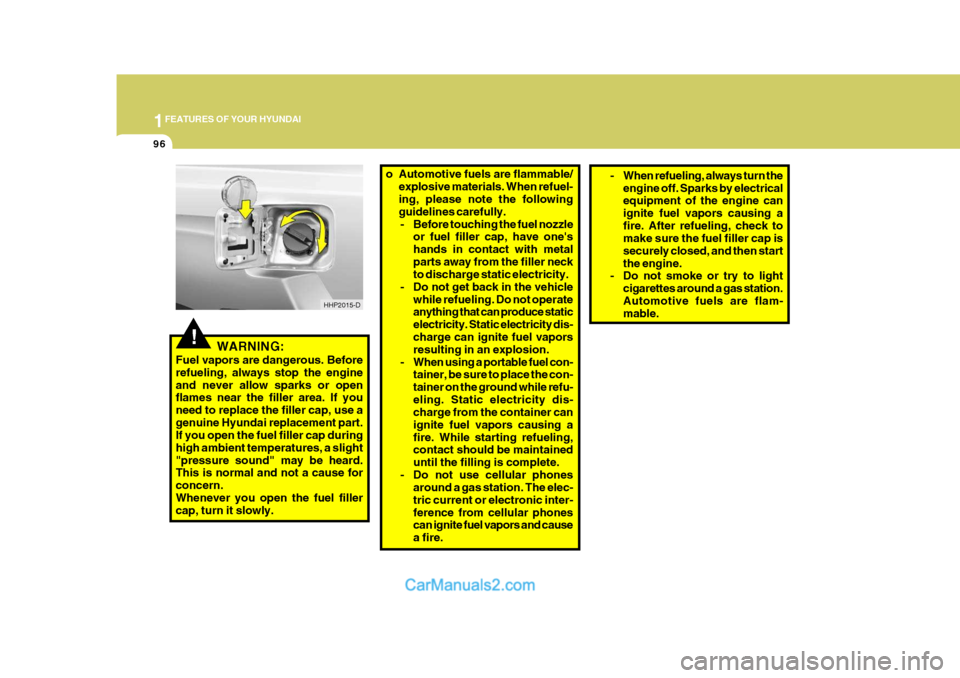
Fuel vapors are dangerous. Before refueling, always stop the engineand never allow sparks or open flames near the filler area. If you need to replace the filler cap, use agenuine Hyundai replacement part. If you open the fuel filler cap during high ambient temperatures, a slight"pressure sound" may be heard. This is normal and not a cause for concern.Whenever you open the fuel filler cap, turn it slowly. HHP2015-D
o Automotive fuels are flammable/
explosive materials. When refuel-ing, please note the following guidelines carefully.- Before touching the fuel nozzle or fuel filler cap, have one'shands in contact with metalparts away from the filler neck to discharge static electricity.
- Do not get back in the vehicle
while refueling. Do not operateanything that can produce static electricity. Static electricity dis- charge can ignite fuel vapors resulting in an explosion.
- When using a portable fuel con- tainer, be sure to place the con-tainer on the ground while refu-eling. Static electricity dis- charge from the container can ignite fuel vapors causing afire. While starting refueling, contact should be maintained until the filling is complete.
- Do not use cellular phones around a gas station. The elec-tric current or electronic inter-ference from cellular phones can ignite fuel vapors and cause a fire. - When refueling, always turn the
engine off. Sparks by electrical equipment of the engine can ignite fuel vapors causing afire. After refueling, check to make sure the fuel filler cap is securely closed, and then startthe engine.
- Do not smoke or try to light
cigarettes around a gas station.Automotive fuels are flam- mable.
Page 192 of 539

3
WHAT TO DO IN AN EMERGENCY
5SPARE TIRE
!
!!WARNING (Diesel only):
Never work on injection system with engine running or within 30 sec- onds after shutting off engine. High pressure pump, rail, injectors andhigh pressure pipes are subject to high pressure even after the engine stopped. The fuel jet produced byfuel leaks may cause serious in- jury, if it touch the body. People using pacemakers should not movethan 30cm closer to the ECU or wiring harness within the engine room while engine is running, sincethe high currents in the Common Rail system produce considerable magnetic fields. WARNING:
Do not remove the radiator cap whenthe engine is hot. This can allowcoolant to be blown out of the open- ing and cause serious burns.
5. If the water pump drive belt is bro- ken or coolant is leaking out, stop the engine immediately and call the nearest Hyundai dealer for assis- tance. 6. If you cannot find the cause of the
overheating, wait until the enginetemperature has returned to nor-mal. Then, if coolant has been lost, carefully add coolant to the reser- voir (Page 6-12) to bring the fluidlevel in the reservoir up to the half- way mark.
7. Proceed with caution, keeping alert for further signs of overheating. Ifoverheating happens again, call a Hyundai dealer for assistance.
CAUTION:
Serious loss of coolant indicates there is a leak in the cooling system and this should be checked as soonas possible by a Hyundai dealer. D040A01HP-GAT The following instructions for the FULL SIZE spare tire should be observed: Check inflation pressure as soon as possible after installing the spare tire,and adjust to the specified pressure. The tire pressure should be periodi- cally checked and maintained at thespecified pressure while the tire is stored. Spare Tire Pressure
Tire Size Inflation Pressure Full Size 200 kPa (29 psi)
Page 262 of 539
6
DO-IT-YOURSELF MAINTENANCE
35
!WARNING:
o Do not smoke or have any other open flame near the vehicle while bleeding the fuel system.
o Be sure to carefully clean away any fuel which spilled onto nearby parts coming out of the air bleed bolt, because suchaccumulations of fuel might ig- nite and cause a fire. G300A02HP-GAT Removal of Water from the Fuel Filter (For Diesel Engine (2.5 TCI)) If the fuel filter warning lamp illumi- nates during driving, it indicates thatwater has accumulated in the fuel filter. If this occurs, remove the water as described below.
G300A01HP
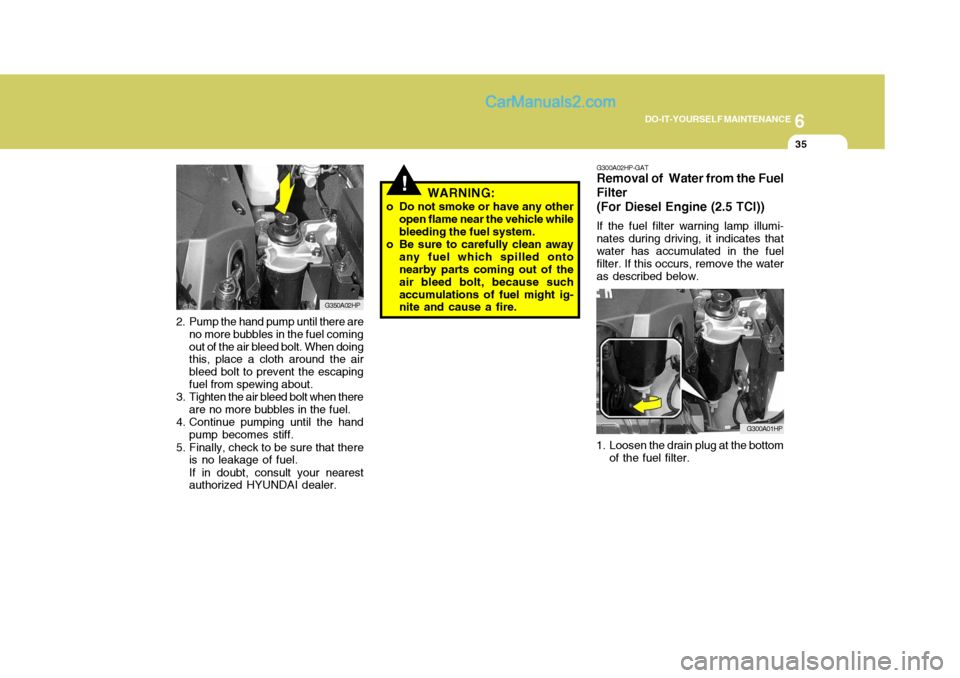
1. Loosen the drain plug at the bottom of the fuel filter.
2. Pump the hand pump until there are
no more bubbles in the fuel comingout of the air bleed bolt. When doing this, place a cloth around the air bleed bolt to prevent the escapingfuel from spewing about.
3. Tighten the air bleed bolt when there
are no more bubbles in the fuel.
4. Continue pumping until the hand pump becomes stiff.
5. Finally, check to be sure that there is no leakage of fuel. If in doubt, consult your nearest authorized HYUNDAI dealer. G350A02HP
Page 276 of 539
7EMISSION CONTROL SYSTEMS
2EMISSION CONTROL SYSTEMS
H010A01A-GAT
(If Installed)
Your Hyundai is equipped with an
emission control system to meet all requirements of the Emission prohibi- tion rules of your province.
There are three emission control sys-
tems which are as follows.
(1) Crankcase emission control sys- tem (For a Gasoline Engine)
(2) Evaporative emission control sys- tem (For a Gasoline Engine)
(3) Exhaust emission control system
In order to assure the proper function
of the emission control systems, it is recommended that you have your carinspected and maintained by an au- thorized Hyundai dealer in accordance with the maintenance schedule in thismanual. H010B01A-AAT
1. Crankcase Emission Control
System ; For a Gasoline Engine
The positive crankcase ventilation
system is employed to prevent air pollution caused by blow-by gasesbeing emitted from the crankcase. This system supplies fresh filtered air to the crankcase through the air in-take hose. Inside the crankcase, which the fresh air mixes with blow-by gases, which then pass through the PCVvalve into the induction system.
H010C02Y-GAT
2. Evaporative Emission
Control System ; For a Gasoline Engine
The Evaporative Emission Control
System is designed to prevent fuel vapors from escaping into the atmo- sphere. Canister
While the engine is inoperative, fuel
vapors generated inside the fuel tankare absorbed and stored in the canis- ter. When the engine is running, thefuel vapors absorbed in the canister are drawn into the induction system through the purge control solenoidvalve. Purge Control Solenoid Valve
The purge control solenoid valve is
controlled by the ECM; when the en- gine coolant temperature is low, and during idling, it closes, so that evapo- rated fuel is not taken into the surgetank. After engine warm-up, during ordinary driving, it opens so as to introduce evaporated fuel to the surgetank. H010D01A-AAT
3. Exhaust Emission Control
System
The Exhaust Emission Control Sys- tem is a highly effective system whichcontrols exhaust emissions while maintaining good vehicle performance.
hpflene-7.p65 3/9/2005, 1:52 PM
2
Page 390 of 539

1CONTROLS AND EQUIPMENT
82
!The fuel-filler flap may be opened from inside the vehicle by pulling up on the fuel-filler flap opener located below the left of the driver's side crash pad. NOTE: If the fuel-filler flap will not open because ice has formed around it,lightly tap or push on the lid to break the ice and release it. Do not lever the flap. If necessary, spray around theflap with an approved de-icer fluid (do not use radiator anti-freeze) or move the vehicle to a warmer areaplace and allow the ice to melt. WARNING:
o Fuel vapors are dangerous. Be- fore refueling, always stop the engine and never allow sparks or open flames near the filler area. Ifyou need to replace the filler cap, use a genuine Hyundai replace- ment part.If you open the fuel filler cap dur- ing high ambient temperatures, a slight "pressure sound" may beheard. This is normal and not a cause for concern. Whenever you open the fuel fillercap, turn it slowly.
REMOTE FUEL-FILLER FLAP RELEASE
HPB360A2-E
B560A01HP-EHHP2015-D
In addition to the lower-mounted rear stop lights on either side of the car, the high mounted rear stop light in the centre of the rear window also lightswhen the brakes are applied.
HIGH-MOUNTED REAR STOP LIGHT
B550A01A-EAT
B550A01HP
Page 451 of 539
3
IN CASE OF EMERGENCY
5
!
!
!WARNING:
Whilst the engine is running, keep hands and clothing away from mov- ing parts such as the fan and drive belts to prevent injury.
WARNING (Diesel only):
Never work on injection system withengine running or within 30 seconds after shutting off engine. High pres- sure pump, rail, injectors and highpressure pipes are subject to high pressure even after the engine stopped. The fuel jet produced byfuel leaks may cause serious in- jury, if it contacts the body. People using pacemakers should ensure thatthey keep a distance of 30cm from the ECU or wiring harness within the engine room while engine is run-ning, since the high currents in the Common Rail system produce con- siderable magnetic fields. 5. If the water pump drive belt is broken
or coolant is leaking out, stop theengine immediately and call the near- est Hyundai authorised repairer for assistance.
WARNING:
Do not remove the radiator cap when the engine is hot since steam and boiling water may be ejected fromthe radiator resulting in burns or scalding.
6. If the cause of the overheating can- not be found, wait until the engine temperature has returned to normal. Then, if coolant has been lost, care-fully remove the radiator cap and add water to bring the fluid level in the reservoir(page 6-10) up to the baseof the radiator fill opening. Fill the coolant expansion tank to the half- way mark.
7. Proceed with caution until it is estab- lished that the engine is operatingnormally. If the engine overheatsrepeatedly, the advice of a Hyundai authorised repairer should be sought.! CAUTION:
Serious loss of coolant indicates there is a leak in the cooling system and this should be checked as soon as possible by a Hyundai authorisedrepairer.
Page 521 of 539
7
EMISSION CONTROL SYSTEMS
3
DH010B1-E
1. Crankcase Emission Control System ; For a Petrol Engine
The positive crankcase ventilation
(PVC) system is employed to prevent air pollution caused by blow-by gases being emitted from the crankcase.
This system supplies fresh air to the
crankcase through the air cleaner.Inside the crankcase, the fresh airmixes with blow-by gases, then passes through the PCV valve into the intake system.
ZH010C1-E
2. Evaporative Emission Control System ; For a Petrol Engine
The Evaporative Emission Control
System is designed to prevent fuel vapors from escaping into the atmo- sphere. Canister
Whilst the engine is inoperative, fuel
vapors generated inside the fuel tank are absorbed and stored in the canis-ter. When the engine is running, the fuel vapors absorbed in the canister are drawn into the induction systemthrough the purge control solenoid valve. Purge Control Solenoid Valve
The purge control solenoid valve is
controlled by the ECU (Engine Control Unit); when the engine coolant tem- perature is low, and during idling, it closes, so that evaporated fuel is nottaken into the surge tank. After engine warm-up, during ordinary driving, it opens to introduce evaporated fuel tothe surge tank.
SH010D1-E
3. Exhaust Emission Control System
The exhaust emission control system
is a highly effective system which controls exhaust emission while main- taining good vehicle performance.
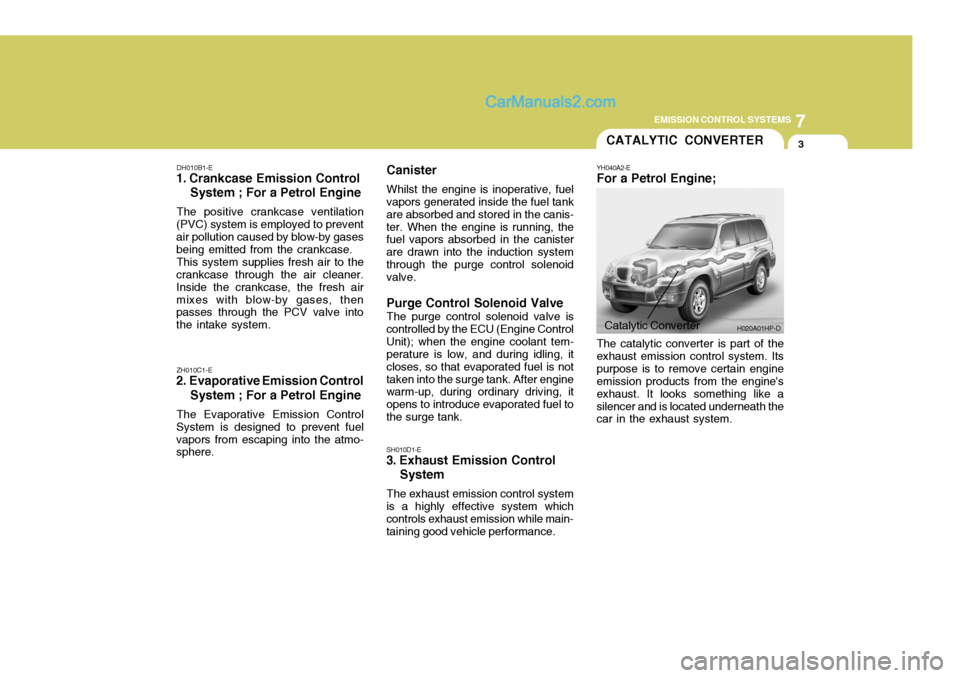
Catalytic Converter H020A01HP-D
CATALYTIC CONVERTER
YH040A2-E For a Petrol Engine; The catalytic converter is part of the exhaust emission control system. Itspurpose is to remove certain engine emission products from the engine's exhaust. It looks something like asilencer and is located underneath the car in the exhaust system.