2006 Hyundai Terracan parking brake
[x] Cancel search: parking brakePage 358 of 539
1CONTROLS AND EQUIPMENT
50
!
!
!
B260P02Y-EAT
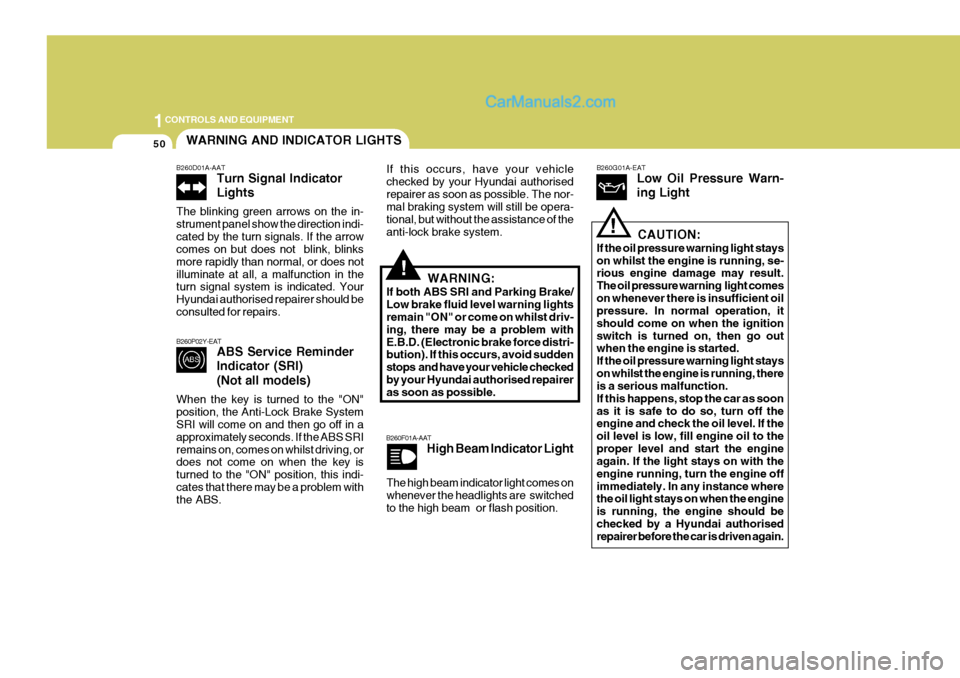
ABS Service Reminder Indicator (SRI) (Not all models)
When the key is turned to the "ON" position, the Anti-Lock Brake System SRI will come on and then go off in a approximately seconds. If the ABS SRIremains on, comes on whilst driving, or does not come on when the key is turned to the "ON" position, this indi-cates that there may be a problem with the ABS. If this occurs, have your vehicle checked by your Hyundai authorisedrepairer as soon as possible. The nor- mal braking system will still be opera- tional, but without the assistance of theanti-lock brake system.
B260F01A-AAT High Beam Indicator Light B260G01A-EAT
Low Oil Pressure Warn- ing Light
CAUTION:
If the oil pressure warning light stays on whilst the engine is running, se- rious engine damage may result. The oil pressure warning light comeson whenever there is insufficient oil pressure. In normal operation, it should come on when the ignitionswitch is turned on, then go out when the engine is started. If the oil pressure warning light stayson whilst the engine is running, there is a serious malfunction. If this happens, stop the car as soonas it is safe to do so, turn off the engine and check the oil level. If the oil level is low, fill engine oil to theproper level and start the engine again. If the light stays on with the engine running, turn the engine offimmediately. In any instance where the oil light stays on when the engine is running, the engine should bechecked by a Hyundai authorised repairer before the car is driven again.
WARNING AND INDICATOR LIGHTS
B260D01A-AAT Turn Signal Indicator Lights
The blinking green arrows on the in- strument panel show the direction indi-cated by the turn signals. If the arrow comes on but does not blink, blinks more rapidly than normal, or does notilluminate at all, a malfunction in the turn signal system is indicated. Your Hyundai authorised repairer should beconsulted for repairs.
The high beam indicator light comes on whenever the headlights are switched to the high beam or flash position. WARNING:
If both ABS SRI and Parking Brake/ Low brake fluid level warning lights remain "ON" or come on whilst driv- ing, there may be a problem withE.B.D. (Electronic brake force distri- bution). If this occurs, avoid sudden stops and have your vehicle checkedby your Hyundai authorised repairer as soon as possible.
Page 359 of 539
1
CONTROLS AND EQUIPMENT
51
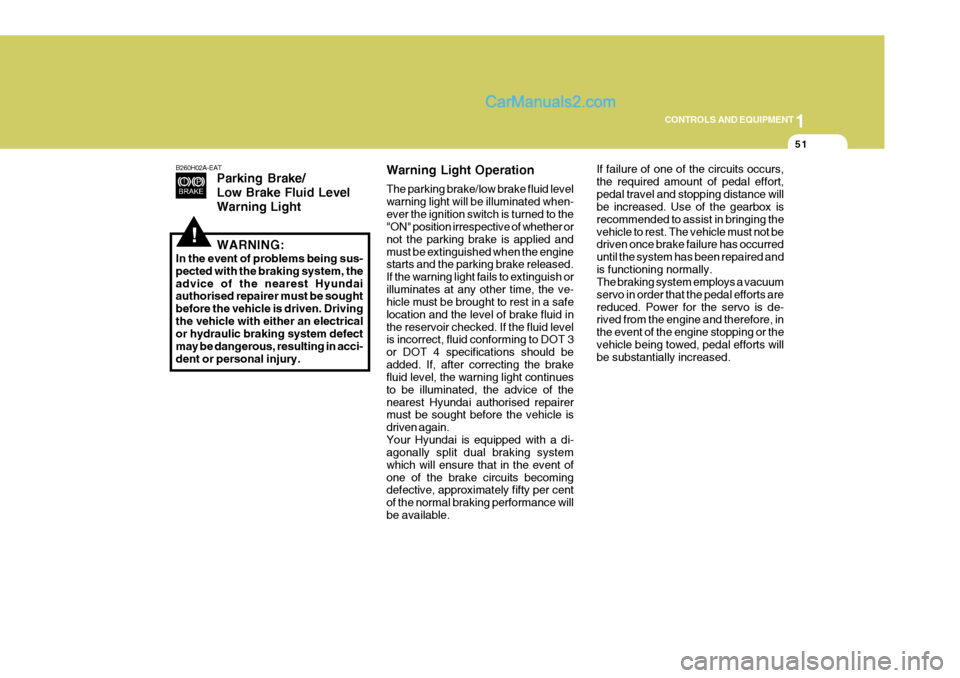
B260H02A-EAT
Parking Brake/ Low Brake Fluid LevelWarning Light WARNING:
In the event of problems being sus- pected with the braking system, theadvice of the nearest Hyundai authorised repairer must be sought before the vehicle is driven. Drivingthe vehicle with either an electrical or hydraulic braking system defect may be dangerous, resulting in acci-dent or personal injury. Warning Light Operation The parking brake/low brake fluid level warning light will be illuminated when-ever the ignition switch is turned to the "ON" position irrespective of whether or not the parking brake is applied andmust be extinguished when the engine starts and the parking brake released. If the warning light fails to extinguish orilluminates at any other time, the ve- hicle must be brought to rest in a safe location and the level of brake fluid inthe reservoir checked. If the fluid level is incorrect, fluid conforming to DOT 3 or DOT 4 specifications should beadded. If, after correcting the brake fluid level, the warning light continues to be illuminated, the advice of thenearest Hyundai authorised repairer must be sought before the vehicle is driven again.Your Hyundai is equipped with a di- agonally split dual braking system which will ensure that in the event ofone of the brake circuits becoming defective, approximately fifty per cent of the normal braking performance willbe available.If failure of one of the circuits occurs,the required amount of pedal effort,pedal travel and stopping distance will be increased. Use of the gearbox is recommended to assist in bringing thevehicle to rest. The vehicle must not be driven once brake failure has occurred until the system has been repaired andis functioning normally. The braking system employs a vacuum servo in order that the pedal efforts arereduced. Power for the servo is de- rived from the engine and therefore, in the event of the engine stopping or thevehicle being towed, pedal efforts will be substantially increased.
!
Page 386 of 539
1CONTROLS AND EQUIPMENT
78
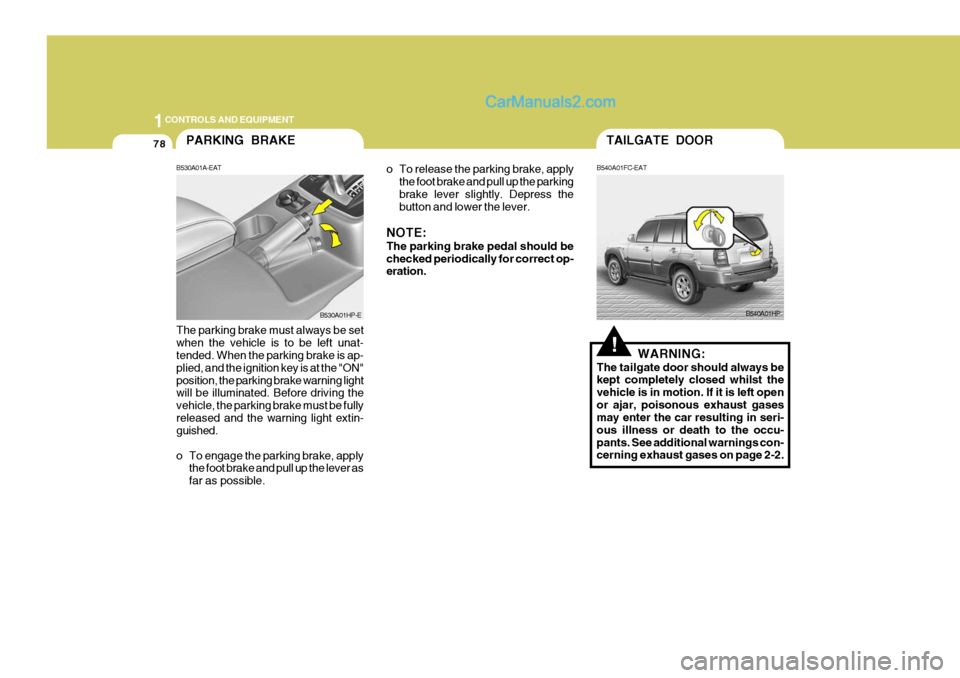
o To release the parking brake, applythe foot brake and pull up the parking brake lever slightly. Depress the button and lower the lever.
NOTE: The parking brake pedal should be checked periodically for correct op- eration.
The parking brake must always be set when the vehicle is to be left unat- tended. When the parking brake is ap- plied, and the ignition key is at the "ON"position, the parking brake warning light will be illuminated. Before driving the vehicle, the parking brake must be fullyreleased and the warning light extin- guished.
o To engage the parking brake, apply the foot brake and pull up the lever as far as possible.PARKING BRAKE
B530A01A-EAT
B530A01HP-E
!
B540A01HP
TAILGATE DOOR
B540A01FC-EAT
WARNING:
The tailgate door should always be
kept completely closed whilst the vehicle is in motion. If it is left openor ajar, poisonous exhaust gases may enter the car resulting in seri- ous illness or death to the occu-pants. See additional warnings con- cerning exhaust gases on page 2-2.
Page 419 of 539
2
DRIVING YOUR HYUNDAI
3
!WARNING:
Your vehicle is equipped with tyres designed to provide for safe ride and handling capability.Do not use a size and type of tyre and wheel that is different from the one that was originally installed on yourvehicle. It can affect the safety and performance of your vehicle, which could lead to handling failure orrollover and serious injury. When replacing the tyres, be sure to equip all four tyres with the tyre andwheel of the same size, type, tread, brand and load-carrying capacity. If you nevertheless decide to equipyour vehicle with any tyre/wheel com- bination not recommended by Hyundai for off-road driving, youshould not use these tyres for high- way driving.
BEFORE STARTING THE ENGINE
C020A02A-EAT Before you start the engine, you should always:
1. Look around the vehicle to be sure
there are no flat tyres, puddles of oil or water or other indications of pos- sible trouble.
2. After entering the car, check to be
sure the parking brake is engaged.
3. Check that all windows, and lights
are clean.
4. Check that the interior and exterior mirrors are clean and in position.
5. Check your seat, seatback and headrest to be sure they are in theirproper positions.
6. Close all the doors.
7. Fasten your seat belt and be sure that all other occupants have fas-tened theirs.
8. Turn off all lights and accessories that are not needed.
9. When you turn the ignition switch to "ON" check that all appropriate warning lights are operating and that you have sufficient fuel.
10.Check the operation of warning lights and all bulbs when key is inthe "ON" position. WARNING:
Always wear appropriate shoes when operating your vehicle. Unsuitable shoes (high heels, skiboots, etc.) may interfere with your ability to use the brake and accelera- tor pedal, and the clutch (Not allmodels).
!
Page 422 of 539

2 DRIVING YOUR HYUNDAI
6
!
NOTE: Do not operate the starter for more than 15 seconds continuously or continue to operate the starter afterthe engine has started to avoid dam- aging the starter motor. If the en- gine makes a false start, allow it andthe starter motor to come to rest before attempting to start the en- gine again. Never attempt to startthe engine with the transmission in gear. Do not depress the accelera- tor pedal whilst starting the engine.Allow the engine to idle for 20 sec- onds or so before driving the ve- hicle.
CAUTION:
Do not leave the vehicle unattendedwhilst idling. Never allow the vehicleto idle or warm up in a confined space (i.e. garage) longer than is necessary to move the vehicle intoan open area. C050B01HP-EAT Starting Procedure
1. Insert key, and fasten the seat belt.
2. Apply the parking brake.
3. If your Hyundai is equipped with a
manual transmission, place the shiftlever in neutral and depress theclutch pedal fully. If your Hyundai has an automatic transmission, place the shift lever in "P" (park).
Amber lamp ON
C050B01HP
Amber lamp OFF
4. On vehicles equipped with the diesel preheat indication lamp, turn the igni- tion key to the "ON" position. The diesel-preheat indication lamp will first illuminate in amber, and thenafter a short time, the amber illumi- nation will go off, indicating that pre- heating is completed.
1. Ensure that the gearshift lever is in
neutral and that the clutch pedal isheld depressed (manual transmis-sion) or the selector lever is at the "P" position (automatic transmission vehicle).
2. Turn the ignition key to and hold at the "START" position until the en-gine starts. When the engine hasstarted, release the key.
STARTING
HPC060A1-E Starting The Engine
C050A01E
Page 425 of 539
2
DRIVING YOUR HYUNDAI
9
o When slippery conditions are en-
countered, increased caution should be exercised when gear changing, braking or accelerat- ing. Abrupt changes in speed maycause a loss of traction or control of the vehicle.
o During cold weather, shifting may be difficult until the transmis-sion lubricant has warmed up. This is normal and not harmful tothe transmission.
o If you've come to a complete stop
and it's hard to shift into 1st orR(Reverse), put the gearshift lever in N(Neutral) position and release the clutch. Press the clutch pedalback down, and then shift into 1st or R(Reverse) gear position.
o Do not use the gearshift lever as a handrest during driving, as thiscan result in premature wear of the transmission shift forks. C070B01A-EAT Using the Clutch The clutch should be pressed all the way to the floor before shifting, then released slowly. The clutch pedal should aways be used after fully re-turning to the original position. Do not rest your foot on the clutch pedal whilst driving. This can cause unnecessarywear. Do not partially engage the clutch to hold the car on an incline. This causesunnecessary wear. Use the parking brake to hold the car on an incline. Do not operate the clutch pedal rapidlyand repeatedly.
!WARNING:
o Avoid high cornering speeds.
o Do not make quick steering wheel movements, such as sharp lane changes or fast, sharp turns.
o Always wear your seat belts.
In a collision crash, an unbeltedperson is significantly more likely to die than a person wearing a seatbelt.
o The risk of rollover is greatly in- creased if you lose control of yourvehicle at motorway speeds.
o Loss of control often occurs if two or more wheels drop off the road-way and the driver oversteers toreenter the roadway.
o In the event your vehicle leaves
the roadway, do not steer sharply.Instead, slow down before pulling back into the travel lanes.
o Never exceed posted speed limits.
Page 428 of 539
2 DRIVING YOUR HYUNDAI
12
!
C090I01E-EAT
CAUTION:
o Shift into "R" and "P" only when the vehicle has completely stopped.
o Do not accelerate the engine in reverse or any of the forward posi-tions with the brakes applied.
o Always apply the footbrake when shifting from "P" or "N" to "R","D", "2" or "L" position.
o Do not use the "P" (Park) posi- tion in place of the parking brake.Always set the parking brake,shift the transmission into "P" (Park) and turn off the ignition when you leave the vehicle, evenmomentarily. Never leave the ve- hicle unattended whilst the en- gine is running.
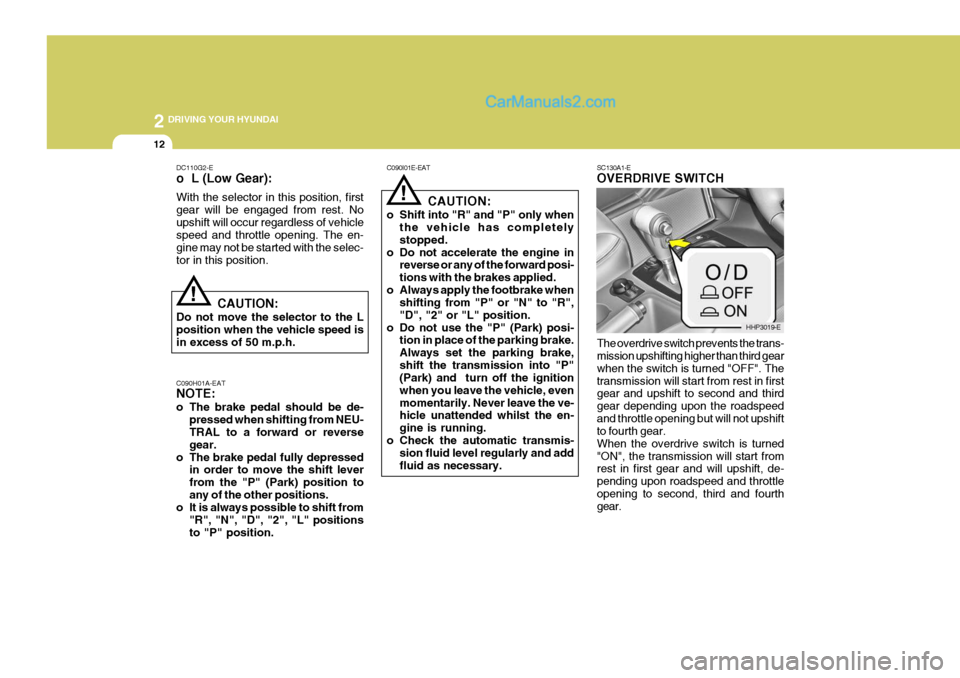
o Check the automatic transmis- sion fluid level regularly and addfluid as necessary. SC130A1-E OVERDRIVE SWITCH The overdrive switch prevents the trans- mission upshifting higher than third gear when the switch is turned "OFF". Thetransmission will start from rest in first gear and upshift to second and third gear depending upon the roadspeedand throttle opening but will not upshift to fourth gear. When the overdrive switch is turned"ON", the transmission will start from rest in first gear and will upshift, de- pending upon roadspeed and throttleopening to second, third and fourth gear.
!
DC110G2-E o L (Low Gear): With the selector in this position, first gear will be engaged from rest. Noupshift will occur regardless of vehicle speed and throttle opening. The en- gine may not be started with the selec-tor in this position.
CAUTION:
Do not move the selector to the Lposition when the vehicle speed isin excess of 50 m.p.h. C090H01A-EAT NOTE:
o The brake pedal should be de- pressed when shifting from NEU- TRAL to a forward or reverse gear.
o The brake pedal fully depressed in order to move the shift leverfrom the "P" (Park) position toany of the other positions.
o It is always possible to shift from
"R", "N", "D", "2", "L" positionsto "P" position.
HHP3019-E
Page 429 of 539
2
DRIVING YOUR HYUNDAI
13
Therefore, when the overdrive switch is turned "OFF", the transmission per-forms as a three speed unit and the overdrive warning light located in the instrument cluster will be illuminated.When the overdrive switch is turned "ON", the transmission functions as a fully automatic four speed unit with themaximum fuel economy potential of the vehicle being realized. HPC120D2-E General Operating Instructions
o The button in the selector handle
must be depressed before the selec- tor lever can be moved.
o The engine may only be started
when the selector is at position "P"or "N".
o Ensure that the footbrake is firmly
applied when shifting from "P" or"N" to "D", "2" or "L" and vice versa.
o Always engage the parking brake
when the vehicle is unattended,never use the "P" position in place of the parking brake.
o Under normal circumstances, the selector lever should be placed in the"D" position and the transmission allowed to select the most ideal ratiofor the circumstances. In this posi- tion maximum fuel economy will be achieved.
o When descending steep gradients where engine braking is required,the selector lever should be placedat the "2" or "L" position depending upon the vehicle speed. o When climbing steep gradients us-
ing large throttle openings, the trans- mission may repeatedly change be- tween two adjacent ratios. This is a normal characteristic and may beprevented by cancelling the over- drive facility if the shifting occurs between third and fourth ratios, se-lecting position "2" if the shifting occurs between third and second ratios or selecting position "1" if theshifting occurs between first and second ratios.
o Never move the selector lever to or from the "P" or "N" position with theaccelerator depressed.
o Ensure that the overdrive switch is at the "ON" position for maximumeconomy.
o If rapid acceleration is required, fully depress the accelerator pedal. Inthis condition, the kickdown mecha- nism will be operated and the trans-mission will automatically downshift according to the vehicle speed.
o The automatic transaxle may be used to great effect if the vehicle becomesstuck in snow or mud by allowing the vehicle to be rocked to and fro.