2006 Hyundai Terracan oil temperature
[x] Cancel search: oil temperaturePage 265 of 539

6 DO-IT-YOURSELF MAINTENANCE
38REPLACING HEADLIGHT BULBS
G260A03A-GAT Before attempting to replace a head- light bulb, be sure the switch is turned to the "OFF" position. The next paragraph shows how to reach the headlight bulbs so they may be changed. Be sure to replacethe burned-out bulb with one of the same number and wattage rating.
CAUTION:
o Keep the lamps out of contact with petroleum product, such as oil, gasoline, etc.
o After heavy, driving rain or wash- ing, headlight and taillight lensescould appear frosty. This condi- tion is caused by the temperature difference between the lamp in-side and outside. This is similar to the condensation on your win- dows inside your vehicle duringthe rain and doesn’t indicate a problem with your vehicle. If the water leaks into the lamp bulbcircuitry, have the vehicle checked by an Authorized Hyundai Dealer.
! G270A01B-GAT
Headlight Bulb
1. Allow the bulb to cool. Wear eye
protection.
2. Open the engine hood.
3. Always grasp the bulb by its plas- tic base, avoid touching the glass.
4. Using a spanner, remove the head- light assembly mounting bolts.
5. Disconnect the power cord from the bulb base in the back of the headlight.
G270A01HP7. Disconnect the connector from the
bulb base in the back of the head- light.
G270A02HP
6. Turn the plastic cover counterclock- wise and remove it. 8. Push the bulb spring to remove the
headlight bulb.
Page 308 of 539
YOUR VEHICLE AT A GLANCE
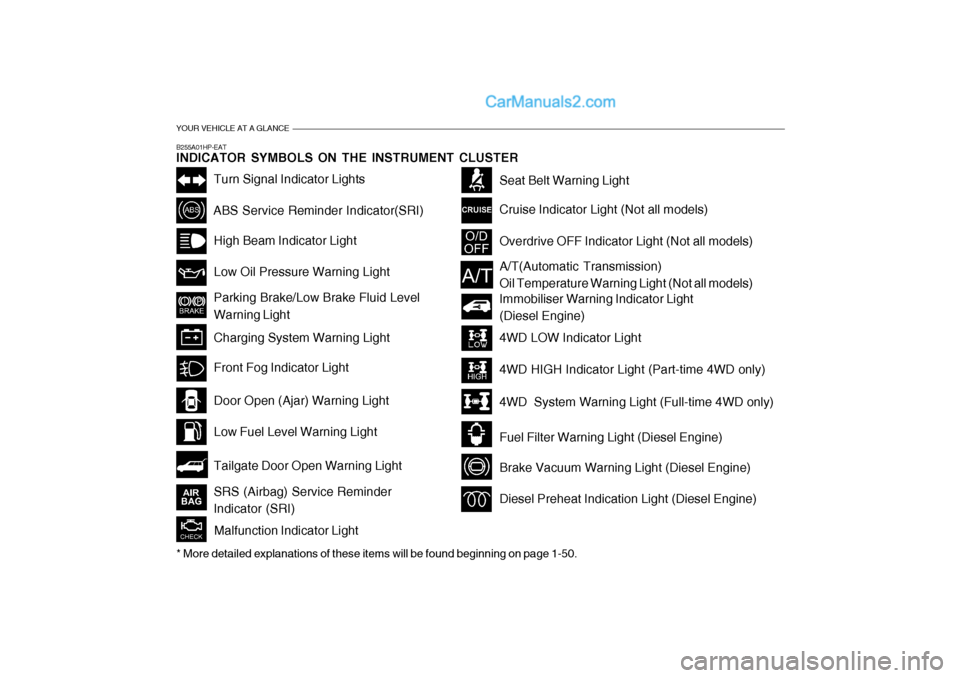
B255A01HP-EAT INDICATOR SYMBOLS ON THE INSTRUMENT CLUSTER
Turn Signal Indicator Lights
ABS Service Reminder Indicator(SRI)High Beam Indicator Light Low Oil Pressure Warning Light Parking Brake/Low Brake Fluid Level Warning Light Charging System Warning Light
Tailgate Door Open Warning Light
Door Open (Ajar) Warning Light Low Fuel Level Warning Light
Front Fog Indicator Light
Overdrive OFF Indicator Light (Not all models)
Immobiliser Warning Indicator Light (Diesel Engine)
Seat Belt Warning Light Cruise Indicator Light (Not all models)
Malfunction Indicator Light
A/T(Automatic Transmission) Oil Temperature Warning Light (Not all models)
4WD LOW Indicator Light 4WD HIGH Indicator Light (Part-time 4WD only)
4WD System Warning Light (Full-time 4WD only)
Fuel Filter Warning Light (Diesel Engine)
Brake Vacuum Warning Light (Diesel Engine)
Diesel Preheat Indication Light (Diesel Engine)
* More detailed explanations of these items will be found beginning on page 1-50.SRS (Airbag) Service Reminder Indicator (SRI)
Page 355 of 539

1
CONTROLS AND EQUIPMENT
47
1. Tachometer
2. Turn Signal Indicator Light
3. Coolant Temperature Gauge
4. Fuel Gauge
5. Speedometer
6. ABS Service Reminder Indicator(SRI) (Not all models)
7. Supplemental Restraint (AirBag) System Service Reminder lndicator (SRI)
8. Low Oil Pressure Warning Light
9. Parking Brake/Low Brake Fluid LevelWarning Light
10. Charging System Warning Light
11. A/T Oil Temperature Warning Light (Not all models)
12. Overdrive OFF Indicator Light (Not all models)
13. High Beam Indicator Light 14. Front Fog Indicator Light
15. Automatic Transmission Position Indicator Light (Not all models)
16. Cruise Indicator Light (Not all models)
17. 4WD LOW Indicator Light
18. 4WD HIGH Indicator Light (Part-time 4WD)
/4WD System Warning Light (Full-time 4WD)
19. Malfunction Indicator Light (MIL)
20. Trip Odometer
21. Odometer 22.Trip odometer Reset Knob
23. Tailgate Door Open Warning Light
24. Door Open (Ajar) Warning Light
25. Seat Belt Warning Light
26. Low Fuel Warning Light
Page 357 of 539
1
CONTROLS AND EQUIPMENT
49
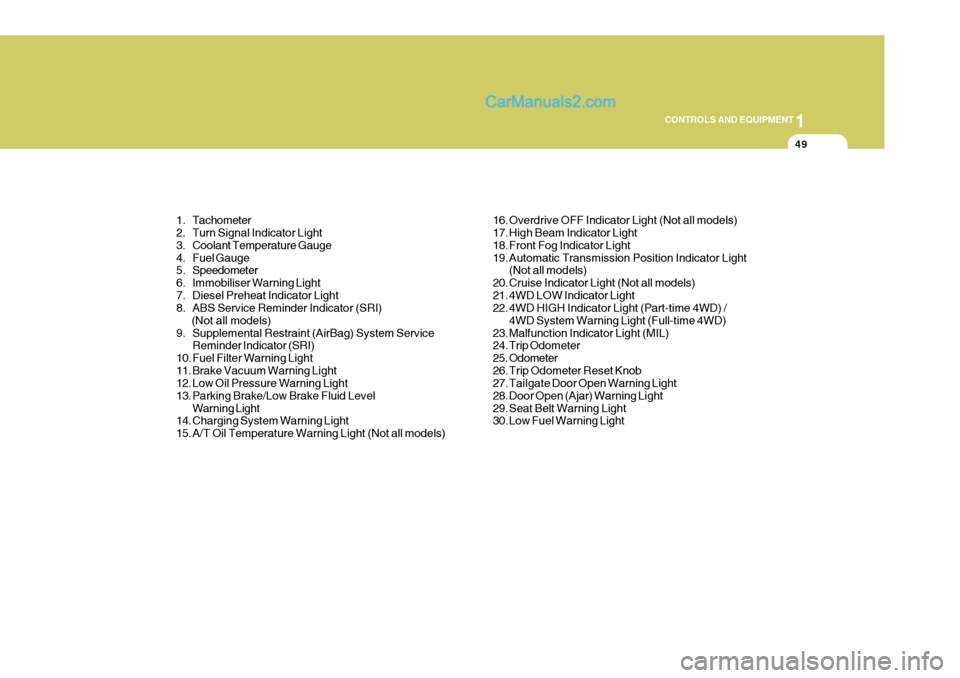
1. Tachometer
2. Turn Signal Indicator Light
3. Coolant Temperature Gauge
4. Fuel Gauge
5. Speedometer
6. Immobiliser Warning Light
7. Diesel Preheat Indicator Light
8. ABS Service Reminder Indicator (SRI) (Not all models)
9. Supplemental Restraint (AirBag) System Service Reminder Indicator (SRI)
10. Fuel Filter Warning Light
11. Brake Vacuum Warning Light
12. Low Oil Pressure Warning Light
13. Parking Brake/Low Brake Fluid Level Warning Light
14. Charging System Warning Light
15. A/T Oil Temperature Warning Light (Not all models) 16. Overdrive OFF Indicator Light (Not all models)
17. High Beam Indicator Light
18. Front Fog Indicator Light
19. Automatic Transmission Position Indicator Light
(Not all models)
20. Cruise Indicator Light (Not all models)
21. 4WD LOW Indicator Light
22. 4WD HIGH Indicator Light (Part-time 4WD) / 4WD System Warning Light (Full-time 4WD)
23. Malfunction Indicator Light (MIL)
24. Trip Odometer
25. Odometer
26. Trip Odometer Reset Knob
27. Tailgate Door Open Warning Light
28. Door Open (Ajar) Warning Light
29. Seat Belt Warning Light
30. Low Fuel Warning Light
Page 362 of 539
1CONTROLS AND EQUIPMENT
54
!
B260U01HP-EAT
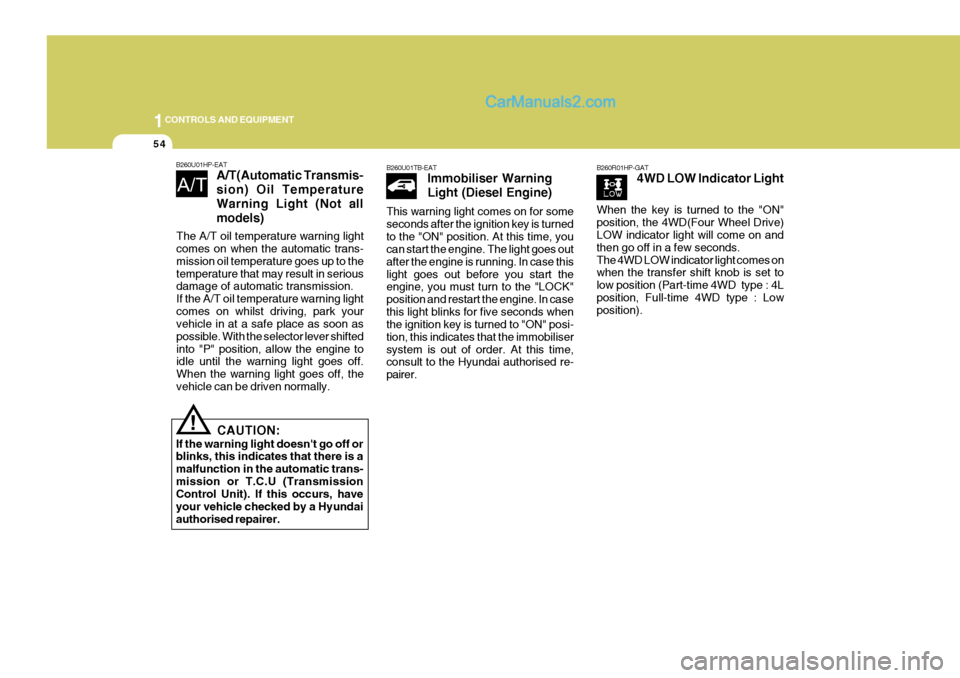
A/T(Automatic Transmis- sion) Oil TemperatureWarning Light (Not allmodels)
CAUTION:
If the warning light doesn't go off or blinks, this indicates that there is a malfunction in the automatic trans-mission or T.C.U (Transmission Control Unit). If this occurs, have your vehicle checked by a Hyundaiauthorised repairer.
B260U01TB-EAT Immobiliser Warning Light (Diesel Engine)
This warning light comes on for some seconds after the ignition key is turnedto the "ON" position. At this time, you can start the engine. The light goes out after the engine is running. In case thislight goes out before you start the engine, you must turn to the "LOCK" position and restart the engine. In casethis light blinks for five seconds when the ignition key is turned to "ON" posi- tion, this indicates that the immobilisersystem is out of order. At this time, consult to the Hyundai authorised re- pairer.B260R01HP-GAT 4WD LOW Indicator Light
The A/T oil temperature warning light comes on when the automatic trans- mission oil temperature goes up to thetemperature that may result in serious damage of automatic transmission. If the A/T oil temperature warning lightcomes on whilst driving, park your vehicle in at a safe place as soon as possible. With the selector lever shiftedinto "P" position, allow the engine to idle until the warning light goes off. When the warning light goes off, thevehicle can be driven normally. When the key is turned to the "ON"position, the 4WD(Four Wheel Drive) LOW indicator light will come on and then go off in a few seconds.The 4WD LOW indicator light comes on when the transfer shift knob is set to low position (Part-time 4WD type : 4Lposition, Full-time 4WD type : Low position).
Page 451 of 539
3
IN CASE OF EMERGENCY
5
!
!
!WARNING:
Whilst the engine is running, keep hands and clothing away from mov- ing parts such as the fan and drive belts to prevent injury.
WARNING (Diesel only):
Never work on injection system withengine running or within 30 seconds after shutting off engine. High pres- sure pump, rail, injectors and highpressure pipes are subject to high pressure even after the engine stopped. The fuel jet produced byfuel leaks may cause serious in- jury, if it contacts the body. People using pacemakers should ensure thatthey keep a distance of 30cm from the ECU or wiring harness within the engine room while engine is run-ning, since the high currents in the Common Rail system produce con- siderable magnetic fields. 5. If the water pump drive belt is broken
or coolant is leaking out, stop theengine immediately and call the near- est Hyundai authorised repairer for assistance.
WARNING:
Do not remove the radiator cap when the engine is hot since steam and boiling water may be ejected fromthe radiator resulting in burns or scalding.
6. If the cause of the overheating can- not be found, wait until the engine temperature has returned to normal. Then, if coolant has been lost, care-fully remove the radiator cap and add water to bring the fluid level in the reservoir(page 6-10) up to the baseof the radiator fill opening. Fill the coolant expansion tank to the half- way mark.
7. Proceed with caution until it is estab- lished that the engine is operatingnormally. If the engine overheatsrepeatedly, the advice of a Hyundai authorised repairer should be sought.! CAUTION:
Serious loss of coolant indicates there is a leak in the cooling system and this should be checked as soon as possible by a Hyundai authorisedrepairer.
Page 465 of 539
4
CORROSION PREVENTION AND APPEARANCE CARE
3
4
APPEARANCE CARE
3
ZE020C1-E Interior During the winter period, it is possible that the carpet within the passengercompartment may become wet. The carpet should not be allowed to remain in this condition for prolonged periodssince the carpet may begin to create musty smells and promote internal corrosion of the floorpan. Use only a shampoo intended for thepurpose and ensure that the body workis thoroughly wet to soften the dirt film prior to attempting to remove this. After removing the dirt film with a softsponge, the body work should be thor- oughly rinsed and then dried with a good quality chamois leather to pre-vent streaking or spotting of the paint work. Household detergents, solvents andabrasive cleaning materials should not be used in order to avoid damaging the paint film.Plastic wheel covers should be cleaned using a sponge and water. Cast alloy wheels should be cleaned using a mildsoap or neutral detergent. Abrasive compounds must not be used since in the event of these damaging the lac-quer coating, oxidisation of the alu- minium wheel will occur, spoiling the appearance.The use of a toothbrush will facilitate cleaning between the wheel "spokes".VALETING
JE050A1-E Regular cleaning of the exterior paintwork serves two important func- tions. Firstly, the removal of abrasive dirt and contaminants will maintain thelustre of the paintwork and will prevent discolouration and dulling due to pro- longed contact.Secondly, the presence of damage through impact or abrasion will be ap- parent allowing early rectification to bemade thus preventing corrosion from becoming established and spreading beneath the paint film. To avoid "waterspotting" the vehicle should not be washed in direct sunlight particularly in the case of vehicles having dark bodycolours. The heat from the sun rays is absorbed by the paint film increasing the surface temperature. This actioncauses water used for washing to evaporate quickly leaving behind the deposits from the water and the sham-poo used.
Page 474 of 539

5VEHICLE MAINTENANCE REQUIREMENTS
6
R R RRII II
R RR I
R
ENGINE OIL AND FILTER AIR CLEANER FILTER SPARK PLUGS (FOR PETROL ENGINE) TIMING BELTBRAKE PADS, CALIPERS AND ROTORSREAR BRAKE LININGS, CYLINDERS AND PARKING BRAKESTEERING GEAR BOX, LINKAGE AND BOOTS/LOWER ARM BALL JOINT, UPPER ARM BALL JOINT DRIVE SHAFTS AND BOOTS MANUAL TRANSMISSION OILAUTOMATIC TRANSMISSION FLUIDTRANSFER CASE OIL *1AXLE GEAR OIL *1
CLIMATE CONTROL AIR FILTER
(FOR EVAPORATOR AND BLOWER UNIT)MAINTENANCE UNDER SEVERE USAGE CONDITIONS
A, B, C, D, E, F, G, H, I, K A, B, F, G, H, I, JC, EG, H, I, JD, E, F, GC, D, E, G, H, I C, D, E, G, H, I C, D, E, F C, D, E, F A, C, D, E, F, G, H, I, JA, C, E, F, G, H, IC, E, G, H, IC, E, G, H, I C, E
F040A07HP-EAT The following items must be serviced more frequently on cars normally used under severe driving conditions. Refer to the chart below for the appropriate maintenance intervals. R : Replace I : Inspect and, after inspection, clean, adjust, repair or replace if necessary
EVERY 4,500 MILES OR 6 MONTHS MORE FREQUENTLY MORE FREQUENTLYEVERY 37,000 MILES OR 48 MONTHSMORE FREQUENTLYMORE FREQUENTLY MORE FREQUENTLYEVERY 9,000 MILES OR 12 MONTHS EVERY 60,000 MILESEVERY 27,000 MILESEVERY 60,000 MILESMORE FREQUENTLYMORE FREQUENTLY
DRIVING
CONDITION
MAINTENANCE INTERVALS
MAINTENANCE
OPERATION
MAINTENANCE ITEM
*1. Transfer Case Oil and Axle Gear Oil should be checked(and replaced if necessary) anytime they have been submerged in water over 15.7 in. (40 cm) deep.
PETROL ENGINE DIESEL ENGINE
SEVERE DRIVING CONDITIONS A - Repeatedly driving short distance of less than 5miles(8km) in normal temperature or less than 10miles(16km) in freezing temperature
B - Extensive engine idling or low speed driving for long distances
C - Driving on rough, dusty, muddy, unpaved, graveled or salt- spread roads
D - Driving in areas using salt or other corrosive materials or in very cold weather E - Driving in sandy areas
F - Driving in heavy traffic area over 90°F(32°C) G - Driving on uphill, downhill, or mountain roadH - Towing a Trailer, or using a camper, or roof rack
I - Driving as a patrol car, taxi, other commercial use or vehicle towing
J - Driving over 100 MPH(170 Km/h)K - Frequently driving in stop-and-go conditions