Page 352 of 539
1CONTROLS AND EQUIPMENT
44
!WARNING:
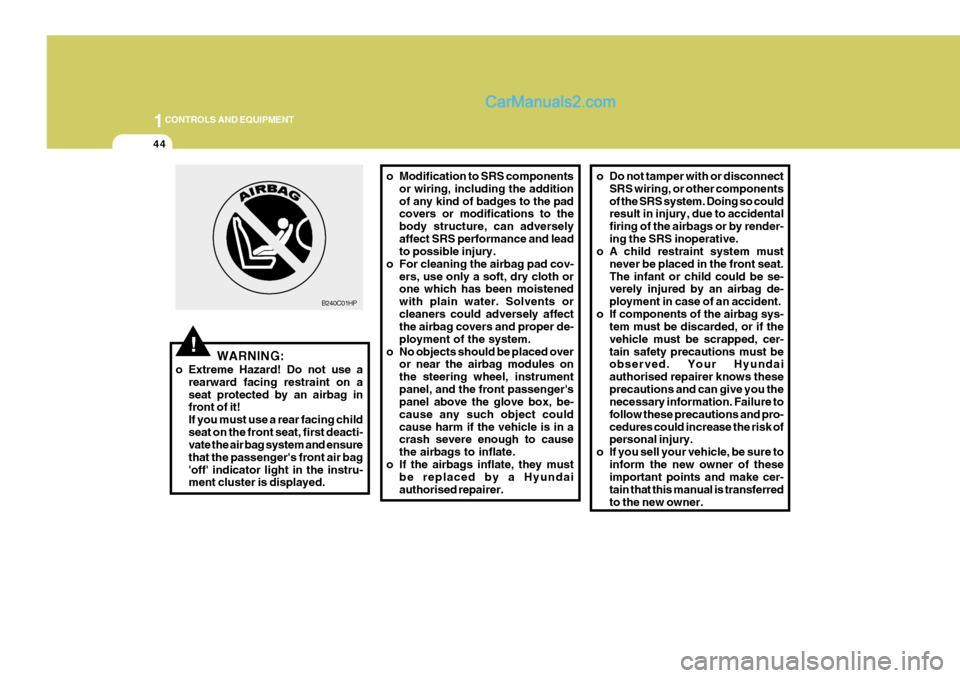
o Extreme Hazard! Do not use a rearward facing restraint on a seat protected by an airbag in front of it! If you must use a rear facing childseat on the front seat, first deacti- vate the air bag system and ensure that the passenger's front air bag'off' indicator light in the instru- ment cluster is displayed. o Modification to SRS components
or wiring, including the addition of any kind of badges to the pad covers or modifications to the body structure, can adverselyaffect SRS performance and lead to possible injury.
o For cleaning the airbag pad cov- ers, use only a soft, dry cloth orone which has been moistened with plain water. Solvents orcleaners could adversely affect the airbag covers and proper de- ployment of the system.
o No objects should be placed over or near the airbag modules onthe steering wheel, instrumentpanel, and the front passenger's panel above the glove box, be- cause any such object couldcause harm if the vehicle is in a crash severe enough to cause the airbags to inflate.
o If the airbags inflate, they must be replaced by a Hyundaiauthorised repairer.
B240C01HP
o Do not tamper with or disconnect
SRS wiring, or other components of the SRS system. Doing so could result in injury, due to accidental firing of the airbags or by render-ing the SRS inoperative.
o A child restraint system must
never be placed in the front seat.The infant or child could be se- verely injured by an airbag de- ployment in case of an accident.
o If components of the airbag sys- tem must be discarded, or if thevehicle must be scrapped, cer-tain safety precautions must be observed. Your Hyundai authorised repairer knows theseprecautions and can give you the necessary information. Failure to follow these precautions and pro-cedures could increase the risk of personal injury.
o If you sell your vehicle, be sure to inform the new owner of theseimportant points and make cer- tain that this manual is transferredto the new owner.
Page 451 of 539
3
IN CASE OF EMERGENCY
5
!
!
!WARNING:
Whilst the engine is running, keep hands and clothing away from mov- ing parts such as the fan and drive belts to prevent injury.
WARNING (Diesel only):
Never work on injection system withengine running or within 30 seconds after shutting off engine. High pres- sure pump, rail, injectors and highpressure pipes are subject to high pressure even after the engine stopped. The fuel jet produced byfuel leaks may cause serious in- jury, if it contacts the body. People using pacemakers should ensure thatthey keep a distance of 30cm from the ECU or wiring harness within the engine room while engine is run-ning, since the high currents in the Common Rail system produce con- siderable magnetic fields. 5. If the water pump drive belt is broken
or coolant is leaking out, stop theengine immediately and call the near- est Hyundai authorised repairer for assistance.
WARNING:
Do not remove the radiator cap when the engine is hot since steam and boiling water may be ejected fromthe radiator resulting in burns or scalding.
6. If the cause of the overheating can- not be found, wait until the engine temperature has returned to normal. Then, if coolant has been lost, care-fully remove the radiator cap and add water to bring the fluid level in the reservoir(page 6-10) up to the baseof the radiator fill opening. Fill the coolant expansion tank to the half- way mark.
7. Proceed with caution until it is estab- lished that the engine is operatingnormally. If the engine overheatsrepeatedly, the advice of a Hyundai authorised repairer should be sought.! CAUTION:
Serious loss of coolant indicates there is a leak in the cooling system and this should be checked as soon as possible by a Hyundai authorisedrepairer.
Page 475 of 539
5
VEHICLE MAINTENANCE REQUIREMENTS
7
!
F060B01A-EAT
o Drive belts
Inspect all drive belts for evidence of cuts, cracks, excessive wear or oil contamination and replace if neces-sary. Drive belts should be checked periodically for proper tension and ad- justed as necessary. F060C01A-AAT
o Fuel filter
A clogged filter can limit the speed at
which the vehicle may be driven, dam- age the emission system and cause hard starting. If an excessive amountof foreign matter accumulates in the fuel tank, the filter may require re- placement more frequently. After installing a new filter, run the
engine for several minutes, and checkfor leaks at the connections. Fuel fil- ters should be installed by trained technicians.
F060D01TB-EAT
o Fuel lines, fuel hoses and con- nections
Check the fuel lines, fuel hoses and
connections for leakage and damage. Have a trained technician replace anydamaged or leaking parts immediately. WARNING (Diesel only):
Never work on injection system withengine running or within 30 sec-onds after shutting off engine. High pressure pump, rail, injectors and high pressure pipes are subject tohigh pressure even after the engine stopped. The fuel jet produced by fuel leaks may cause serious injury,if it contacts the body. People using pacemakers should ensure that they keep a distance of 30cm from theECU or wiring harness within the engine room while engine is run- ning, since the high currents in theCommon Rail system produce con- siderable magnetic fields.
EXPLANATION OF SCHED- ULED MAINTENANCE ITEMS
F060M01A-AAT
o Engine oil and filter
The engine oil and filter should be
changed at the intervals specified in the maintenance schedule. If the car is being driven in severe conditions,more frequent oil and filter changes are required.
Page 496 of 539

6 OWNER MAINTENANCE
18
!
!!WARNING (Diesel only):
Never work on injection system with
engine running or within 30 sec- onds after shutting off engine. Highpressure pump, rail, injectors and high pressure pipes are subject to high pressure even after the enginestopped. The fuel jet produced by fuel leaks may cause serious injury, if it contacts the body. People usingpacemakers should ensure that they keep a distance of 30cm from the ECU or wiring harness within theengine room whilst engine is run- ning, since the high currents in the Common Rail system produce con-siderable magnetic fields.
WARNING:
The electric engine cooling fan au-
tomatically switches on and off ac- cording to engine temperature. Be careful to keep away from the fanduring this check as it may switch on at any time.
NOTE: Only lint free cloth should be used
for wiping the dipstick. The pres- ence of lint within the transmis- sion may cause problems with the normal function of the transmis-sion. CAUTION:
Correct operation of the braking
system is essential to the safe op- eration of the vehicle and there- fore, any maintenance operationsother than those listed below should be entrusted to a Hyundai authorised repairer.
SG120C2-E
Brake Fluid Recommendations
Only brake fluid conforming to DOT 3
or DOT 4 specifications or highermay be used in the braking system. Care should be taken to observe the instructions and precautions printedupon the container.
BRAKE SYSTEM CHECKING
SG120A1-E
Page 503 of 539
6
OWNER MAINTENANCE
25
!
!
1. Loosen the adusting bolts just
enough so that the components can be moved.
2. Whilst pulling outward on the pry bar
or screwdriver, test the belt deflec-tion with your thumb.
3. After tightening the adjusting bolts, be sure to recheck the belt tension. Overtightening drive belts can cause excessive wear and failurein driven components and belts.
WARNING:
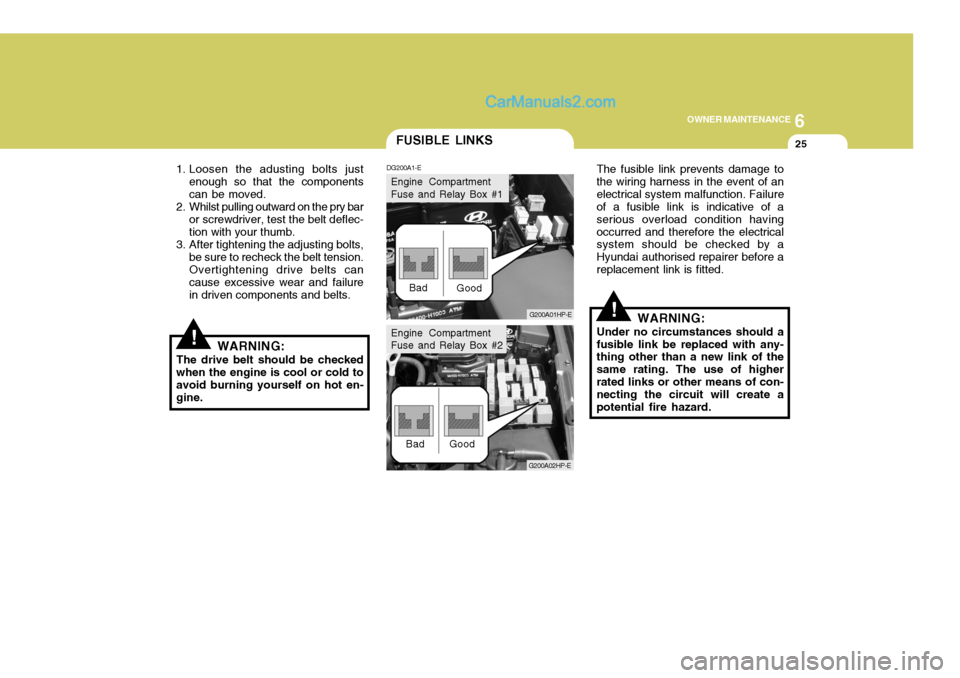
The drive belt should be checked when the engine is cool or cold to avoid burning yourself on hot en-gine. The fusible link prevents damage tothe wiring harness in the event of anelectrical system malfunction. Failure of a fusible link is indicative of a serious overload condition havingoccurred and therefore the electrical system should be checked by a Hyundai authorised repairer before areplacement link is fitted.
WARNING:
Under no circumstances should afusible link be replaced with any- thing other than a new link of the same rating. The use of higherrated links or other means of con- necting the circuit will create a potential fire hazard.
FUSIBLE LINKS
DG200A1-E
G200A01HP-E
Bad
Good
G200A02HP-E
Bad Good
Engine Compartment Fuse and Relay Box #1
Engine Compartment Fuse and Relay Box #2