2006 HUMMER H3 service
[x] Cancel search: servicePage 310 of 410
All-Wheel Drive
Lubricant checks in this section apply to this vehicle.
There are two additional systems that need lubrication.
Transfer Case
When to Check Lubricant
Refer to the Maintenance Schedule to determine how
often to check the lubricant. SeeAdditional Required
Services on page 6-6.
How to Check Lubricant
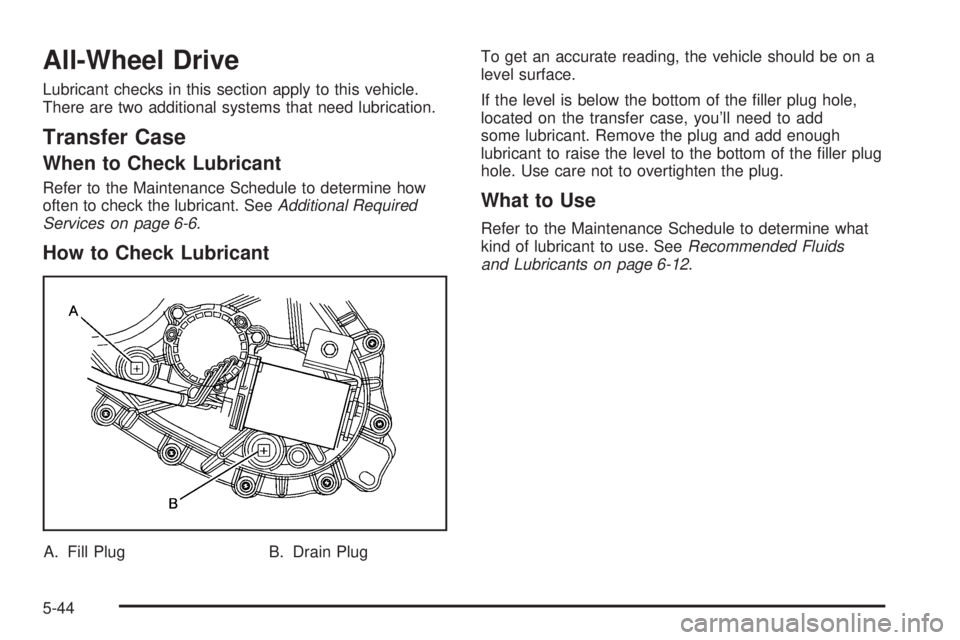
A. Fill Plug B. Drain PlugTo get an accurate reading, the vehicle should be on a
level surface.
If the level is below the bottom of the ller plug hole,
located on the transfer case, you’ll need to add
some lubricant. Remove the plug and add enough
lubricant to raise the level to the bottom of the ller plug
hole. Use care not to overtighten the plug.
What to Use
Refer to the Maintenance Schedule to determine what
kind of lubricant to use. SeeRecommended Fluids
and Lubricants on page 6-12.
5-44
Page 312 of 410

Headlamp Aiming
The vehicle has a visual optical headlamp aiming
system. The aim has been preset at the factory and
should need no further adjustment.
However, if the vehicle is damaged in an accident,
the headlamp aim may be affected and adjustment may
be necessary.
If oncoming vehicles ash their high beams at you, this
may also mean the vertical aim needs to be adjusted.
It is recommended that the vehicle is taken to your
dealer for service if the headlamps need to be re-aimed.
It is possible however, to re-aim the headlamps as
described in the following procedure.The vehicle should be properly prepared as follows:The vehicle should be placed so the headlamps
are 25 ft. (7.6 m) from a light colored wall or
other at surface.
The vehicle must have all four tires on a level
surface which is level all the way to the wall or
other at surface.
The vehicle should be placed so it is perpendicular
to the wall or other at surface.
The vehicle should not have any snow, ice,
or mud on it.
The vehicle should be fully assembled and all other
work stopped while headlamp aiming is being
performed.
The vehicle should be normally loaded with a
full tank of fuel and one person or 160 lbs (75 kg)
sitting on the driver’s seat.
Tires should be properly inated.
The spare tire is in its original location in the vehicle.
5-46
Page 319 of 410

Tires
Your new vehicle comes with high-quality tires made by
a leading tire manufacturer. If you ever have questions
about your tire warranty and where to obtain service,
see your GM Warranty booklet for details. For additional
information refer to the tire manufacturer’s booklet
included with your vehicle’s Owner Manual.
{CAUTION:
Poorly maintained and improperly used tires
are dangerous.
Overloading your tires can cause
overheating as a result of too much
friction. You could have an air-out and a
serious accident. SeeLoading Your
Vehicle on page 4-52.
CAUTION: (Continued)
CAUTION: (Continued)
Underinated tires pose the same danger
as overloaded tires. The resulting accident
could cause serious injury. Check all tires
frequently to maintain the recommended
pressure. Tire pressure should be checked
when your tires are cold. SeeInflation - Tire
Pressure on page 5-60.
Overinated tires are more likely to be
cut, punctured or broken by a sudden
impact — such as when you hit a pothole.
Keep tires at the recommended pressure.
Worn, old tires can cause accidents. If your
tread is badly worn, or if your tires have
been damaged, replace them.
5-53
Page 320 of 410

Tire Sidewall Labelling
Useful information about a tire is molded into the
sidewall. The following illustrations are examples of a
typical P-Metric and a LT-Metric tire sidewall.
(A) Tire Size:The tire size code is a combination of
letters and numbers used to dene a particular
tire’s width, height, aspect ratio, construction type and
service description. See the “Tire Size” illustration
later in this section for more detail.(B) TPC Spec (Tire Performance Criteria
Specication):Original equipment tires designed
to GM’s specic tire performance criteria have a
TPC specication code molded onto the sidewall.
GM’s TPC specications meet or exceed all federal
safety guidelines.
(C) DOT (Department of Transportation):The
Department of Transportation (DOT) code indicates that
the tire is in compliance with the U.S. Department of
Transportation Motor Vehicle Safety Standards.
(D) Tire Identication Number (TIN):The letters and
numbers following DOT code are the Tire Identication
Number (TIN). The TIN shows the manufacturer and
plant code, tire size, and date the tire was manufactured.
The TIN is molded onto both sides of the tire, although
only one side may have the date of manufacture.
(E) Tire Ply Material:The type of cord and number of
plies in the sidewall and under the tread.
(F) Uniform Tire Quality Grading (UTQG):Tire
manufacturers are required to grade tires based on
three performance factors: treadwear, traction and
temperature resistance. For more information,
seeUniform Tire Quality Grading on page 5-68.
(G) Maximum Cold Ination Load Limit:Maximum
load that can be carried and the maximum pressure
needed to support that load. For information on
recommended tire pressure seeInation - Tire Pressure
on page 5-60andLoading Your Vehicle on page 4-52. Passenger (P-Metric) Tire
5-54
Page 321 of 410

(A) Tire Size:The tire size code is a combination of
letters and numbers used to dene a particular
tire’s width, height, aspect ratio, construction type and
service description. See the “Tire Size” illustration
later in this section for more detail.
(B) TPC Spec (Tire Performance Criteria
Specication):Original equipment tires designed
to GM’s specic tire performance criteria have a
TPC specication code molded onto the sidewall.GM’s TPC specications meet or exceed all federal
safety guidelines.
(C) Dual Tire Maximum Load:Maximum load that
can be carried and the maximum pressure needed to
support that load when used in a dual conguration.
For information on recommended tire pressure see
Ination - Tire Pressure on page 5-60andLoading Your
Vehicle on page 4-52.
(D) DOT (Department of Transportation):The
Department of Transportation (DOT) code indicates that
the tire is in compliance with the U.S. Department of
Transportation Motor Vehicle Safety Standards.
(E) Tire Identication Number (TIN):The letters and
numbers following DOT code are the Tire Identication
Number (TIN). The TIN shows the manufacturer and
plant code, tire size, and date the tire was manufactured.
The TIN is molded onto both sides of the tire, although
only one side may have the date of manufacture.
(F) Tire Ply Material:The type of cord and number of
plies in the sidewall and under the tread.
(G) Single Tire Maximum Load:Maximum load that
can be carried and the maximum pressure needed to
support that load when used as a single. For information
on recommended tire pressure seeInation - Tire
Pressure on page 5-60andLoading Your Vehicle on
page 4-52. Light Truck (LT-Metric) Tire
5-55
Page 322 of 410

Tire Size
The following examples show the different parts of a
tire size.
(A) Passenger (P-Metric) Tire:The United States
version of a metric tire sizing system. The letter P as
the rst character in the tire size means a passenger
vehicle tire engineered to standards set by the U.S. Tire
and Rim Association.(A) Light Truck (LT-Metric) Tire:The United States
version of a metric tire sizing system. The letters LT as
the rst two characters in the tire size means a light
truck tire engineered to standards set by the U.S. Tire
and Rim Association.
(B) Tire Width:The three-digit number indicates the
tire section width in millimeters from sidewall to sidewall.
(C) Aspect Ratio:A two-digit number that indicates
the tire height-to-width measurements. For example,
if the tire size aspect ratio is 75, as shown in item C of
the light truck (LT-Metric) tire illustration, it would
mean that the tire’s sidewall is 75% as high as it is wide.
(D) Construction Code:A letter code is used to
indicate the type of ply construction in the tire.
The letter R means radial ply construction; the letter D
means diagonal or bias ply construction; and the
letter B means belted-bias ply construction.
(E) Rim Diameter:Diameter of the wheel in inches.
(F) Service Description:The service description
indicates the load range and speed rating of a tire.
The load index can range from 1 to 279. Speed ratings
range from A to Z. Passenger (P-Metric) Tire
Light Truck (LT-Metric) Tire
5-56
Page 328 of 410

When a low tire pressure condition is detected, the
TPMS will illuminate the low tire pressure warning
symbol on the instrument panel cluster, and at the same
time display the LOW TIRE message on the Driver
Information Center (DIC). The message will appear at
each ignition cycle until the tires are inated to the
correct ination pressure. For additional information and
details about the DIC operation and displays seeDIC
Controls and Displays on page 3-41andDIC Warnings
and Messages on page 3-44.
A Tire and Loading Information label, attached to your
vehicle, shows the size of your vehicle’s original
equipment tires and the correct ination pressure for
your vehicle’s tires when they are cold. SeeLoading
Your Vehicle on page 4-52, for an example of the
tire information label and its location on your vehicle.
Also seeInation - Tire Pressure on page 5-60for
additional information.
Your vehicle’s TPMS can warn you about a low tire
pressure condition but it does not replace normal
tire maintenance. SeeTire Inspection and Rotation on
page 5-64,When It Is Time for New Tires on page 5-65,
andTires on page 5-53.Notice:Do not use a tire sealant if your vehicle is
equipped with Tire Pressure Monitors. The liquid
sealant can damage the tire pressure monitor
sensors.
The SERV (Service) TPM message is displayed when
the TPMS system is malfunctioning. One or more
missing or inoperable TPMS sensors will cause the
service tire monitor message to be displayed. See your
dealer for service,
TPMS Sensor Identication Codes
Each TPMS sensor has a unique identication code.
Any time you rotate your vehicle’s tires or replace one or
more of the TPM sensors, the identication codes will
need to be matched to the new tire/wheel position.
The sensors are matched to the tire/wheel positions in
the following order: left front (LF), right front (RF),
right rear (RR) and left rear (LR).
You will have one minute to match the rst tire/wheel
position, and ve minutes overall to match all four
tire/wheel positions. If it takes longer than one minute,
to match the rst tire and wheel, or more than ve
minutes to match all four tire and wheel positions the
matching process stops and you will need to start over.
5-62
Page 330 of 410

Federal Communications Commission
and Industry and Science Canada
The TPMS operates on a radio frequency subject to
Federal Communications Commission (FCC) Rules and
with Industry and Science Canada.
This device complies with Part 15 of the FCC Rules and
with RSS-210 of Industry and Science Canada.
Operation is subject to the following two conditions:
1. This device may not cause harmful interference.
2. This device must accept any interference received
including interference that may cause undesired
operation of the device.
Changes or modications to this system by other than
an authorized service facility could void authorization to
use this equipment.
Tire Inspection and Rotation
Tires should be rotated every 5,000 to 8,000 miles
(8 000 to 13 000 km).
Any time you notice unusual wear, rotate your tires as
soon as possible and check wheel alignment. Also
check for damaged tires or wheels. SeeWhen It Is Time
for New Tires on page 5-65andWheel Replacement
on page 5-69for more information.
The purpose of regular rotation is to achieve more
uniform wear for all tires on the vehicle. The rst rotation
is the most important, seeScheduled Maintenance on
page 6-4.
When rotating your vehicle’s tires, always use one of
the correct rotation patterns shown here.
5-64