Page 237 of 316

�Ì�Ì
�µ�µ
�Ì
Maintenance Minder
235
Maintenance Sub Items
Rotate tires
Replace air cleaner element
Replace dust and pollen filter
Inspect drive belt
Replace transmission and transfer fluid
Replace spark plugs
Replace timing belt and inspect water pump
Inspect valve clearance
Replace engine coolant
Replace VTM-4 rear differential fluid
:
If the message ‘‘SERVICE OIL’’ does not appear more than 12 months after
the display is reset, change the engine oil every year.
See information on maintenance and emissions warranty on page .
Independent of the maintenance minder display, replace the brake fluid
every 3 years.
Inspect idle speed every 160,000 miles (256,000 km).
Adjust the valves during services A, B, 1, 2, or 3 only if they are noisy.
NOTE: 1:
233
Maintenance Main Items
Replace engine oil
Replace engine oil and oil filter
Inspect front and rear brakes
Check parking brake adjustment
Inspect these items: Tie rod ends, steering gear box, and boots
Suspension components
Driveshaft boots
Brake hoses and lines (including ABS)
All fluid levels and condition of fluids
Exhaust system
Fuel lines and connections
A
B
1
2
3
4
5
61
1
If you drive in dusty conditions, replace every 15,000 miles
(24,000 km).
If you drive primarily in urban areas that have high concentrations
of soot in the air from industry and from diesel-powered vehicles,
replace every 15,000 miles (24,000 km).
Driving in mountainous areas at very low vehicle speeds or trailer
towing results in higher transmission and transfer temperatures or
frequently fully loaded. This requires transmission and transfer
fluid changes more frequently than recommended by the
Maintenance Minder. If you regularly drive your vehicle under
these conditions, have the transmission and transfer fluid changed
every 30,000 miles (48,000 km).
If you drive regularly in very high temperatures (over 110°F, 43°C),
in very low temperatures (under 20°F, 29°C), or towing a trailer,
replace every 60,000 miles (U.S.) /100,000 km
Driving in mountainous areas at very low vehicle speeds or trailer
towing results in higher level of mechanical (shear) stress to fluid
or frequently fully loaded. This requires differential fluid changes
more frequently than recommended by the Maintenance Minder.
If you regularly drive your vehicle under these conditions, have the
differential fluid changed at 7,500 miles (12,000 km), then every
15,000 miles (24,000 km).
Symbol
Symbol
Maintenance Minder
Page 247 of 316

�µ�µ
Put a new washer on the f iller bolt,
then reinstall the f iller bolt and
tighten it securely. Tightening
torque:
The dif f erential should be drained
and ref illed with new f luid according
to the time and distance recommen-
dations in the maintenance schedule.
In very high temperatures
(over 110°F, 43°C).
In very low temperatures
(under 20°F, 29°C).
Frequently tow a trailer.
Insert the dipstick all the way back
into the transmission.
The transmission should be drained
and ref illed with new f luid according
to the time and distance recommen-
dations in the maintenance schedule.
If you are not sure how to add f luid,
contact your dealer.
The timing belt should be replaced
according to the maintenance
message shown on the inf ormation
display. Replaced the belt at 60,000
miles (100,000 km) if you regularly
drive your vehicle in one or more of
these conditions:
Check the f luid level with the
dif f erential at normal operating
temperature and the vehicle sitting
on level ground. Remove the
dif f erential f luid f iller bolt and
washer, and caref ully f eel inside the
bolt hole with your f inger. The f luid
level should be up to the edge of the
bolt hole. If it is not, slowly add
VTM-4 Dif f erential Fluid until it
starts to run out of the hole.
6.
4WD models only
Timing Belt
Dif f erential Oil
A utomatic Transmission Fluid, Dif f erential Oil, Timing Belt
Maint enance
245
FILLER BOLT
CORRECT LEVEL
33 lbf·ft (45 N·m , 4.6 kgf·m)
Page 257 of 316
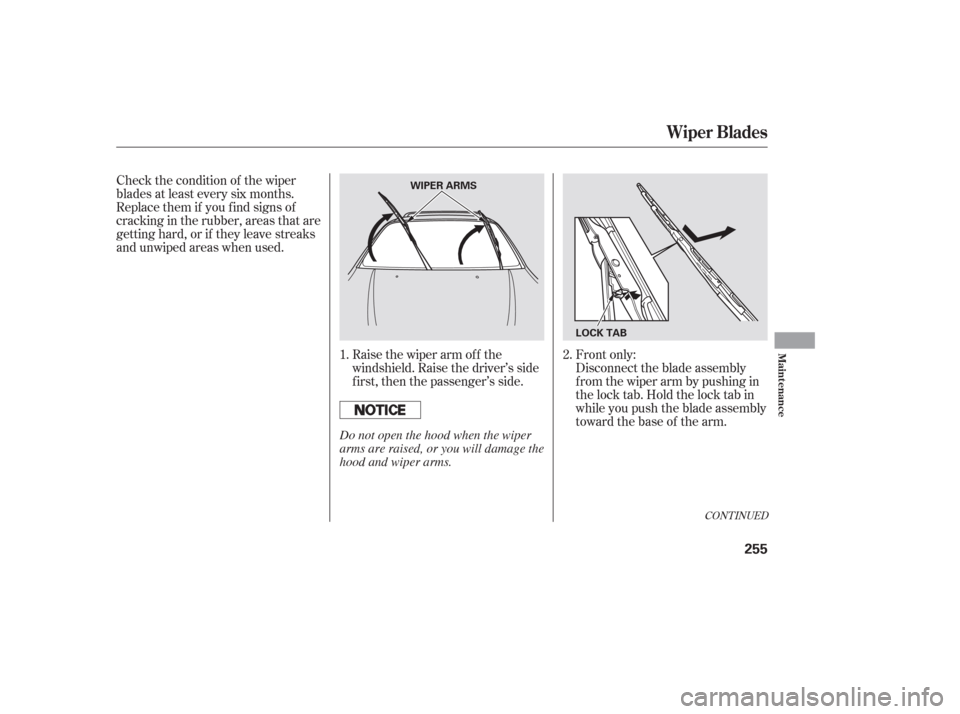
Raise the wiper arm of f the
windshield. Raise the driver’s side
first, then the passenger’s side.
Check the condition of the wiper
blades at least every six months.
Replace them if you f ind signs of
cracking in the rubber, areas that are
getting hard, or if they leave streaks
and unwiped areas when used.
Disconnect the blade assembly
fromthewiperarmbypushingin
the lock tab. Hold the lock tab in
while you push the blade assembly
toward the base of the arm.
1.
2. Front only:
CONT INUED
Wiper Blades
Maint enance
255
WIPER ARMS
LOCK TAB
Do not open the hood when the wiper
arms are raised, or you will damage the
hood and wiper arms.
Page 264 of 316
�µ
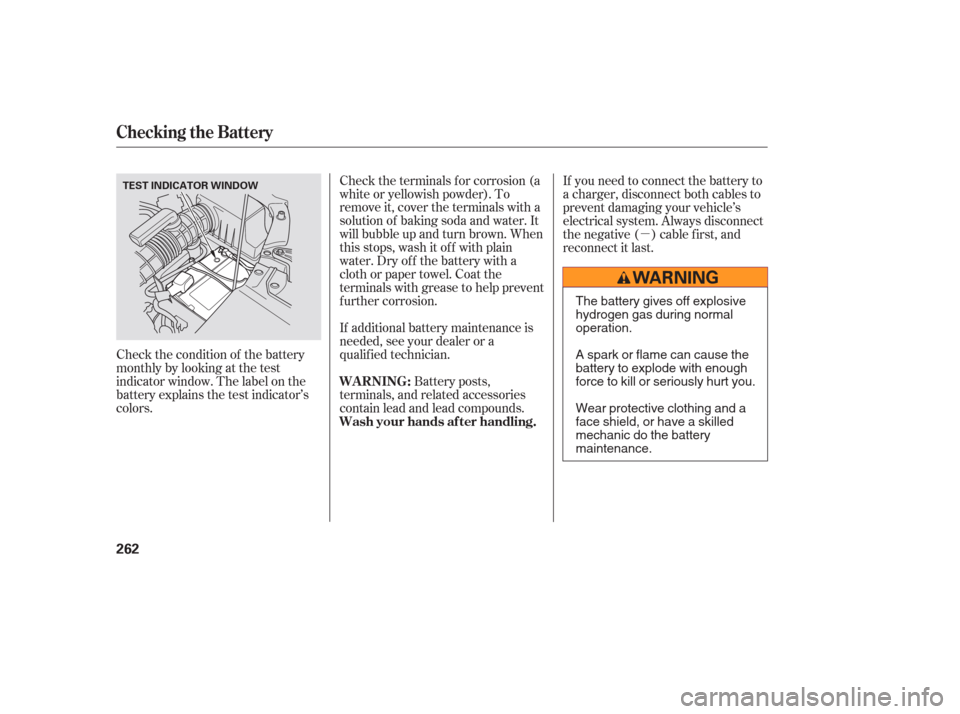
Check the condition of the battery
monthlybylookingatthetest
indicator window. The label on the
battery explains the test indicator’s
colors. If additional battery maintenance is
needed, see your dealer or a
qualif ied technician.
Battery posts,
terminals, and related accessories
contain lead and lead compounds. Check the terminals f or corrosion (a
white or yellowish powder). To
remove it, cover the terminals with a
solution of baking soda and water. It
will bubble up and turn brown. When
this stops, wash it of f with plain
water. Dry off the battery with a
cloth or paper towel. Coat the
terminals with grease to help prevent
f urther corrosion. If you need to connect the battery to
a charger, disconnect both cables to
prevent damaging your vehicle’s
electrical system. Always disconnect
the negative ( ) cable first, and
reconnect it last.
WARNING:
Wash your hands af ter handling.
Checking the Battery
262
TEST INDICATOR WINDOW
The battery gives off explosive
hydrogen gas during normal
operation.
A spark or flame can cause the
battery to explode with enough
force to kill or seriously hurt you.
Wear protective clothing and a
face shield, or have a skilled
mechanic do the battery
maintenance.
Page 265 of 316
Fill the f uel tank.
Change the engine oil and f ilter.Block the rear wheels.
If the vehicle is to be stored f or a
longer period, it should be
supported on jackstands so the
tires are of f the ground.
Wash and dry the exterior
completely.
Cleantheinterior.Makesurethe
carpeting, floor mats, etc., are
completely dry.
If you need to park your vehicle f or
an extended period (more than 1
month), there are several things you
should do to prepare it f or storage.
Proper preparation helps prevent
deterioration and makes it easier to
get your vehicle back on the road. If
possible, store your vehicle indoors. Leave one window open slightly (if
the vehicle is being stored
indoors).Cover the vehicle with a
‘‘breathable’’ cover, one made
f rom a porous material such as
cotton. Non-porous materials, such
as plastic sheeting, trap moisture,
which can damage the paint.
Support the f ront wiper blade
arms with a f olded towel or rag so
they do not touch the windshield. Disconnect the battery.
Leave the parking brake off. Put
the transmission in Park. To minimize sticking, apply a
silicone spray lubricant to all door
and tailgate seals. Also, apply a
vehiclebodywaxtothepainted
surfaces that mate with the door
and tailgate seals.If possible periodically run the
engine until it reaches normal
operating temperature (the
cooling f ans cycle twice).
Pref erably, do this once a month.
Vehicle Storage
Maint enance
263
Page 267 of 316

This section covers the more
common problems that motorists
experience with their vehicles. It
gives you inf ormation about how to
safely evaluate the problem and what
to do to correct it. If the problem has
stranded you on the side of the road,
you may be able to get going again.
If not, you will also f ind instructions
on getting your vehicle towed.......................
Compact Spare Tire .266
....................
Changing a Flat Tire .267
.............
If the Engine Won’t Start . 271
................................
Jump Starting .272
..............
If the Engine Overheats . 274
.........
Low Oil Pressure Indicator . 276
..........
Charging System Indicator . 276
..................
Malf unction Indicator . 277
...............
Brake System Indicator . 278
..............................................
Fuses .279
..............................
Fuse Locations .283
Taking Care of the Unexpected
Taking Care of the Unexpected
265
Emergency Towing ....................... 278
Page 268 of 316

Use the compact spare tire as a
temporary replacement only. Get
your regular tire repaired or replaced,
and put it back on your vehicle as
soon as you can.
Check the inf lation pressure of the
compact spare tire every time you
check the other tires. It should be
inf lated to:Replace the tire when you can see
the tread wear indicator bars. The
replacement should be the same size
and design tire, mounted on the
same wheel. The spare tire is not
designed to be mounted on a regular
wheel, and the spare wheel is not
designed f or mounting a regular tire.
Follow these precautions:
Never exceed 50 mph (80 km/h).
This tire gives a harsher ride and
less traction on some road sur-
f aces. Use greater caution while
driving.
Do not mount snow chains on it.
Do not use the compact spare tire
if you are towing a trailer.
Do not use your compact spare
tire on another vehicle unless it is
thesamemakeandmodel.
Turn of f the VSA system (see
page ). Driving with the
compact spare tire may activate
the VSA system. 212
Compact Spare Tire
266
INDICATOR LOCATION MARK
TREAD WEAR INDICATOR BAR
60 psi (420 kPa , 4.2 kgf/cm)
Page 272 of 316
Insert the hoist bracket into the
center hole of the f lat tire.
Slowly turn the wheel nut wrench
clockwisetotakeuptheslackof
the hoist cable. Make sure the
bracketisseatedinthecenter
hole of the spare tire.Store the jack in its holder. Turn
the jacks’ end bracket to lock it in
place and replace the tools and
cover. Turn the wheel nut wrench
clockwise until the f lat tire rests
against the underbody of the
vehicle and you hear the hoist
click.
17. 18. 19.
20.
Changing a Flat Tire
270
Loose items can fly around the
interiorinacrashandcould
seriously injure the occupants.
Store the wheel, jack, and tools
securely before driving.
Always raise the spare tire hoist, even
if you are not stowing a tire. If the
hoist is lef t down, it will be damaged
during driving and need to be replaced.