Page 240 of 316
Fluid Locations
238
RADIATOR CAP
ENGINE OIL DIPSTICK
(Orange loop)
BRAKE FLUID
(Gray cap)
WASHER FLUID
(Blue cap)
AUTOMATIC
TRANSMISSION
FLUID DIPSTICK
(Yellow loop)
POWER STEERING
FLUID (Red cap) COOLANT
RESERVOIR
ENGINE OIL FILL CAP
Page 241 of 316

Oil is a major contributor to your
engine’s perf ormance and longevity.
Always use a premium-grade 5W-20
detergent oil displaying the API
Certif ication Seal. This seal indicates
the oil is energy conserving, and that
it meets the American Petroleum
Institute’s latest requirements.Honda Motor Oil is the pref erred
5W-20 lubricant f or your vehicle. It is
highly recommended that you use
Honda Motor Oil in your vehicle f or
optimum engine protection. Make
sure the API Certif ication Seal says
‘‘For Gasoline Engines.’’
The oil viscosity or weight is
provided on the container’s label.
5W-20 oil is f ormulated f or year-
round protection of your Honda to
improve cold weather starting and
f uel economy.
Unscrew and remove the engine oil
fill cap on top of the valve cover.
Pour in the oil slowly and caref ully so
you do not spill. Clean up any spills
immediately. Spilled oil could
damage components in the engine
compartment. Install the engine oil
f ill cap, and tighten it securely. Wait
a f ew minutes, and recheck the oil
level. Do not f ill above the upper
mark; you could damage the engine. Recommended Engine Oil
A dding Engine Oil
Maint enance
239
API CERTIFICATION SEAL
Ambient Temperature
ENGINE OIL FILL CAP
Page 242 of 316
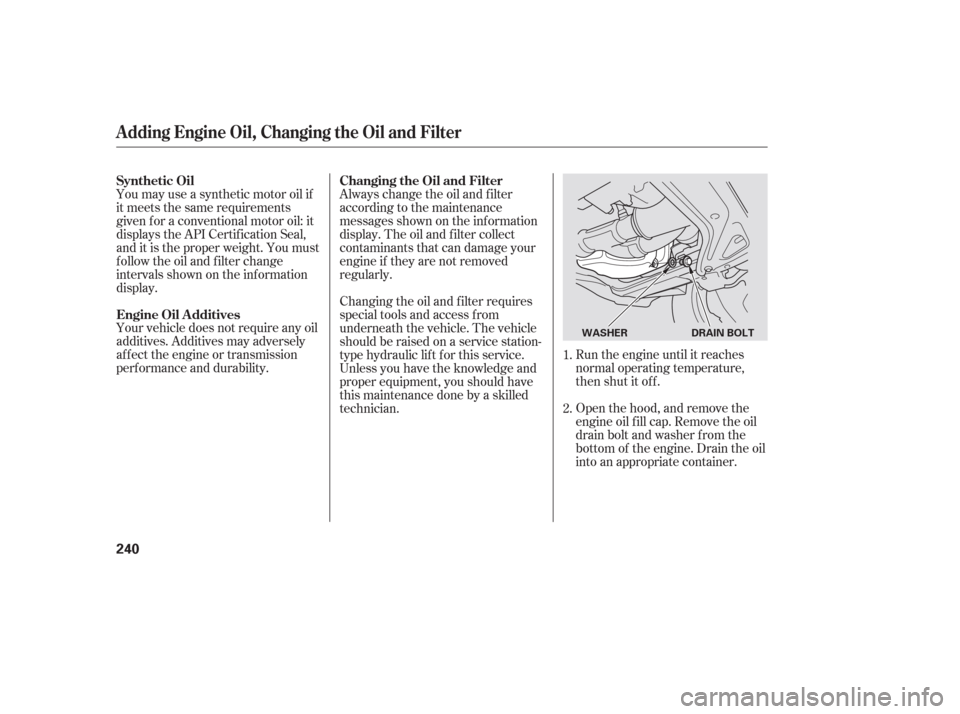
Run the engine until it reaches
normal operating temperature,
then shut it off.
Open the hood, and remove the
engine oil f ill cap. Remove the oil
drain bolt and washer f rom the
bottom of the engine. Drain the oil
into an appropriate container.
Your vehicle does not require any oil
additives. Additives may adversely
af f ect the engine or transmission
perf ormance and durability. You may use a synthetic motor oil if
it meets the same requirements
given f or a conventional motor oil: it
displays the API Certif ication Seal,
and it is the proper weight. You must
f ollow the oil and f ilter change
intervals shown on the information
display.
Always change the oil and f ilter
according to the maintenance
messages shown on the inf ormation
display. The oil and f ilter collect
contaminants that can damage your
engine if they are not removed
regularly.
Changing the oil and f ilter requires
special tools and access f rom
underneath the vehicle. The vehicle
should be raised on a service station-
type hydraulic lif t f or this service.
Unless you have the knowledge and
proper equipment, you should have
this maintenance done by a skilled
technician.
1.
2.
Changing the Oil and Filter
Synthetic Oil
Engine Oil A dditives
A dding Engine Oil, Changing the Oil and Filter
240
DRAIN BOLT
WASHER
Page 243 of 316

Put a new washer on the drain bolt,
then reinstall the drain bolt.
Tighten it to:
Remove the oil f ilter and let the
remaining oil drain. A special
wrench (available from your
dealer) is required. Turn of f the engine, let it sit f or
several minutes, then check the oil
level on the dipstick. If necessary,
add more oil.
Refill the engine with the
recommended oil.
Engine oil change capacity
(including f ilter):
Replace the engine oil f ill cap.
Start the engine. The oil pressure
indicator should go out within 5
seconds. If it does not, turn of f the
engine, and check your work.
Let the engine run f or several
minutes, then check the drain bolt
and oil f ilter f or leaks.
Install a new oil f ilter according to
the instructions that come with it. Check the oil f ilter to make sure
its gasket did not stick to the
engine block. A stuck gasket could
cause an oil leak.
3.
4.
5. 6.
7.
8.
9.
10.
Changing the Oil and Filter
Maint enance
241
OIL FILTER
29 lbf·ft (39 N·m , 4.0 kgf·m)
4.5 US qt (4.3
)
Improper disposal of engine oil can be
harmf ul to the environment. If you
change your own oil, please dispose of
the used oil properly. Put it in a sealed
container and take it to a recycling
center. Do not discard it in a trash bin
or dump it on the ground.
Page 247 of 316

�µ�µ
Put a new washer on the f iller bolt,
then reinstall the f iller bolt and
tighten it securely. Tightening
torque:
The dif f erential should be drained
and ref illed with new f luid according
to the time and distance recommen-
dations in the maintenance schedule.
In very high temperatures
(over 110°F, 43°C).
In very low temperatures
(under 20°F, 29°C).
Frequently tow a trailer.
Insert the dipstick all the way back
into the transmission.
The transmission should be drained
and ref illed with new f luid according
to the time and distance recommen-
dations in the maintenance schedule.
If you are not sure how to add f luid,
contact your dealer.
The timing belt should be replaced
according to the maintenance
message shown on the inf ormation
display. Replaced the belt at 60,000
miles (100,000 km) if you regularly
drive your vehicle in one or more of
these conditions:
Check the f luid level with the
dif f erential at normal operating
temperature and the vehicle sitting
on level ground. Remove the
dif f erential f luid f iller bolt and
washer, and caref ully f eel inside the
bolt hole with your f inger. The f luid
level should be up to the edge of the
bolt hole. If it is not, slowly add
VTM-4 Dif f erential Fluid until it
starts to run out of the hole.
6.
4WD models only
Timing Belt
Dif f erential Oil
A utomatic Transmission Fluid, Dif f erential Oil, Timing Belt
Maint enance
245
FILLER BOLT
CORRECT LEVEL
33 lbf·ft (45 N·m , 4.6 kgf·m)
Page 250 of 316

Theheadlightswereproperlyaimed
when your vehicle was new. If you
regularly carry heavy items in the
trunk, readjustment may be required.
Adjustments should be perf ormed by
your dealer or other qualif ied
mechanic.
Your vehicle has halogen headlight
bulbs. Handle a bulb by its steel base,
and protect the glass from contact
with your skin or hard objects. If you
touch the glass, clean it with
denaturedalcoholandacleancloth.Open the hood.
Remove the electrical connector
f rom the bulb by squeezing the
connector to unlock the tab, then
slide the connector of f the bulb.
Remove the bulb by turning it
approximately one-quarter turn
counterclockwise.Insert the new bulb into the hole,
and turn it one-quarter turn clock-
wise to lock it in place.
Push the electrical connector onto
the new bulb.
Turn on the headlights to test the
new bulb.
1.
2.
3.
4.
5.
6.
Headlight A iming
Replacing a Headlight Bulb
Lights
248
NOTE:
TAB
BULB CONNECTOR
Halogen headlight bulbs get
very hot when lit. Oil, perspiration, or a
scratch on the glass can cause the bulb
to overheat and shatter.
Page 265 of 316
Fill the f uel tank.
Change the engine oil and f ilter.Block the rear wheels.
If the vehicle is to be stored f or a
longer period, it should be
supported on jackstands so the
tires are of f the ground.
Wash and dry the exterior
completely.
Cleantheinterior.Makesurethe
carpeting, floor mats, etc., are
completely dry.
If you need to park your vehicle f or
an extended period (more than 1
month), there are several things you
should do to prepare it f or storage.
Proper preparation helps prevent
deterioration and makes it easier to
get your vehicle back on the road. If
possible, store your vehicle indoors. Leave one window open slightly (if
the vehicle is being stored
indoors).Cover the vehicle with a
‘‘breathable’’ cover, one made
f rom a porous material such as
cotton. Non-porous materials, such
as plastic sheeting, trap moisture,
which can damage the paint.
Support the f ront wiper blade
arms with a f olded towel or rag so
they do not touch the windshield. Disconnect the battery.
Leave the parking brake off. Put
the transmission in Park. To minimize sticking, apply a
silicone spray lubricant to all door
and tailgate seals. Also, apply a
vehiclebodywaxtothepainted
surfaces that mate with the door
and tailgate seals.If possible periodically run the
engine until it reaches normal
operating temperature (the
cooling f ans cycle twice).
Pref erably, do this once a month.
Vehicle Storage
Maint enance
263
Page 267 of 316

This section covers the more
common problems that motorists
experience with their vehicles. It
gives you inf ormation about how to
safely evaluate the problem and what
to do to correct it. If the problem has
stranded you on the side of the road,
you may be able to get going again.
If not, you will also f ind instructions
on getting your vehicle towed.......................
Compact Spare Tire .266
....................
Changing a Flat Tire .267
.............
If the Engine Won’t Start . 271
................................
Jump Starting .272
..............
If the Engine Overheats . 274
.........
Low Oil Pressure Indicator . 276
..........
Charging System Indicator . 276
..................
Malf unction Indicator . 277
...............
Brake System Indicator . 278
..............................................
Fuses .279
..............................
Fuse Locations .283
Taking Care of the Unexpected
Taking Care of the Unexpected
265
Emergency Towing ....................... 278
