Page 232 of 316
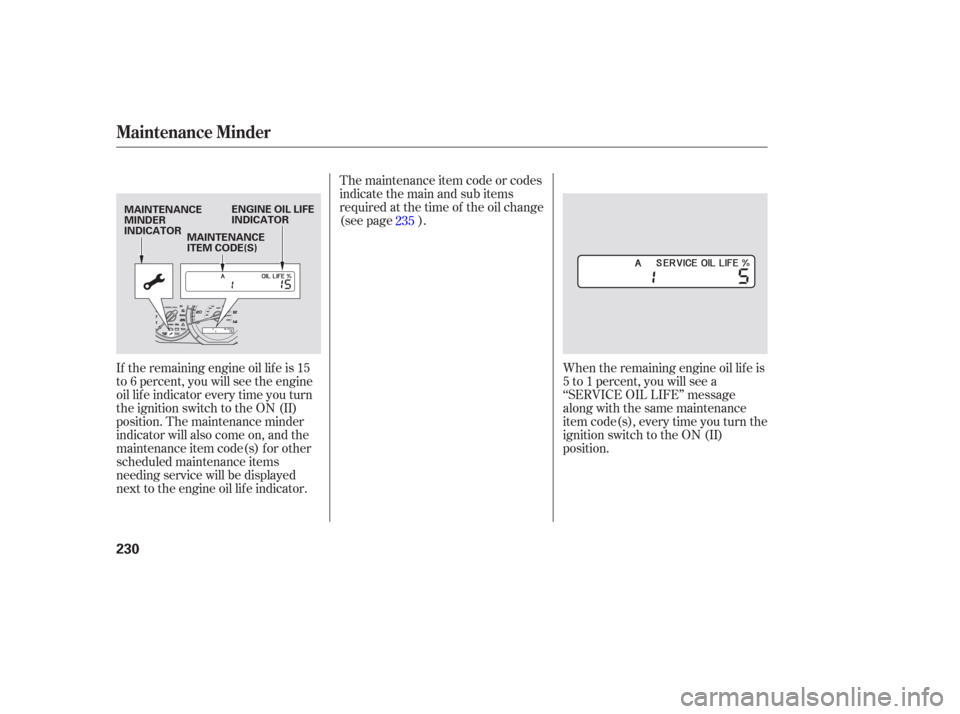
The maintenance item code or codes
indicate the main and sub items
required at the time of the oil change
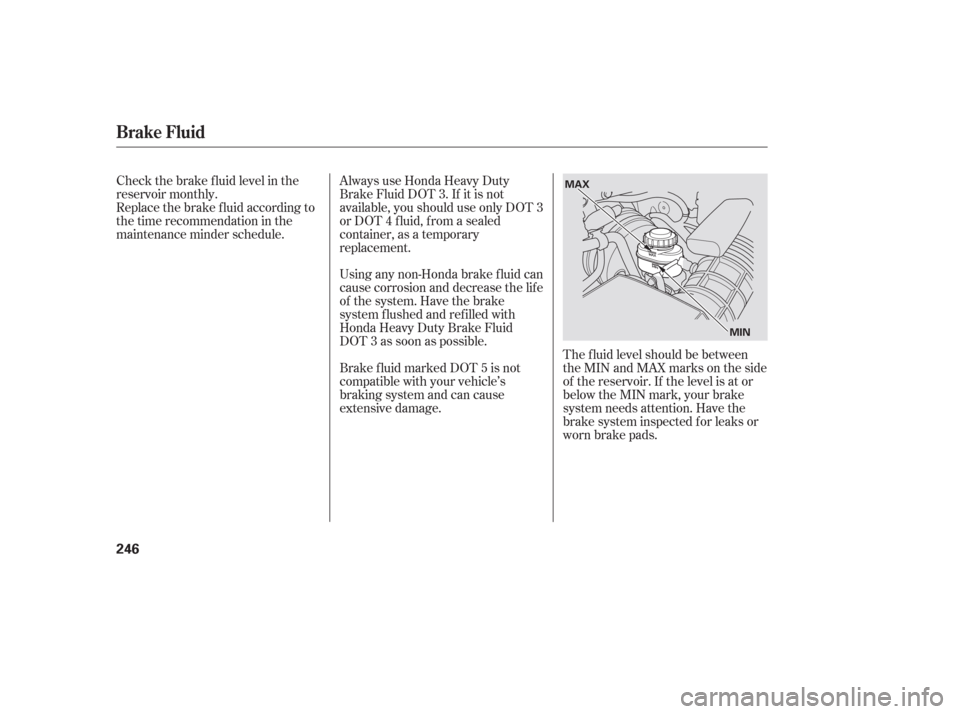
(see page ).When the remaining engine oil lif e is
5 to 1 percent, you will see a
‘‘SERVICE OIL LIFE’’ message
along with the same maintenance
item code(s), every time you turn the
ignition switch to the ON (II)
position.
If the remaining engine oil lif e is 15
to 6 percent, you will see the engine
oil lif e indicator every time you turn
the ignition switch to the ON (II)
position. The maintenance minder
indicator will also come on, and the
maintenance item code(s) for other
scheduled maintenance items
needing service will be displayed
next to the engine oil lif e indicator. 235
Maintenance Minder
230
MAINTENANCE
MINDER
INDICATOR
ENGINE OIL LIFE
INDICATOR
MAINTENANCE
ITEM CODE(S)
Page 247 of 316

�µ�µ
Put a new washer on the f iller bolt,
then reinstall the f iller bolt and
tighten it securely. Tightening
torque:
The dif f erential should be drained
and ref illed with new f luid according
to the time and distance recommen-
dations in the maintenance schedule.
In very high temperatures
(over 110°F, 43°C).
In very low temperatures
(under 20°F, 29°C).
Frequently tow a trailer.
Insert the dipstick all the way back
into the transmission.
The transmission should be drained
and ref illed with new f luid according
to the time and distance recommen-
dations in the maintenance schedule.
If you are not sure how to add f luid,
contact your dealer.
The timing belt should be replaced
according to the maintenance
message shown on the inf ormation
display. Replaced the belt at 60,000
miles (100,000 km) if you regularly
drive your vehicle in one or more of
these conditions:
Check the f luid level with the
dif f erential at normal operating
temperature and the vehicle sitting
on level ground. Remove the
dif f erential f luid f iller bolt and
washer, and caref ully f eel inside the
bolt hole with your f inger. The f luid
level should be up to the edge of the
bolt hole. If it is not, slowly add
VTM-4 Dif f erential Fluid until it
starts to run out of the hole.
6.
4WD models only
Timing Belt
Dif f erential Oil
A utomatic Transmission Fluid, Dif f erential Oil, Timing Belt
Maint enance
245
FILLER BOLT
CORRECT LEVEL
33 lbf·ft (45 N·m , 4.6 kgf·m)
Page 248 of 316
The f luid level should be between
theMINandMAXmarksontheside
of the reservoir. If the level is at or
below the MIN mark, your brake
system needs attention. Have the
brake system inspected f or leaks or
worn brake pads.
Always use Honda Heavy Duty
Brake Fluid DOT 3. If it is not
available, you should use only DOT 3
or DOT 4 f luid, f rom a sealed
container, as a temporary
replacement.
Using any non-Honda brake f luid can
cause corrosion and decrease the lif e
of the system. Have the brake
system f lushed and ref illed with
Honda Heavy Duty Brake Fluid
DOT 3 as soon as possible.
Brake f luid marked DOT 5 is not
compatible with your vehicle’s
braking system and can cause
extensive damage.
Check the brake f luid level in the
reservoir monthly.
Replace the brake f luid according to
the time recommendation in the
maintenance minder schedule.
Brake Fluid
246
MAX
MIN
Page 295 of 316
�Î�ÎIn Canada, Honda vehicles comply
with the Canadian emission
requirements, as specif ied in an
agreement with Environment
Canada, at the time they are
manuf actured.
Your vehicle has a positive
crankcase ventilation system. This
keeps gasses that build up in the
engine’s crankcase f rom going into
the atmosphere. The positive crankcase ventilation valve routes
them from the crankcase back to the
intake manif old. They are then
drawn into the engine and burned.
As gasoline evaporates in the f uel
tank, an evaporative emissions
control canister f illed with charcoal
adsorbs the vapor. It is stored in this
canister while the engine is of f . Af ter
the engine is started and warmed up,
the vapor is drawn into the engine
and burned during driving.
The onboard ref ueling vapor
recovery (ORVR) system captures
the f uel vapors during ref ueling. The
vapors are adsorbed in a canister
f illed with activated carbon. While
driving, the f uel vapors are drawn
into the engine and burned of f .
The burning of gasoline in your
vehicle’s engine produces several by-
products. Some of these are carbon
monoxide (CO), oxides of nitrogen
(NOx), and hydrocarbons (HC).
Gasoline evaporating f rom the tank
also produces hydrocarbons. Con-
trolling the production of NOx, CO,
and HC is important to the environ-
ment. Under certain conditions of
sunlight and climate, NOx and HC
react to f orm photochemical ‘‘smog.’’
Carbon monoxide does not contri-
bute to smog creation, but it is a
poisonous gas.
The United States Clean Air Act
sets standards f or automobile
emissions. It also requires that
automobile manufacturers explain to
owners how their emissions controls
workandwhattodotomaintain
them. This section summarizes how
the emissions controls work.
Scheduled maintenance is on page
.
234
Crankcase Emissions Control
System Evaporative Emissions Control
System
Onboard Ref ueling Vapor
Recovery
The Clean Air Act
Emissions Controls
T echnical Inf ormation
293