2006 HONDA ODYSSEY weight
[x] Cancel search: weightPage 26 of 420

Your Airbag System includes:Two SRS (supplemental restraint
system) f ront airbags. The driver’s
airbag is stored in the center of
the steering wheel; the f ront
passenger’sairbagisstoredinthe
dashboard. Both are marked ‘‘SRS
AIRBAG’’ (see page ).
Two side airbags, one f or the
driver and one f or a f ront
passenger. The airbags are stored
in the outer edges of the seat-
backs. Both are marked ‘‘SIDE
AIRBAG’’ (see page ).
Two side curtain airbags, one f or
each side of the vehicle. The
airbags are stored in the ceiling
above the side windows. All pillars
are marked ‘‘SIDE CURTAIN
AIRBAG’’ (see page ). 27
30
32
CONT INUED
A irbag System Components
Additional Inf ormation About Your Airbags
Driver and Passenger Saf ety
25
(3)
(4)
(1)
(8) (9)
(2)
(7) (5) (10)
(6)
(5) (4)
(11)(9)
(11) (12)
(13)
(1) Driver’s Front Airbag
(2) Passenger’s Front Airbag
(3) Control Unit
(4) Seat Belt Tensioners
(5) Side Airbags
(6) Side Curtain Airbag
(7) Driver’s Seat Position Sensor (8) Front Passenger’s Weight Sensors
(9) Front Impact Sensors
(10) Passenger Airbag Off Indicator
(11) Side Impact Sensors
(12) Occupant Position Detection
System (OPDS) Sensors
(13) Rollover Sensor
Page 27 of 420

A driver’s seat position sensor that
monitors the distance of the seat
from the front airbag. If the seat is
too f ar f orward, the airbag will
inf late with less f orce (see page).
Automatic seat belt tensioners
(see page ).
Sensors that can detect a
moderate to severe front impact or
side impact.
An indicator on the instrument
panel that alerts you to a possible
problem with your airbags (see
page ).Emergency backup power in case
your vehicle’s electrical system is
disconnected in a crash. An indicator on the dashboard that
alerts you that the passenger’s
f ront airbag has been turned of f
(see page ).
Sensors that can detect whether a
child is in the passenger’s side
airbag path and signal the control
unit to turn the airbag of f (see
page ). Weight sensors that monitor the
weight on the f ront passenger’s
seat. If the weight of an inf ant or
small child is detected, the
passenger’s f ront airbag will be
turned of f (see page ).
A rollover sensor that can detect if
your vehicle is about to roll over
and signal the control unit to
deploy both side curtain airbags
and f ront seat belt tensioners (see
page ).An indicator on the instrument
panel that alerts you that the
passenger’s side airbag has been
turned of f (see page ).
A sophisticated electronic system
that continually monitors and
records inf ormation about the
sensors, the control unit, the
airbag activators, the seat belt
tensioners, and driver and f ront
passenger seat belt use when the
ignition switch is in the ON (II)
position. 23
29
32 33
33 29
32 33
Additional Inf ormation About Your Airbags
26
Page 30 of 420

CONT INUED
The driver’s advanced front airbag
system includes a seat position
sensor under the seat. If the seat is
too f ar f orward, the airbag will
inf late with less f orce, regardless of
the severity of the impact.
Your f ront airbags are also advanced
airbags. The main purpose of this
feature is to help prevent airbag-
caused injuries to short drivers and
children who ride in f ront.
For both advanced airbags to work
properly:
Occupants must sit upright and
wear their seat belts properly.
Do not spill any liquids on or
under the seats, cover the sensors,
or put any cargo or metal objects
under the f ront seats.
Failure to f ollow these instructions
could damage the sensors or prevent
them f rom working properly. If there is a problem with the sensor,
the SRS indicator will come on, and
the airbag will inf late in the normal
manner regardless of the driver’s
seating position.
Second-row passengers should not
put their f eet under the f ront seats. The passenger’s advanced f ront
airbag system has weight sensors
under the seat. Although we do not
encourage carrying an infant or
small child in the f ront passenger’s
seat, if the sensors detect the weight
of an inf ant or small child, the
system will automatically turn the
passenger’s front airbag off.
Additional Inf ormation About Your Airbags
Advanced Airbags
Driver and Passenger Saf ety
29
DRIVER’S
SEAT
POSITION
SENSOR
PASSENGER’S
SEAT WEIGHT
SENSOR
Page 31 of 420

When the airbag is turned of f , an
indicator in the center of the
dashboard will come on indicating
passenger airbag ‘‘OFF’’ (see page).
If there is no passenger in the f ront
seat, the airbag will be off. However,
the Passenger Airbag Of f indicator
will not come on.
To ensure that the passenger’s
advanced front airbag system will
work properly,
This includes: A rear passenger pushing or
pulling on the back of the
passenger’s seat. Moving the f ront seat f orcibly
back against cargo on the seat or
f loor behind it.
Hanging heavy items on the f ront
passenger seat, or placing heavy
items in the seat-back pocket.
If you ever have a moderate to
severe side impact, sensors will
detect rapid acceleration and signal
the control unit to instantly inf late
either the driver’s or the passenger’s
side airbag and activate the seat belt
tensioner.
33
Additional Inf ormation About Your Airbags
How Your Side A irbags Work
do not do anyt hing
t hat would increase or decrease t he weight on the f ront passenger’s seat.
30
Page 34 of 420

CONT INUED
This indicator
alerts you that the
passenger’s side
airbag has been automatically shut
of f . It does mean there is a
problem with your side airbags.
When you turn the ignition switch to
the ON (II) position, the indicator
should come on brief ly and then go
off(seepage ).Ifitdoesn’tcome
on, stays on, or comes on while
driving without a passenger in the
f ront seat, have the system checked.
If you see any of these indications,
the airbags and seat belt tensioners
may not work properly when you
need them.
This indicator alerts you that the
passenger’s f ront airbag has been
shut of f because weight sensors
detect the weight of an inf ant or
small child on the f ront passenger’s
seat. It does there is a
problem with the airbag.
64
not mean
Additional Inf ormation About Your Airbags
How the Side Airbag Of f
Indicator Works
How the Passenger Airbag Of f
Indicator Works
not
Driver and Passenger Saf ety
33
PASSENGER AIRBAG OFF
INDICATOR
U.S. Canada
Ignoring the SRS indicator can
result in serious injury or death
if the airbag systems or
tensioners do not work properly.
Have your vehicle checked by a
dealer as soon as possible if
the SRS indicator alerts you to
a possible problem.
Page 35 of 420

Even if your
airbags do not inflate, your dealer
should inspect the driver’s seat
position sensor and the f ront
passenger’s weight sensors to
make sure they are operating
properly.
Any airbag
that has deployed must be
replaced along with the control
unit and other related parts. If a
f ront airbag inf lates, the seat belt
tensioners must also be replaced.
Do not try to remove or replace
anyairbagbyyourself.Thismust
be done by your dealer or a
knowledgeable body shop.
Take your vehicle to an
authorized dealer as soon as
possible. If you ignore this
indication, your airbags may not
operate properly.
Your airbag systems are virtually
maintenance f ree, and there are no
parts you can saf ely service.
However, you must have your
vehicle serviced if:
If no one is riding in the f ront seat,
the airbag will be automatically shut
of f . However, the indicator will not
come on.
If the indicator comes on with no
passenger in the f ront, or with an
adult in the seat, there may be a
problem with the advanced airbag
system. Have the vehicle checked by
the dealer as soon as possible.
The passenger airbag of f indicator
may also come on and of f repeatedly
if total weight on the seat is near the
airbag cutoff threshold.
If this happens, have the passenger
ride properly restrained in a back
seat. If the passenger must ride in
front, move the seat as far to the
rear as possible, and have the
passenger sit upright and wear the
seat belt properly.
Additional Inf ormation About Your Airbags
If your vehicle has a moderat e t o
severe impact .
An airbag ever inf lates.
T he SRS indicat or alert s you t o aproblem.Airbag Service
34
Page 36 of 420

Together, airbags and
seat belts provide the best
protection.
Tampering could cause
the airbags to deploy, possibly
causing very serious injury. This could make the
driver’s seat position sensor or the
f ront passenger’s weight sensors
inef f ective. If it is necessary to
remove or modif y a f ront seat to
accommodate a person with
disabilities, f irst contact American
Honda at 800-999-1009.
Improperly replacing
or covering f ront seat-back covers
can prevent your side airbags f rom
inf lating during a side impact.
If water or
another liquid soaks into the seat-
back, it can prevent the side airbag
cutof f system f rom working
properly.
Additional Saf ety Precautions
Donotattempttodeactivateyour
airbags.
Do not t amper wit h airbagcomponent s or wiring f or anyreason. Do not remove or modif y a f ront
seat without consulting yourdealer.
Do not cover or replace f ront seat -back covers wit hout consult ingyour dealer.
Do not expose the f ront passenger’s
seat-back to liquid.
Additional Inf ormation About Your Airbags
Driver and Passenger Saf ety
35
Page 42 of 420
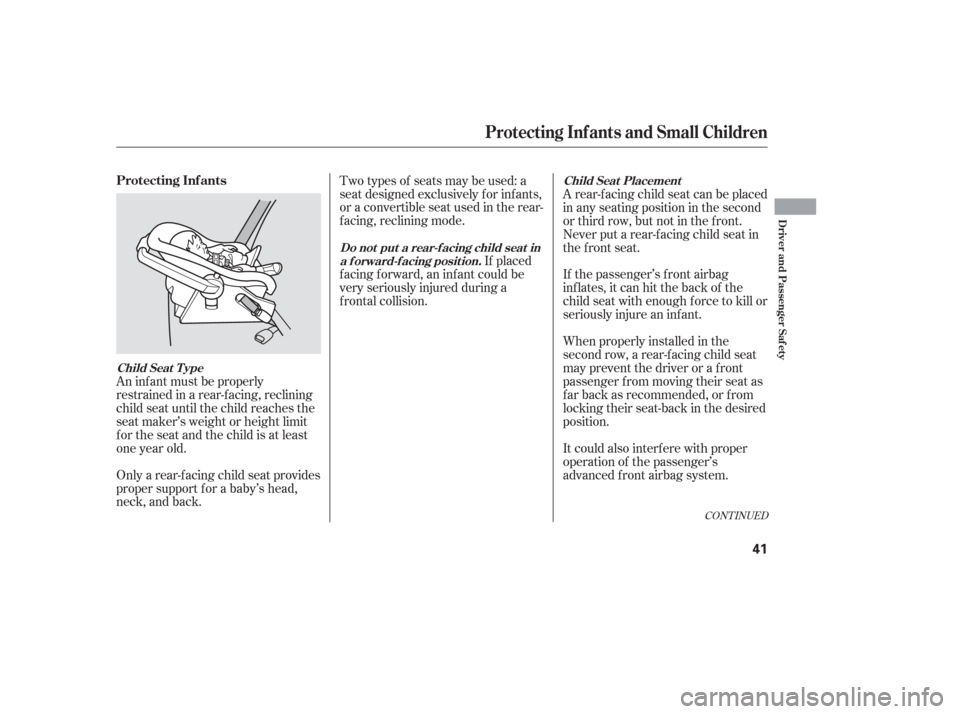
An inf ant must be properly
restrained in a rear-f acing, reclining
child seat until the child reaches the
seat maker’s weight or height limit
for the seat and the child is at least
one year old.
Only a rear-f acing child seat provides
proper support f or a baby’s head,
neck, and back.Two types of seats may be used: a
seat designed exclusively f or inf ants,
or a convertible seat used in the rear-
f acing, reclining mode.
If placed
f acing f orward, an inf ant could be
very seriously injured during a
f rontal collision. If the passenger’s front airbag
inflates, it can hit the back of the
child seat with enough f orce to kill or
seriously injure an inf ant. A rear-f acing child seat can be placed
in any seating position in the second
or third row, but not in the f ront.
Never put a rear-f acing child seat in
the front seat.
When properly installed in the
second row, a rear-f acing child seat
maypreventthedriverorafront
passenger f rom moving their seat as
f ar back as recommended, or f rom
locking their seat-back in the desired
position.
It could also interf ere with proper
operation of the passenger’s
advanced front airbag system.
CONT INUED
Protecting Inf ants
Child Seat T ype Child Seat Placement
Do not put a rear-f acing child seat in a f orward-f acing position.
Protecting Inf ants and Small Children
Driver and Passenger Saf ety
41