Page 204 of 274

The f luid level should be between
theMINandMAXmarksontheside
of the reservoir. If the level is at or
below the MIN mark, your brake
system needs attention. Have the
brake system inspected f or leaks or
worn brake pads.
Check the brake f luid level in the
reservoirs monthly.
The rear dif f erential should be
drained and ref illed with new f luid
accordingtothetimeanddistance
recommendations in the
maintenance schedule. Have your
dealer replace the rear differential
fluid.
Use Honda Dual Pump Fluid only.
Do not use automatic transmission
fluid (ATF).
Brake f luid marked DOT 5 is not
compatible with your vehicle’s
braking system and can cause
extensive damage. Using any non-Honda brake f luid can
cause corrosion and decrease the lif e
of the system. Have the brake
system f lushed and ref illed with
Honda Heavy Duty Brake Fluid
DOT 3 as soon as possible. Always use Honda Heavy Duty
Brake Fluid DOT 3. If it is not
available, you should use only DOT 3
or DOT 4 f luid, f rom a sealed
container, as a temporary
replacement. Replace the brake f luid according to
the time recommendation in the
maintenance schedule.
4WD model only
Rear Dif f erential Fluid, Brake and Clutch Fluid
Brake and Clutch Fluid
Rear Dif f erential Fluid Brake Fluid
Maint enance
201
MAX
MIN
Page 221 of 274

Fill the f uel tank.
Change the engine oil and f ilter.
Wash and dry the exterior
completely.
Cleantheinterior.Makesurethe
carpeting, floor mats, etc., are
completely dry.Block the rear wheels.
If the vehicle is to be stored f or a
longer period, it should be
supported on jackstands so the
tires are of f the ground.
Cover the vehicle with a
‘‘breathable’’ cover, one made
f rom a porous material such as
cotton. Non-porous materials, such
as plastic sheeting, trap moisture,
which can damage the paint.
If you need to park your vehicle f or
an extended period (more than 1
month), there are several things you
should do to prepare it f or storage.
Proper preparation helps prevent
deterioration and makes it easier to
get your vehicle back on the road. If
possible, store your vehicle indoors. Leave one window open slightly (if
the vehicle is being stored
indoors).
Disconnect the battery.
Support the f ront and rear wiper
blade arms with a f olded towel or
ragsotheydonottouchthe
windshield.
To minimize sticking, apply a
silicone spray lubricant to all door
and tailgate seals. Also, apply a
vehiclebodywaxtothepainted
surfaces that mate with the door
and tailgate seals.If possible, periodically run the
engine until it reaches f ull
operating temperature (the
cooling f ans cycle on and of f
twice). Pref erably, do this once a
month.
If you store your vehicle f or 1 year or
longer, have your dealer perf orm the
inspections called f or in the 2 years/
30,000 miles (48,000 km)
maintenance schedule (Normal
Conditions) as soon as you take it
out of storage (see page ). The
replacements called f or in the
maintenance schedule are not
needed unless the vehicle has
actually reached that time or mileage.
Leave the parking brake off. Put
the transmission in reverse
(manual) or Park (automatic).
187
Vehicle Storage
218
Page 223 of 274
To keep the tailgate door open,
use the stop f rom the tool kit. Put
the stop on the support strut as
shown.
If you are towing a trailer, unhitch
the trailer.
Turn on the hazard warning lights,
and turn the ignition switch to the
LOCK (0) position. Have all
passengers get out of the vehicle
while you change the tire.
If you have a f lat tire while driving,
stop in a saf e place to change it.
Drive slowly along the shoulder until
you get to an exit or an area that is
far away from the traffic lanes.
Park the vehicle on f irm, level, and
non-slippery ground. Put the
transmission in Park (automatic)
or reverse (manual). Apply the
parking brake.
1.
2.
3.
Changing a Flat Tire
220
JACKSTOP
SPARE TIRE
TOOL
The vehicle can easily roll off
the jack, seriously injuring
anyone underneath.
Follow the directions for
changing a tire exactly, and
never get under the vehicle
when it is supported only by the
jack.
Page 230 of 274

Diagnosing why the engine won’t
start f alls into two areas, depending
on what you hear when you turn the
ignition switch to the START (III)
position:When you turn the ignition switch to
the START (III) position, you do not
hear the normal noise of the engine
trying to start. You may hear a
clicking sound or series of clicks, or
nothing at all. Turn the ignition switch to the
START (III) position. If the
headlights do not dim, check the
condition of the f uses. If the f uses
areOK,thereisprobably
something wrong with the
electrical circuit f or the ignition
switch or starter motor. You will
need a qualif ied technician to
determine the problem (see
on page ).
If the headlights dim noticeably or
go out when you try to start the
engine, either the battery is dis-
charged or the connections are
corroded. Check the condition of the
battery and terminal connections
(see page ). You can then try
jump starting the vehicle from a
booster battery (see page ).
You can hear the starter motor
operating normally, or the starter
motor sounds like it is spinning
f aster than normal, but the engine
does not start up and run. You hear nothing, or almost
nothing. The engine’s starter
motor does not operate at all, or
operates very slowly.
Turn the ignition switch to the ON
(II) position. Turn on the
headlights, and check their
brightness. If the headlights are
very dim or do not come on at all,
the battery is discharged. Seeon page .
Check the transmission interlock.
If you have a manual transmission,
the clutch pedal must be pushed
all the way to the f loor or the
starter will not operate. With an
automatic transmission, it must be
in Park or neutral.
Check these things:
229217
229242
Nothing Happens or the Starter
Motor Operates Very Slowly
Emergency T owing
Jump Starting
If theEngineWon’tStart
T aking Care of t he Unexpect ed
227
Page 232 of 274
�´�´
Although this seems like a simple
procedure, you should take several
precautions.
You cannot start your vehicle with an
automatic transmission by pushing
or pulling it. Open the hood, and check the
physical condition of the battery.
In very cold weather, check the
condition of the electrolyte. If it
seems slushy or f rozen, do not try
jump starting until it thaws.
Connect one jumper cable to the
positive ( ) terminal on your
battery. Connect the other end to
the positive ( ) terminal on the
booster battery.
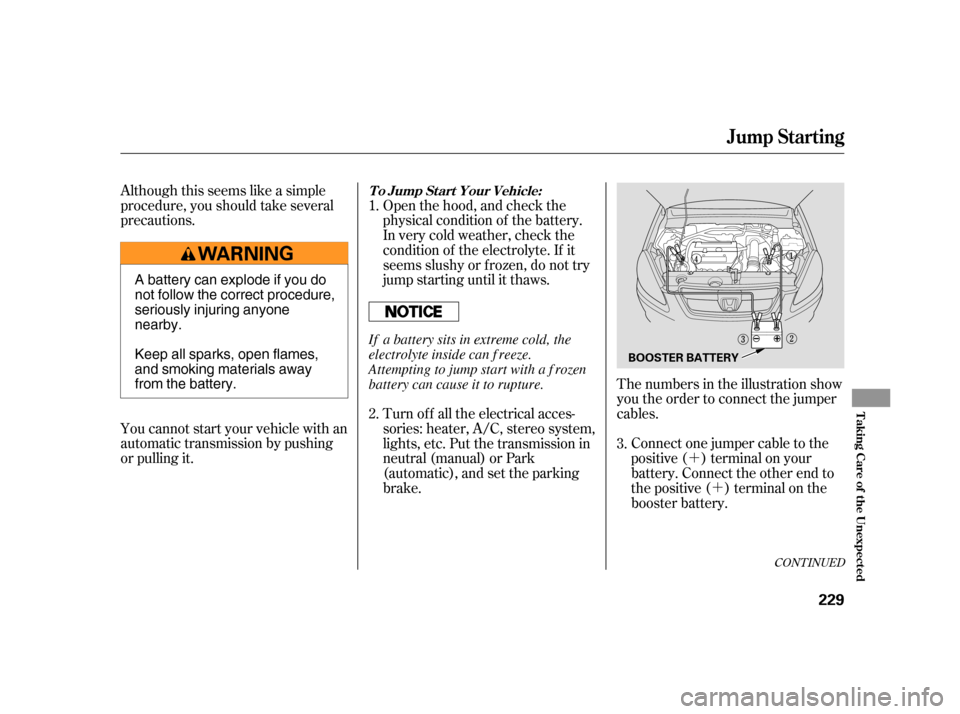
The numbers in the illustration show
you the order to connect the jumper
cables.
Turn of f all the electrical acces-
sories: heater, A/C, stereo system,
lights, etc. Put the transmission in
neutral (manual) or Park
(automatic), and set the parking
brake.
1.
2.
3.
CONT INUED
To Jump Start Your Vehicle:
Jump Starting
T aking Care of t he Unexpect ed
229
BOOSTER BATTERY
A battery can explode if you do
not follow the correct procedure,
seriously injuring anyone
nearby.
Keep all sparks, open flames,
and smoking materials away
from the battery.If a battery sits in extreme cold, the
electrolyte inside can f reeze.
Attempting to jump start with a f rozen
battery can cause it to rupture.
Page 234 of 274
If you do not see steam or spray,
leave the engine running, and
watch the temperature gauge. If
the high heat is due to overloading,
the engine should start to cool
down almost immediately. If it
does, wait until the temperature
gauge comes down to the midpoint,
then continue driving.
If the temperature gauge stays at
the red mark, turn of f the engine.
The pointer of the vehicle’s
temperature gauge should stay in
the midrange. If it climbs to the red
mark, you should determine the
reason (hot day, driving up a steep
hill, etc.).
If the vehicle overheats, you should
take immediate action. The only
indicationmaybethetemperature
gauge climbing to or above the red
mark. Or you may see steam or
spray coming f rom under the hood.
Saf ely pull to the side of the road.
Put the transmission in neutral
(manual) or Park (automatic), and
set the parking brake. Turn of f all
the accessories, and turn on the
hazard indicators.
If you see steam and/or spray
coming f rom under the hood, turn
of f the engine. Wait until you see
no more signs of steam or spray,
then open the hood.
1.
2. 3.
4.
CONT INUED
If theEngineOverheats
T aking Care of t he Unexpect ed
231
Steam and spray from an
overheated engine can
seriously scald you.
Do not open the hood if steam
is coming out.
Driving with the temperature gauge
pointer at the red mark can cause
serious damage to the engine.
Page 248 of 274
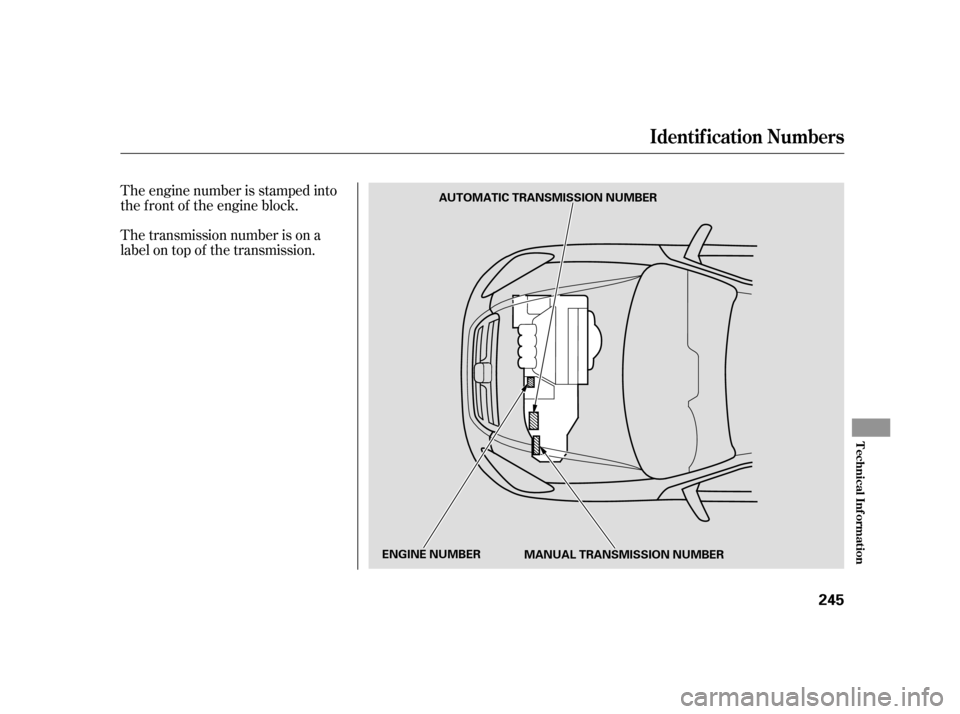
The transmission number is on a
label on top of the transmission. The engine number is stamped into
the f ront of the engine block.
Identif ication Numbers
Technical Inf ormation
245
AUTOMATIC TRANSMISSION NUMBER
ENGINE NUMBER MANUAL TRANSMISSION NUMBER
Page 249 of 274

�Î�Î
�Î
�Î
�Î
�Î
�Î
Specif ications
246
Capacities Engine Weights Dimensions
Capacities
181.0 in (4,597 mm) 1.43 US gal (5.4
)
1.88 US gal (7.1)
1.45 US gal (5.5
)
1.90 US gal (7.2)
3.3 US qt (3.1
)
3.1 US qt (2.9)
7.6 US qt (7.2
)
6.9 US qt (6.5)
2.0 US qt (1.9)
2.4 US qt (2.3)
1.1 US qt (1.0
)
1.3 US qt (1.2)
4.8 US qt (4.5
)
2.6 US qt (2.5)
0.16 US gal (0.6
)
Excluding the oil remaining in the engine
Including the coolant in the reserve tank and that remaining in the
engine
Reserve tank capacity:
Fuel tank
Engine oil
5.6 US qt (5.3
)
4.2 US qt (4.0)
4.4 US qt (4.2)
15.3 US gal (58
)
Type
BorexStroke
Displacement
Compression ratio
Spark plugs Gross vehicle weight rating Length
Width
Height
Wheelbase
Track
See the certification label attached
to the driver’s doorjamb.
SKJ20DR-M11 IZFR6K-11 9.6 : 1
144 cu-in (2,354 cm
)
3.43 x 3.90 in (87.0 x 99.0 mm) 60.6 in (1,538 mm)
60.4 in (1,533 mm)
103.1 in (2,620 mm)
66.2 in (1,682 mm)
70.2 in (1,782 mm)
181.8 in (4,617 mm)
Engine
coolant
Automatic
transmission
fluid
Manual
transmission
fluid
Rear
differential
fluid (4WD)
Windshield
washer
reservoir
Water cooled 4-stroke DOHC
i-VTEC 4-cylinder gasoline engine
Approx.
Front
Rear
Change
Without filter
Total 1:
2:Change
Total
Change
Total
Change
4WD
2WD
Total 4WD
2WD
Change
Total
Change
Total
U.S. Vehicles
Canada
Vehicles
(NGK)
(DENSO)
1 : U.S. SE model and Canada EX-L model
Automatic Transmission
Manual Transmission
1 2
2
1
Including filter