Page 185 of 253
If the reserve tank is completely
empty, you should also check the
coolant level in the radiator.
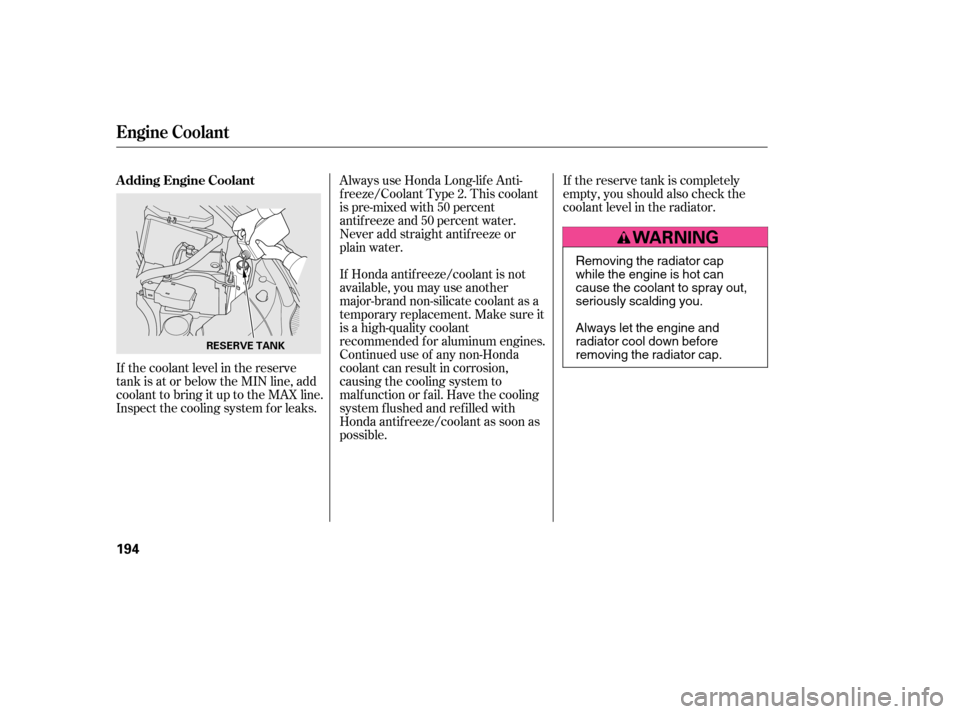
If the coolant level in the reserve
tank is at or below the MIN line, add
coolant to bring it up to the MAX line.
Inspect the cooling system f or leaks. If Honda antif reeze/coolant is not
available, you may use another
major-brand non-silicate coolant as a
temporaryreplacement.Makesureit
is a high-quality coolant
recommended f or aluminum engines.
Continued use of any non-Honda
coolant can result in corrosion,
causing the cooling system to
malf unction or f ail. Have the cooling
system f lushed and ref illed with
Honda antif reeze/coolant as soon as
possible.
Always use Honda Long-lif e Anti-
f reeze/Coolant Type 2. This coolant
is pre-mixed with 50 percent
antif reeze and 50 percent water.
Never add straight antifreeze or
plain water.
A dding Engine Coolant
Engine Coolant
194
RESERVE TANK
Removing the radiator cap
while the engine is hot can
cause the coolant to spray out,
seriously scalding you.
Always let the engine and
radiator cool down before
removing the radiator cap.
�����—�����—�����y�
�������������y���
�(�#���������y���
�����y
Page 186 of 253
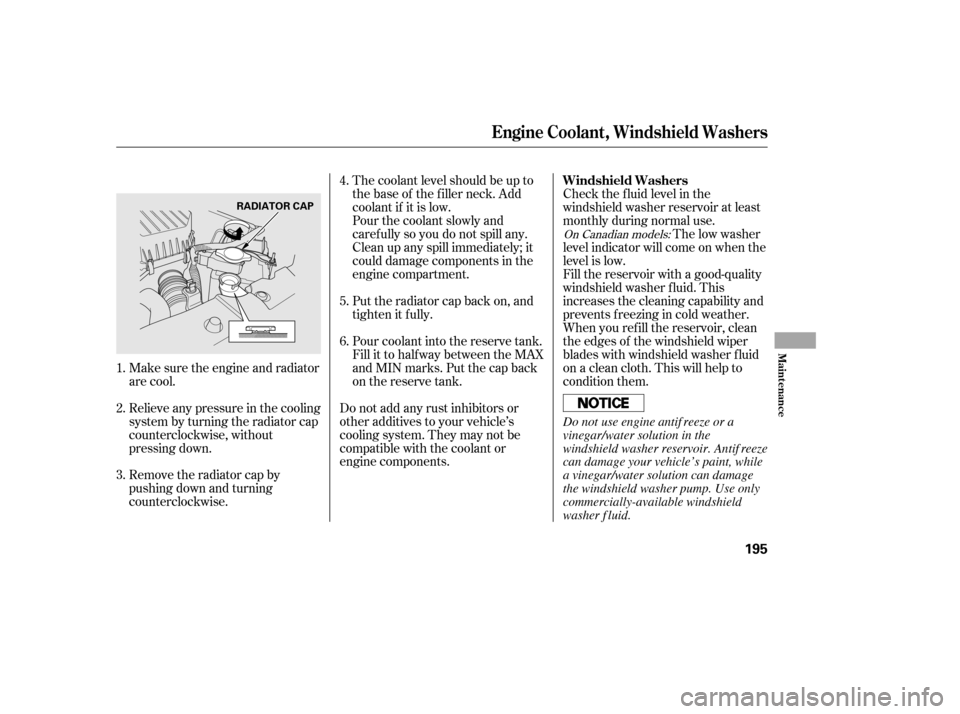
The coolant level should be up to
the base of the f iller neck. Add
coolant if it is low.
Pourthecoolantslowlyand
caref ully so you do not spill any.
Clean up any spill immediately; it
could damage components in the
engine compartment.
Pour coolant into the reserve tank.
Fill it to half way between the MAX
and MIN marks. Put the cap back
on the reserve tank.
Do not add any rust inhibitors or
other additives to your vehicle’s
cooling system. They may not be
compatible with the coolant or
engine components. Check the f luid level in the
windshield washer reservoir at least
monthly during normal use.
Make sure the engine and radiator
are cool. When you ref ill the reservoir, clean
the edges of the windshield wiper
blades with windshield washer f luid
on a clean cloth. This will help to
condition them.
Fill the reservoir with a good-quality
windshield washer f luid. This
increases the cleaning capability and
prevents f reezing in cold weather.
The low washer
level indicator will come on when the
level is low.
Relieve any pressure in the cooling
system by turning the radiator cap
counterclockwise, without
pressing down.
Remove the radiator cap by
pushing down and turning
counterclockwise. Put the radiator cap back on, and
tighten it fully.
3. 4. 5.
1. 2. 6.
On Canadian models:
Windshield Washers
Engine Coolant, Windshield Washers
Maint enance
195
RADIATOR CAP
Do not use engine antif reeze or a
vinegar/water solution in the
windshield washer reservoir. Antif reeze
can damage your vehicle’s paint, while
a vinegar/water solution can damage
the windshield washer pump. Use only
commercially-available windshield
washer f luid.
�����—�����—�����y�
�������������y���
�(�#���������y���
�����y
Page 203 of 253
It is best to replace all f our tires at
thesametime.If thatisnotpossible
or necessary, replace the two f ront
tires or two rear tires as a pair.
Replacing just one tire can seriously
af f ect your vehicle’s handling.
If you ever replace a wheel, make
sure that the wheel’s specif ications
match those of the original wheels.
Replacement wheels are available at
your dealer.
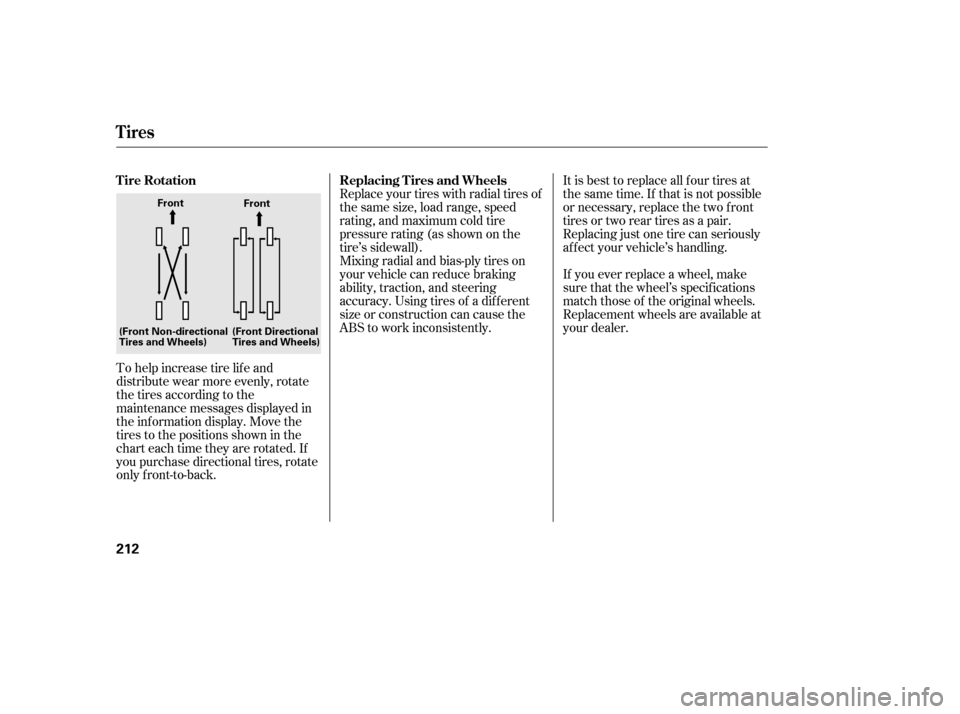
To help increase tire lif e and
distribute wear more evenly, rotate
the tires according to the
maintenance messages displayed in
the information display. Move the
tires to the positions shown in the
chart each time they are rotated. If
you purchase directional tires, rotate
only f ront-to-back. Replace your tires with radial tires of
the same size, load range, speed
rating, and maximum cold tire
pressure rating (as shown on the
tire’s sidewall).
Mixing radial and bias-ply tires on
your vehicle can reduce braking
ability, traction, and steering
accuracy. Using tires of a dif f erent
size or construction can cause the
ABS to work inconsistently.
T ire Rotation Replacing T ires and Wheels
Tires
212
Front
Front
(Front Directional
Tires and Wheels)
(Front Non-directional
Tires and Wheels)
�����—�����—�����y�
������
������y���
�(�#���������y�����
���y
Page 204 of 253

�´
Wheels:
Tires: Tires marked ‘‘M S’’ or ‘‘All
Season’’ on the sidewall have an all-
weather tread design suitable for
most winter driving conditions.
For the best perf ormance in snowy
or icy conditions, you should install
snow tires or tire chains. They may
be required by local laws under
certain conditions.
If you mount snow tires on your
vehicle, make sure they are radial
tires of the same size and load range
as original tires. Mount snow tires on
all f our wheels. The traction
provided by snow tires on dry roads
maybelowerthanyouroriginaltires.
Check with the tire dealer f or
maximum speed recommendations.
See page f or DOT tire quality
grading inf ormation, and page
f or tire size inf ormation.
(LX, EX)
(LX, EX)
(DX, Canadian DX-G)
(DX, Canadian DX-G)
244
246
CONT INUED
Wheel and T ire Specif ications Winter Driving
Tires
Snow T iresMaint enance
213
15x6J
P195/65R15 89H
16x61/2JJ
P205/55R16 89H
Installing improper tires on your
vehicle can affect handling and
stability. This can cause a crash
in which you can be seriously
hurt or killed.
Always use the size and type of
tires recommended in this
owner’s manual.
�����—�����—�����y�
�������������y���
�(�#���������y�����
���y
Page 217 of 253
If you do not f ind an obvious leak,
check the coolant level in the
radiator reserve tank. Add coolant
if the level is below the MIN mark.
Look f or any obvious coolant leaks,
such as a split radiator hose.
Everything is still extremely hot,
so use caution. If you f ind a leak, it
must be repaired bef ore you
continue driving (see
on page ).
If the temperature gauge reading
stays at the red mark, turn of f the
engine.
Saf ely pull to the side of the road.
Put the transmission in neutral
(M/T) or Park (A/T), and set the
parking brake. Turn of f all the
accessories, and turn on the
hazard indicator.
If you see steam and/or spray
coming f rom under the hood, turn
of f the engine. Wait until you see
no more signs of steam or spray,
then open the hood.
If you do not see steam or spray,
leave the engine running, and
watch the temperature gauge. If
the high heat is due to overloading,
the engine should start to cool
down almost immediately. If it
does, wait until the temperature
gauge reading comes down to the
midpoint, then continue driving.
1. 2. 3.
4. 5. 6.
237
CONT INUED
If theEngineOverheats
Emergency
Towing
T aking Care of t he Unexpect ed
227
Steam and spray from an
overheated engine can
seriously scald you.
Do not open the hood if steam
is coming out.
�����—�����—�����y�
�������������y���
�(�#���������y���������y
Page 218 of 253

Start the engine, and set the
temperature control dial to
maximum. Add coolant to the
radiator up to the base of the f iller
neck. If you do not have the
proper coolant mixture available,
you can add plain water.
Remember to have the cooling
system drained and ref illed with
the proper mixture as soon as you
can.Put the radiator cap back on
tightly. Run the engine, and watch
the temperature gauge. If it goes
back to the red mark, the engine
needs repair (see
on page ).
If the temperature stays normal,
check the coolant level in the
radiator reserve tank. If it has
gone down, add coolant to the
MAX mark. Put the cap back on
tightly.
Using gloves or a large heavy
cloth, turn the radiator cap
counterclockwise, without pushing
down, to the f irst stop. Af ter the
pressure releases, push down on
the cap, and turn it until it comes
off.
If there was no coolant in the
reserve tank, you may need to add
coolant to the radiator. Let the
engine cool down until the reading
reaches the middle of the
temperature gauge or lower
bef ore checking the radiator. 8. 9. 10. 11.
7.
237Emergency
Towing
If theEngineOverheats
228
Removing the radiator cap
while the engine is hot can
cause the coolant to spray out,
seriously scalding you.
Always let the engine and
radiator cool down before
removing the radiator cap.
�����—�����—�����y�
�������������y���
�(�#���������y�������
�y
Page 224 of 253

If the replacement fuse of the
same rating blows in a short time,
there is probably a serious
electrical problem with your
vehicle. Leave the blown fuse in
that circuit, and have your vehicle
checked by a qualif ied mechanic.
If you cannot drive the vehicle
without f ixing the problem, and you
do not have a spare fuse, take a fuse
of the same rating or a lower rating
f rom one of the other circuits. Make
sureyoucandowithoutthatcircuit
temporarily (such as the accessory
power socket or radio).
If you replace the blown f use with a
spare f use that has a lower rating, it
might blow out again. This does not
indicate anything wrong. Replace the
f use with one of the correct rating as
soon as you can.
If the driver’s power window f use is
removed, the AUTO f unction of the
driver’s window will be disabled. To
reset the AUTO f unction, see page
.
Look f or a blown wire inside the
f use. If it is blown, replace it with
oneof thesparefusesof thesame
rating or lower. The spare f uses
are provided back of the under-
hood f use cover. 6.
5. 94
On LX and EX models
Fuses
234
BLOWN
Replacing a f use with one that has a
higher rating greatly increases the
chances of damaging the electrical
system. If you do not have a
replacement f use with the proper rating
f or the circuit, install one with a lower
rating.
�����—�����—���
�y�
�������������y���
�(�#���������y���������y
Page 226 of 253
�Î�Î
�Î �Î
�Î
�µ �µ�µ �µ �µ �µ �µ
�Î
No.
No.No.
Amps. Circuits Protected
Circuits Protected
Amps. Circuits Protected
Amps.
:
1 2345678 9
10111213141516 17181920212223242526272829303132333435363738
7.5 A
7.5 A
10 A
10 A
10 A
7.5 A
7.5 A 10 A ODS
MET ER
SRS
Right Headlight High
Left Headlight High
Small (Interior)
Small (Exterior)
Right Headlight Low
Power Window
Fuel Pump
Alternator
ABS Unit
Heated Seat
Not Used
Not Used
Not Used
7.5 A
15 A
10 A
7.5 A
(15 A) Left Headlight Low
Headlight High Main
Small (Main)
Not Used
Headlight Low Main
(HAC)
STS
Moonroof
Door Lock
Driver’s Power Window
Not Used
Rear ACC Socket
ACC
Passenger’s Power Window
Not Used
Right Rear Power Window
Left Rear Power Window
Not Used
ACC Radio
HAC
Daytime Running Light
Wiper
10 A
20 A
15 A
20 A
(7.5 A)
(7.5 A) (20 A) 20 A
20 A
(15 A) 15 A
20 A
20 A
20 A
7.5 A 10 A
7.5 A
30 A
If equipped
Fuse Locations
236
INTERIOR FUSE BOX
�����—�����—���
�y�
���������
�
�y���
�(�#���������y���������y
