Page 81 of 267

�µ�µ
�µ
�µ
The ignition switch has f our
positions: LOCK (0), ACCESSORY
(I), ON (II), and START (III).
You can insert or
remove the key only in this position.
To turn the key, the shift lever must
be in Park, and you must push the
key in slightly. If the f ront wheels
are turned, the anti-thef t lock may
make it difficult to turn the key.
Firmly turn the steering wheel to the
left or to the right as you turn the key.
You can
operate the audio system and the
accessory power sockets in this
position.
This is the normal key
position when driving. Several of the
indicators on the instrument panel
come on as a test when you turn the
ignition switch f rom the
ACCESSORY (I) to the ON (II)
position.
Use this position
only to start the engine. The switch
returns to the ON (II) position when
you let go of the key. You will hear a reminder beeper if
you leave the key in the LOCK (0) or
the ACCESSORY (I) position and
open the driver’s door. Remove the
key to turn of f the beeper.
TheshiftlevermustbeinPark
bef ore you can remove the key f rom
the ignition switch.
LOCK (0) A CCESSORY (I)
ON (II)
ST A RT (III)
Ignition Switch
Inst rument s and Cont rols
79
�����—�����—�����y�
�����������
�y���
�(�#���������y���������y
Page 104 of 267

Air conditioning places an extra load
on the engine. Watch the engine
coolant temperatu re gauge (see page
). If it moves near the red zone,
turn of f the A/C until the gauge
reading returns to normal.
you can
cool it down more rapidly by partially
opening the windows, turning on the
A/C, and setting the fan to
maximum speed in f resh air mode. Turn on the A/C by pressing the
button. The indicator in the button
comesonwhenafanspeedis
selected.
Make sure the temperature is set
to maximum cool.
Select .
If the outside air is humid, select
recirculation mode. If the outside
air is dry, select f resh air mode.
Set the f an to the desired speed.
The f low-through ventilation system
draws in outside air, circulates it
through the interior, then exhausts it
through vents near the rear window.
Select .
When you select , the system
automatically switches to the fresh
air mode.
Set the f an to the desired speed.
Adjust the warmth of the air with
the temperature control dial.
The heater uses engine coolant to
warm the air. If the engine is cold, it
will be several minutes bef ore you
f eel warm air coming f rom the
system.
Set the temperature to the lower
limit.
Make sure the A/C is of f .
Select and fresh air mode.
Set the f an to the desired speed.
Airf low is divided between
the f loor vents and the def roster
vents at the base of the windshield.
Air f lows f rom the def roster
vents at the base of the windshield.
When you select or ,
the system automatically switches to
Fresh Air mode and turns on the
A/C.
In AUTO mode, the system controls
the airf low direction automatically
between the dashboard vents and
the f loor vents. 1.
2.
3.
4.
1.
2.
3.
4.
5.
1.
2.
3. 67
If the interior is very warm,
Using the A/C
Ventilation
Using the Heater
Vents, Heating, and A/C
102
�����—�����—�����y�
����
�
��
���y���
�(�#���������y���
�����y
Page 151 of 267
Bef ore you begin driving your
vehicle, you should know what
gasoline to use and how to check the
levels of important f luids. You also
need to know how to properly store
luggage or packages. The
inf ormation in this section will help
you. If you plan to add any
accessories to your vehicle, please
read the information in this section
first..............................
Break-in Period .150
.................
Fuel Recommendation .150
.........
Service Station Procedures .151
....................................
Ref ueling .151
OpeningandClosingthe
.......................................
Hood .152
...................................
Oil Check .153
.............
Engine Coolant Check .154
...............................
Fuel Economy .154
...
Accessories and Modif ications .156
.............................
Carrying Cargo .158
Bef ore Driving
Bef ore Driving
149
�����—�����—�����y�
����
��������y���
�(�#���������y���
�����y
Page 152 of 267

Help assure your vehicle’s f uture
reliability and perf ormance by paying
extra attention to how you drive
during the f irst 600 miles (1,000 km).
During this period:Avoid full-throttle starts and rapid
acceleration.
You should also f ollow these
recommendations with an
overhauled or exchanged engine, or
when the brakes are replaced. Your vehicle is designed to operate
on unleaded gasoline with a pump
octane number of 87 or higher. Use
of a lower octane gasoline can cause
a persistent, heavy metallic rapping
noise that can lead to engine damage.
Do not change the oil until the
scheduled maintenance time.
Avoidhardbrakingforthefirst
200 miles (300 km). Using gasoline containing lead will
damage your vehicle’s emissions
controls. This contributes to air
pollution.
In addition, in order to maintain good
perf ormance, f uel economy, and
emissions control, we strongly
recommend, in areas where it is
available, the use of gasoline that
does NOT contain manganese-based
f uel additives such as MMT. We recommended using a quality
gasoline containing detergent
additives that help prevent fuel
system and engine deposits. Use of gasoline with these additives
may adversely af f ect perf ormance,
and cause the malfunction indicator
lamp on your instrument panel to
come on. If this happens, contact
your authorized dealer f or service.
Some gasoline today is blended with
oxygenates such as ethanol or
MTBE. Your vehicle is designed to
operate on oxygenated gasoline
containing up to 10 % ethanol by
volume and up to 15 % MTBE by
volume. Do not use gasoline
containing methanol.
If you notice any undesirable
operating symptoms, try another
service station or switch to another
brand of gasoline.
For f urther important f uel-related
inf ormation, please ref er to your
.
Break-in Period Fuel Recommendation
Quick Start Guide
Break-in Period, Fuel Recommendation
150
�����—�����—�����y�
����
��������y���
�(�#���������y���
�����y
Page 153 of 267
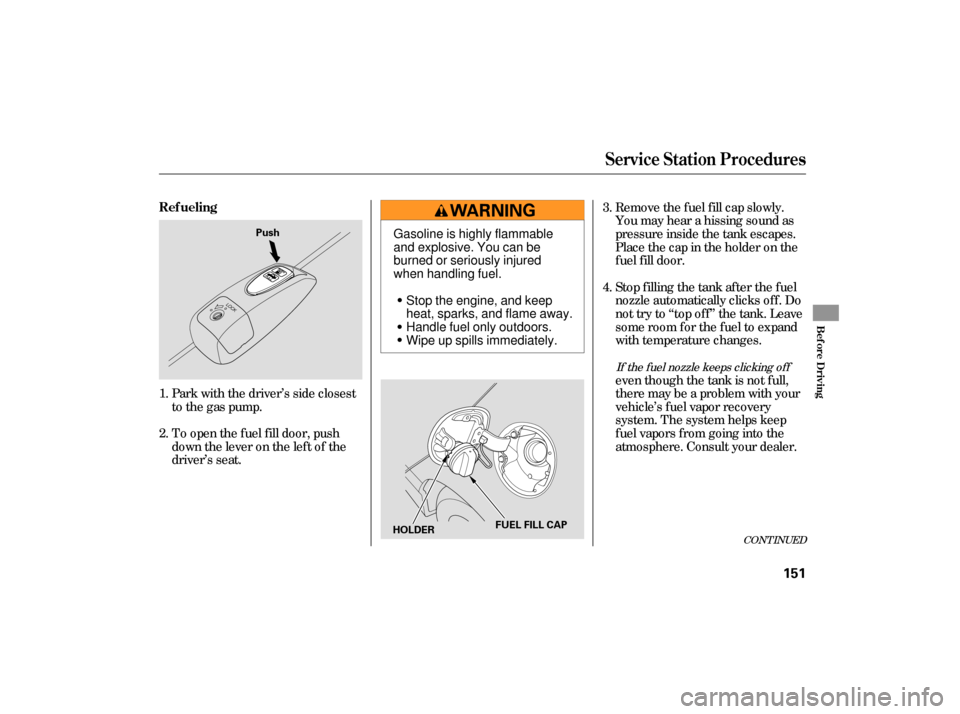
Park with the driver’s side closest
to the gas pump.even though the tank is not f ull,
there may be a problem with your
vehicle’s fuel vapor recovery
system. The system helps keep
f uel vapors f rom going into the
atmosphere. Consult your dealer. Stop f illing the tank af ter the f uel
nozzle automatically clicks of f . Do
not try to ‘‘top off’’ the tank. Leave
some room f or the f uel to expand
with temperature changes. Removethefuelfillcapslowly.
You may hear a hissing sound as
pressure inside the tank escapes.
Place the cap in the holder on the
fuel fill door.
To open the f uel f ill door, push
down the lever on the lef t of the
driver’s seat.
1.
2. 3.
4.
If the f uel nozzle keeps clicking of f
CONT INUED
Service Station Procedures
Ref ueling
Bef ore Driving
151
Push
HOLDERFUEL FILL CAPGasoline is highly flammable
and explosive. You can be
burned or seriously injured
when handling fuel.
Stop the engine, and keep
heat, sparks, and flame away.
Handle fuel only outdoors.
Wipe up spills immediately.
�����—�����—�����y�
����
��������y���
�(�#���������y���
�����y
Page 154 of 267
If the hood latch handle moves
stiffly, or if you can open the hood
without lifting the handle, the
mechanism should be cleaned and
lubricated.
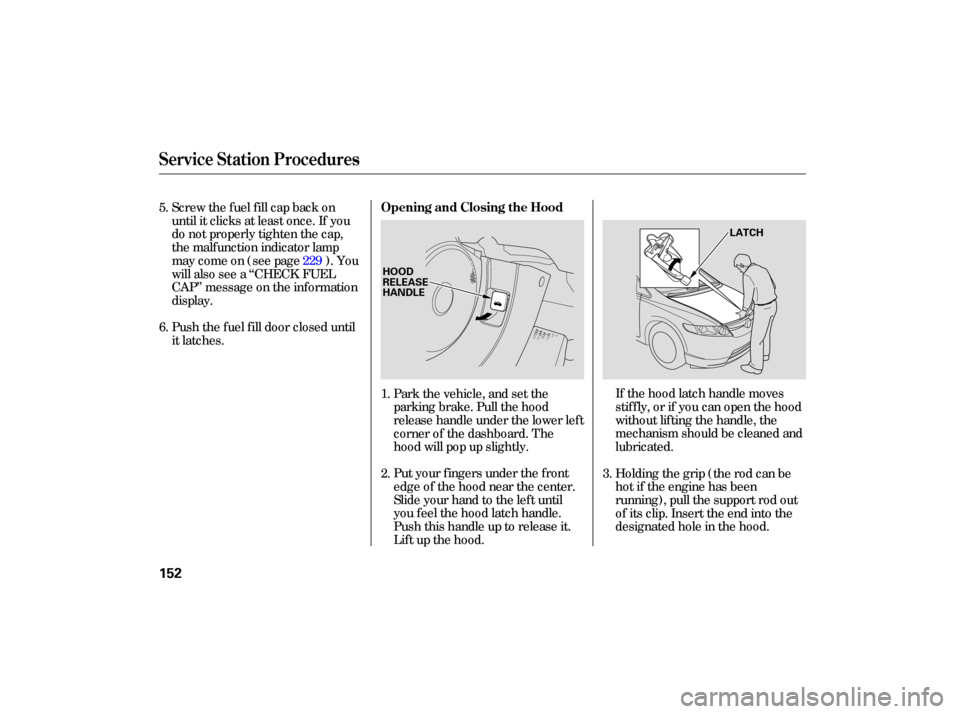
Put your fingers under the front
edge of the hood near the center.
Slide your hand to the left until
you feel the hood latch handle.
Push this handle up to release it.
Lift up the hood.
Push
the fuel fill door closed until
it latches.
Screw
the fuel fill cap back on
until it clicks at least once. If you
do not properly tighten the cap,
the malf unction indicator lamp
maycomeon(seepage ).You
will also see a ‘‘CHECK FUEL
CAP’’ message on the inf ormation
display.
Park the vehicle, and set the
parking brake. Pull the hood
release handle under the lower lef t
corner of the dashboard. The
hood will pop up slightly.Holding the grip (the rod can be
hot if the engine has been
running), pull the support rod out
of its clip. Insert the end into the
designated hole in the hood.
2. 1.
3.
5.
6.
229
Service Station Procedures
Opening and Closing the Hood
152
HOOD
RELEASE
HANDLE LATCH
�����—�����—�����y�
����
����
���y���
�(�#���������y���
�����y
Page 155 of 267
Remove the dipstick again, and
check the level. It should be
between the upper and lower
marks.
Wait
a few minutes after turning the
engine off before you check the oil.
Remove the dipstick (orange loop).
Wipe the dipstick with a clean
cloth or paper towel.
Insert it all the way back in its tube.
To
close the hood, lift it up slightly to
remove the support rod from the
hole. Put the support rod back into
its holding clip. Lower the hood to
about a foot (30 cm) above the
fender, then let it drop. Make sure it
is securely latched. If it is near or below the lower mark,
see
on page .
2.
3. 1. 4.
192
Service Station Procedures
Oil Check
A dding Engine Oil
Bef ore Driving
153
DIPSTICK UPPER MARK
LOWER MARK
SUPPORT ROD
CLIP
GRIP
�����—�����—�����y�
����
��������y���
�(�#���������y���
�����y
Page 156 of 267

Drive moderately. Rapid
acceleration, abrupt cornering,
and hard braking use more fuel.
Always drive in the highest gear
possible.
Always maintain your vehicle
according to the maintenance
schedule. See
(see page
).
an underinflated tire
causes more ‘‘rolling resistance,’’
which u ses more fuel.
Engine oil also affects fuel
economy. The fuel efficient, low-
vi scosity 0W-20 oil recommended
for your Civic Hybrid is
formulated to help the engine use
less fu el. This oil is available at
your dealer.
The build-up of snow or mud on
your vehicl e’s underside adds
weight and rolling resistance.
Frequent cl eaning helps your fuel
mileage and reduces the chance of
corrosion.
Look at the coolant level in the
radiator reserve tank. Make sure it is
between
the MAX and MIN lines. If
it is below the MIN line, see
on page .
Refer to
on page for information
about checking other items on your
vehicle. You may find that your Civic Hybrid’s
unique combination of an engine and
an electric motor has driving
characteristics that are somewhat
dif f erent f rom what you are used to.
192
184 184
For example,
Service Station Procedures, Fuel Economy
Improving Fuel Economy
Owner’s
Maintenance Checks
Engine Coolant Check
A dding
Engine Coolant
Owner’s Maintenance
Checks
154
MAX
MIN RESERVE TANK
�����—�����—�����y�
����
��������y���
�(�#���������y���
�����y