Page 71 of 267
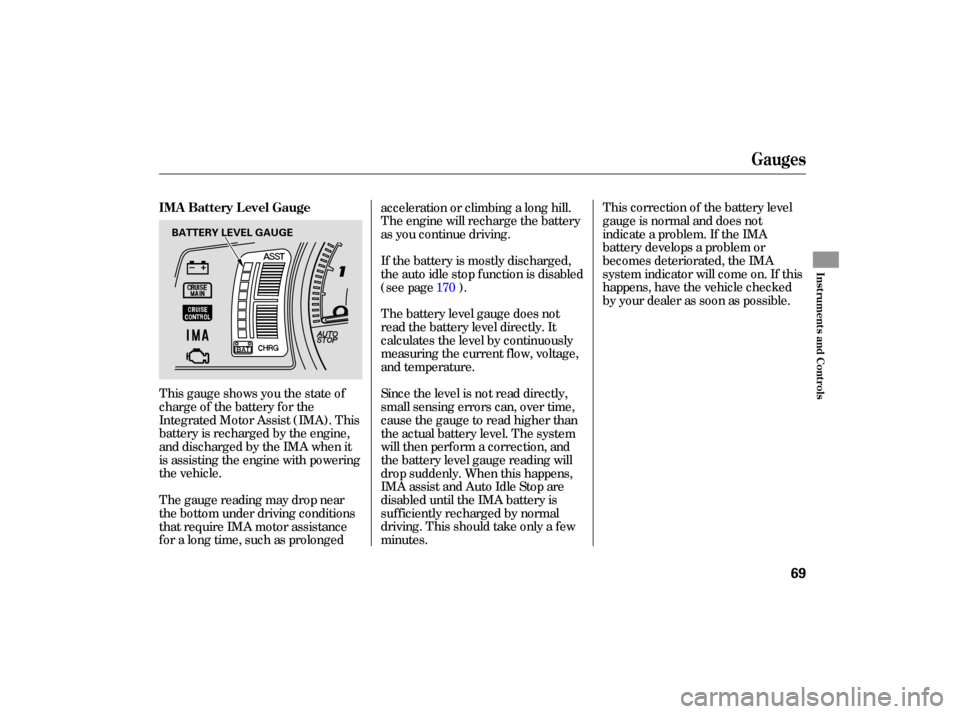
This gauge shows you the state of
charge of the battery for the
Integrated Motor Assist (IMA). This
battery is recharged by the engine,
anddischargedbytheIMAwhenit
is assi sting the engine with powering
the vehicle. The
battery level gauge does not
read the battery level directly. It
calculates the level by continuously
measuring the current flow, voltage,
and temperature.
Since the level is not read directly,
small sensing errors can, over time,
cause the gauge to read higher than
the actual battery level. The system
will then perform a correction, and
the battery level gauge reading will
drop suddenly. When this happens,
IMA assist and Auto Idle Stop are
disabled until the IMA battery is
sufficiently recharged by normal
driving. This should take only a few
minutes. This
correction of the battery level
gauge is normal and does not
indicate a problem. If the IMA
battery develops a problem or
becomes deteriorate d, the IMA
system indicator will come on. If this
happens, have the vehic le checked
by your dealer as soon as possible.
The gauge reading may drop near
the bottom under driving conditions
that require IMA motor assistance
for a long time, such as prolonged acceleration or climbing a long hill.
The engine will recharge the battery
as you continue driving.
If the battery is mostly discharged,
the auto idle stop f unction is disabled
(see page ).
170
IMA Battery Level Gauge
Gauges
Inst rument s and Cont rols
69
BATTERY LEVEL GAUGE
�����—�����—�����y�
�������������y���
�(�#���������y���������y
Page 151 of 267
Bef ore you begin driving your
vehicle, you should know what
gasoline to use and how to check the
levels of important f luids. You also
need to know how to properly store
luggage or packages. The
inf ormation in this section will help
you. If you plan to add any
accessories to your vehicle, please
read the information in this section
first..............................
Break-in Period .150
.................
Fuel Recommendation .150
.........
Service Station Procedures .151
....................................
Ref ueling .151
OpeningandClosingthe
.......................................
Hood .152
...................................
Oil Check .153
.............
Engine Coolant Check .154
...............................
Fuel Economy .154
...
Accessories and Modif ications .156
.............................
Carrying Cargo .158
Bef ore Driving
Bef ore Driving
149
�����—�����—�����y�
����
��������y���
�(�#���������y���
�����y
Page 154 of 267
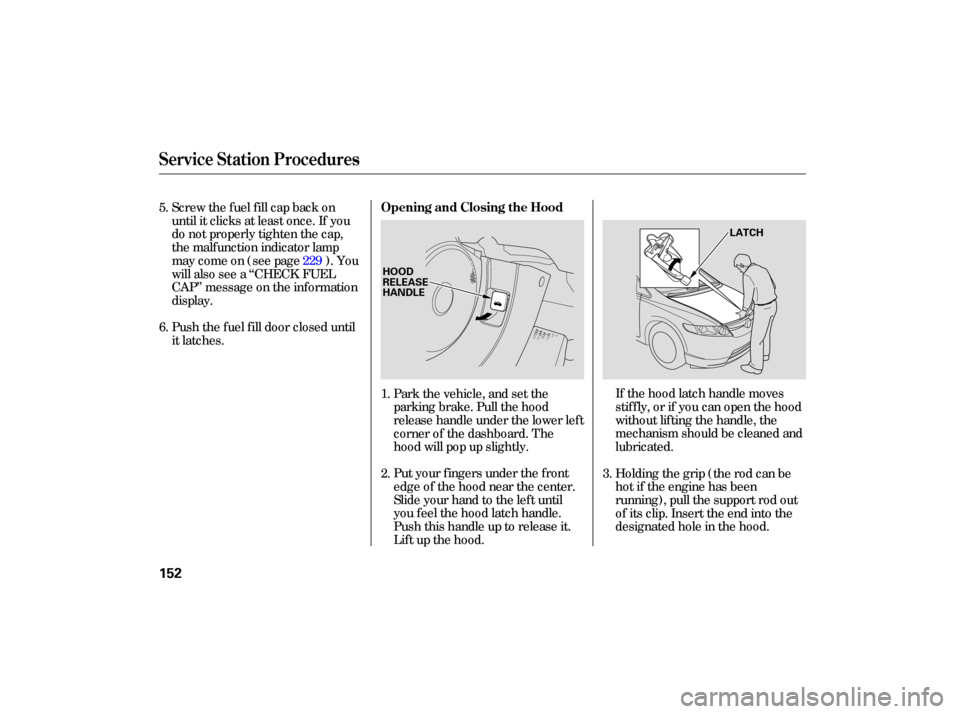
If the hood latch handle moves
stiffly, or if you can open the hood
without lifting the handle, the
mechanism should be cleaned and
lubricated.
Put your fingers under the front
edge of the hood near the center.
Slide your hand to the left until
you feel the hood latch handle.
Push this handle up to release it.
Lift up the hood.
Push
the fuel fill door closed until
it latches.
Screw
the fuel fill cap back on
until it clicks at least once. If you
do not properly tighten the cap,
the malf unction indicator lamp
maycomeon(seepage ).You
will also see a ‘‘CHECK FUEL
CAP’’ message on the inf ormation
display.
Park the vehicle, and set the
parking brake. Pull the hood
release handle under the lower lef t
corner of the dashboard. The
hood will pop up slightly.Holding the grip (the rod can be
hot if the engine has been
running), pull the support rod out
of its clip. Insert the end into the
designated hole in the hood.
2. 1.
3.
5.
6.
229
Service Station Procedures
Opening and Closing the Hood
152
HOOD
RELEASE
HANDLE LATCH
�����—�����—�����y�
����
����
���y���
�(�#���������y���
�����y
Page 155 of 267
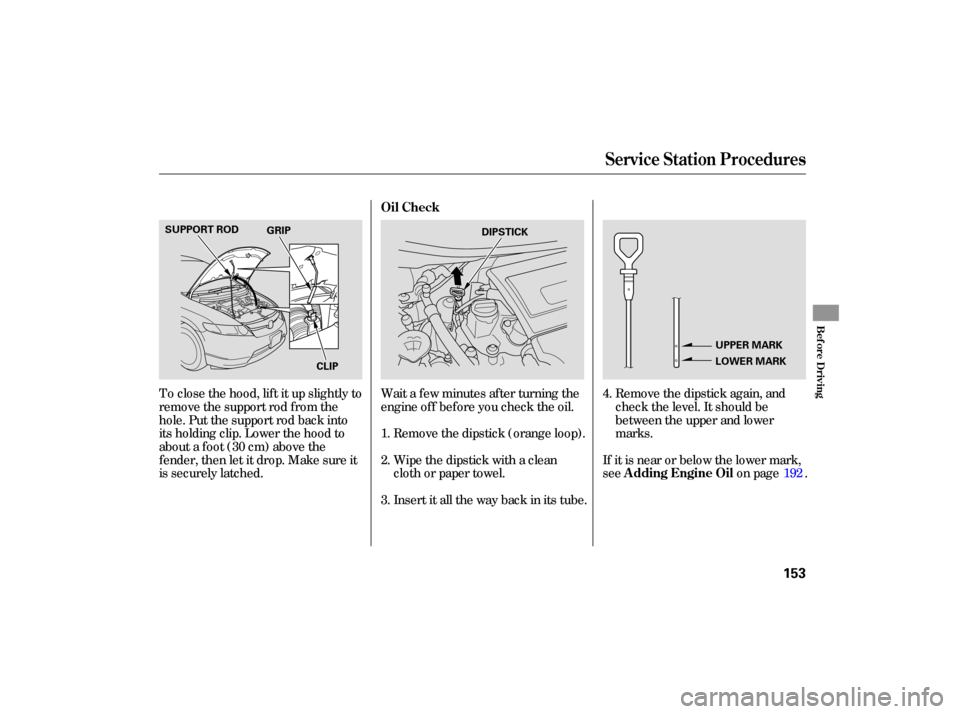
Remove the dipstick again, and
check the level. It should be
between the upper and lower
marks.
Wait
a few minutes after turning the
engine off before you check the oil.
Remove the dipstick (orange loop).
Wipe the dipstick with a clean
cloth or paper towel.
Insert it all the way back in its tube.
To
close the hood, lift it up slightly to
remove the support rod from the
hole. Put the support rod back into
its holding clip. Lower the hood to
about a foot (30 cm) above the
fender, then let it drop. Make sure it
is securely latched. If it is near or below the lower mark,
see
on page .
2.
3. 1. 4.
192
Service Station Procedures
Oil Check
A dding Engine Oil
Bef ore Driving
153
DIPSTICK UPPER MARK
LOWER MARK
SUPPORT ROD
CLIP
GRIP
�����—�����—�����y�
����
��������y���
�(�#���������y���
�����y
Page 156 of 267

Drive moderately. Rapid
acceleration, abrupt cornering,
and hard braking use more fuel.
Always drive in the highest gear
possible.
Always maintain your vehicle
according to the maintenance
schedule. See
(see page
).
an underinflated tire
causes more ‘‘rolling resistance,’’
which u ses more fuel.
Engine oil also affects fuel
economy. The fuel efficient, low-
vi scosity 0W-20 oil recommended
for your Civic Hybrid is
formulated to help the engine use
less fu el. This oil is available at
your dealer.
The build-up of snow or mud on
your vehicl e’s underside adds
weight and rolling resistance.
Frequent cl eaning helps your fuel
mileage and reduces the chance of
corrosion.
Look at the coolant level in the
radiator reserve tank. Make sure it is
between
the MAX and MIN lines. If
it is below the MIN line, see
on page .
Refer to
on page for information
about checking other items on your
vehicle. You may find that your Civic Hybrid’s
unique combination of an engine and
an electric motor has driving
characteristics that are somewhat
dif f erent f rom what you are used to.
192
184 184
For example,
Service Station Procedures, Fuel Economy
Improving Fuel Economy
Owner’s
Maintenance Checks
Engine Coolant Check
A dding
Engine Coolant
Owner’s Maintenance
Checks
154
MAX
MIN RESERVE TANK
�����—�����—�����y�
����
��������y���
�(�#���������y���
�����y
Page 166 of 267
Make sure all windows, mirrors,
and outside lights are clean and
unobstructed. Remove frost, snow,
or ice.Check that any items you may be
carrying are stored properly or
fastened down securely.
Check the seat adjustment (see
page ).
Check the adjustment of the
inside and outside mirrors (see
page ).
Check the steering wheel
adjustment (see page ).
Make sure the doors are securely
closed and locked.Fasten your seat be
lt. Check that
your passengers have fastened
their seat belts (see page ).
Youshoulddothefollowingchecks
and
adjustmen ts before you drive
your vehicle.
When you start the engine, check
the gauges and indicato rs in the
instrument panel (see page ).
Check that the hood and trunk are
fully closed.
Visually check the tires. If a tire
looks low, use a gauge to check its
pressure (see page ).
1.
2.
3.
8. 7. 6. 14
9.
4.
5.
207 93
75
89
57
10.
Preparing to Drive
164
�����—�����—�����y�
����
��������y���
�(�#���������y���
�����y
Page 171 of 267
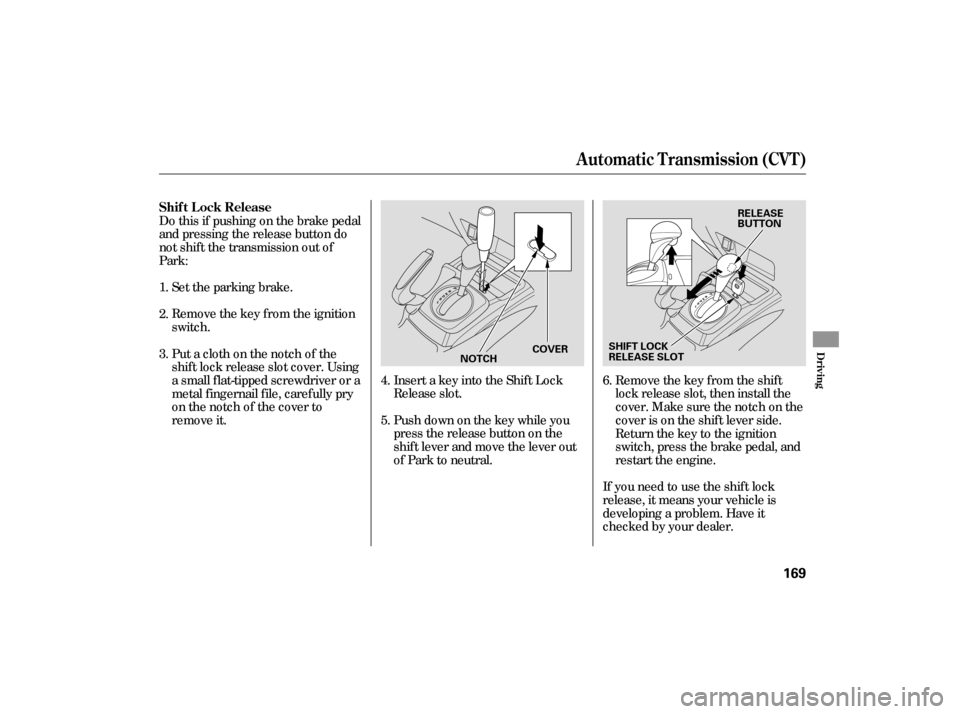
Do this if pushing on the brake pedal
and pressing the release button do
not shif t the transmission out of
Park:Remove the key from the ignition
switch. Set the parking brake.
Insert a key into the Shift Lock
Release slot.
Push down on the key while you
pressthereleasebuttononthe
shif t lever and move the lever out
of Park to neutral.Remove the key from the shift
lock release slot, then install the
cover. Make sure the notch on the
cover is on the shif t lever side.
Return the key to the ignition
switch, press the brake pedal, and
restart the engine.
If you need to use the shif t lock
release, it means your vehicle is
developing a problem. Have it
checked by your dealer.
Putaclothonthenotchof the
shif t lock release slot cover. Using
a small f lat-tipped screwdriver or a
metal f ingernail f ile, caref ully pry
on the notch of the cover to
remove it.
1.
2.
3.
4.
5.6.
Shif t L ock Release
Automatic Transmission (CVT)
Driving
169
SHIFT LOCK
RELEASE SLOT
COVER RELEASE
BUTTON
NOTCH
�����—�����—�
���y�
�������������y���
�(�#���������y���
�����y
Page 175 of 267

Your vehicle is equipped with f ront
disc brakes. The brakes on the rear
wheels are drum. A power assist
helps reduce the ef f ort needed on
thebrakepedal.TheABShelpsyou
retain steering control when braking
very hard.
Resting your f oot on the pedal keeps
the brakes applied lightly, builds up
heat, and reduces their ef f ectiveness.
It also keeps your brake lights on all
the time, conf using drivers behind
you.
Constant application of the brakes
when going down a long hill builds
up heat and reduces their ef f ective-
ness. Use the engine to assist the
brakes by taking your f oot of f the
accelerator and downshif ting to a
lower gear.Check the brakes after driving
through deep water. Apply the
brakes moderately to see if they f eel
normal. If not, apply them gently and
f requently until they do. Be extra
cautious in your driving.
Your vehicle is equipped with an
advanced hydraulic booster.
The advanced hydraulic booster has
some f eatures.
This f eature enables you to press the
brakepedalwithlessforcebythe
help of hydraulic pressure in the oil
pressure pump.
This f eature controls the braking
pressure appropriately, coordinating
with the regenerating brake of the
IMA motor.
When you release the brake pedal
while your vehicle idles, this f eature
keeps the braking pressure until the
engine starts, and prevents the
vehicle f rom dropping back.
This f eature helps you apply the
brakes with less f orce during an
emergency braking situation.
Power-Assist
Brake-Assist
Cooperative Control with Regenerative
Brake
Creep Aid System
Braking System
Driving
173
�����—�����—�����y�
����
��������y���
�(�#���������y���
�����y