Page 60 of 319

This indicator has two functions: This indicator c
omes on when you
turn the ignition switch to the ON
(II) position. If it comes on at any
other time, it indicates that the
passenger’s side airbag has
automatically shut off. For more
information, see page .
Itcomesonwhenyouturnthe
ignition switch to the ON (II)
position. It is a reminder to check
the parking brake. A beeper
sounds if you try to drive with the
parking b
rake not fully released.
Driving with the parking brake not
fully released can damage the
brakes and tires.
If it stays on after you have fully
released the parking brake while
the engine is running, or if it
comes on while driving, there
could be a problem with the brake
system. For more information, see
page . This indicator comes on for several
seconds wh
en you turn the ignition
switch to the ON (II) position. If it
comes on at any other time, it
indicates a poten tial problem with
your front airbags. This indicator will
also alert you to a potential problem
with your side airbags, passenger’s
side airbag automatic cutoff system,
side curtain airbags, automatic seat
belt tensioners, driver’s seat position
sensor, or the front passenger’s
weight sensors. For more
info rmation, see page .
1.
2.
2829
278
Parking Brake and Brake System
Indicator
Supplemental Restraint
System Indicator
Side Airbag Of f Indicator
Instrument Panel Indicators
58
U.S. Canada U.S. Canada
�����—�����—�����y�
�������������y���
�(���%�������y�������
�y
Page 194 of 319

Some examples are:Larger or smaller wheels and tires
can interf ere with the operation of
your vehicle’s anti-lock brakes and
other systems.
If you plan to modif y your vehicle,
consult your dealer. Modif ying your steering wheel or
any other part of your vehicle’s
safety features can make the
systems inef f ective.
Removing parts f rom your vehicle,
or replacing components with
non-Honda components could
seriously af f ect your vehicle’s
handling, stability, and reliability.
Lowering your vehicle with a
non-Honda suspension kit that
signif icantly reduces ground
clearance can allow the
undercarriage to hit speed bumps
or other raised objects, which
could cause the airbags to deploy.
Raising your vehicle with a
non-Honda suspension kit can
af f ect the handling and stability.
Non-Honda wheels, because they
are a universal design, can cause
excessive stress on suspension
components.
Modif ying Your Vehicle
A ccessories and Modif ications
192
�����—�����—�����y�
�������������y���
�(���%�������y���
�����y
Page 195 of 319
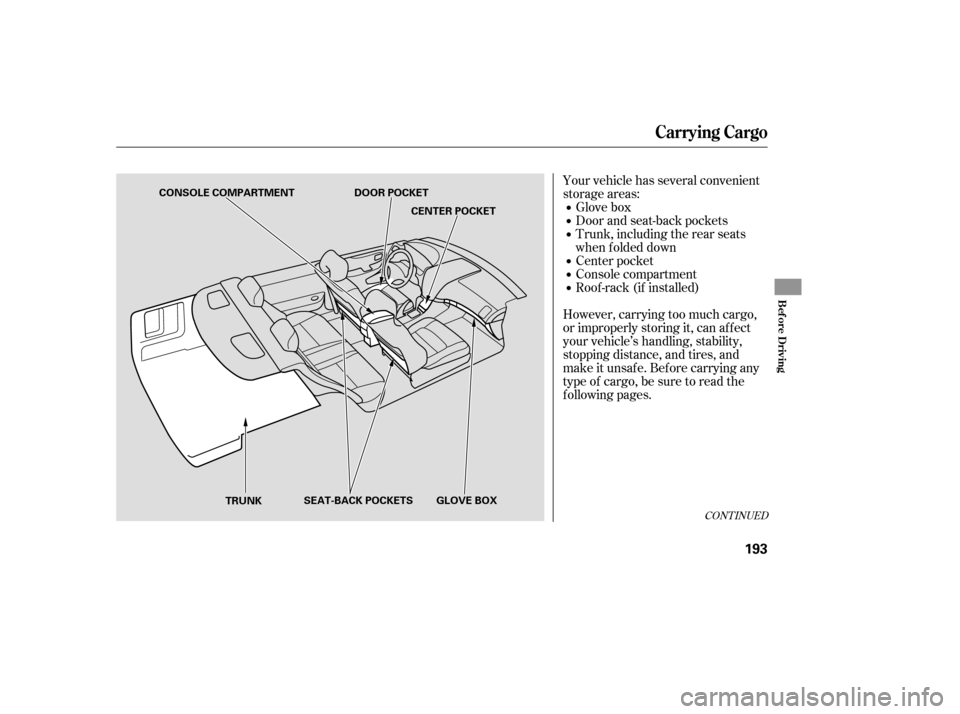
Your vehicle has several convenient
storage areas:Glove box
Door and seat-back pockets
Trunk, including the rear seats
when f olded down
Center pocket
Console compartment
Roof -rack (if installed)
However, carrying too much cargo,
or improperly storing it, can af f ect
your vehicle’s handling, stability,
stopping distance, and tires, and
make it unsaf e. Bef ore carrying any
type of cargo, be sure to read the
f ollowing pages.
CONT INUED
Carrying Cargo
Bef ore Driving
193
CONSOLE COMPARTMENT
TRUNK GLOVE BOX
CENTER POCKET
DOOR POCKET
SEAT-BACK POCKETS
�����—�����—�����y�
�������������y���
�(���%�������y���
�����y
Page 200 of 319
Youshoulddothefollowingchecks
and adjustments before you d rive
your vehicle.
Make sure all windows, mirrors,
and outside lights are clean and
unobstructed. Remove frost, snow,
or ice.
Check that the hood is fully closed. Check the seat adjustment (see
page ).
Check the adjustment of the
inside and outside mirrors (see
page ).
Check the steering wheel
adjustment (see page ).
Make sure the doors and the
trunk are securely closed and
locked.
Fasten your seat be
lt. Check that
your passengers have fastened their seat belts (see page ).
Wh en you start the engine, check
the gauges and indicato rs in the
instrument panel (see page ).
Check that the trunk is f ully
closed.
Visually check the tires. If a tire
looks low, use a gauge to check its
pressure.
Check that any items you may be
carrying are stored properly or
f astened down securely.
2.
1.
6.
7.
8.
9.
14
3.
4.
5.
10.
11. 55
95
82
73
Preparing to Drive
198
�����—�����—�����y�
�������������y���
�(���%�������y�������
�y
Page 214 of 319
Driving with varying tire or wheel
sizes may cause the VSA to
malfunction. When replacing tires,
make sure they are of the same size
and type as your original tires (see
page ).
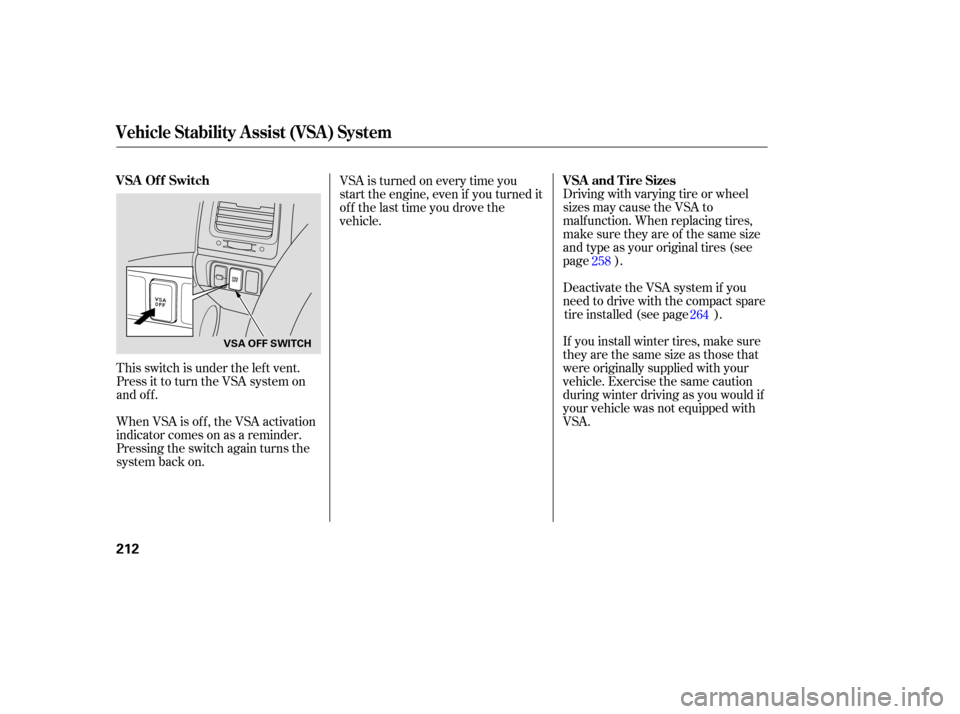
This switch is under the left vent.
Press it to turn the VSA system on
and off.
When VSA is off, the VSA activation
indicator comes on as a reminder.
Pressing the switch again turns the
system back on. VSA
is turned on every time you
start the engine, even if you turn ed it
off the last time you drove the
vehicle.
Deactivate the VSA system if you
need to drive with the compact spare tire installed (see page ).
If you install winter tires, make sure
they are the same size as those that
were originally supplied with your
vehicle. Exercise the same caution
during winter driving as you would if
your vehicle was not equipped with
VSA. 264
258
Vehicle Stability Assist (VSA) System
VSA and Tire Sizes
VSA Of f Switch
212
VSA OFF SWITCH
�����—�����—�����y�
�������������y���
�(���%�������y�����
���y
Page 218 of 319

Many states and Canadian provinces
require special outside mirrors when
towing a trailer. Even if they don’t,
you should install special mirrors if
you cannot clearly see behind you, or
if the trailer creates a blind spot.
Askyourtrailersalesorrental
agency if any other items are
recommended or required f or your
towing situation.When preparing to tow, and bef ore
driving away, be sure to check the
f ollowing:
The vehicle has been properly
serviced, and the tires, brakes,
suspension, cooling system, and
lights are in good operating
condition.
All weights and loads are within
limits.
Thehitch,safetychains,andany
other attachments are secure.
All items in or on the trailer are
properly secured and cannot shif t
while you drive.
The lights and brakes on your
vehicle and the trailer are working
properly. Your vehicle tires and spare are
properly inf lated, and the trailer
tires and spare are inflated as
recommended by the trailer
maker.
A ddit ional T owing EquipmentPre-T ow Checklist
Towing a Trailer
216
�����—�����—�����y�
������
������y���
�(���%�������y�����
���y
Page 220 of 319
Always drive slowly and have
someone guide you when backing up.
Grip the of the steering
wheel; then turn the wheel to the lef t
to get the trailer to move to the lef t,
andturnthewheelrighttomovethe
trailer to the right.
Follow all normal precautions when
parking, including f irmly setting the
parking brake and putting the
transmission in Park (automatic) or
in f irst or reverse (manual). Also,
place wheel chocks at each of the
trailer’s tires.
bottom
Backing Up
Parking
Towing a Trailer
218
�����—�����—�����y�
������
������y���
�(���%�������y�������
�y
Page 221 of 319

This section explains why it is
important to keep your vehicle well
maintained and how to follow basic
maintenance safety precautions.
If you have the skills and tools to
perform more complex maintenance
tasks on your vehicle, you may want
to purchase the service manual. See
page for information on how to
obtain a copy, or see your dealer. This section also includes
instructions on how to read the
maintenance messages in the
inf ormation display, a maintenance
record, and instructions f or simple
maintenance tasks you may want to
take care of yourself . ......................
Maintenance Saf ety .220
....................
Maintenance Minder .221
....................
Maintenance Record .228
..............................
Fluid Locations .230
........................
Adding Engine Oil .232
.........
Changing the Oil and Filter .233
..............................
Engine Coolant .236
....................
Windshield Washers .238
.......................
Transmission Fluid .239
..........
Automatic Transmission .239
..............
Manual Transmission .242
................
Brake and Clutch Fluid .243
....................
Power Steering Fluid .245
....................................
Timing Belt .246
.............................................
Lights .246
................
Cleaning the Seat Belts .251
.....................................
Floor Mats .251
..................
Dust and Pollen Filter .252
.................................
Wiper Blades .252
...............................................
Tires .254
...................
Checking the Battery .260
.............................
Vehicle Storage .262
305
Maintenance
Maint enance
219
�����—�����—�����y�
�������������y���
�(���%�������y���������y