Page 456 of 600
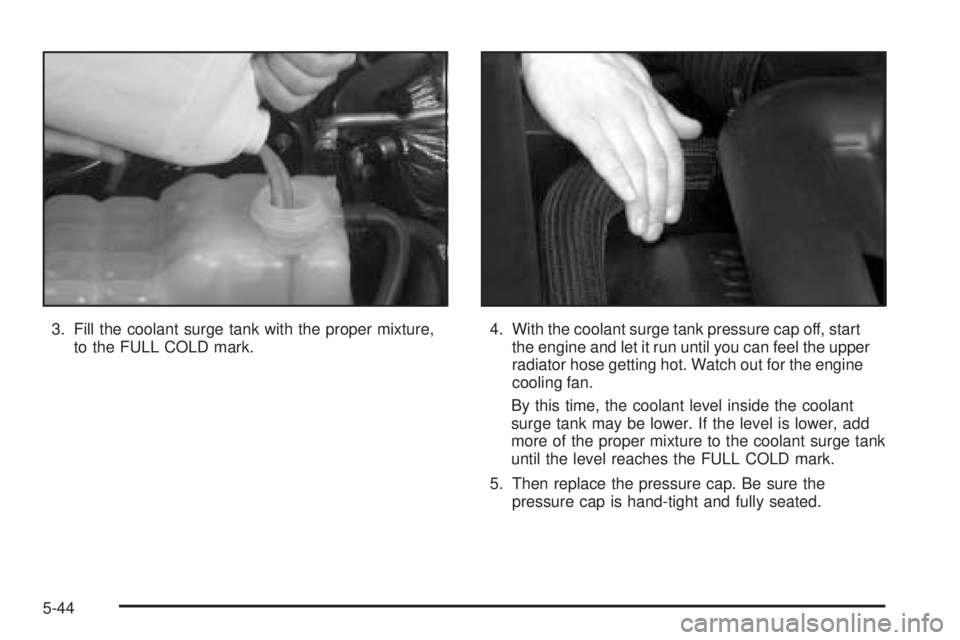
3. Fill the coolant surge tank with the proper mixture,
to the FULL COLD mark.4. With the coolant surge tank pressure cap off, start
the engine and let it run until you can feel the upper
radiator hose getting hot. Watch out for the engine
cooling fan.
By this time, the coolant level inside the coolant
surge tank may be lower. If the level is lower, add
more of the proper mixture to the coolant surge tank
until the level reaches the FULL COLD mark.
5. Then replace the pressure cap. Be sure the
pressure cap is hand-tight and fully seated.
5-44
Page 457 of 600

Engine Fan Noise
If your vehicle is equipped with a clutched engine cooling
fan, when the clutch is engaged, the fan spins faster to
provide more air to cool the engine. In most everyday
driving conditions, the fan is spinning slower and the
clutch is not fully engaged. This improves fuel economy
and reduces fan noise. Under heavy vehicle loading,
trailer towing, and/or high outside temperatures, the fan
speed increases as the clutch more fully engages, so you
may hear an increase in fan noise. This is normal and
should not be mistaken as the transmission slipping or
making extra shifts. It is merely the cooling system
functioning properly. The fan will slow down when
additional cooling is not required and the clutch
disengages.
You may also hear this fan noise when you start the
engine. It will go away as the fan clutch partially
disengages.
If your vehicle is equipped with electric cooling fans,
you may hear the fans spinning at low speed during most
everyday driving. The fans may turn off if no cooling is
required. Under heavy vehicle loading, trailer towing,
and/or high outside temperatures, or if you are operating
your air conditioning system, the fans change to high
speed and you may hear an increase in fan noise.
This is normal and indicates that the cooling system is
functioning properly. The fans will change to low speed
when additional cooling is no longer required.
Power Steering Fluid
SeeEngine Compartment
Overview on page 5-14for
reservoir location.
When to Check Power Steering Fluid
It is not necessary to regularly check power steering uid
unless you suspect there is a leak in the system or you
hear an unusual noise. A uid loss in this system could
indicate a problem. Have the system inspected and
repaired.
5-45
Page 500 of 600

Each new wheel should have the same load-carrying
capacity, diameter, width, offset and be mounted
the same way as the one it replaces.
If you need to replace any of your wheels, wheel bolts
or wheel nuts, replace them only with new GM
original equipment parts. This way, you will be sure to
have the right wheel, wheel bolts and wheel nuts
for your vehicle.
{CAUTION:
Using the wrong replacement wheels, wheel
bolts, or wheel nuts on your vehicle can be
dangerous. It could affect the braking and
handling of your vehicle, make your tires lose
air and make you lose control. You could have
a collision in which you or others could be
injured. Always use the correct wheel, wheel
bolts and wheel nuts for replacement.
Notice:The wrong wheel can also cause problems
with bearing life, brake cooling, speedometer or
odometer calibration, headlamp aim, bumper height,
vehicle ground clearance, and tire or tire chain
clearance to the body and chassis.Whenever a wheel, wheel bolt or wheel nut is replaced
on a dual wheel setup, check the wheel nut torque
after 100, 1,000 and 6,000 miles (160, 1 600 and
10 000 km) of driving. For proper torque, see “Wheel
Nut Torque” underCapacities and Specications
on page 5-133.
SeeChanging a Flat Tire on page 5-91for more
information.
Used Replacement Wheels
{CAUTION:
Putting a used wheel on your vehicle is
dangerous. You cannot know how it has been
used or how far it has been driven. It could fail
suddenly and cause a crash. If you have to
replace a wheel, use a new GM original
equipment wheel.
5-88
Page 544 of 600
Auxiliary Electric Cooling Fan
Fuse Block
The auxiliary electric
cooling fan fuse block is
located in the engine
compartment on the
driver’s side of the vehicle
next to the underhood
fuse block.
Lift the cover for access to the fuse/relay block.
Fuses Usage
COOL/FAN Cooling Fan
COOL/FAN Cooling Fan Relay Fuse
COOL/FAN Cooling Fan Fuse
Relays Usage
COOL/FAN 1 Cooling Fan Relay 1
COOL/FAN 3 Cooling Fan Relay 3
COOL/FAN 2 Cooling Fan Relay 2
5-132
Page 545 of 600
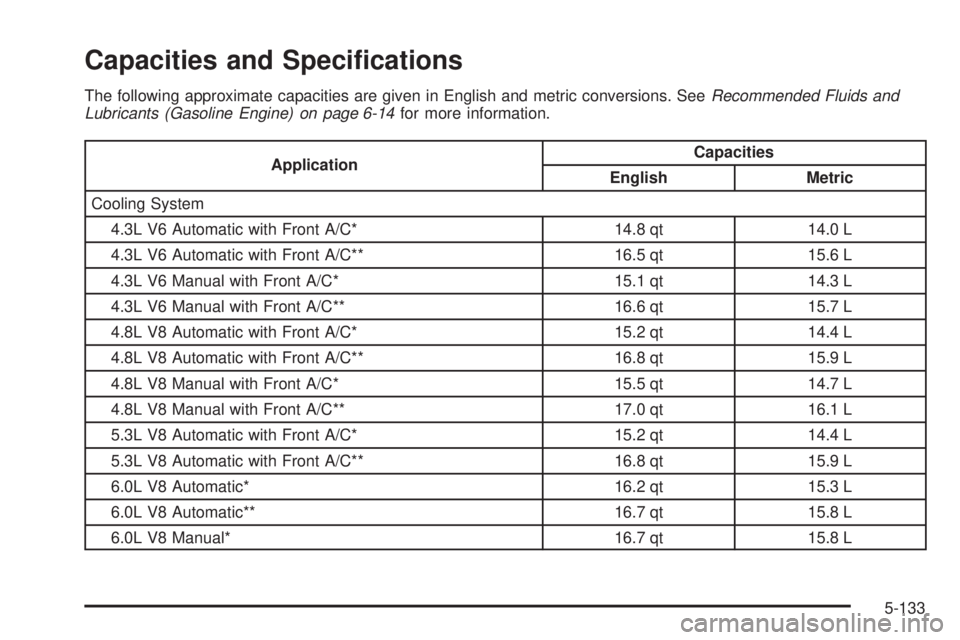
Capacities and Specications
The following approximate capacities are given in English and metric conversions. SeeRecommended Fluids and
Lubricants (Gasoline Engine) on page 6-14for more information.
ApplicationCapacities
English Metric
Cooling System
4.3L V6 Automatic with Front A/C* 14.8 qt 14.0 L
4.3L V6 Automatic with Front A/C** 16.5 qt 15.6 L
4.3L V6 Manual with Front A/C* 15.1 qt 14.3 L
4.3L V6 Manual with Front A/C** 16.6 qt 15.7 L
4.8L V8 Automatic with Front A/C* 15.2 qt 14.4 L
4.8L V8 Automatic with Front A/C** 16.8 qt 15.9 L
4.8L V8 Manual with Front A/C* 15.5 qt 14.7 L
4.8L V8 Manual with Front A/C** 17.0 qt 16.1 L
5.3L V8 Automatic with Front A/C* 15.2 qt 14.4 L
5.3L V8 Automatic with Front A/C** 16.8 qt 15.9 L
6.0L V8 Automatic* 16.2 qt 15.3 L
6.0L V8 Automatic** 16.7 qt 15.8 L
6.0L V8 Manual* 16.7 qt 15.8 L
5-133
Page 546 of 600
ApplicationCapacities
English Metric
8.1L V8 HD Automatic* 25.0 qt 23.7 L
8.1L V8 Automatic* 26.9 qt 25.5 L
8.1 V8 Manual* 27.1 qt 25.6 L
* Engine Fan Driven cooling system
** Electric Cooling Fan system
Engine Oil with Filter
4.3 V6 4.5 qt 4.3 L
4.8 V8; 5.3 V8; 6.0 V8 6.0 qt 5.7 L
8.1 V8 6.5 qt 6.1 L
Fuel Tank
Short Bed and 2500 LD 26.0 gal 98.0 L
Long Bed and Chassis Cab (Pickup Box Delete) 34.0 gal 128.7 L
Chassis Cab 3500 and 3500HD — front 27.0 gal 102.0 L
Chassis Cab 3500 and 3500HD — rear 23.0 gal 87.0 L
Transfer Case Fluid 2.0 qt 1.9 L
Wheel Nut Torque 140 ft lb 190Y
After rell, the level must be rechecked. Add enough engine coolant so that the uid is within the proper operating
range.
5-134
Page 554 of 600
Scheduled Maintenance (cont’d)
Service MaintenanceIMaintenanceII
Perform any needed additional services. See “Additional Required Services” in
this section.••
Inspect suspension and steering components.See footnote (b).•
Inspect engine cooling system.See footnote (c).•
Inspect wiper blades.See footnote (d).•
Inspect restraint system components.See footnote (e).•
Lubricate body components.See footnote (f).•
Check transmission uid level and add uid as needed.•
Inspect shields, vehicles with diesel engine or with GVWR above
10,000 lbs (4 536 kg) only.See footnote (n).•
6-6
Page 556 of 600
Additional Required Services (cont’d)
Service and Miles (Kilometers)25,000
(41 500)50,000
(83 000)75,000
(125 000)100,000
(166 000)125,000
(207 500)150,000
(240 000)
Except Allison Transmission
®: Change
automatic transmission uid and lter
(severe service).See footnote (h).•••
Except Allison Transmission
®: Change
automatic transmission uid and lter
(normal service).•
Four-wheel drive with automatic transfer
case only: Change transfer case uid.
See footnote (g).•••
Inspect evaporative control system.
An Emission Control Service. See
footnotes † and (k).•••
Replace spark plugs and inspect
spark plug wires.An Emission
Control Service.•
5-speed manual transmission only:
Change manual transmission uid.•
Engine cooling system service
(or every ve years, whichever occurs
rst).An Emission Control Service. See
footnote (i).•
Inspect engine accessory drive belt.
An Emission Control Service. See
footnote (q).•
6-8