2006 GMC ENVOY XL driver
[x] Cancel search: driverPage 1 of 524

Index ................................................................ 1
2006 GMC Envoy, Envoy XL, Envoy Denali,
and Envoy XL Denali Owner Manual
M
Seats and Restraint Systems ........................... 1-1
Front Seats ............................................... 1-2
Rear Seats ............................................... 1-9
Safety Belts ............................................. 1-14
Child Restraints ....................................... 1-32
Airbag System ......................................... 1-58
Restraint System Check ............................1-73
Features and Controls ..................................... 2-1
Keys ........................................................ 2-3
Doors and Locks ....................................... 2-8
Windows ................................................. 2-14
Theft-Deterrent Systems ............................2-17
Starting and Operating Your Vehicle ...........2-19
Mirrors .................................................... 2-36
OnStar
®System ...................................... 2-49
Universal Home Remote System ................2-51
Storage Areas ......................................... 2-56
Sunroof .................................................. 2-62
Vehicle Personalization .............................2-62
Instrument Panel ............................................. 3-1
Instrument Panel Overview
.......................... 3-4
Climate Controls ...................................... 3-20
Warning Lights, Gages, and Indicators ........3-31 Driver Information Center (DIC)
..................3-50
Audio System(s) ....................................... 3-66
Driving Your Vehicle ....................................... 4-1
Your Driving, the Road, and Your Vehicle
..... 4-2
Towing ................................................... 4-50
Service and Appearance Care .......................... 5-1
Service ..................................................... 5-3
Fuel ......................................................... 5-5
Checking Things Under the Hood ...............5-10
Rear Axle ............................................... 5-47
Four-Wheel Drive ..................................... 5-48
Front Axle ............................................... 5-49
Bulb Replacement .................................... 5-50
Windshield Wiper Blade Replacement .........5-53
Tires ...................................................... 5-55
Appearance Care ..................................... 5-92
Vehicle Identication ...............................5-101
Electrical System .................................... 5-102
Capacities and Specications ...................5-119
Maintenance Schedule ..................................... 6-1
Maintenance Schedule
................................ 6-2
Customer Assistance and Information .............. 7-1
Customer Assistance and Information ........... 7-2
Reporting Safety Defects ...........................7-14
Page 7 of 524

Front Seats......................................................1-2
Manual Seats................................................1-2
Power Seats..................................................1-3
Manual Lumbar..............................................1-3
Power Lumbar ...............................................1-4
Heated Seats.................................................1-4
Reclining Seatbacks........................................1-5
Head Restraints.............................................1-8
Rear Seats.......................................................1-9
Rear Seat Operation.......................................1-9
Safety Belts...................................................1-14
Safety Belts: They Are for Everyone................1-14
Questions and Answers About Safety Belts......1-18
How to Wear Safety Belts Properly.................1-19
Driver Position..............................................1-19
Safety Belt Use During Pregnancy..................1-25
Right Front Passenger Position.......................1-26
Rear Seat Passengers..................................1-26
Rear Safety Belt Comfort Guides....................1-28
Safety Belt Pretensioners...............................1-31
Safety Belt Extender.....................................1-31
Child Restraints.............................................1-32
Older Children..............................................1-32
Infants and Young Children............................1-34Child Restraint Systems.................................1-37
Where to Put the Restraint.............................1-42
Lower Anchors and Tethers for
Children (LATCH)......................................1-43
Securing a Child Restraint in a Rear
Outside Seat Position................................1-51
Securing a Child Restraint in the Center
Rear Seat Position....................................1-53
Securing a Child Restraint in the Right
Front Seat Position....................................1-53
Airbag System...............................................1-58
Where Are the Airbags?................................1-61
When Should an Airbag Inate?.....................1-63
What Makes an Airbag Inate?.......................1-65
How Does an Airbag Restrain?.......................1-65
What Will You See After an Airbag Inates?.....1-66
Passenger Sensing System............................1-67
Servicing Your Airbag-Equipped Vehicle...........1-71
Adding Equipment to Your Airbag-Equipped
Vehicle....................................................1-72
Restraint System Check..................................1-73
Checking the Restraint Systems......................1-73
Replacing Restraint System Parts
After a Crash............................................1-74
Section 1 Seats and Restraint Systems
1-1
Page 8 of 524

Front Seats
Manual Seats
{CAUTION:
You can lose control of the vehicle if you try to
adjust a manual driver’s seat while the vehicle
is moving. The sudden movement could startle
and confuse you, or make you push a pedal
when you do not want to. Adjust the driver’s
seat only when the vehicle is not moving.
Lift the bar located under the front of the seat to unlock
it. Slide the seat to where you want it and release
the bar. Try to move the seat with your body to be sure
the seat is locked in place.
1-2
Page 9 of 524

Power Seats
If the vehicle has power
seats, the controls used to
operate them are located
on the outboard side of
the seats.
To adjust the seat, do any of the following:
Move the seat forward or rearward by sliding the
horizontal control forward or rearward.
Raise or lower the front part of the seat cushion by
moving the front of the horizontal control up or down.
Raise or lower the rear part of the seat cushion by
moving the rear of the horizontal control up or down.
Raise or lower the entire seat by moving the entire
horizontal control up or down.
If the seats have power reclining seatbacks, the control
used to operate them is located behind the power
seat control on the outboard side of the seats. See
“Power Reclining Seatbacks” underReclining Seatbacks
on page 1-5.
Manual Lumbar
If your vehicle has this
feature, there is a knob
located on the outboard
side of the driver’s seat.
Turn the top of the knob toward the front of the
vehicle to increase lumbar support. Turn the top of
the knob toward the rear of the vehicle to decrease
lumbar support.
1-3
Page 10 of 524

Power Lumbar
Your vehicle may have power lumbar on the driver’s
and front passenger’s seats.
The seatback lumbar
support can be adjusted
by moving the control
located on the outboard
side of the seat cushions.
To increase or decrease support, hold the control
forward or rearward.
Keep in mind that as your seating position changes,
as it may during long trips, so should the position of your
lumbar support. Adjust the seat as needed.
Heated Seats
Your vehicle may have
heated front seats. The
buttons used to control this
feature are located on
the front door armrests.
The engine must be
running for the heated seat
feature to work.
To heat the entire seat, press the horizontal button with
the heated seat and seatback symbol. Press the
button to cycle through the temperature settings of high,
medium, and low and to turn the heated seat off. The
indicator lights above the button will come on to
designate the level of heat selected: three for high,
two for medium, and one for low. The low setting warms
the seatback and seat cushion until the seat temperature
is near body temperature. The medium and high
settings heat the seatback and seat cushion to a slightly
higher temperature. You will be able to feel heat in
about two minutes.
1-4
Page 11 of 524

To heat only the seatback, press the vertical button with
the heated seatback symbol. An indicator light on the
button will come on to designate that only the seatback
is being heated. Additional presses will cycle through
the heat levels for the seatback only.
The feature will shut off automatically when the ignition
is turned off.
Reclining Seatbacks
Manual Reclining Seatbacks
{CAUTION:
You can lose control of the vehicle if you try to
adjust a manual driver’s seat while the vehicle
is moving. The sudden movement could startle
and confuse you, or make you push a pedal
when you do not want to. Adjust the driver’s
seat only when the vehicle is not moving.
{CAUTION:
If the seatback is not locked, it could move
forward in a sudden stop or crash. That could
cause injury to the person sitting there. Always
push and pull on the seatback to be sure it is
locked.
If the seats have manual reclining seatbacks, the lever
used to operate them is located on the outboard
side of the seats(s).
1-5
Page 25 of 524
Q:If I am a good driver, and I never drive far from
home, why should I wear safety belts?
A:You may be an excellent driver, but if you are in an
accident — even one that is not your fault — you
and your passengers can be hurt. Being a good
driver does not protect you from things beyond your
control, such as bad drivers.
Most accidents occur within 25 miles (40 km)
of home. And the greatest number of serious
injuries and deaths occur at speeds of less than
40 mph (65 km/h).
Safety belts are for everyone.
How to Wear Safety Belts Properly
This part is only for people of adult size.
Be aware that there are special things to know about
safety belts and children. And there are different
rules for smaller children and babies. If a child will be
riding in your vehicle, seeOlder Children on page 1-32
orInfants and Young Children on page 1-34. Follow
those rules for everyone’s protection.
First, you will want to know which restraint systems your
vehicle has.
We will start with the driver position.
Driver Position
Lap-Shoulder Belt
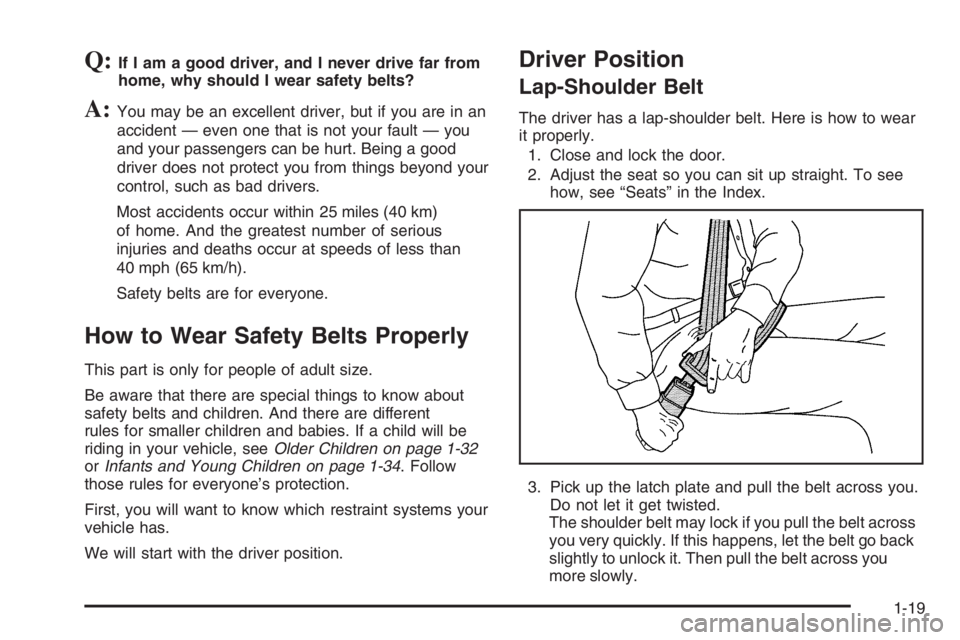
The driver has a lap-shoulder belt. Here is how to wear
it properly.
1. Close and lock the door.
2. Adjust the seat so you can sit up straight. To see
how, see “Seats” in the Index.
3. Pick up the latch plate and pull the belt across you.
Do not let it get twisted.
The shoulder belt may lock if you pull the belt across
you very quickly. If this happens, let the belt go back
slightly to unlock it. Then pull the belt across you
more slowly.
1-19
Page 32 of 524

Right Front Passenger Position
To learn how to wear the right front passenger’s safety
belt properly, seeDriver Position on page 1-19.
The right front passenger’s safety belt works the
same way as the driver’s safety belt — except for
one thing. If you ever pull the shoulder portion of the
belt out all the way, you will engage the child restraint
locking feature. If this happens, just let the belt go back
all the way and start again.
Rear Seat Passengers
It is very important for rear seat passengers to buckle
up! Accident statistics show that unbelted people in
the rear seat are hurt more often in crashes than those
who are wearing safety belts.
Rear passengers who are not safety belted can be
thrown out of the vehicle in a crash. And they can strike
others in the vehicle who are wearing safety belts.
Lap-Shoulder Belt
All rear seat positions have lap-shoulder belts. Here is
how to wear one properly.
1. Pick up the latch plate and pull the belt across you.
Do not let it get twisted.
The shoulder belt may lock if you pull the belt
across you very quickly. If this happens, let the belt
go back slightly to unlock it. Then pull the belt
across you more slowly.
1-26