2006 FORD SUPER DUTY load capacity
[x] Cancel search: load capacityPage 129 of 312
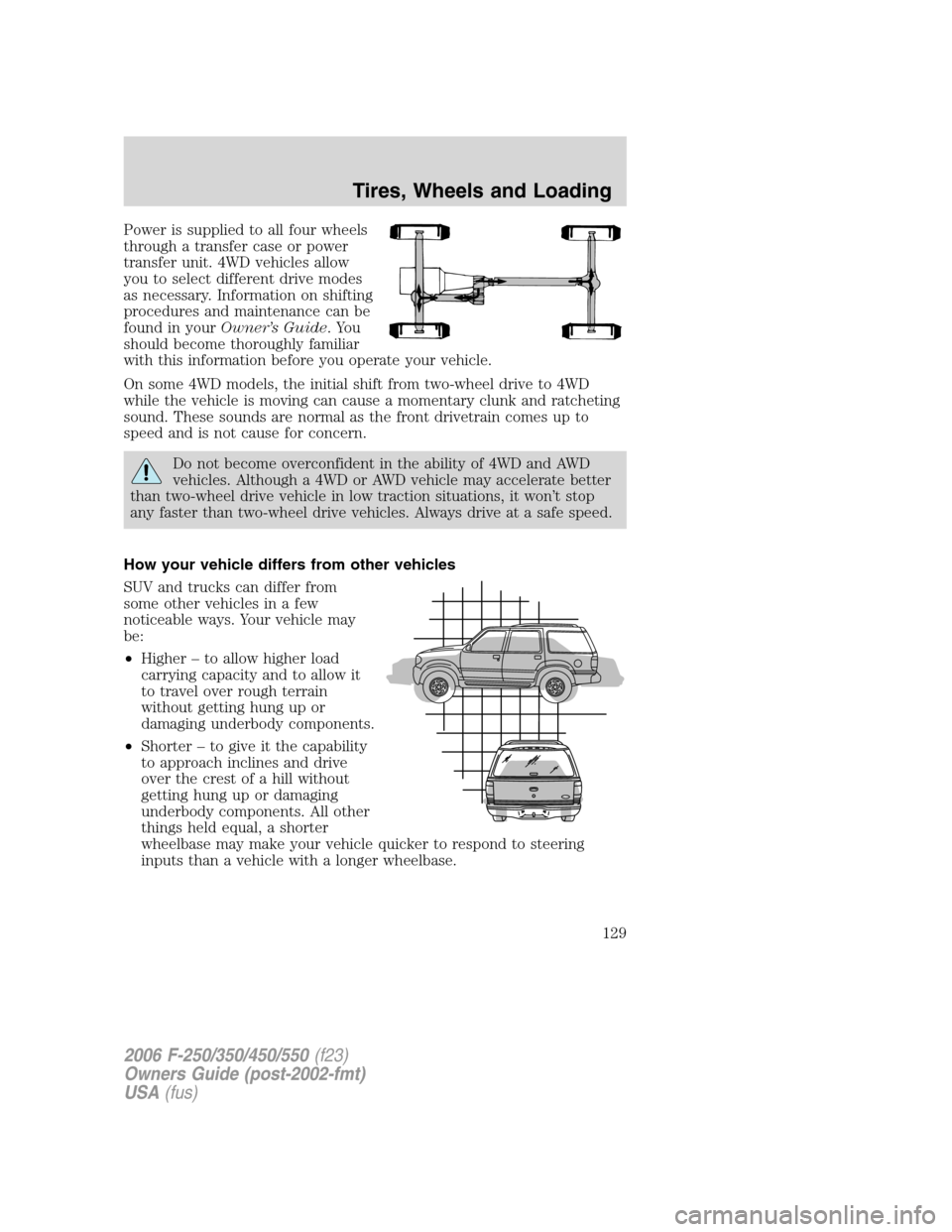
Power is supplied to all four wheels
through a transfer case or power
transfer unit. 4WD vehicles allow
you to select different drive modes
as necessary. Information on shifting
procedures and maintenance can be
found in yourOwner’s Guide.You
should become thoroughly familiar
with this information before you operate your vehicle.
On some 4WD models, the initial shift from two-wheel drive to 4WD
while the vehicle is moving can cause a momentary clunk and ratcheting
sound. These sounds are normal as the front drivetrain comes up to
speed and is not cause for concern.
Do not become overconfident in the ability of 4WD and AWD
vehicles. Although a 4WD or AWD vehicle may accelerate better
than two-wheel drive vehicle in low traction situations, it won’t stop
any faster than two-wheel drive vehicles. Always drive at a safe speed.
How your vehicle differs from other vehicles
SUV and trucks can differ from
some other vehicles in a few
noticeable ways. Your vehicle may
be:
•Higher – to allow higher load
carrying capacity and to allow it
to travel over rough terrain
without getting hung up or
damaging underbody components.
•Shorter – to give it the capability
to approach inclines and drive
over the crest of a hill without
getting hung up or damaging
underbody components. All other
things held equal, a shorter
wheelbase may make your vehicle quicker to respond to steering
inputs than a vehicle with a longer wheelbase.
2006 F-250/350/450/550(f23)
Owners Guide (post-2002-fmt)
USA(fus)
Tires, Wheels and Loading
129
Page 147 of 312
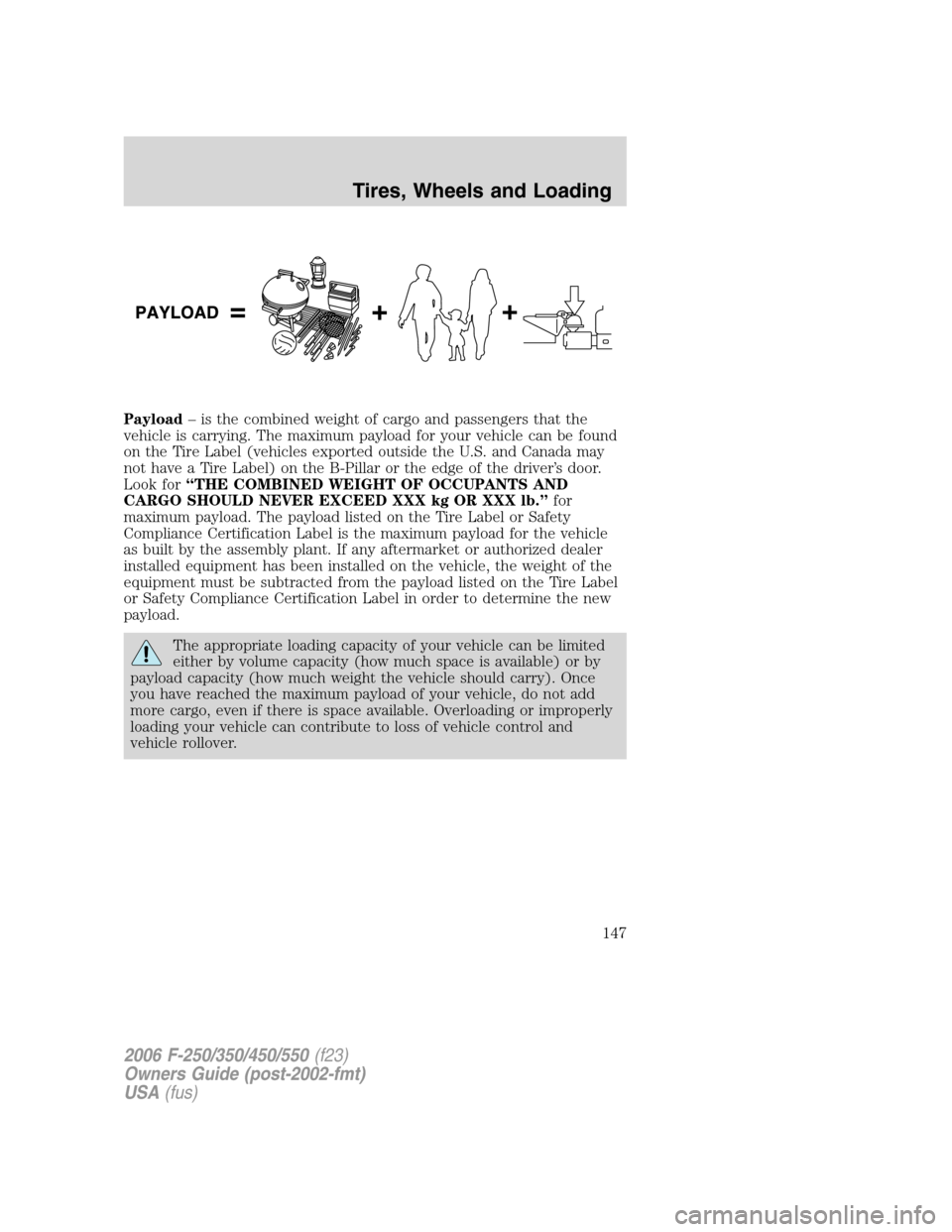
Payload– is the combined weight of cargo and passengers that the
vehicle is carrying. The maximum payload for your vehicle can be found
on the Tire Label (vehicles exported outside the U.S. and Canada may
not have a Tire Label) on the B-Pillar or the edge of the driver’s door.
Look for“THE COMBINED WEIGHT OF OCCUPANTS AND
CARGO SHOULD NEVER EXCEED XXX kg OR XXX lb.”for
maximum payload. The payload listed on the Tire Label or Safety
Compliance Certification Label is the maximum payload for the vehicle
as built by the assembly plant. If any aftermarket or authorized dealer
installed equipment has been installed on the vehicle, the weight of the
equipment must be subtracted from the payload listed on the Tire Label
or Safety Compliance Certification Label in order to determine the new
payload.
The appropriate loading capacity of your vehicle can be limited
either by volume capacity (how much space is available) or by
payload capacity (how much weight the vehicle should carry). Once
you have reached the maximum payload of your vehicle, do not add
more cargo, even if there is space available. Overloading or improperly
loading your vehicle can contribute to loss of vehicle control and
vehicle rollover.
2006 F-250/350/450/550(f23)
Owners Guide (post-2002-fmt)
USA(fus)
Tires, Wheels and Loading
147
Page 151 of 312
Maximum Loaded Trailer Weight– is the highest possible weight of a
fully loaded trailer the vehicle can tow. It assumes a vehicle with only
mandatory options, no cargo (internal or external), a tongue load of
10–15% (conventional trailer) or king pin weight of 15–25% (fifth wheel
trailer), and driver only (150 lb. [68 kg]).Consult your authorized
dealer (or theRV and Trailer Towing Guideprovided by your
authorized dealer) for more detailed information.
Tongue Load or Fifth Wheel King Pin Weight– refers to the amount
of the weight that a trailer pushes down on a trailer hitch.
Examples:For a 5,000 lb. (2,268 kg) conventional trailer, multiply 5,000
by 0.10 and 0.15 to obtain a proper tongue load range of 500 to 750 lb.
(227 to 340 kg). For an 11,500 lb. (5,216 kg) fifth wheel trailer, multiply
by 0.15 and 0.25 to obtain a proper king pin load range of 1,725 to 2,875
lb. (782 to 1,304 kg)
Do not exceed the GVWR or the GAWR specified on the Tire
Label or Safety Compliance Certification Label.
Do not use replacement tires with lower load carrying capacities
than the originals because they may lower the vehicle’s GVWR
and GAWR limitations. Replacement tires with a higher limit than the
originals do not increase the GVWR and GAWR limitations.
Exceeding any vehicle weight rating limitation could result in
serious damage to the vehicle and/or personal injury.
Steps for determining the correct load limit:
1. Locate the statement “The combined weight of occupants and cargo
should never exceed XXX kg or XXX lbs.” on your vehicle’s placard.
2. Determine the combined weight of the driver and passengers that will
be riding in your vehicle.
3. Subtract the combined weight of the driver and passengers from XXX
kg or XXX lbs.
4. The resulting figure equals the available amount of cargo and luggage
load capacity. For example, if the “XXX” amount equals 1,400 lbs. and
there will be five 150 lb. passengers in your vehicle, the amount of
available cargo and luggage load capacity is 650 lbs. (1,400–750
(5 x 150) = 650 lb.). In metric units (635–340 (5 x 68) = 295 kg.)
2006 F-250/350/450/550(f23)
Owners Guide (post-2002-fmt)
USA(fus)
Tires, Wheels and Loading
151
Page 152 of 312
5. Determine the combined weight of luggage and cargo being loaded on
the vehicle. That weight may not safely exceed the available cargo and
luggage load capacity calculated in Step 4.
6. If your vehicle will be towing a trailer, load from your trailer will be
transferred to your vehicle. Consult this manual to determine how this
reduces the available cargo and luggage load capacity of your vehicle.
The following gives you a few examples on how to calculate the available
amount of cargo and luggage load capacity:
•Another example for your vehicle with 1,400 lb. (635 kg) of cargo and
luggage capacity. You decide to go golfing. Is there enough load
capacity to carry you, 4 of your friends and all the golf bags? You and
four friends average 220 lb. (99 kg) each and the golf bags weigh
approximately 30 lb. (13.5 kg) each. The calculation would be: 1,400 –
(5 x 220) – (5 x 30) = 1,400 – 1,100 – 150 = 150 lb. Yes, you have
enough load capacity in your vehicle to transport four friends and
your golf bags. In metric units, the calculation would be: 635 kg —
(5 x 99 kg) — (5 x 13.5 kg) = 635 — 495 — 67.5 = 72.5 kg.
•A final example for your vehicle with 1,400 lb. (635 kg) of cargo and
luggage capacity. You and one of your friends decide to pick up
cement from the local home improvement store to finish that patio
you have been planning for the past 2 years. Measuring the inside of
the vehicle with the rear seat folded down, you have room for 12-100
lb. (45 kg) bags of cement. Do you have enough load capacity to
transport the cement to your home? If you and your friend each weigh
220 lb. (99 kg), the calculation would be: 1,400 – (2 x 220) –
(12 x 100) = 1,400 – 440 – 1,200 = – 240 lb. No, you do not have
enough cargo capacity to carry that much weight. In metric units, the
calculation would be: 635 kg — (2 x 99 kg) — (12 x 45 kg) = 635 —
198 — 540 = —103 kg. You will need to reduce the load weight by at
least 240 lb. (104 kg). If you remove 3-100 lb. (45 kg) cement bags,
then the load calculation would be:
1,400 – (2 x 220) – (9 x 100) = 1,400 – 440 – 900 = 60 lb. Now you
have the load capacity to transport the cement and your friend home. .
In metric units, the calculation would be: 635 kg — (2 x 99 kg) —
(9 x 45 kg) = 635 — 198 — 405 = 32 kg.
The above calculations also assume that the loads are positioned in your
vehicle in a manner that does not overload the Front or the Rear Gross
Axle Weight Rating specified for your vehicle on the Tire Label or Safety
Compliance Certification Label found on the edge of the driver’s door.
2006 F-250/350/450/550(f23)
Owners Guide (post-2002-fmt)
USA(fus)
Tires, Wheels and Loading
152
Page 160 of 312
Points to Remember:
•Remember to adjust gain setting before using the TBC for the first
time.
•Readjust GAIN setting on the TBC (according to procedure above)
whenever road, weather and trailer or vehicle loading conditions
change from those that existed when the gain was initially set.
•The sliding lever on the TBC should be used only for manual
activation of trailer brakes to assist with proper adjustment of the
GAIN. Misuse, such as application during trailer sway, could cause
instability of trailer and/or tow vehicle.
•Avoid towing in adverse weather conditions. The TBC does not
provide anti-lock control of the trailer wheels. Trailer wheels can
lock-up on slippery surfaces, resulting in reduced stability of trailer
and tow vehicle.
•The TBC interacts with the brake system of the vehicle, including
ABS, in order to reduce the likelihood of trailer wheel lockup.
Therefore, if these systems are not functioning properly the TBC may
not function at full performance.
•When the vehicle is turned off, the TBC Output is disabled and the
display is shut down. Reactivation of the ignition from 3 (OFF) to 4
(ON) will awaken the TBC module.
•The TBC is only a factory or dealer installed item. Ford is not
responsible for warranty or performance of the TBC due to misuse or
customer installation.
Trailer lamps
Trailer lamps are required on most towed vehicles. Make sure all running
lights, brake lights, turn signals and hazard lights are working. See your
authorized dealer or trailer rental agency for proper instructions and
equipment for hooking up trailer lamps.
Using a step bumper (if equipped)
The rear bumper is equipped with an integral hitch and only requires a
ball with a one inch (25.4 mm) shank diameter. The bumper has a 5,000 lb.
(2,270 kg) trailer weight and 500 lb. (227 kg) tongue weight capacity.
If it is necessary to relocate the trailer hitch ball position, a
frame-mounted trailer hitch must be installed.
2006 F-250/350/450/550(f23)
Owners Guide (post-2002-fmt)
USA(fus)
Tires, Wheels and Loading
160
Page 212 of 312
Temporary Emergency Spare Tire Information
Your vehicle may be equipped with a temporary emergency spare tire.
This tire may be a T-type/mini-spare tire which will have the words
“Temporary Use Only” molded into the tire sidewall or it may be a full
size dissimilar spare tire/wheel that is different in brand, size or
appearance from the road tire, which will be identified with a“Caution”
label on the wheel. Both of these spare tires are considered
“temporary”. Replace these temporary emergency spare tires on the
vehicle with a tire of the same size, speed rating and load carrying
capacity as the other road tires as soon as possible.
It is not recommended that the vehicle be operated in 4WD modes with
a temporary emergency spare tire. If 4WD operation is necessary, do not
operate above speeds of 10 mph (16 km/h) or for distances above 50 miles
(80 km).
When driving with the temporary emergency spare tire do not:
• Exceed 50 mph (80 km/h)
• Exceed 2000 miles (3200 km)
• Load the vehicle beyond maximum vehicle load rating listed on the
Safety Compliance Certification Label
• Use snow chains
• Use more than one temporary emergency spare tire
• Use commercial car washing equipment
• Try to repair the temporary emergency spare tire
Use of a temporary emergency spare tire at any one wheel location can
lead to impairment of the following:
• Handling, stability and braking performance
• Comfort and noise
• Ground clearance and parking at curbs
• Winter weather driving capability
• Wet weather driving capability
2006 F-250/350/450/550 (f23)
Owners Guide (post-2002-fmt)
USA (fus)
Roadside Emergencies
212
Page 221 of 312
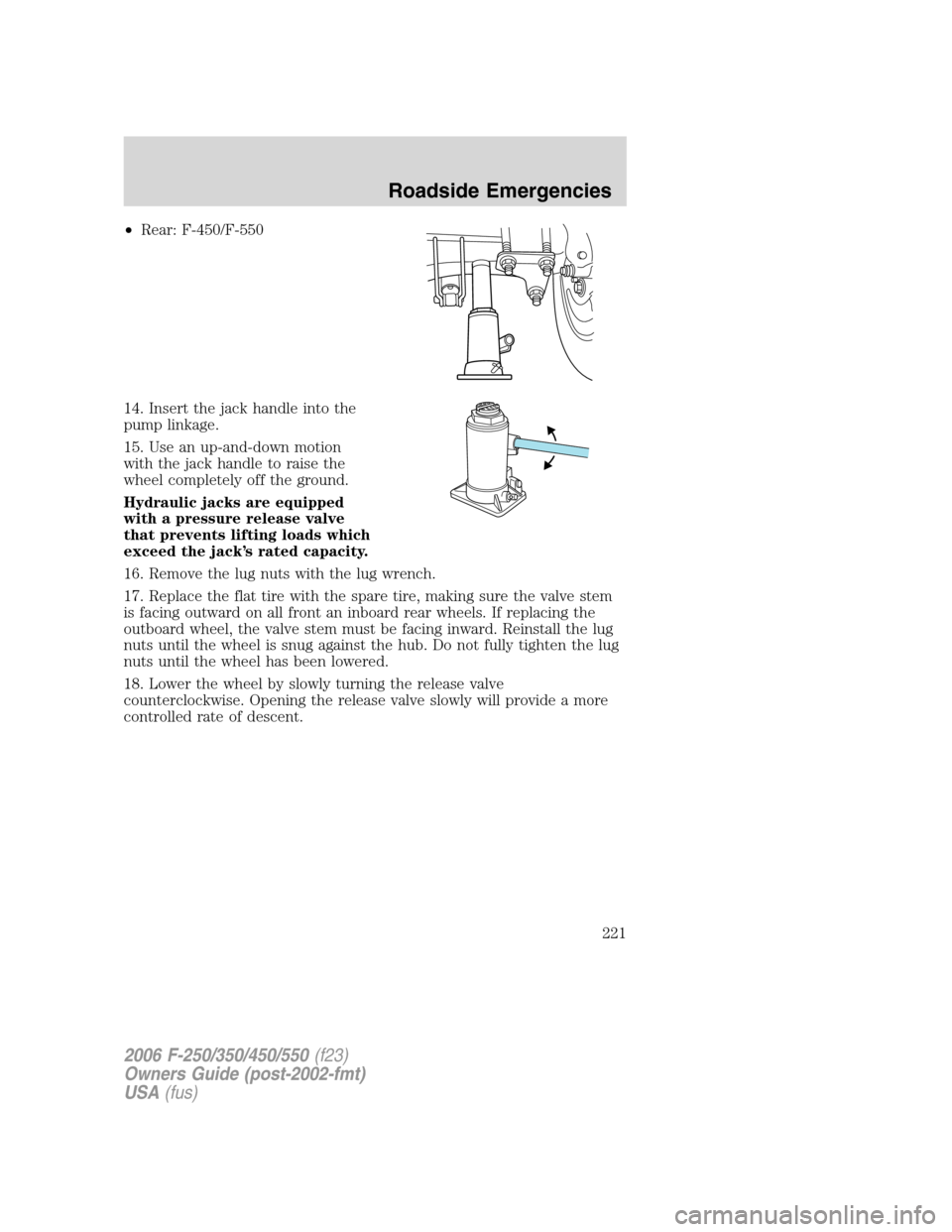
•Rear: F-450/F-550
14. Insert the jack handle into the
pump linkage.
15. Use an up-and-down motion
with the jack handle to raise the
wheel completely off the ground.
Hydraulic jacks are equipped
with a pressure release valve
that prevents lifting loads which
exceed the jack’s rated capacity.
16. Remove the lug nuts with the lug wrench.
17. Replace the flat tire with the spare tire, making sure the valve stem
is facing outward on all front an inboard rear wheels. If replacing the
outboard wheel, the valve stem must be facing inward. Reinstall the lug
nuts until the wheel is snug against the hub. Do not fully tighten the lug
nuts until the wheel has been lowered.
18. Lower the wheel by slowly turning the release valve
counterclockwise. Opening the release valve slowly will provide a more
controlled rate of descent.
2006 F-250/350/450/550(f23)
Owners Guide (post-2002-fmt)
USA(fus)
Roadside Emergencies
221
Page 310 of 312
K
Keyless entry system .................86
Keys
positions of the ignition .........165
L
Lamps
autolamp system .......................39
daytime running light ...............40
fog lamps ...................................40
headlamps .................................39
headlamps, flash to pass ..........41
instrument panel, dimming .....41
interior lamps ...........................45
replacing bulbs .............46, 48–53
Lane change indicator
(see Turn signal) ........................45
Lights, warning and indicator ....12
anti-lock brakes (ABS) ..........171
speed control ............................63
Load limits .................................146
Loading instructions .................153
Locks
childproof ..................................81
Lubricant specifications ...........290
Lug nuts ....................................223
Lumbar support, seats ...............94
M
Manual transmission .................178
fluid capacities ........................287
reverse .....................................180
Message center ...............67, 69–70
english/metric button ...............74
system check button ................73warning messages .....................75
Mirrors .........................................55
automatic dimming rearview
mirror ........................................58
fold away ...................................60
heated ........................................58
side view mirrors (power) .......58
signal .........................................59
Moon roof ....................................66
Motorcraft parts ................266, 286
O
Octane rating ............................270
Oil (see Engine oil) ..................254
Overdrive .....................................55
P
Parking brake ............................172
Parts (see Motorcraft parts) ....286
Pedals (see Power adjustable
foot pedals) .................................61
Power adjustable foot pedals .....61
Power distribution box
(see Fuses) ...............................209
Power door locks ........................80
Power mirrors .............................58
Power point .................................56
Power steering ..........................173
fluid, checking and adding ....276
fluid, refill capacity ................287
fluid, specifications .................290
Power Windows ...........................56
Preparing to drive your
vehicle ........................................174
2006 F-250/350/450/550(f23)
Owners Guide (post-2002-fmt)
USA(fus)
Index
310