2006 FORD SUPER DUTY tires
[x] Cancel search: tiresPage 199 of 312
certain frontal and offset frontal collisions when the vehicle sustains
sufficient longitudinal deceleration.
Careless or high speed driving while plowing snow which results in
sufficient vehicle decelerations can deploy the airbag. Such driving also
increases the risk of accidents.
All occupants of the vehicle, including the driver, should always
properly wear their safety belts, even when an air bag
supplemental restraint system (SRS) is provided.
Never remove or defeat the “tripping mechanisms” designed into the
snow removal equipment by its manufacturer. Doing so may cause
damage to the vehicle and the snow removal equipment as well as
possible airbag deployment.
Do not attempt to service, repair, or modify the air bag
supplemental restraint system (SRS) or its fuses. See your Ford
or Lincoln Mercury dealer.
Additional equipment such as snowplow equipment may effect
the performance of the airbag sensors increasing the risk of
injury. Please refer to theBody Builders Layout Bookfor instructions
about the appropriate installation of additional equipment.
Transmission operation while plowing
Operate the vehicle with the automatic transmission gearshift lever in
the D (Overdrive) position and Tow/Haul OFF.
•Shift transfer case to 4x4 LOW (4WD Low) when plowing in small
areas at speeds below 5 mph (8 km/h).
•Shift transfer case to 4x4 HIGH (4WD High) when plowing larger
areas or light snow at higher speeds. Do not exceed 15 mph
(24 km/h).
•Do not shift the transmission from a forward gear to R (Reverse) until
the engine is at idle and the wheels are stopped.
•If the vehicle is stuck, shift the transmission in a steady motion
between forward and reverse gears. Do not rock the vehicle for more
than a few minutes. The transmission and tires may be damaged or
the engine can overheat.
2006 F-250/350/450/550(f23)
Owners Guide (post-2002-fmt)
USA(fus)
Driving
199
Page 200 of 312
Do not rock the vehicle if the engine is not at normal operating
temperature. Do not rock the vehicle for more than a minute. The
transmission and tires may be damaged or the engine may
overheat.
Refer toTransmission temperature gaugein theInstrument Cluster
chapter for transmission fluid temperature information.
Do not spin the wheels at over 35 mph (55 km/h). The tires may
fail and injure a passenger or bystander.
Removing the snowplow frame mount
A metal crossmember is included below the front bumper on Super Duty
vehicles called a “BlockerBeam”. Typical snowplow installations require
removal of this BlockerBeam to install the snowplow mounting hardware
to the vehicle frame.
The BlockerBeam must be re-installed if the snowplow
frame-mounting hardware is removed from the vehicle to ensure
proper airbag deployment in a crash.
2006 F-250/350/450/550(f23)
Owners Guide (post-2002-fmt)
USA(fus)
Driving
200
Page 211 of 312
Fuse/Relay
LocationFuse Amp
RatingPower Distribution Box
Description
14 — Not used
15 15A** IDM logic (Diesel engine only)
16 — Not used
17 10A** A/C clutch
18 10A** IDM relay (Diesel engine only)
19 — Not used
20 10A** Trailer tow back-up lamps
21 — Not used
22 60A*** ABS (Coils)
23 60A*** ABS (Pump)
201
12ISO relay Trailer tow right turn signal/stop
lamp
202
12ISO relay Trailer tow left turn signal/stop lamp
203
12ISO relay A/C clutch
204 — Not used
205
12ISO relay DRL #1
206
12ISO relay DRL #2
301 Full ISO relay DRL #3
302 Full ISO relay HFCM
303 Full ISO relay Blower
304 High-current
relayIDM (Diesel engine only)
* Cartridge Fuse ** Mini Fuses *** Maxi fuse
CHANGING A FLAT TIRE
If you get a flat tire while driving:
•do not brake heavily.
•gradually decrease the vehicle’s speed.
•hold the steering wheel firmly.
•slowly move to a safe place on the side of the road.
The use of tire sealants may damage your tires.
2006 F-250/350/450/550(f23)
Owners Guide (post-2002-fmt)
USA(fus)
Roadside Emergencies
211
Page 212 of 312
Temporary Emergency Spare Tire Information
Your vehicle may be equipped with a temporary emergency spare tire.
This tire may be a T-type/mini-spare tire which will have the words
“Temporary Use Only” molded into the tire sidewall or it may be a full
size dissimilar spare tire/wheel that is different in brand, size or
appearance from the road tire, which will be identified with a“Caution”
label on the wheel. Both of these spare tires are considered
“temporary”. Replace these temporary emergency spare tires on the
vehicle with a tire of the same size, speed rating and load carrying
capacity as the other road tires as soon as possible.
It is not recommended that the vehicle be operated in 4WD modes with
a temporary emergency spare tire. If 4WD operation is necessary, do not
operate above speeds of 10 mph (16 km/h) or for distances above 50 miles
(80 km).
When driving with the temporary emergency spare tire do not:
• Exceed 50 mph (80 km/h)
• Exceed 2000 miles (3200 km)
• Load the vehicle beyond maximum vehicle load rating listed on the
Safety Compliance Certification Label
• Use snow chains
• Use more than one temporary emergency spare tire
• Use commercial car washing equipment
• Try to repair the temporary emergency spare tire
Use of a temporary emergency spare tire at any one wheel location can
lead to impairment of the following:
• Handling, stability and braking performance
• Comfort and noise
• Ground clearance and parking at curbs
• Winter weather driving capability
• Wet weather driving capability
2006 F-250/350/450/550 (f23)
Owners Guide (post-2002-fmt)
USA (fus)
Roadside Emergencies
212
Page 213 of 312
Dissimilar spare tire/wheel information (if equipped)
Failure to follow these guidelines could result in an increased
risk of loss of vehicle control, injury or death.
Your vehicle may be equipped with a dissimilar spare tire/wheel. A
dissimilar spare tire/wheel is defined as a spare tire and/or wheel that is
different in brand, size or appearance from the road tires and wheels. If
you have a dissimilar spare tire/wheel, then it is intended for temporary
use only. This means that if you need to use it, you should replace it as
soon as possible with a road tire/wheel that is the same size and type as
the road tires and wheels that were originally provided by Ford. If the
dissimilar spare tire or wheel is damaged, it should be replaced rather
than repaired.
When driving with the dissimilar spare tire/wheel,do not:
•Exceed 70 mph (113 km/h)
•Use more than one dissimilar spare tire/wheel at a time
•Use commercial car washing equipment
•Use snow chains on the end of the vehicle with the dissimilar spare
tire/wheel
The usage of a dissimilar spare tire/wheel can lead to impairment of the
following:
•Handling, stability and braking performance
•Comfort and noise
•Ground clearance and parking at curbs
•Winter weather driving capability
•Wet weather driving capability
•All-Wheel driving capability (if applicable)
•Load leveling adjustment (if applicable)
When driving with the dissimilar spare tire/wheel additional caution
should be given to:
•Towing a trailer
•Driving vehicles equipped with a camper body
•Driving vehicles with a load on the cargo rack
Drive cautiously when using a dissimilar spare tire/wheel and seek
service as soon as possible.
2006 F-250/350/450/550(f23)
Owners Guide (post-2002-fmt)
USA(fus)
Roadside Emergencies
213
Page 222 of 312
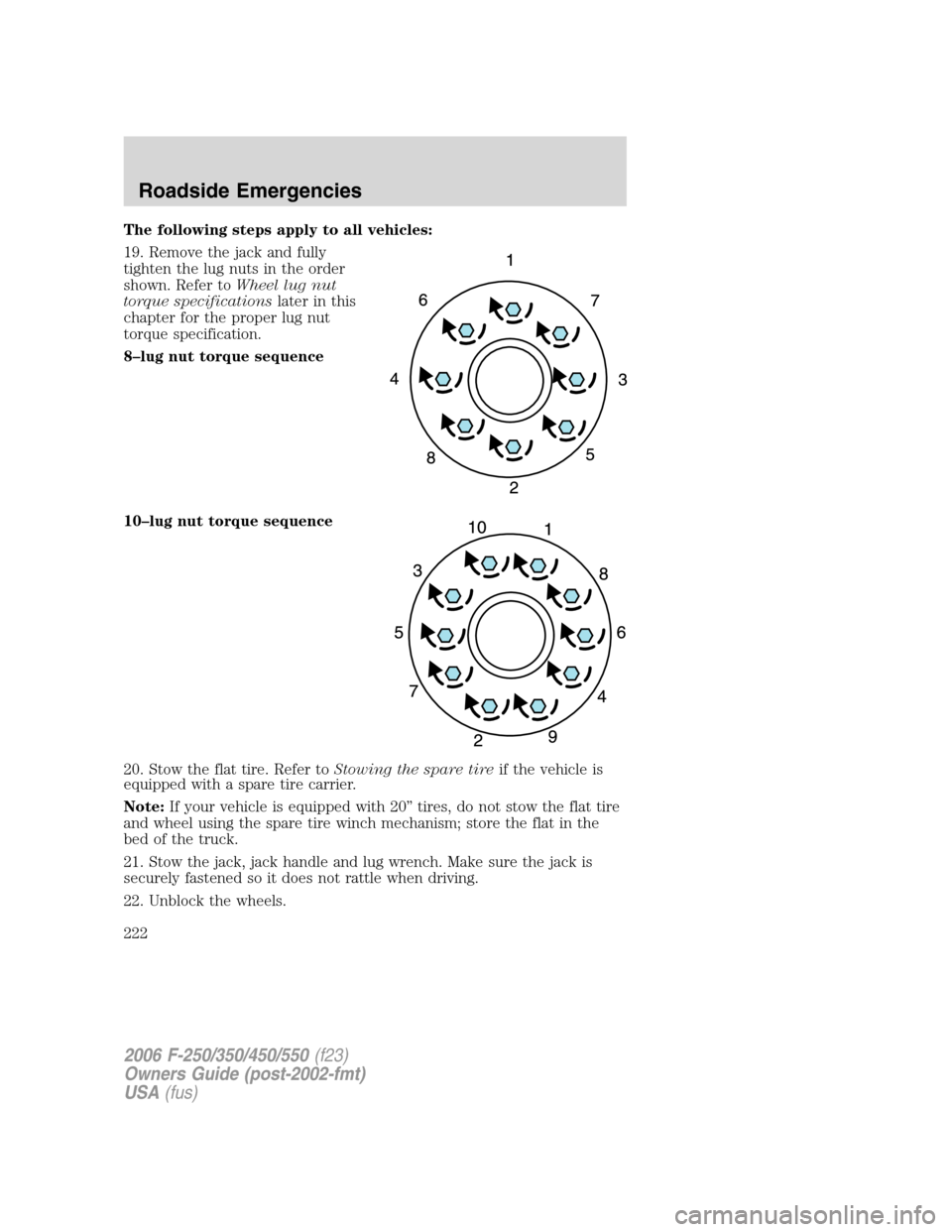
The following steps apply to all vehicles:
19. Remove the jack and fully
tighten the lug nuts in the order
shown. Refer toWheel lug nut
torque specificationslater in this
chapter for the proper lug nut
torque specification.
8–lug nut torque sequence
10–lug nut torque sequence
20. Stow the flat tire. Refer toStowing the spare tireif the vehicle is
equipped with a spare tire carrier.
Note:If your vehicle is equipped with 20” tires, do not stow the flat tire
and wheel using the spare tire winch mechanism; store the flat in the
bed of the truck.
21. Stow the jack, jack handle and lug wrench. Make sure the jack is
securely fastened so it does not rattle when driving.
22. Unblock the wheels.
2006 F-250/350/450/550(f23)
Owners Guide (post-2002-fmt)
USA(fus)
Roadside Emergencies
222
Page 273 of 312
•Revving the engine before turning it off may reduce fuel economy.
•Using the air conditioner or defroster may reduce fuel economy.
•You may want to turn off the speed control in hilly terrain if
unnecessary shifting between third and fourth gear occurs.
Unnecessary shifting of this type could result in reduced fuel
economy.
•Warming up a vehicle on cold mornings is not required and may
reduce fuel economy.
•Resting your foot on the brake pedal while driving may reduce fuel
economy.
•Combine errands and minimize stop-and-go driving.
Maintenance
•Keep tires properly inflated and use only recommended size.
•Operating a vehicle with the wheels out of alignment will reduce fuel
economy.
•Use recommended engine oil. Refer toLubricant specificationsin
this chapter.
•Perform all regularly scheduled maintenance items. Follow the
recommended maintenance schedule and owner maintenance checks
found in your vehicle’sscheduled maintenance information.
Conditions
•Heavily loading a vehicle or towing a trailer may reduce fuel economy
at any speed.
•Carrying unnecessary weight may reduce fuel economy (approximately
1 mpg [0.4 km/L] is lost for every 400 lb [180 kg] of weight carried).
•Adding certain accessories to your vehicle (for example bug
deflectors, rollbars/light bars, running boards, ski/luggage racks) may
reduce fuel economy.
•Using fuel blended with alcohol may lower fuel economy.
•Fuel economy may decrease with lower temperatures during the first
8–10 miles (12–16 km) of driving.
•Driving on flat terrain offers improved fuel economy as compared to
driving on hilly terrain.
•Transmissions give their best fuel economy when operated in the top
cruise gear and with steady pressure on the gas pedal.
2006 F-250/350/450/550(f23)
Owners Guide (post-2002-fmt)
USA(fus)
Maintenance and Specifications
273
Page 311 of 312
R
Radio ..........................20, 22, 25, 28
Relays ........................................203
Remote entry system .................82
illuminated entry ......................85
locking/unlocking doors ...........80
Reverse sensing system ...........181
Roadside assistance ..................201
S
Safety Belt Maintenance ..........107
Safety belts
(see Safety restraints) .......96–100
Safety defects, reporting ..........240
Safety restraints ..................96–100
belt minder .............................103
extension assembly ................106
for adults ...........................97–100
for children .....................116–117
lap belt ....................................102
safety belt maintenance .........107
warning light and
chime ...............................102–103
Safety seats for children ..........119
Safety Compliance
Certification Label ....................301
Seat belts
(see Safety restraints) ...............96
Seats ............................................89
child safety seats ....................119
cleaning ...................................246
Servicing your vehicle ..............249
Snowplowing .................8, 197–200
Spark plugs,
specifications .............286, 293–294Special notice ................................9
ambulance conversions ..............8
diesel-powered vehicles .............7
utility-type vehicles ....................7
Specification chart,
lubricants ...................................290
Speed control ..............................61
Starting your vehicle .......165–166,
169
jump starting ..........................224
Steering wheel
controls ......................................66
tilting .........................................54
T
Tailgate ..................................78–79
Tilt steering wheel ......................54
Tires ...................................130–131
alignment ................................143
care ..........................................142
changing ..................................216
checking the pressure ............133
inspecting and inflating .........132
label .........................................141
replacing ..................................136
rotating ....................................144
safety practices .......................142
sidewall information ...............137
snow tires and chains ............145
spare tire .........................212–213
terminology .............................131
tire grades ...............................131
treadwear ........................130, 142
Towing .......................................153
Trailer Brake
Controller-Integrated ..............157
trailer towing ..........................153
wrecker ....................................230
Traction-lok rear axle ...............173
2006 F-250/350/450/550(f23)
Owners Guide (post-2002-fmt)
USA(fus)
Index
311