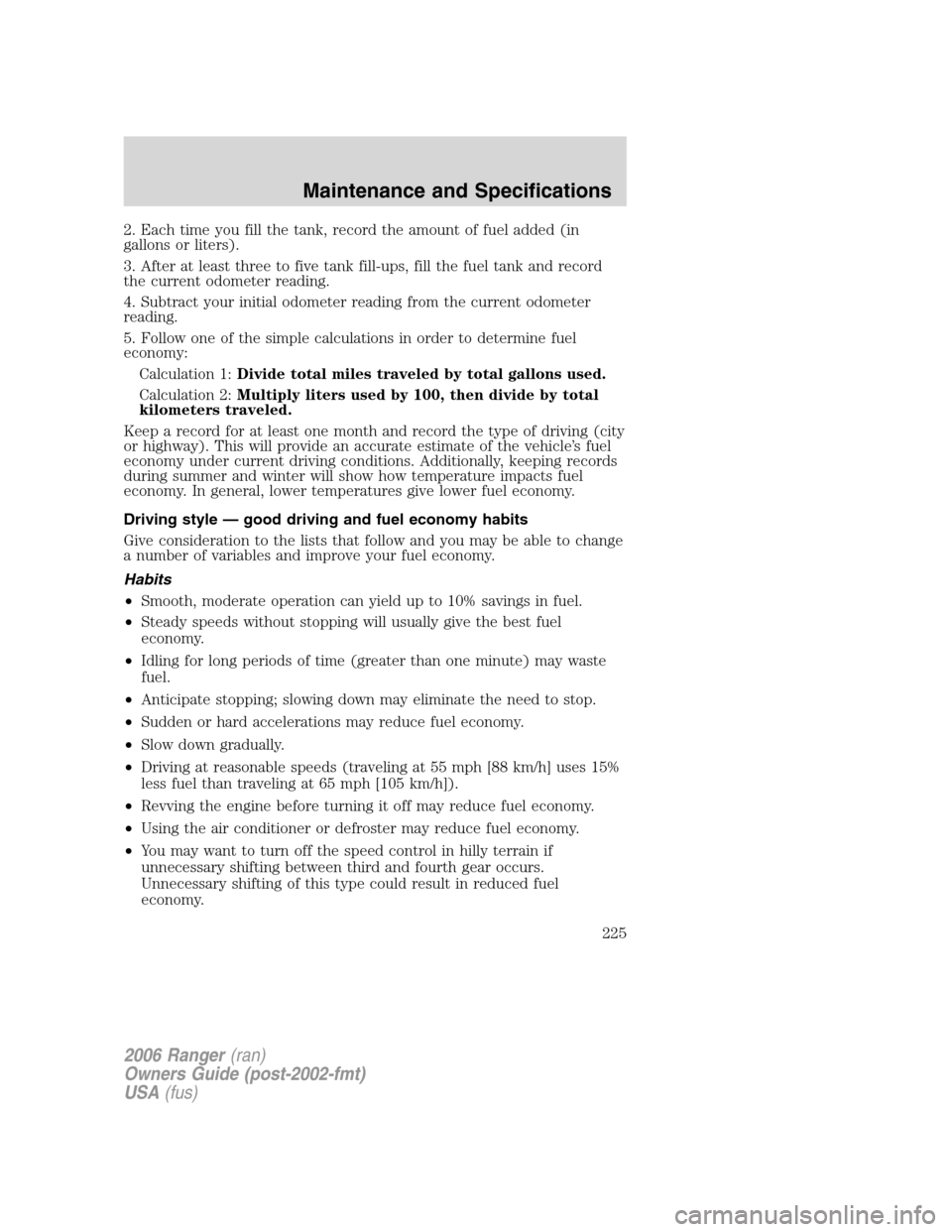
2. Each time you fill the tank, record the amount of fuel added (in
gallons or liters).
3. After at least three to five tank fill-ups, fill the fuel tank and record
the current odometer reading.
4. Subtract your initial odometer reading from the current odometer
reading.
5. Follow one of the simple calculations in order to determine fuel
economy:
Calculation 1:Divide total miles traveled by total gallons used.
Calculation 2:Multiply liters used by 100, then divide by total
kilometers traveled.
Keep a record for at least one month and record the type of driving (city
or highway). This will provide an accurate estimate of the vehicle’s fuel
economy under current driving conditions. Additionally, keeping records
during summer and winter will show how temperature impacts fuel
economy. In general, lower temperatures give lower fuel economy.
Driving style — good driving and fuel economy habits
Give consideration to the lists that follow and you may be able to change
a number of variables and improve your fuel economy.
Habits
•Smooth, moderate operation can yield up to 10% savings in fuel.
•Steady speeds without stopping will usually give the best fuel
economy.
•Idling for long periods of time (greater than one minute) may waste
fuel.
•Anticipate stopping; slowing down may eliminate the need to stop.
•Sudden or hard accelerations may reduce fuel economy.
•Slow down gradually.
•Driving at reasonable speeds (traveling at 55 mph [88 km/h] uses 15%
less fuel than traveling at 65 mph [105 km/h]).
•Revving the engine before turning it off may reduce fuel economy.
•Using the air conditioner or defroster may reduce fuel economy.
•You may want to turn off the speed control in hilly terrain if
unnecessary shifting between third and fourth gear occurs.
Unnecessary shifting of this type could result in reduced fuel
economy.
2006 Ranger(ran)
Owners Guide (post-2002-fmt)
USA(fus)
Maintenance and Specifications
225
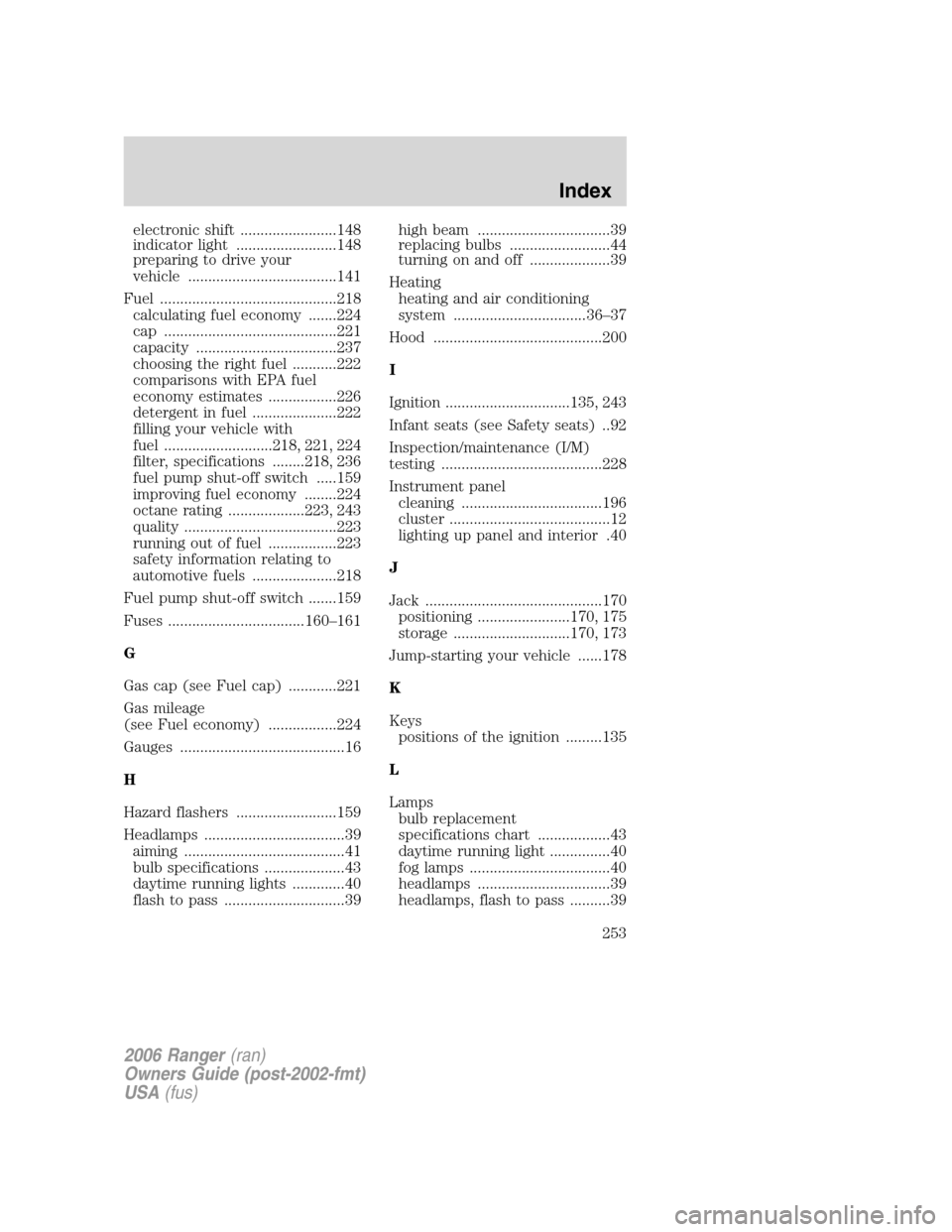
electronic shift ........................148
indicator light .........................148
preparing to drive your
vehicle .....................................141
Fuel ............................................218
calculating fuel economy .......224
cap ...........................................221
capacity ...................................237
choosing the right fuel ...........222
comparisons with EPA fuel
economy estimates .................226
detergent in fuel .....................222
filling your vehicle with
fuel ...........................218, 221, 224
filter, specifications ........218, 236
fuel pump shut-off switch .....159
improving fuel economy ........224
octane rating ...................223, 243
quality ......................................223
running out of fuel .................223
safety information relating to
automotive fuels .....................218
Fuel pump shut-off switch .......159
Fuses ..................................160–161
G
Gas cap (see Fuel cap) ............221
Gas mileage
(see Fuel economy) .................224
Gauges .........................................16
H
Hazard flashers .........................159
Headlamps ...................................39
aiming ........................................41
bulb specifications ....................43
daytime running lights .............40
flash to pass ..............................39high beam .................................39
replacing bulbs .........................44
turning on and off ....................39
Heating
heating and air conditioning
system .................................36–37
Hood ..........................................200
I
Ignition ...............................135, 243
Infant seats (see Safety seats) ..92
Inspection/maintenance (I/M)
testing ........................................228
Instrument panel
cleaning ...................................196
cluster ........................................12
lighting up panel and interior .40
J
Jack ............................................170
positioning .......................170, 175
storage .............................170, 173
Jump-starting your vehicle ......178
K
Keys
positions of the ignition .........135
L
Lamps
bulb replacement
specifications chart ..................43
daytime running light ...............40
fog lamps ...................................40
headlamps .................................39
headlamps, flash to pass ..........39
2006 Ranger(ran)
Owners Guide (post-2002-fmt)
USA(fus)
Index
253