Page 105 of 198
Downloaded from www.Manualslib.com manuals search engine SAFETY PRECAUTIONS
WARNINGS
To avoid fuel spillage that couldbe hazardous to other roadusers, always stop refuelling after thefuel nozzle stops the second time.Additional fuel will fill the expansionspace in the fuel tank which couldlead to fuel overflowing.
The fuel system is underpressure. There is a risk of injuryif the fuel system is leaking. Do notuse any kind of flames or heat nearthe fuel system.
FUEL QUALITY
Use only high quality fuel without anysupplemental additives or otherengine treatments.
Vehicles with a petrolengine
Use unleaded petrol according tospecification EN 228 or equivalentwith minimum 95 octane. Leadedfuel or fuel/additives containing othermetallic compounds (e.g.manganese-based) may damagethe emission system.
Vehicles with a dieselengine
Use diesel fuel according tospecification EN 590 or equivalent.Do not mix it with any oil, petrol orother liquids. Diesel fuels whichcontain a mix of up to 5 % RME (biodiesel) are acceptable.
Prolonged use of supplementaladditives to prevent fuel waxing is notrecommended. Do not addkerosene, paraffin or petrol to dieselfuels.
CATALYTIC CONVERTER
Driving with a catalyticconverter
Avoid running out of fuel.
Avoid unnecessarily long enginecranking periods.
Do not run the engine with adisconnected spark plug.
Do not push-start or tow-starting thevehicle; use booster cables. SeeUsing booster cables (page 158).
Never switch off the ignition whiledriving.
Parking
WARNING
It is important to avoid parking,idling or operating the vehicle ondry leaves or dry grass. Even whenthe engine is switched off, theexhaust will continue to radiate aconsiderable amount of heat for ashort period creating a potential firehazard.
103
Fuel and refuelling
Page 113 of 198
Downloaded from www.Manualslib.com manuals search engine P = Park
WARNINGS
This position should be selectedonly when the vehicle isstationary.
Always apply the parking brakeand make sure that the selectorlever is securely latched in P. Turn offthe ignition whenever you leave thevehicle.
If position P is not selected, awarning chime will sound whenthe driver’s door is opened.
In this position, the transmission islocked.
The engine should be started withthe selector lever in position P. Ifnecessary, it can also be started inposition N.
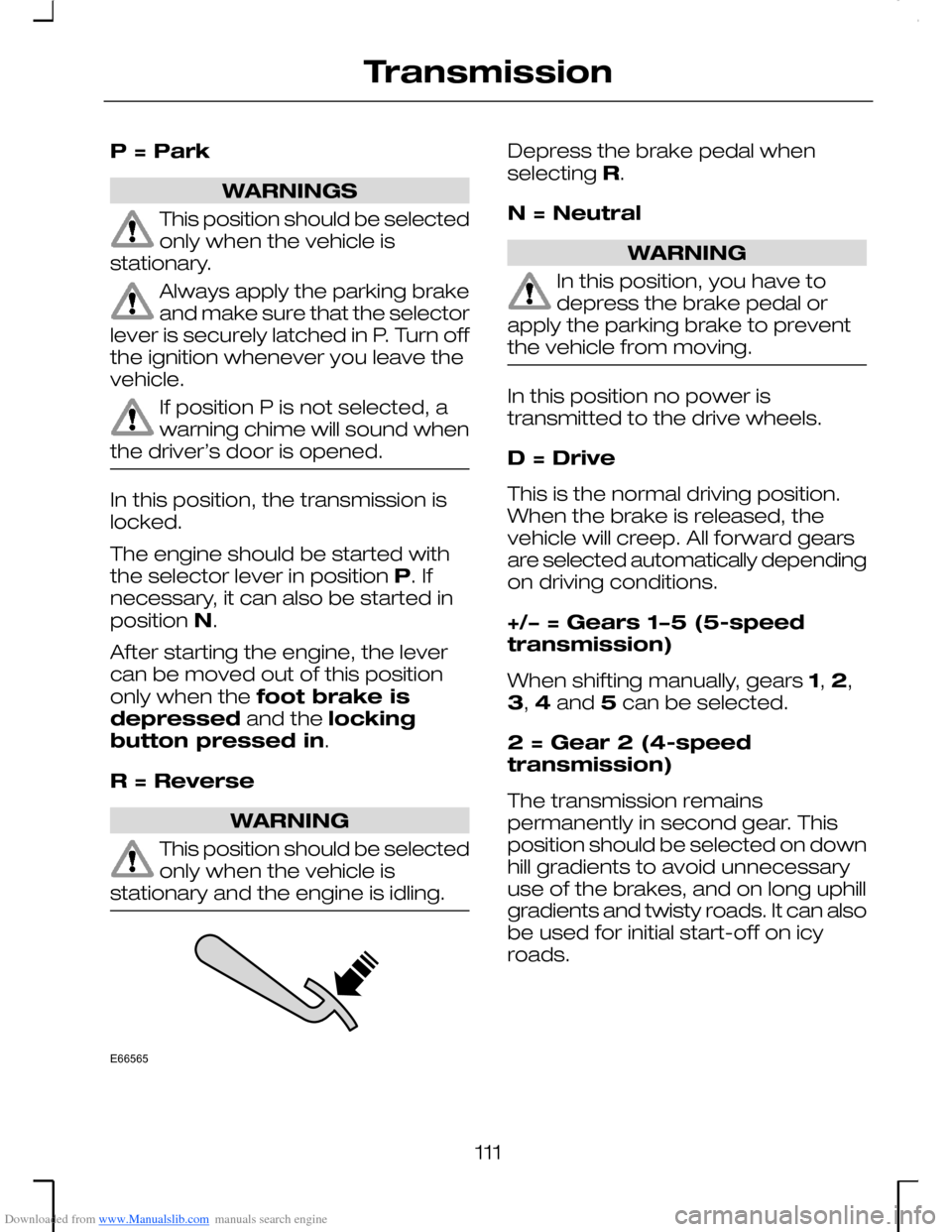
After starting the engine, the levercan be moved out of this positiononly when the foot brake isdepressed and the lockingbutton pressed in.
R = Reverse
WARNING
This position should be selectedonly when the vehicle isstationary and the engine is idling.
Depress the brake pedal whenselecting R.
N = Neutral
WARNING
In this position, you have todepress the brake pedal orapply the parking brake to preventthe vehicle from moving.
In this position no power istransmitted to the drive wheels.
D = Drive
This is the normal driving position.When the brake is released, thevehicle will creep. All forward gearsare selected automatically dependingon driving conditions.
+/− = Gears 1−5 (5-speedtransmission)
When shifting manually, gears 1, 2,3, 4 and 5 can be selected.
2 = Gear 2 (4-speedtransmission)
The transmission remainspermanently in second gear. Thisposition should be selected on downhill gradients to avoid unnecessaryuse of the brakes, and on long uphillgradients and twisty roads. It can alsobe used for initial start-off on icyroads.
111
TransmissionE66565
Page 122 of 198
Downloaded from www.Manualslib.com manuals search engine PRINCIPLE OF
OPERATION
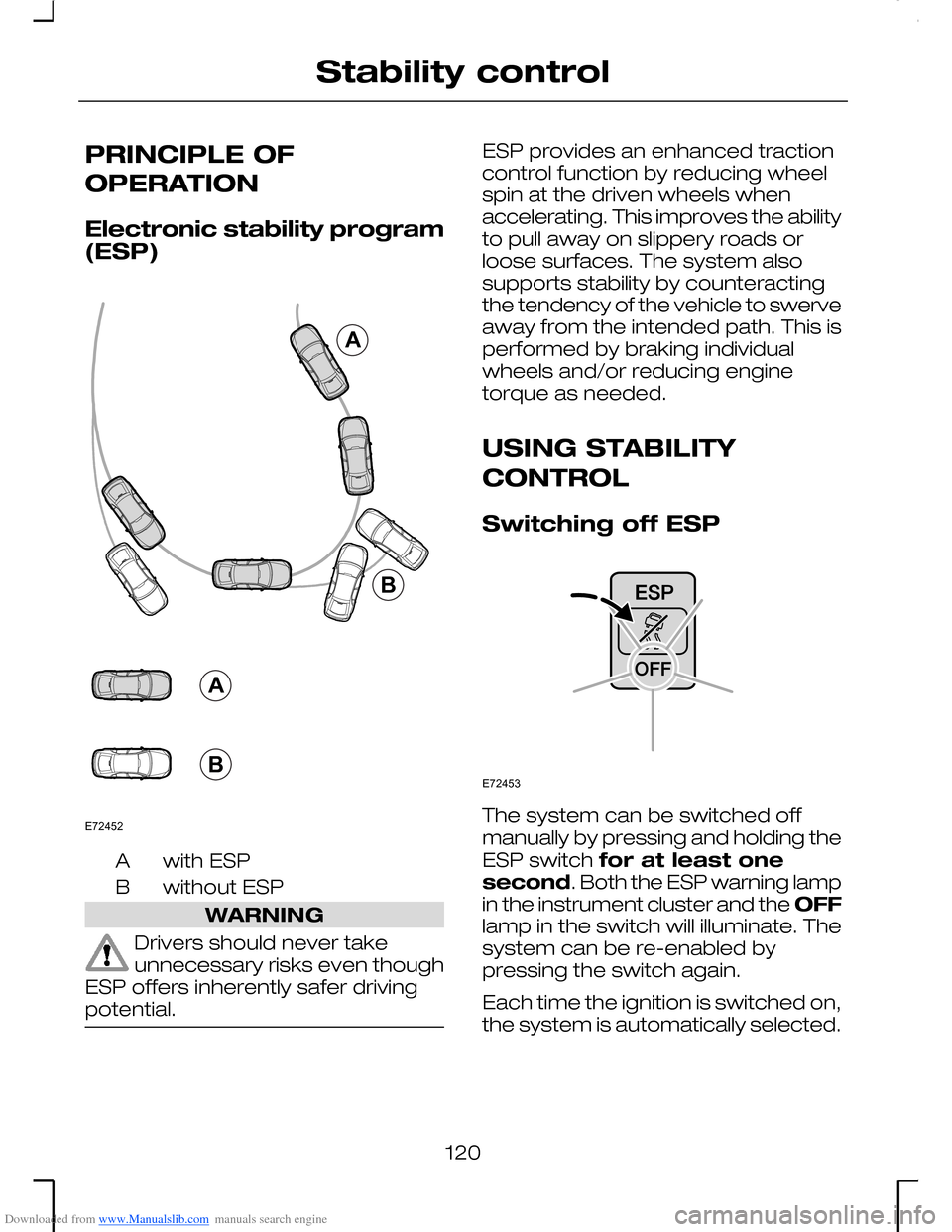
Electronic stability program(ESP)
with ESPA
without ESPB
WARNING
Drivers should never takeunnecessary risks even thoughESP offers inherently safer drivingpotential.
ESP provides an enhanced tractioncontrol function by reducing wheelspin at the driven wheels whenaccelerating. This improves the abilityto pull away on slippery roads orloose surfaces. The system alsosupports stability by counteractingthe tendency of the vehicle to swerveaway from the intended path. This isperformed by braking individualwheels and/or reducing enginetorque as needed.
USING STABILITY
CONTROL
Switching off ESP
The system can be switched offmanually by pressing and holding theESP switch for at least onesecond. Both the ESP warning lampin the instrument cluster and the OFFlamp in the switch will illuminate. Thesystem can be re-enabled bypressing the switch again.
Each time the ignition is switched on,the system is automatically selected.
120
Stability controlAABBE72452 E72453
Page 123 of 198
Downloaded from www.Manualslib.com manuals search engine PRINCIPLE OF
OPERATION
WARNING
Drivers should never takeunnecessary risks even thoughthe system offers inherently saferdriving potential.
The system reduces wheel spin atthe driven wheels at speeds up to 40km/h (25 mph).
The system may become activewhen accelerating on a slippery roador loose surface, or when pullingaway on a hill.
USING TRACTION
CONTROL
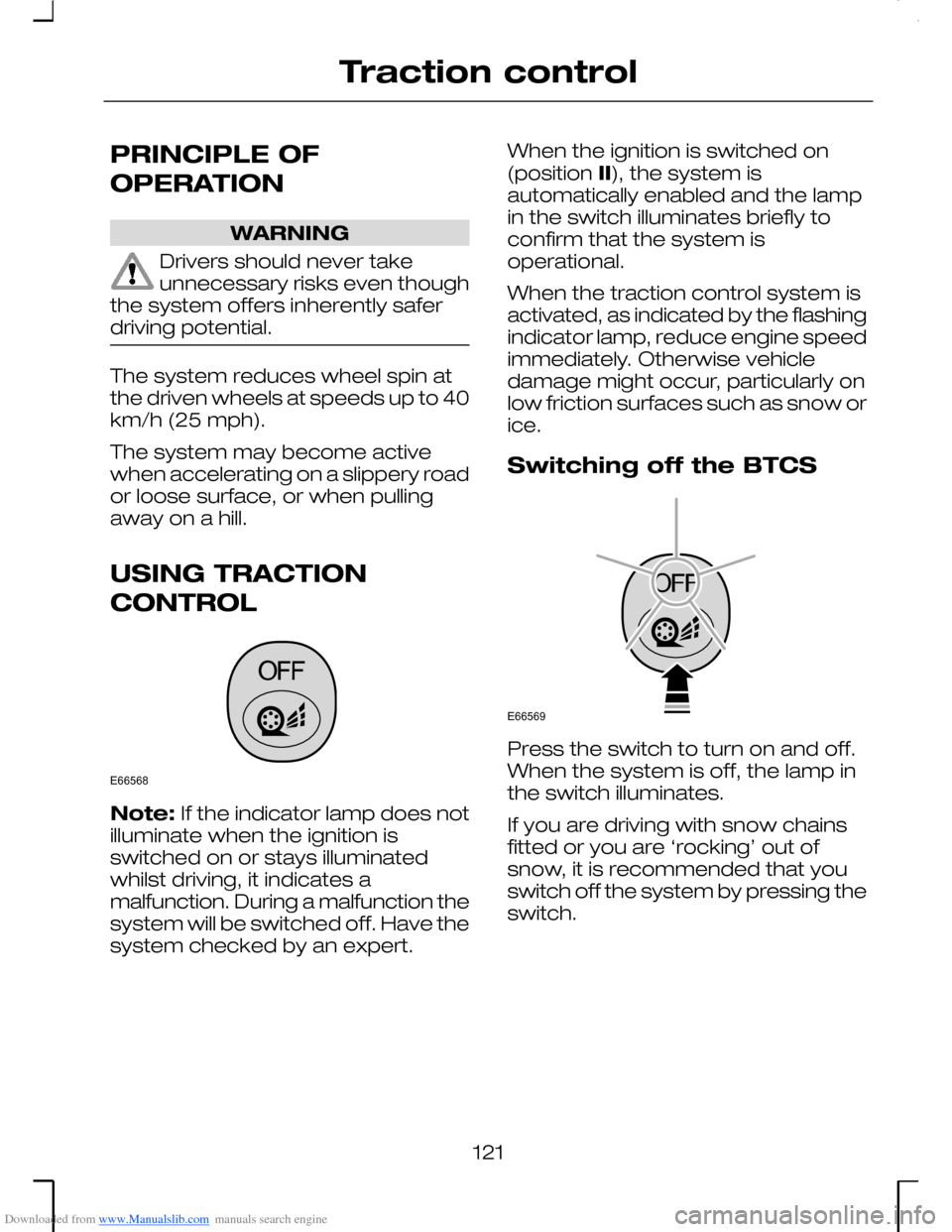
Note: If the indicator lamp does notilluminate when the ignition isswitched on or stays illuminatedwhilst driving, it indicates amalfunction. During a malfunction thesystem will be switched off. Have thesystem checked by an expert.
When the ignition is switched on(position II), the system isautomatically enabled and the lampin the switch illuminates briefly toconfirm that the system isoperational.
When the traction control system isactivated, as indicated by the flashingindicator lamp, reduce engine speedimmediately. Otherwise vehicledamage might occur, particularly onlow friction surfaces such as snow orice.
Switching off the BTCS
Press the switch to turn on and off.When the system is off, the lamp inthe switch illuminates.
If you are driving with snow chainsfitted or you are ‘rocking’ out ofsnow, it is recommended that youswitch off the system by pressing theswitch.
121
Traction controlE66568 E66569
Page 125 of 198
Downloaded from www.Manualslib.com manuals search engine PRINCIPLE OF
OPERATION
WARNING
The parking aid is an auxiliarysystem which is not intended torelieve the driver of his responsibilityfor exercising due care and attentionwhen reversing. In particular, someobjects close to the vehicle (approx.30 cm) and above or below thesensors may not be detected by thepark distance sensor and causedamage to the vehicle. Ultrasonicwaves, heavy rain and/or conditionscausing disruptive reflections maylead to objects not being detectedby the sensors. In addition, objectswhich absorb ultrasonic waves maynot always be detected due to theirunfavourable surface characteristics.
USING THE PARKING AID
WARNING
Be careful when a tow bar isinstalled.
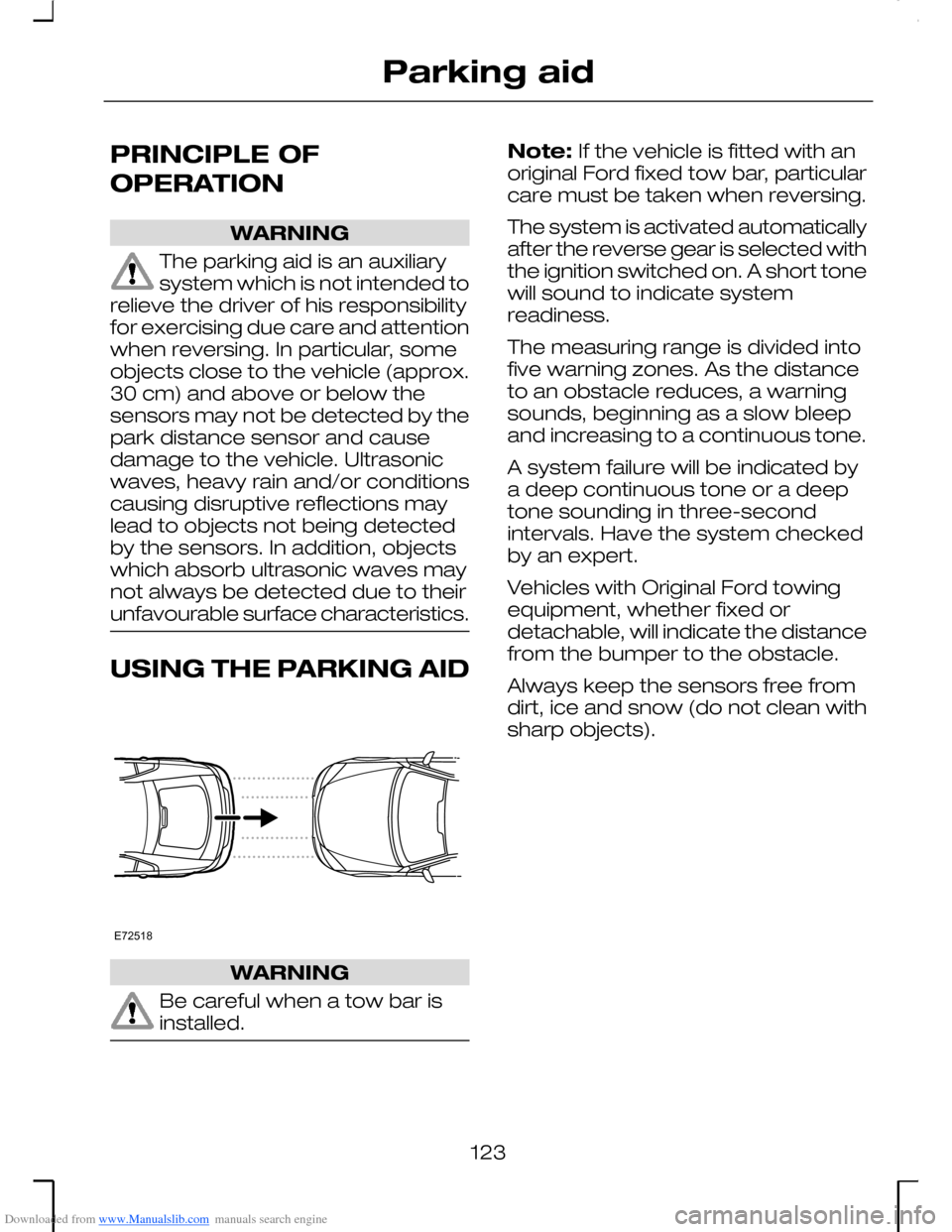
Note: If the vehicle is fitted with anoriginal Ford fixed tow bar, particularcare must be taken when reversing.
The system is activated automaticallyafter the reverse gear is selected withthe ignition switched on. A short tonewill sound to indicate systemreadiness.
The measuring range is divided intofive warning zones. As the distanceto an obstacle reduces, a warningsounds, beginning as a slow bleepand increasing to a continuous tone.
A system failure will be indicated bya deep continuous tone or a deeptone sounding in three-secondintervals. Have the system checkedby an expert.
Vehicles with Original Ford towingequipment, whether fixed ordetachable, will indicate the distancefrom the bumper to the obstacle.
Always keep the sensors free fromdirt, ice and snow (do not clean withsharp objects).
123
Parking aidE72518
Page 137 of 198
Downloaded from www.Manualslib.com manuals search engine FUEL CUT-OFF SWITCH
Vehicles with a Duratecengine
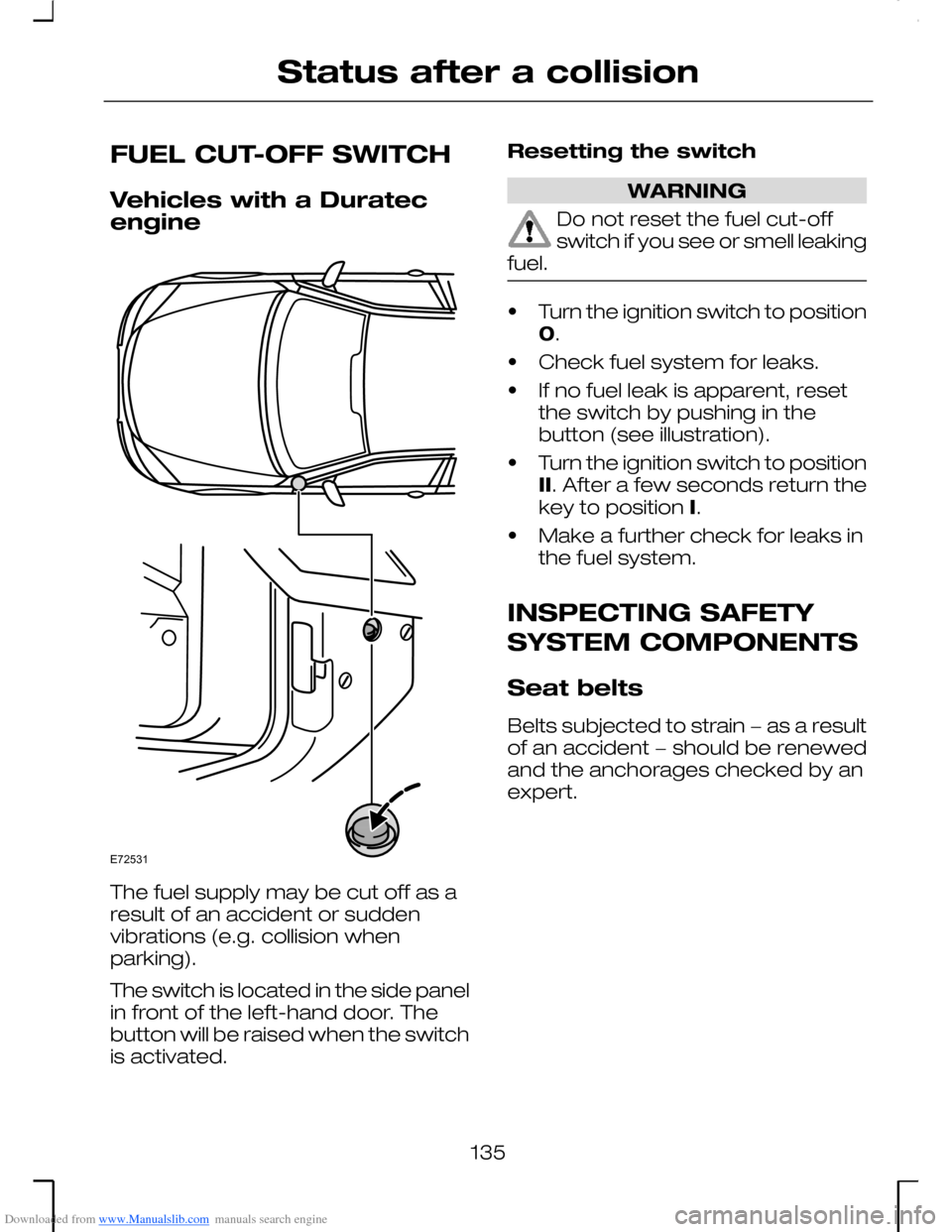
The fuel supply may be cut off as aresult of an accident or suddenvibrations (e.g. collision whenparking).
The switch is located in the side panelin front of the left-hand door. Thebutton will be raised when the switchis activated.
Resetting the switch
WARNING
Do not reset the fuel cut-offswitch if you see or smell leakingfuel.
•Turn the ignition switch to position0.
•Check fuel system for leaks.
•If no fuel leak is apparent, resetthe switch by pushing in thebutton (see illustration).
•Turn the ignition switch to positionII. After a few seconds return thekey to position I.
•Make a further check for leaks inthe fuel system.
INSPECTING SAFETY
SYSTEM COMPONENTS
Seat belts
Belts subjected to strain − as a resultof an accident − should be renewedand the anchorages checked by anexpert.
135
Status after a collisionE72531
Page 139 of 198
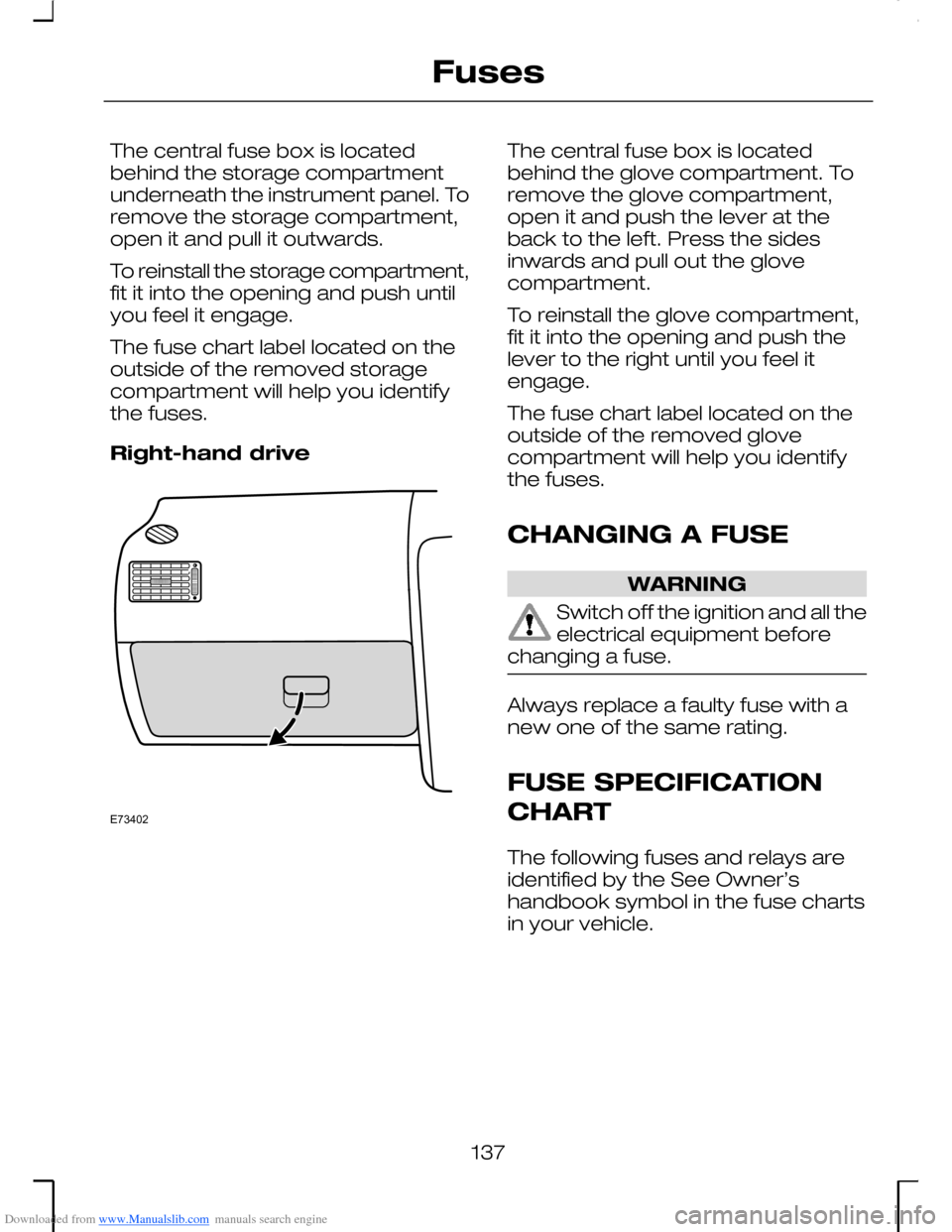
Downloaded from www.Manualslib.com manuals search engine The central fuse box is locatedbehind the storage compartmentunderneath the instrument panel. Toremove the storage compartment,open it and pull it outwards.
To reinstall the storage compartment,fit it into the opening and push untilyou feel it engage.
The fuse chart label located on theoutside of the removed storagecompartment will help you identifythe fuses.
Right-hand drive
The central fuse box is locatedbehind the glove compartment. Toremove the glove compartment,open it and push the lever at theback to the left. Press the sidesinwards and pull out the glovecompartment.
To reinstall the glove compartment,fit it into the opening and push thelever to the right until you feel itengage.
The fuse chart label located on theoutside of the removed glovecompartment will help you identifythe fuses.
CHANGING A FUSE
WARNING
Switch off the ignition and all theelectrical equipment beforechanging a fuse.
Always replace a faulty fuse with anew one of the same rating.
FUSE SPECIFICATION
CHART
The following fuses and relays areidentified by the See Owner’shandbook symbol in the fuse chartsin your vehicle.
137
FusesE73402
Page 142 of 198
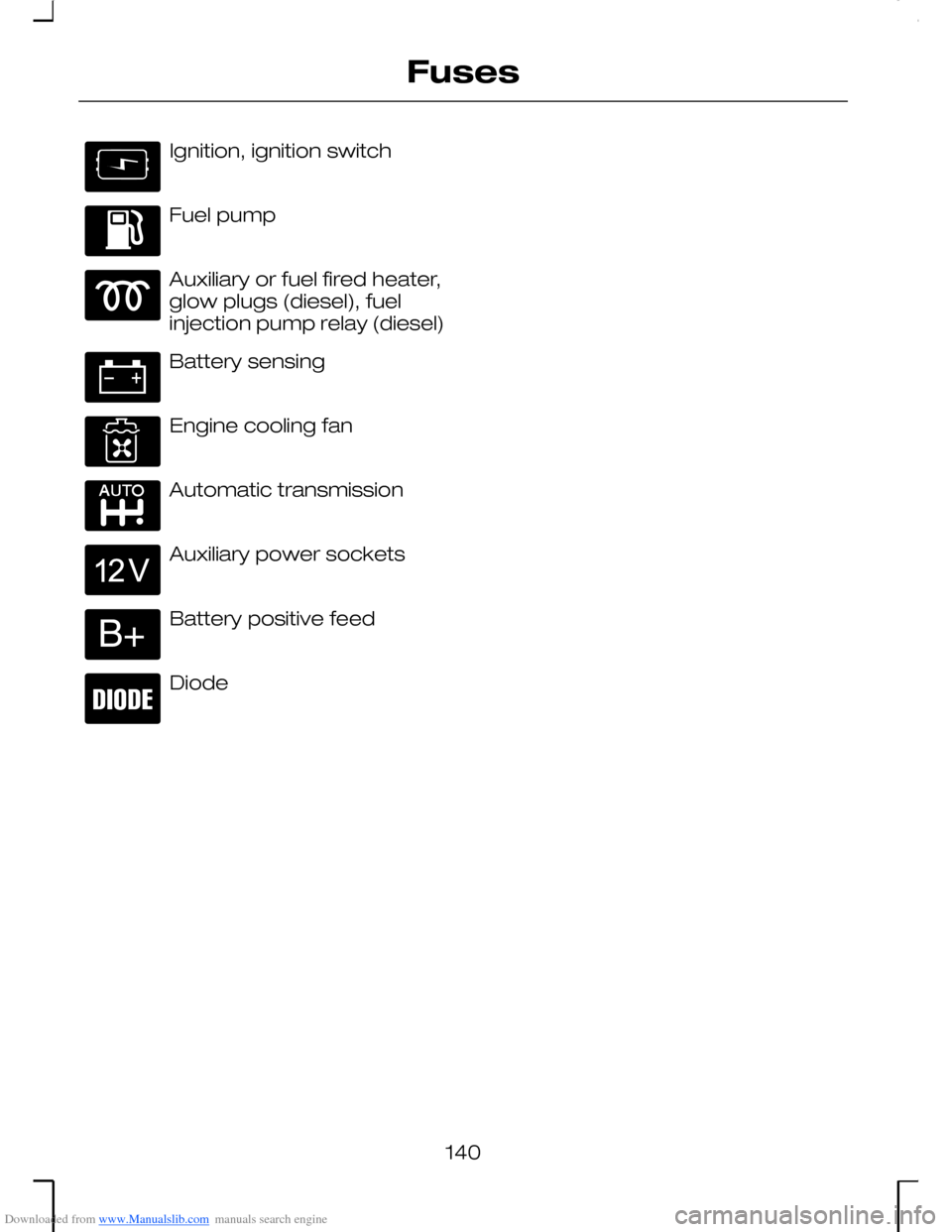
Downloaded from www.Manualslib.com manuals search engine Ignition, ignition switch
Fuel pump
Auxiliary or fuel fired heater,glow plugs (diesel), fuelinjection pump relay (diesel)
Battery sensing
Engine cooling fan
Automatic transmission
Auxiliary power sockets
Battery positive feed
Diode
140
Fuses