Page 120 of 198
Downloaded from www.Manualslib.com manuals search engine PRINCIPLE OF
OPERATION
Dual circuit braking system
WARNING
If a brake circuit fails, you will atfirst experience a softer feel tothe brake pedal. You will then needto exert a greater force on the brakepedal, and make allowance forincreased stopping distances. Havethe braking system checked by anexpert before continuing yourjourney.
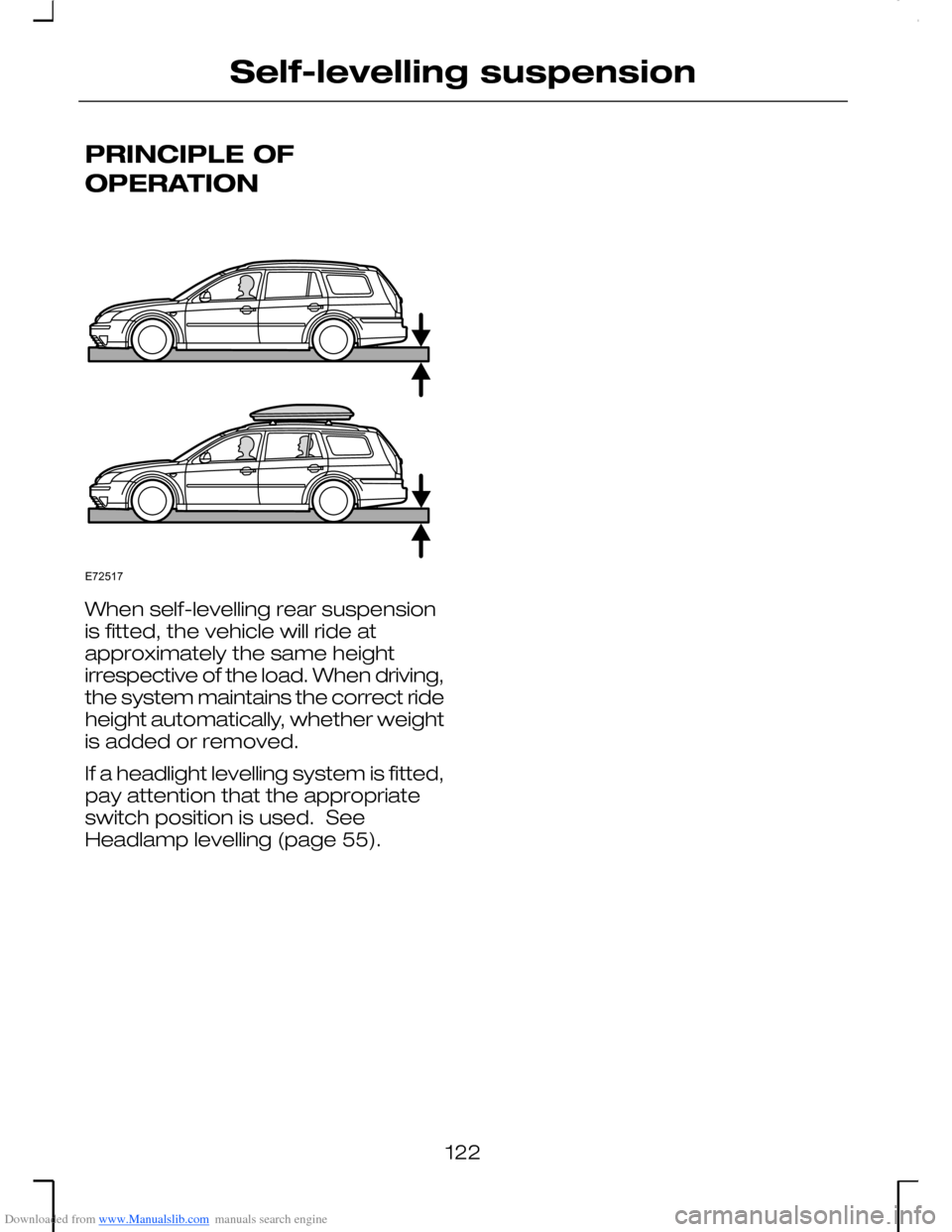
Your vehicle is equipped with adiagonally split dual circuit brakingsystem. If one of the brake circuitsfails, the other remains operative.
Disc brakes
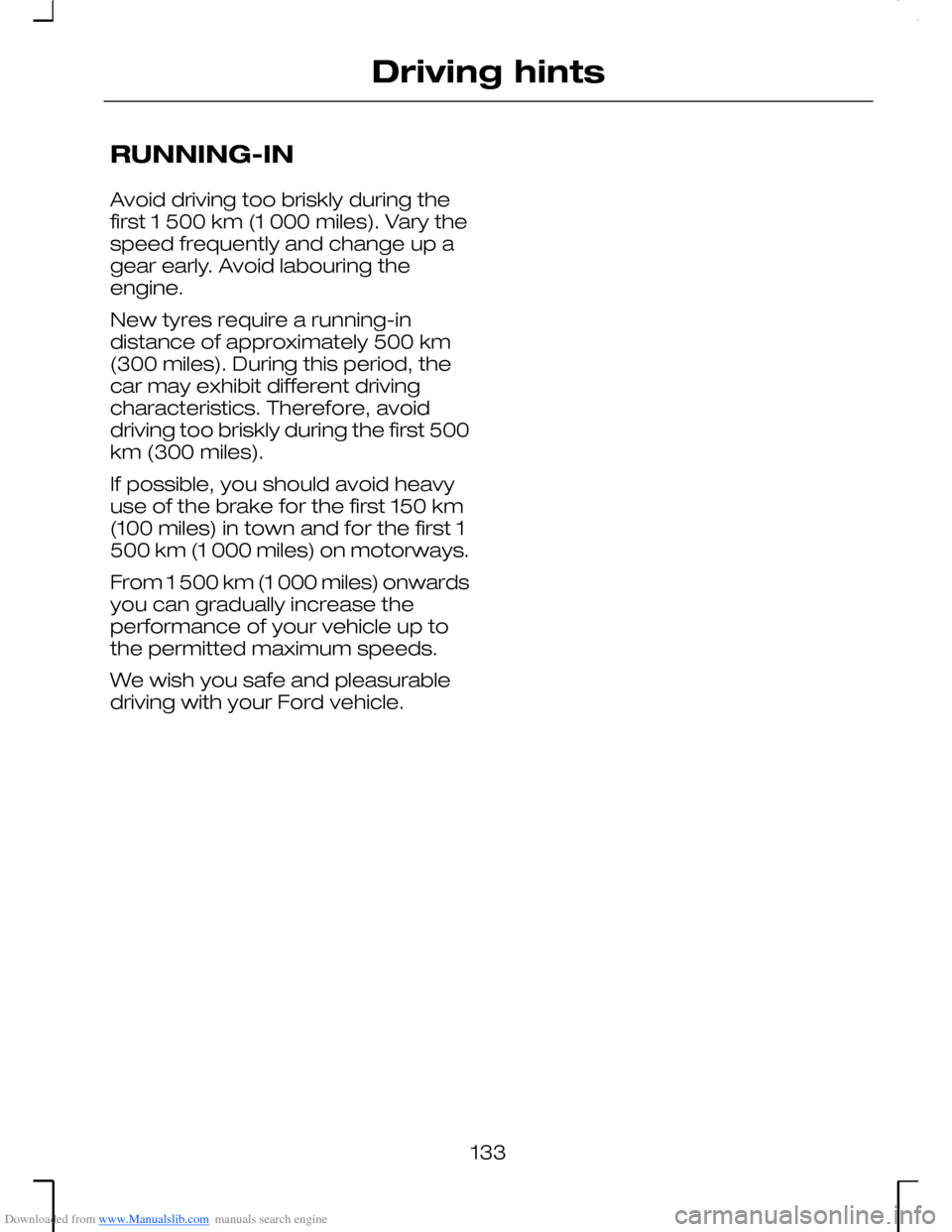
Wet brake discs result in reducedbraking efficiency.
After leaving a carwash or driving thevehicle through water, dab the brakepedal while driving to remove the filmof water.
Emergency brake assist
WARNING
Emergency brake assist is anadditional system which is notintended to relieve the driver of hisresponsibility for exercising due careand attention when driving.
Emergency brake assist is able todetect an emergency brakingsituation by measuring the rate atwhich the brake pedal is applied. Itautomatically provides maximumbraking efficiency as long as thepedal is applied. This can reducestopping distances in criticalsituations.
HINTS ON DRIVING WITH
ABS
WARNING
Although the ABS ensuresoptimum braking efficiency,stopping distances can vary greatlydepending on the road surface andconditions. Use of the ABS cannoteliminate the dangers inherent indriving too close to the vehicle in frontof you, aquaplaning, excessivecornering speed or poor roadsurfaces.
118
BrakesE66564 E66565
Page 122 of 198
Downloaded from www.Manualslib.com manuals search engine PRINCIPLE OF
OPERATION
Electronic stability program(ESP)
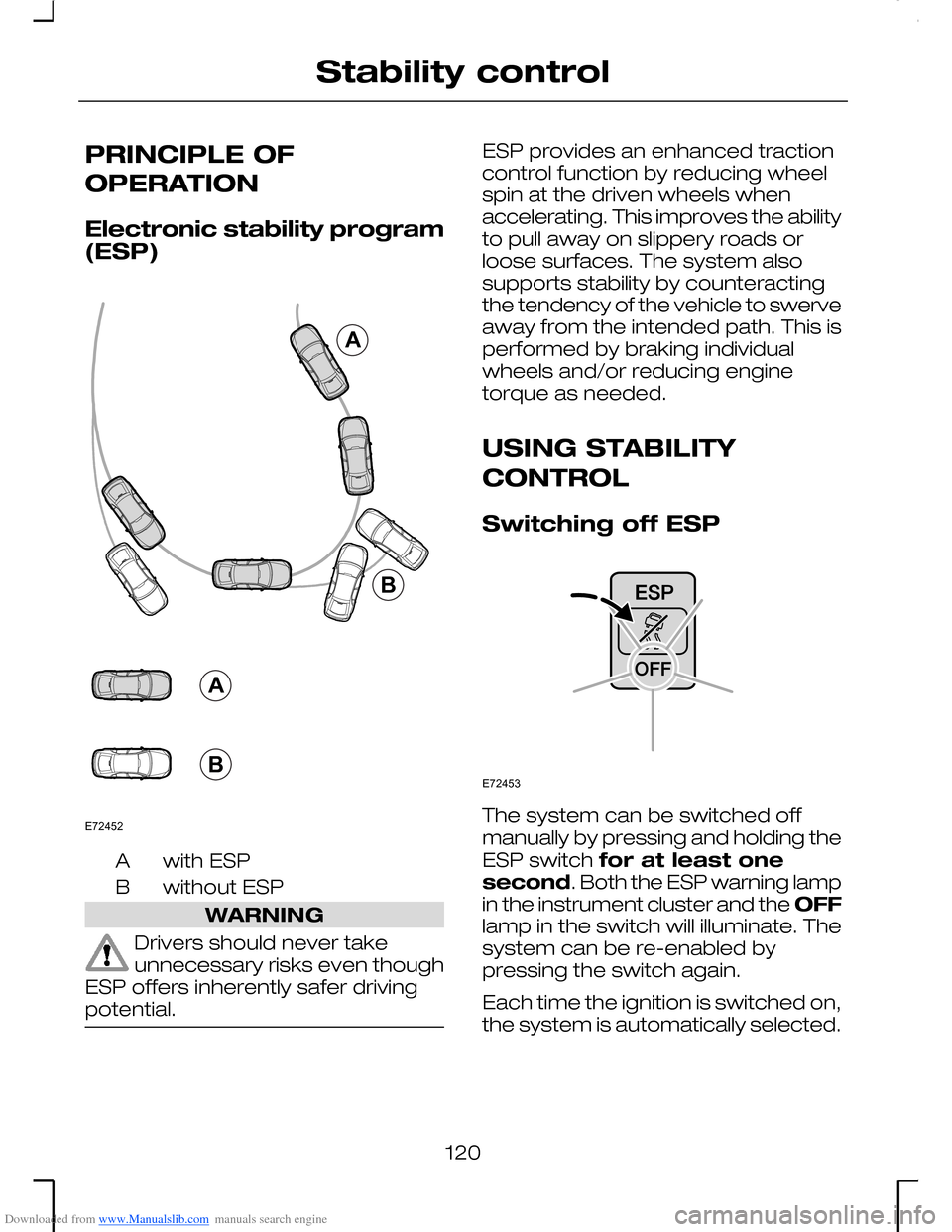
with ESPA
without ESPB
WARNING
Drivers should never takeunnecessary risks even thoughESP offers inherently safer drivingpotential.
ESP provides an enhanced tractioncontrol function by reducing wheelspin at the driven wheels whenaccelerating. This improves the abilityto pull away on slippery roads orloose surfaces. The system alsosupports stability by counteractingthe tendency of the vehicle to swerveaway from the intended path. This isperformed by braking individualwheels and/or reducing enginetorque as needed.
USING STABILITY
CONTROL
Switching off ESP
The system can be switched offmanually by pressing and holding theESP switch for at least onesecond. Both the ESP warning lampin the instrument cluster and the OFFlamp in the switch will illuminate. Thesystem can be re-enabled bypressing the switch again.
Each time the ignition is switched on,the system is automatically selected.
120
Stability controlAABBE72452 E72453
Page 124 of 198
Downloaded from www.Manualslib.com manuals search engine PRINCIPLE OF
OPERATION
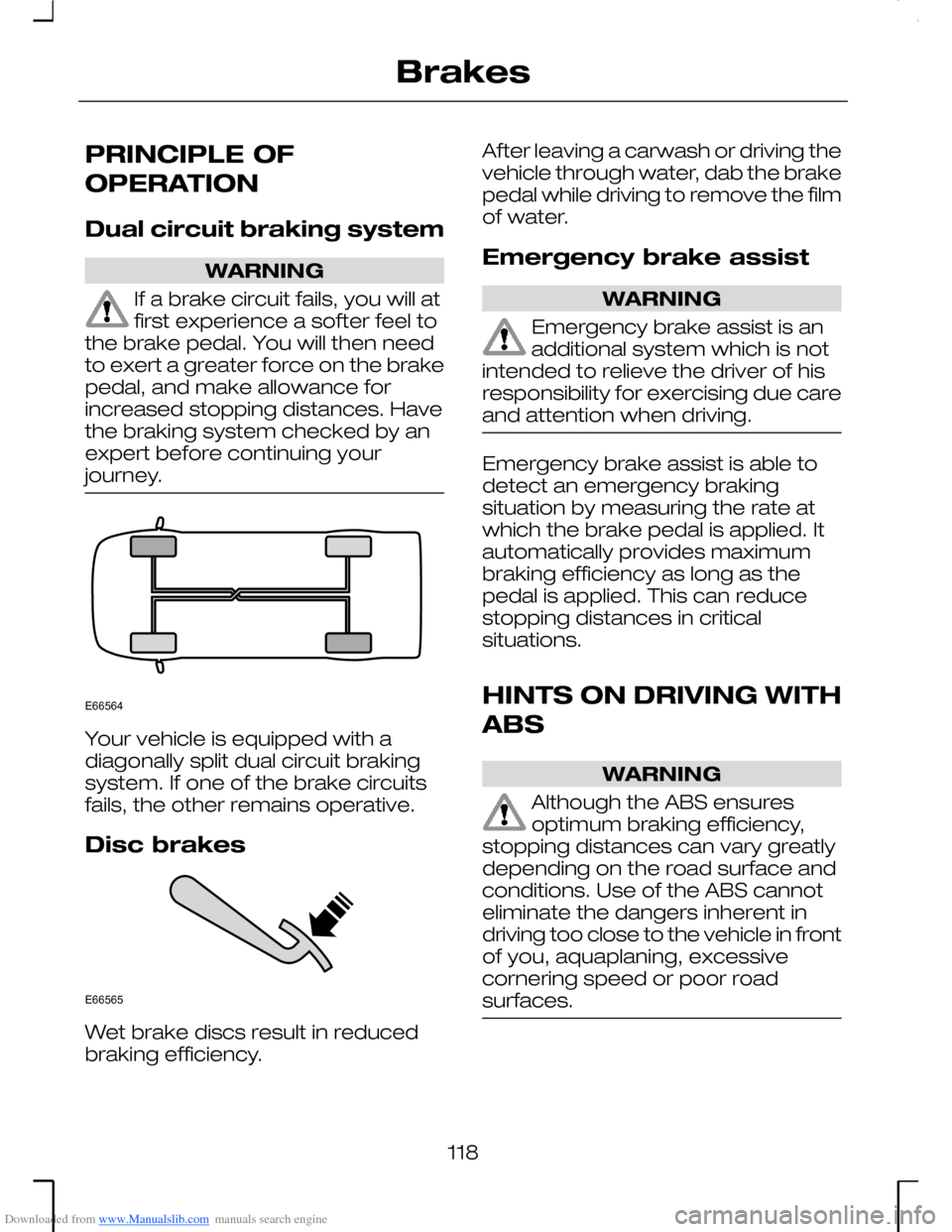
When self-levelling rear suspensionis fitted, the vehicle will ride atapproximately the same heightirrespective of the load. When driving,the system maintains the correct rideheight automatically, whether weightis added or removed.
If a headlight levelling system is fitted,pay attention that the appropriateswitch position is used. SeeHeadlamp levelling (page 55).
122
Self-levelling suspensionE72517
Page 125 of 198
Downloaded from www.Manualslib.com manuals search engine PRINCIPLE OF
OPERATION
WARNING
The parking aid is an auxiliarysystem which is not intended torelieve the driver of his responsibilityfor exercising due care and attentionwhen reversing. In particular, someobjects close to the vehicle (approx.30 cm) and above or below thesensors may not be detected by thepark distance sensor and causedamage to the vehicle. Ultrasonicwaves, heavy rain and/or conditionscausing disruptive reflections maylead to objects not being detectedby the sensors. In addition, objectswhich absorb ultrasonic waves maynot always be detected due to theirunfavourable surface characteristics.
USING THE PARKING AID
WARNING
Be careful when a tow bar isinstalled.
Note: If the vehicle is fitted with anoriginal Ford fixed tow bar, particularcare must be taken when reversing.
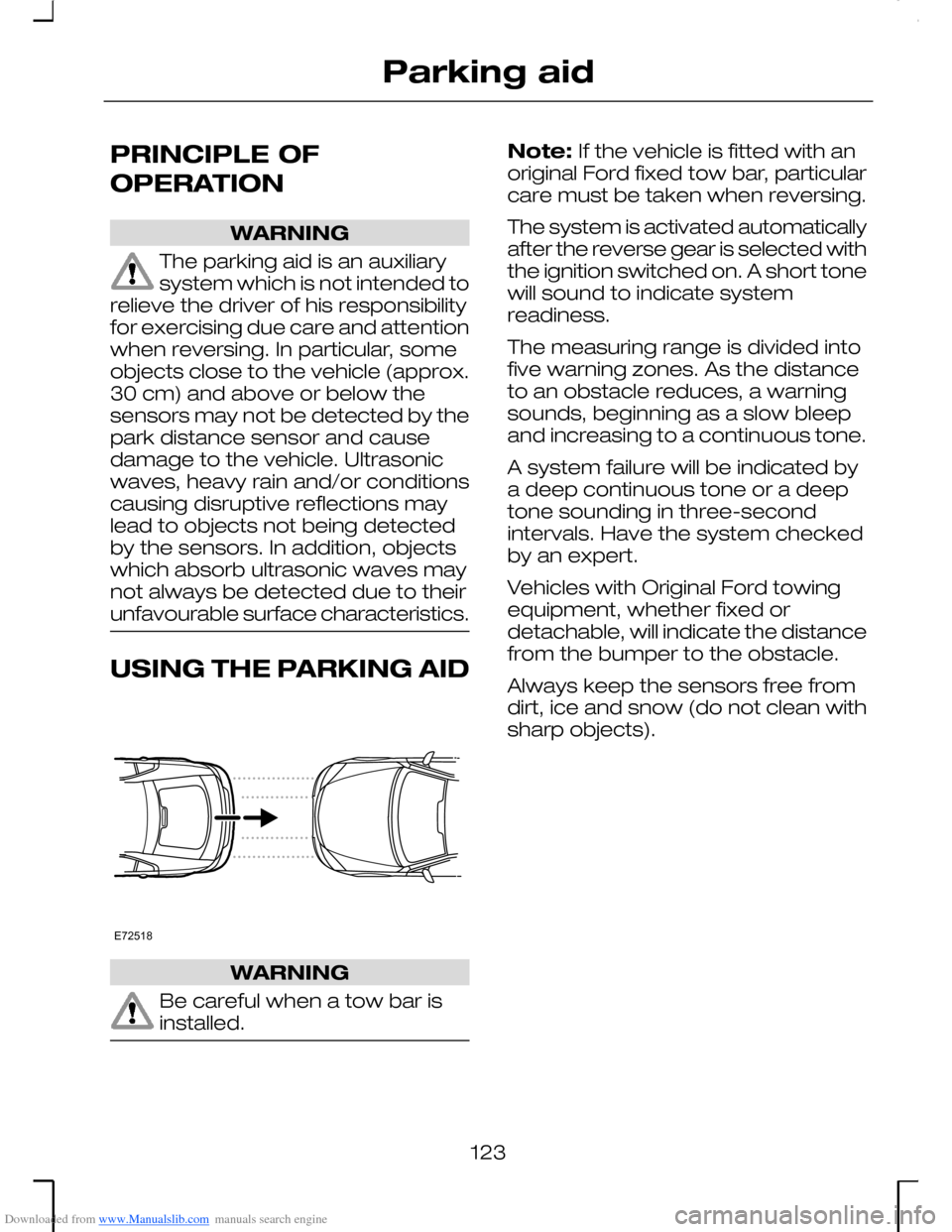
The system is activated automaticallyafter the reverse gear is selected withthe ignition switched on. A short tonewill sound to indicate systemreadiness.
The measuring range is divided intofive warning zones. As the distanceto an obstacle reduces, a warningsounds, beginning as a slow bleepand increasing to a continuous tone.
A system failure will be indicated bya deep continuous tone or a deeptone sounding in three-secondintervals. Have the system checkedby an expert.
Vehicles with Original Ford towingequipment, whether fixed ordetachable, will indicate the distancefrom the bumper to the obstacle.
Always keep the sensors free fromdirt, ice and snow (do not clean withsharp objects).
123
Parking aidE72518
Page 135 of 198
Downloaded from www.Manualslib.com manuals search engine RUNNING-IN
Avoid driving too briskly during thefirst 1 500 km (1 000 miles). Vary thespeed frequently and change up agear early. Avoid labouring theengine.
New tyres require a running-indistance of approximately 500 km(300 miles). During this period, thecar may exhibit different drivingcharacteristics. Therefore, avoiddriving too briskly during the first 500km (300 miles).
If possible, you should avoid heavyuse of the brake for the first 150 km(100 miles) in town and for the first 1500 km (1 000 miles) on motorways.
From 1 500 km (1 000 miles) onwardsyou can gradually increase theperformance of your vehicle up tothe permitted maximum speeds.
We wish you safe and pleasurabledriving with your Ford vehicle.
133
Driving hints
Page 162 of 198
Downloaded from www.Manualslib.com manuals search engine CHANGING A ROAD
WHEEL
Spare wheel
All vehicles
WARNING
Use only approved wheel andtyre sizes. Using other sizescould damage the vehicle and willmake the National Type Approvalinvalid.
Vehicles with a temporaryspare wheel
WARNINGS
If the spare wheel differs fromthe other fitted wheels, theserules must be followed:
Do not exceed 80 km/h (50mph).
Drive the shortest possibledistances.
Do not fit more than one sparewheel on your vehicle at anyone time.
Do not use snow chains on thistype of wheel.
Do not drive through anautomatic car wash.
Vehicles with stability assist
Vehicles with ESP may exhibit someunusual driving characteristics. Switchthe ESP off. See Using stabilitycontrol (page 120).
4-door and 5-door
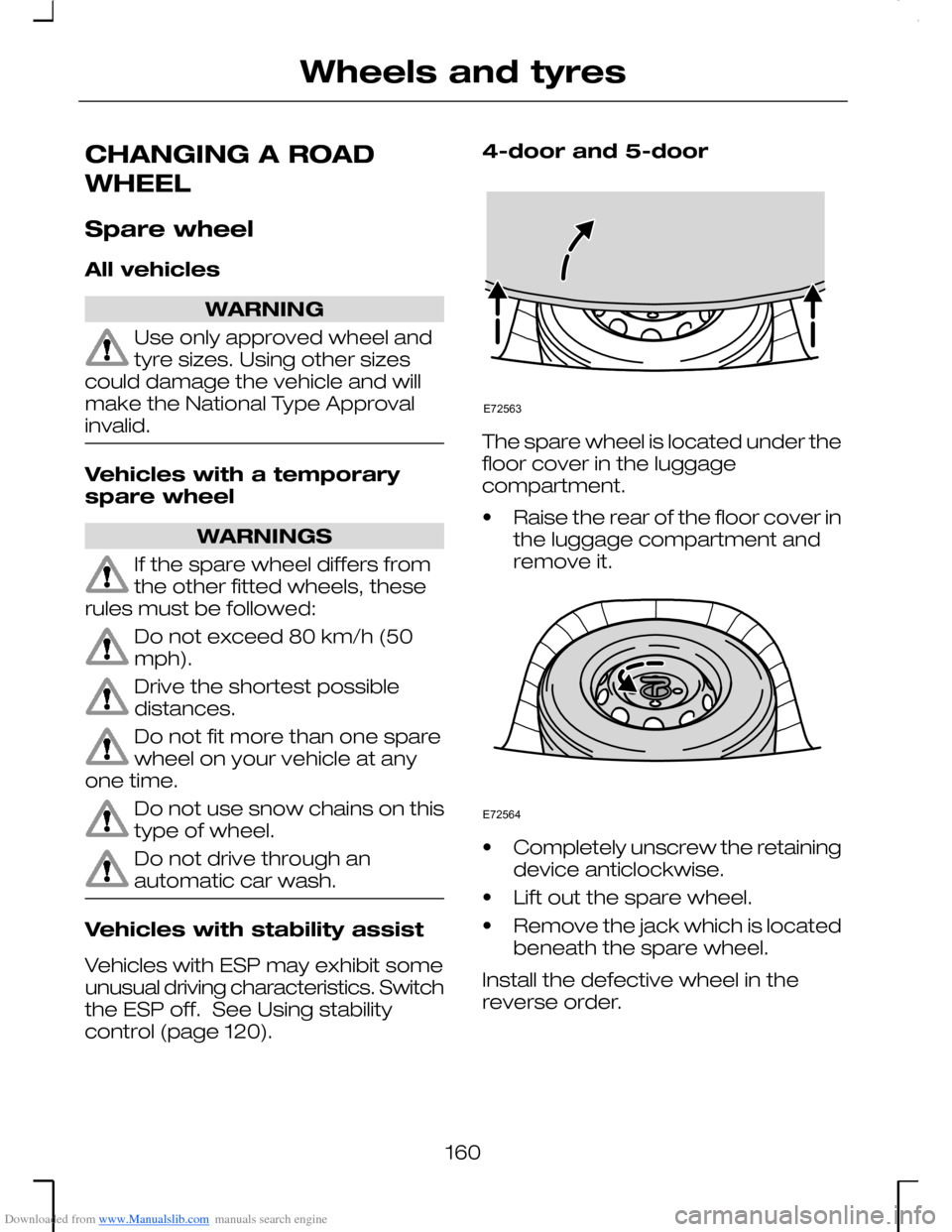
The spare wheel is located under thefloor cover in the luggagecompartment.
•Raise the rear of the floor cover inthe luggage compartment andremove it.
•Completely unscrew the retainingdevice anticlockwise.
•Lift out the spare wheel.
•Remove the jack which is locatedbeneath the spare wheel.
Install the defective wheel in thereverse order.
160
Wheels and tyresE72563 E72564
Page 164 of 198
Downloaded from www.Manualslib.com manuals search engine WARNING
The jack must only be used onthe jacking points specifiedbelow.
The front jacking point 1 is locatedapproximately 27 cm from the frontend of the sill. If you open up theOwner’s handbook, it isapproximately 27 cm wide.
The rear jacking point 2 is locatedapproximately 10 cm from the rearend of the sill.
Vehicles with side skirts
On vehicles with side skirts, the covermust be removed before placing thejack under the vehicle.
To remove pull the lower edge of thecover and rotate upwards, then pullit off.
Additional jacking points
WARNINGS
Positioning at other points maycause considerable damage tothe body, steering, suspension,engine, braking system and fuel lines.
Vehicles with side skirts requirespecial rubber pads to avoiddamaging the side skirts or thevehicle.
Points 1 and 2 can be used for trolleyjacks, workshop hoists or jack stands.
162
Wheels and tyresE72569 E72570
Page 169 of 198
Downloaded from www.Manualslib.com manuals search engine In order to avoid damagingfull-diameter wheel covers, theyshould be removed while driving withsnow chains.
Vehicles with stabilitycontrol (ESP)
Vehicles with stability control (ESP)may exhibit some unusual drivingcharacteristics which can be avoidedby switching the system off. SeeUsing stability control (page 120).
TECHNICAL SPECIFICATIONS
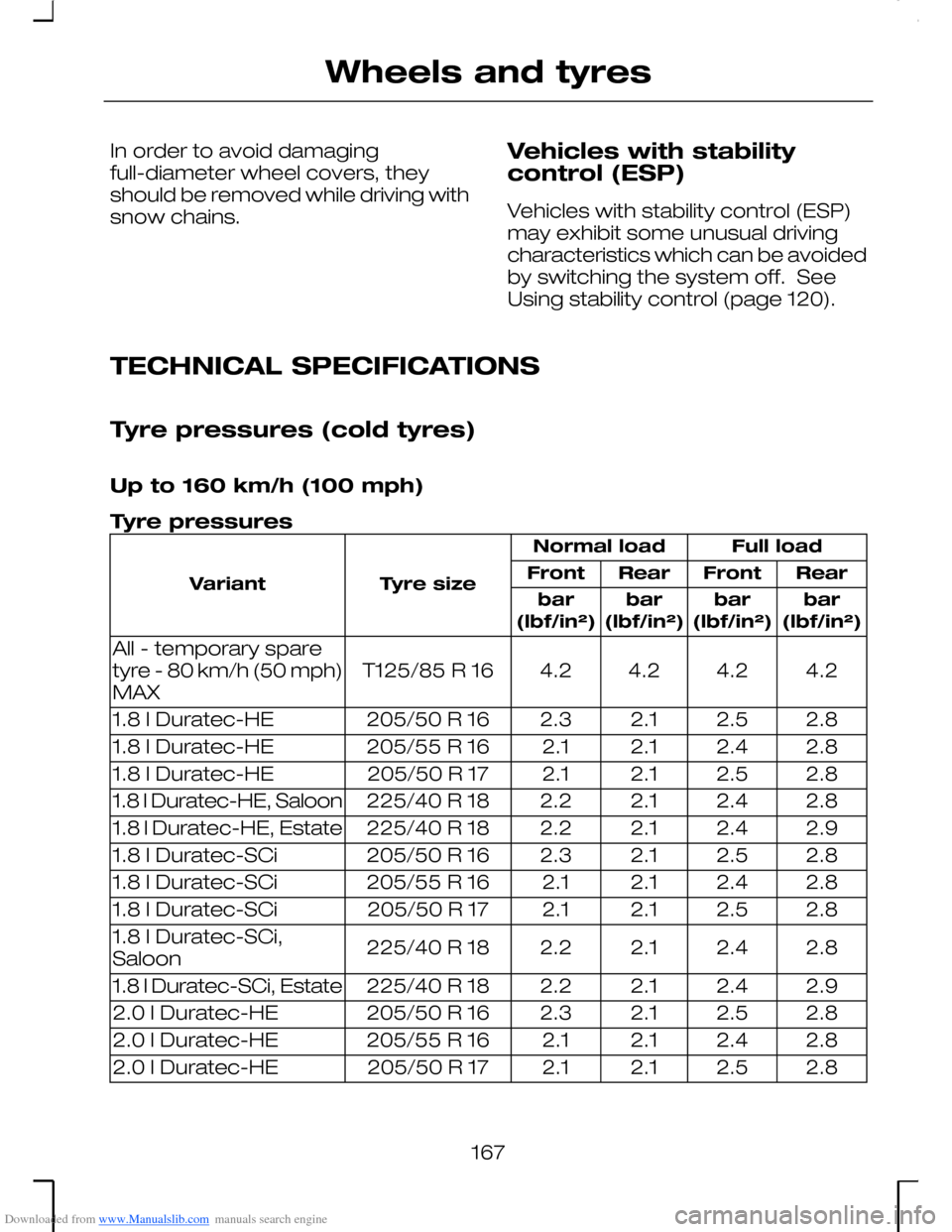
Tyre pressures (cold tyres)
Up to 160 km/h (100 mph)
Tyre pressures
Full loadNormal load
Tyre sizeVariantRearFrontRearFront
bar(lbf/in²)bar(lbf/in²)bar(lbf/in²)bar(lbf/in²)
4.24.24.24.2T125/85 R 16All - temporary sparetyre - 80 km/h (50 mph)MAX
2.82.52.12.3205/50 R 161.8 l Duratec-HE
2.82.42.12.1205/55 R 161.8 l Duratec-HE
2.82.52.12.1205/50 R 171.8 l Duratec-HE
2.82.42.12.2225/40 R 181.8 l Duratec-HE, Saloon
2.92.42.12.2225/40 R 181.8 l Duratec-HE, Estate
2.82.52.12.3205/50 R 161.8 l Duratec-SCi
2.82.42.12.1205/55 R 161.8 l Duratec-SCi
2.82.52.12.1205/50 R 171.8 l Duratec-SCi
2.82.42.12.2225/40 R 181.8 l Duratec-SCi,Saloon
2.92.42.12.2225/40 R 181.8 l Duratec-SCi, Estate
2.82.52.12.3205/50 R 162.0 l Duratec-HE
2.82.42.12.1205/55 R 162.0 l Duratec-HE
2.82.52.12.1205/50 R 172.0 l Duratec-HE
167
Wheels and tyres