2006 FORD FREESTYLE tires
[x] Cancel search: tiresPage 202 of 288
Driving on hilly or sloping terrain
Although natural obstacles may make it necessary to travel diagonally up
or down a hill or steep incline, you should always try to drive straight up
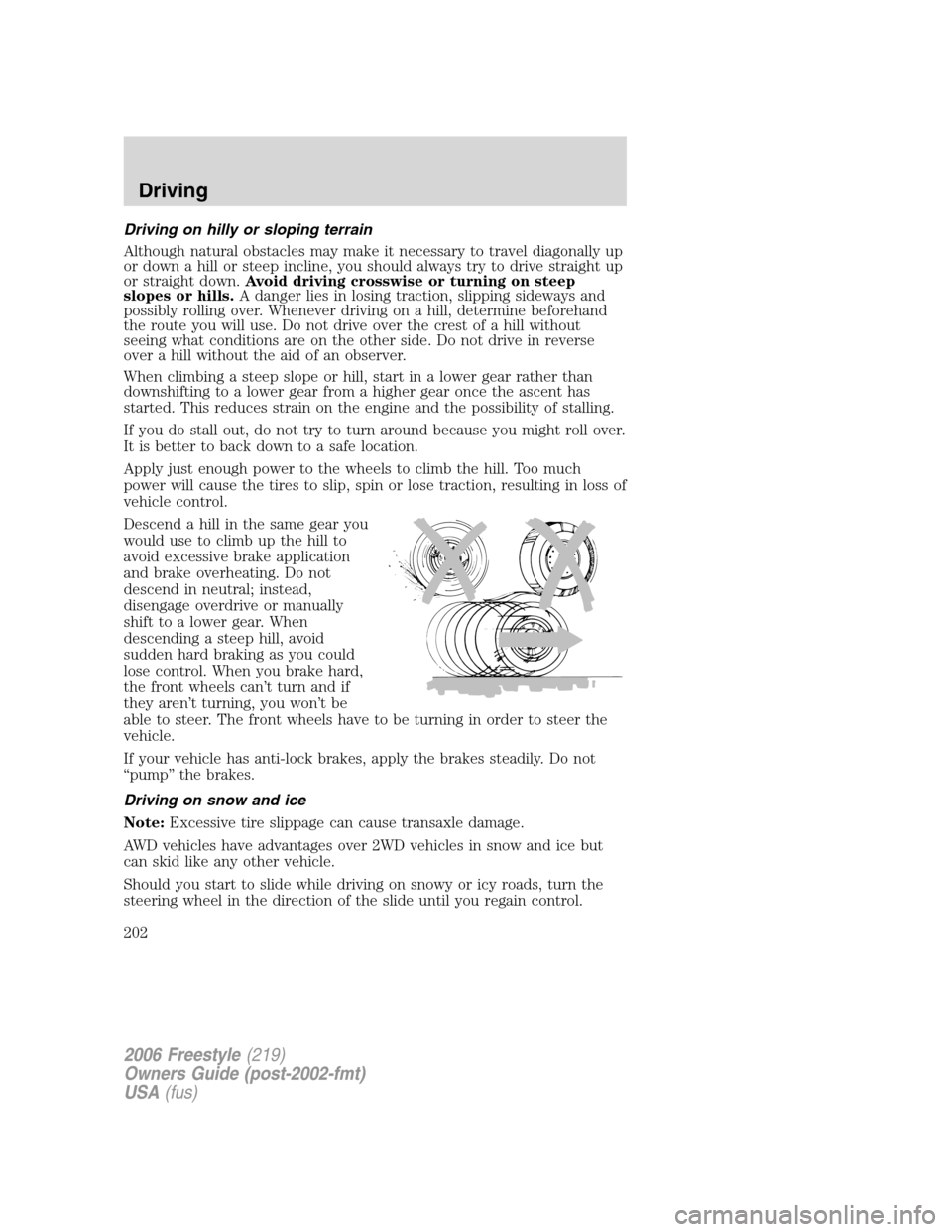
or straight down.Avoid driving crosswise or turning on steep
slopes or hills.A danger lies in losing traction, slipping sideways and
possibly rolling over. Whenever driving on a hill, determine beforehand
the route you will use. Do not drive over the crest of a hill without
seeing what conditions are on the other side. Do not drive in reverse
over a hill without the aid of an observer.
When climbing a steep slope or hill, start in a lower gear rather than
downshifting to a lower gear from a higher gear once the ascent has
started. This reduces strain on the engine and the possibility of stalling.
If you do stall out, do not try to turn around because you might roll over.
It is better to back down to a safe location.
Apply just enough power to the wheels to climb the hill. Too much
power will cause the tires to slip, spin or lose traction, resulting in loss of
vehicle control.
Descend a hill in the same gear you
would use to climb up the hill to
avoid excessive brake application
and brake overheating. Do not
descend in neutral; instead,
disengage overdrive or manually
shift to a lower gear. When
descending a steep hill, avoid
sudden hard braking as you could
lose control. When you brake hard,
the front wheels can’t turn and if
they aren’t turning, you won’t be
able to steer. The front wheels have to be turning in order to steer the
vehicle.
If your vehicle has anti-lock brakes, apply the brakes steadily. Do not
“pump” the brakes.
Driving on snow and ice
Note:Excessive tire slippage can cause transaxle damage.
AWD vehicles have advantages over 2WD vehicles in snow and ice but
can skid like any other vehicle.
Should you start to slide while driving on snowy or icy roads, turn the
steering wheel in the direction of the slide until you regain control.
2006 Freestyle(219)
Owners Guide (post-2002-fmt)
USA(fus)
Driving
202
Page 214 of 288
Fuse/Relay
LocationFuse Amp
RatingPower Distribution Box
Description
51 Full ISO relay Starter motor solenoid
52 Full ISO relay Front A/C blower motor, Coolant
pump relay coil
53 — Not used
54 — Not used
55 — Not used
56 — Not used
57 — Not used
58 High current
relayWipers
* Cartridge Fuses ** Mini Fuses
CHANGING THE TIRES
If you get a flat tire while driving:
•do not brake heavily.
•gradually decrease the vehicle’s speed.
•hold the steering wheel firmly.
•slowly move to a safe place on the side of the road.
The use of tire sealants is not recommended and may damage
your tires.
Dissimilar spare tire/wheel information
Failure to follow these guidelines could result in an increased
risk of loss of vehicle control, injury or death.
If you have a dissimilar spare tire/wheel, then it is intended for
temporary use only. This means that if you need to use it, you should
replace it as soon as possible with a road tire/wheel that is the same size
and type as the road tires and wheels that were originally provided by
Ford. If the dissimilar spare tire or wheel is damaged, it should be
replaced rather than repaired.
2006 Freestyle(219)
Owners Guide (post-2002-fmt)
USA(fus)
Roadside Emergencies
214
Page 215 of 288
A dissimilar spare tire/wheel is defined as a spare tire and/or wheel that
is different in brand, size or appearance from the road tires and wheels
and can be one of three types:
1.T-type mini-spare:This spare tire begins with the letter “T” for tire
size and may have “Temporary Use Only” molded in the sidewall
2.Full-size dissimilar spare with label on wheel:This spare tire has
a label on the wheel that states: “THIS TIRE AND WHEEL FOR
TEMPORARY USE ONLY”
When driving with one of the dissimilar spare tires listed above,do not:
•Exceed 50 mph (80 km/h)
•Load the vehicle beyond maximum vehicle load rating listed on the
Safety Compliance Label
•Tow a trailer
•Use snow chains on the end of the vehicle with the dissimilar spare
tire
•Use more than one dissimilar spare tire at a time
•Use commercial car washing equipment
•Try to repair the dissimilar spare tire
Use of one of the dissimilar spare tires listed above at any one wheel
location can lead to impairment of the following:
•Handling, stability and braking performance
•Comfort and noise
•Ground clearance and parking at curbs
•Winter weather driving capability
•Wet weather driving capability
For vehicles equipped with 4WD, it is not recommended that the vehicle
be operated in 4WD modes with a temporary emergency spare tire. If
4WD operation is necessary, do not operate above speeds of 10 mph
(16 km/h) or for distances above 50 miles (80 km).
2006 Freestyle(219)
Owners Guide (post-2002-fmt)
USA(fus)
Roadside Emergencies
215
Page 264 of 288

•Using the air conditioner or defroster may reduce fuel economy.
•You may want to turn off the speed control in hilly terrain if
unnecessary shifting between third and fourth gear occurs.
Unnecessary shifting of this type could result in reduced fuel
economy.
•Warming up a vehicle on cold mornings is not required and may
reduce fuel economy.
•Resting your foot on the brake pedal while driving may reduce fuel
economy.
•Combine errands and minimize stop-and-go driving.
Maintenance
•Keep tires properly inflated and use only recommended size.
•Operating a vehicle with the wheels out of alignment will reduce fuel
economy.
•Use recommended engine oil. Refer toLubricant specificationsin
this chapter.
•Perform all regularly scheduled maintenance items. Follow the
recommended maintenance schedule and owner maintenance checks
found inscheduled maintenance information.
Conditions
•Heavily loading a vehicle or towing a trailer may reduce fuel economy
at any speed.
•Carrying unnecessary weight may reduce fuel economy (approximately
1 mpg [0.4 km/L] is lost for every 400 lb [180 kg] of weight carried).
•Adding certain accessories to your vehicle (for example bug
deflectors, rollbars/light bars, running boards, ski/luggage racks) may
reduce fuel economy.
•Using fuel blended with alcohol may lower fuel economy.
•Fuel economy may decrease with lower temperatures during the first
8–10 miles (12–16 km) of driving.
•Driving on flat terrain offers improved fuel economy as compared to
driving on hilly terrain.
•Transmissions give their best fuel economy when operated in the top
cruise gear and with steady pressure on the gas pedal.
•Close windows for high speed driving.
2006 Freestyle(219)
Owners Guide (post-2002-fmt)
USA(fus)
Maintenance and Specifications
264
Page 285 of 288

Relays ........................................207
Remote entry system .................92
illuminated entry ................96–97
Reverse sensing system ...........196
Roadside assistance ..................205
Roof rack .....................................89
S
Safety Belt Maintenance ..........131
Safety belts
(see Safety restraints) ............118,
122–125
Safety Canopy ...........................144
Safety defects, reporting ..........235
Safety restraints ........118, 122–125
belt minder .............................126
extension assembly ................131
for adults .........................123–125
for children .............................147
Occupant Classification
Sensor ......................................120
safety belt maintenance .........131
warning light and chime ........126
Safety seats for children ..........151
Safety Compliance
Certification Label ....................276
Seat belts
(see Safety restraints) .............118
Seats ..........................................105
child safety seats ....................151
front seats ...............105–106, 109
heated ............................44, 46, 49
memory seat .....................93, 110
second row seats ............111, 114
third row seats ........114, 116–117
Servicing your vehicle ..............242Setting the clock
AM/FM/In-dash 6 CD ................21
Spare tire
(see Changing the Tire) ...........216
Spark plugs, specifications ......269,
274
Specification chart,
lubricants ...........................272, 274
Speed control ..............................70
Starting your vehicle ........186–188
jump starting ..........................222
Steering wheel
controls ......................................73
tilting .........................................62
T
Tilt steering wheel ......................62
Tires ...........................161–162, 214
alignment ................................168
care ..........................................166
changing ..................214, 216–217
checking the pressure ............166
inspecting and inflating .........163
label .........................................175
replacing ..................................170
rotating ....................................168
safety practices .......................167
sidewall information ...............170
snow tires and chains ............176
spare tire .................................214
terminology .............................162
tire grades ...............................162
treadwear ........................161, 166
Towing .......................................182
recreational towing .................185
trailer towing ..........................182
wrecker ....................................227
Traction control ........................192
2006 Freestyle(219)
Owners Guide (post-2002-fmt)
USA(fus)
Index
285