Page 188 of 288
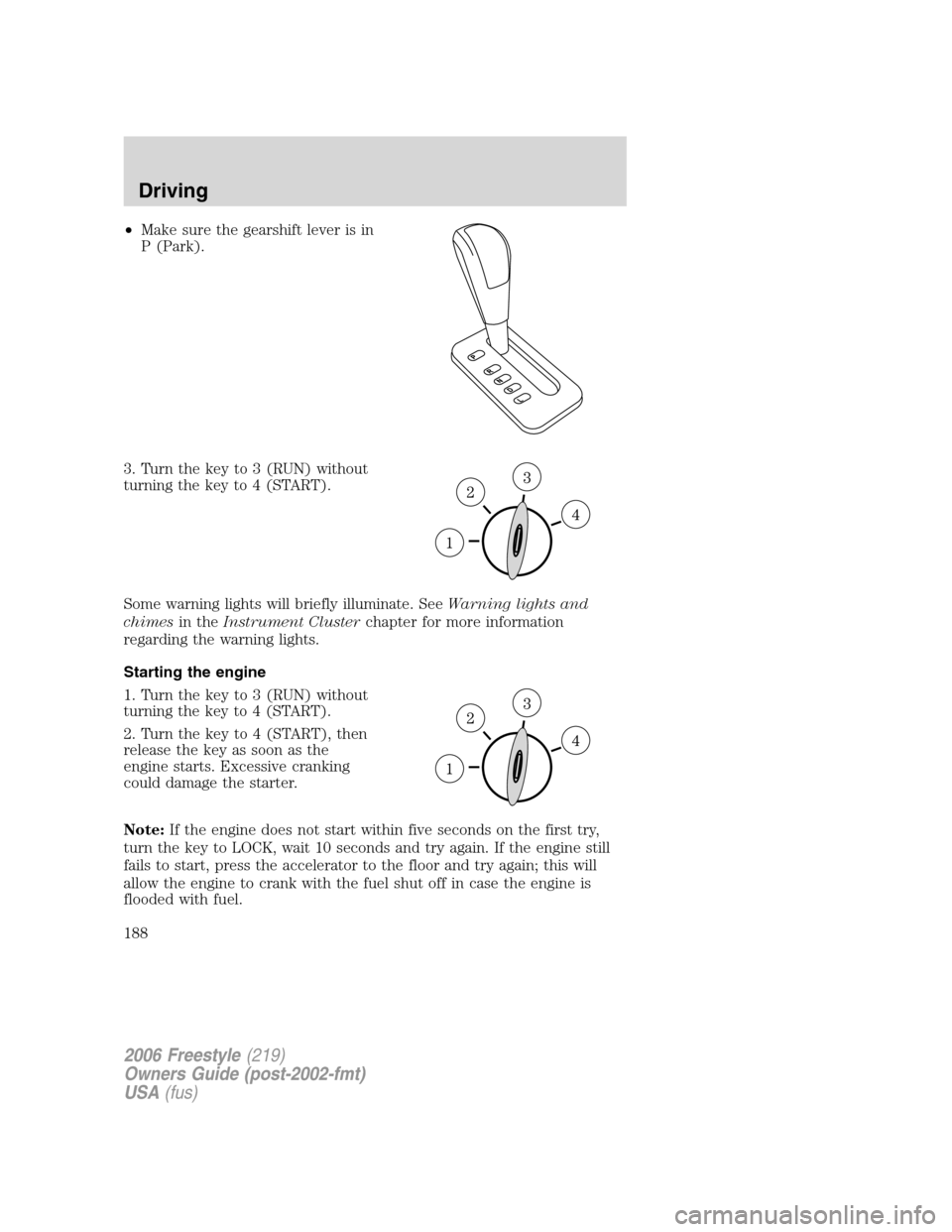
•Make sure the gearshift lever is in
P (Park).
3. Turn the key to 3 (RUN) without
turning the key to 4 (START).
Some warning lights will briefly illuminate. SeeWarning lights and
chimesin theInstrument Clusterchapter for more information
regarding the warning lights.
Starting the engine
1. Turn the key to 3 (RUN) without
turning the key to 4 (START).
2. Turn the key to 4 (START), then
release the key as soon as the
engine starts. Excessive cranking
could damage the starter.
Note:If the engine does not start within five seconds on the first try,
turn the key to LOCK, wait 10 seconds and try again. If the engine still
fails to start, press the accelerator to the floor and try again; this will
allow the engine to crank with the fuel shut off in case the engine is
flooded with fuel.
2006 Freestyle(219)
Owners Guide (post-2002-fmt)
USA(fus)
Driving
188
Page 191 of 288
Parking brake
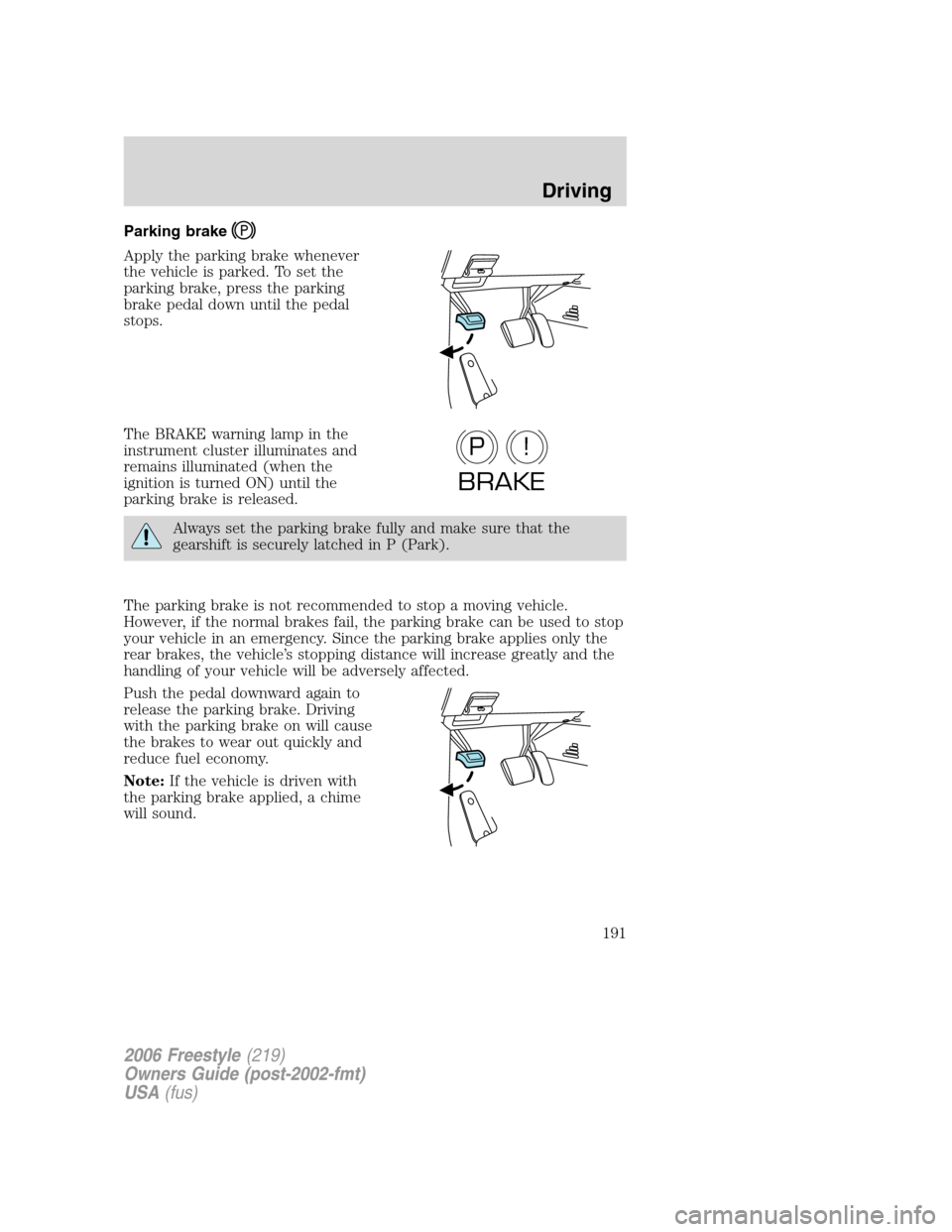
Apply the parking brake whenever
the vehicle is parked. To set the
parking brake, press the parking
brake pedal down until the pedal
stops.
The BRAKE warning lamp in the
instrument cluster illuminates and
remains illuminated (when the
ignition is turned ON) until the
parking brake is released.
Always set the parking brake fully and make sure that the
gearshift is securely latched in P (Park).
The parking brake is not recommended to stop a moving vehicle.
However, if the normal brakes fail, the parking brake can be used to stop
your vehicle in an emergency. Since the parking brake applies only the
rear brakes, the vehicle’s stopping distance will increase greatly and the
handling of your vehicle will be adversely affected.
Push the pedal downward again to
release the parking brake. Driving
with the parking brake on will cause
the brakes to wear out quickly and
reduce fuel economy.
Note:If the vehicle is driven with
the parking brake applied, a chime
will sound.
P!
BRAKE
2006 Freestyle(219)
Owners Guide (post-2002-fmt)
USA(fus)
Driving
191
Page 195 of 288
Understanding the gearshift positions of the Continuously Variable
Transaxle (CVT)
The CVT is a fully automatic transaxle that electronically monitors
vehicle system inputs and outputs and driver demands to select the
desired drive ratio. Unlike traditional automatic transmissions/transaxles,
the CVT continually adjusts the optimum overall drive ratio between
engine and drive wheels for all operating conditions.
As traditional automatic transmissions/transaxles shift up or down in
gears, this shifting in gear ratios is noticeable by increasing and
decreasing engine RPM which causes a slight energy loss as the gears
change. The gear changes can be felt by the driver.
With the CVT, there is no energy transfer loss from shifting because
there is no gear shifting up or down. Acceleration up to vehicle operating
speed is smooth and continuous; uninterrupted by gear shifting. The
same holds true for coasting down to idle; smooth and continuous.
Unlike traditional automatic transmissions/transaxles, the CVT offers
more responsive performance and increased fuel economy.
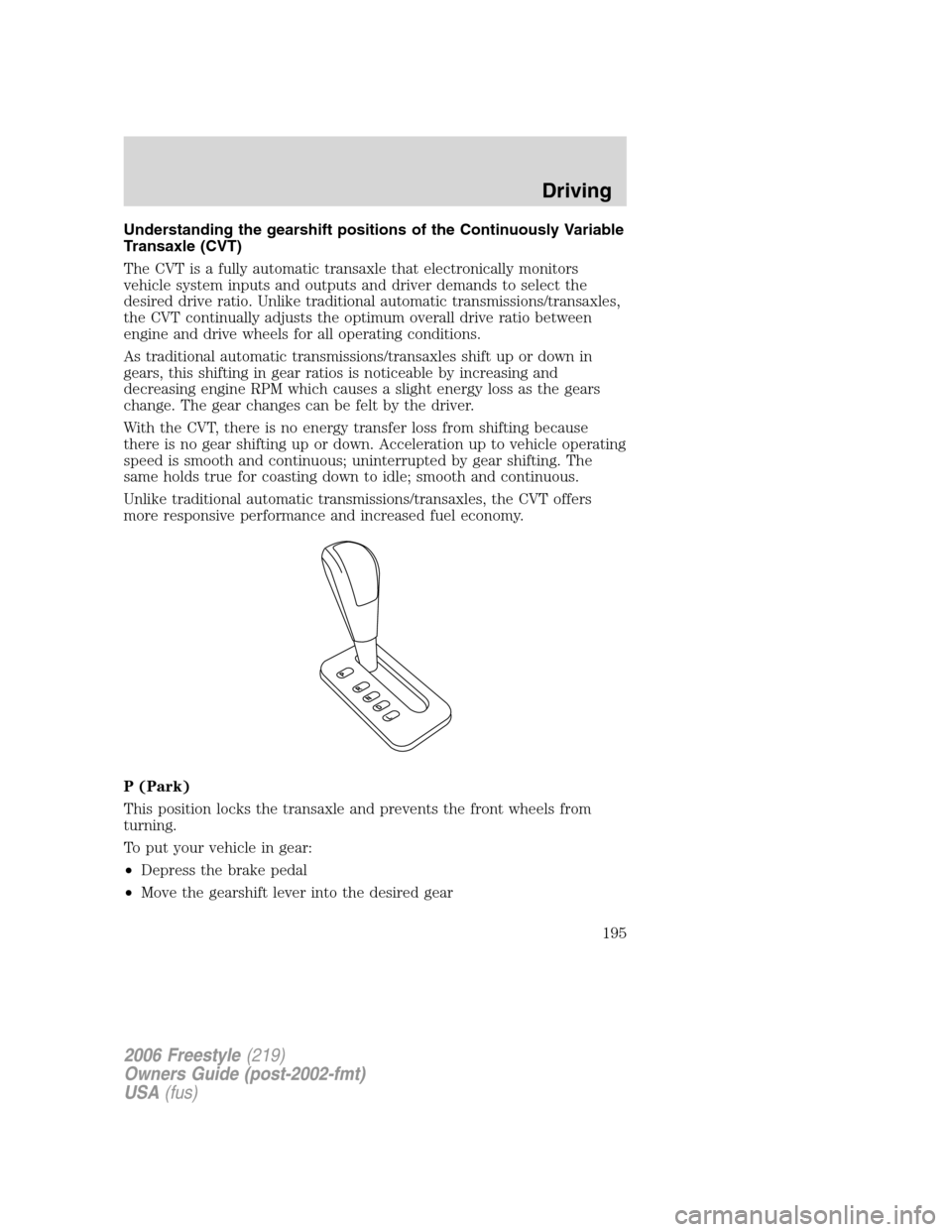
P (Park)
This position locks the transaxle and prevents the front wheels from
turning.
To put your vehicle in gear:
•Depress the brake pedal
•Move the gearshift lever into the desired gear
2006 Freestyle(219)
Owners Guide (post-2002-fmt)
USA(fus)
Driving
195
Page 196 of 288
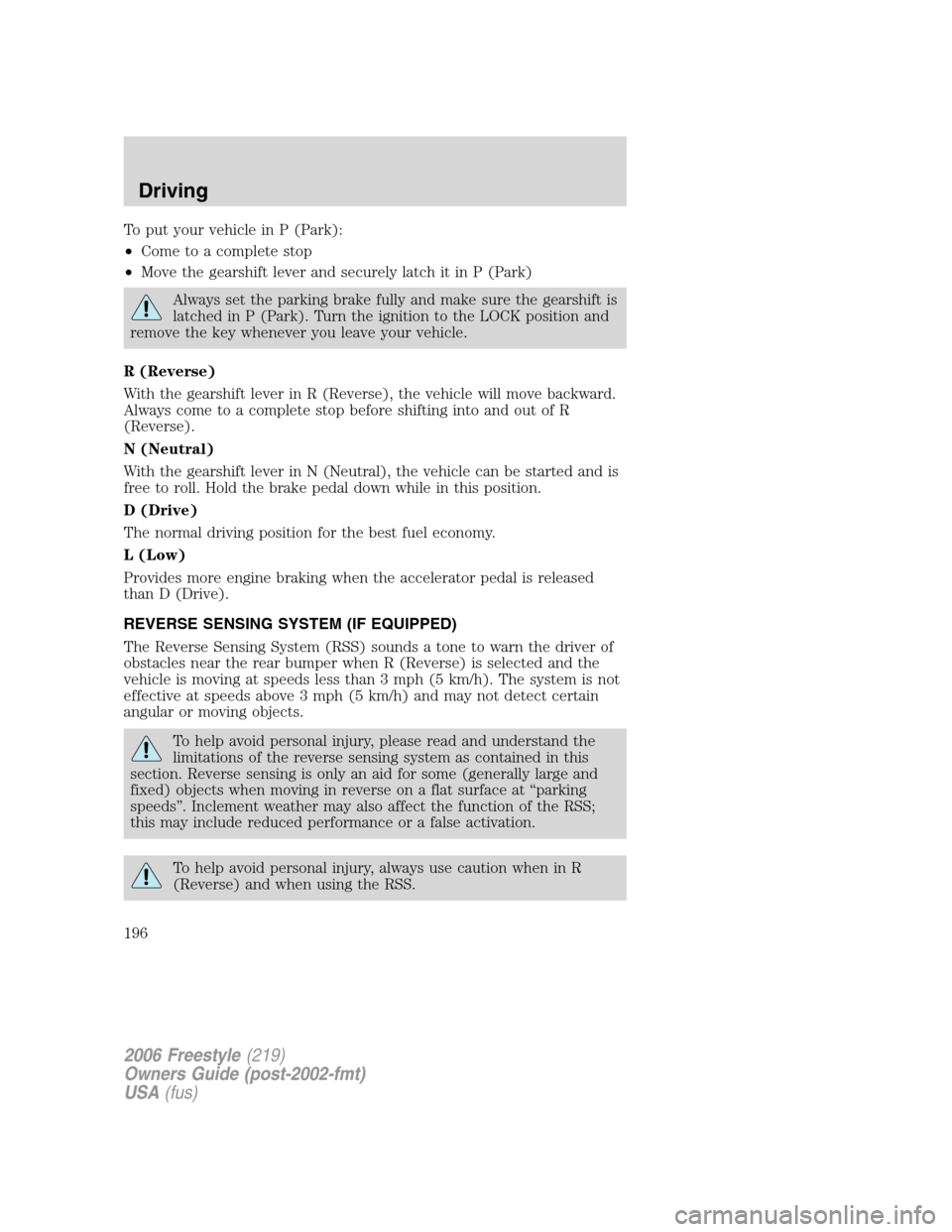
To put your vehicle in P (Park):
•Come to a complete stop
•Move the gearshift lever and securely latch it in P (Park)
Always set the parking brake fully and make sure the gearshift is
latched in P (Park). Turn the ignition to the LOCK position and
remove the key whenever you leave your vehicle.
R (Reverse)
With the gearshift lever in R (Reverse), the vehicle will move backward.
Always come to a complete stop before shifting into and out of R
(Reverse).
N (Neutral)
With the gearshift lever in N (Neutral), the vehicle can be started and is
free to roll. Hold the brake pedal down while in this position.
D (Drive)
The normal driving position for the best fuel economy.
L (Low)
Provides more engine braking when the accelerator pedal is released
than D (Drive).
REVERSE SENSING SYSTEM (IF EQUIPPED)
The Reverse Sensing System (RSS) sounds a tone to warn the driver of
obstacles near the rear bumper when R (Reverse) is selected and the
vehicle is moving at speeds less than 3 mph (5 km/h). The system is not
effective at speeds above 3 mph (5 km/h) and may not detect certain
angular or moving objects.
To help avoid personal injury, please read and understand the
limitations of the reverse sensing system as contained in this
section. Reverse sensing is only an aid for some (generally large and
fixed) objects when moving in reverse on a flat surface at “parking
speeds”. Inclement weather may also affect the function of the RSS;
this may include reduced performance or a false activation.
To help avoid personal injury, always use caution when in R
(Reverse) and when using the RSS.
2006 Freestyle(219)
Owners Guide (post-2002-fmt)
USA(fus)
Driving
196
Page 205 of 288
ROADSIDE ASSISTANCE
Getting roadside assistance
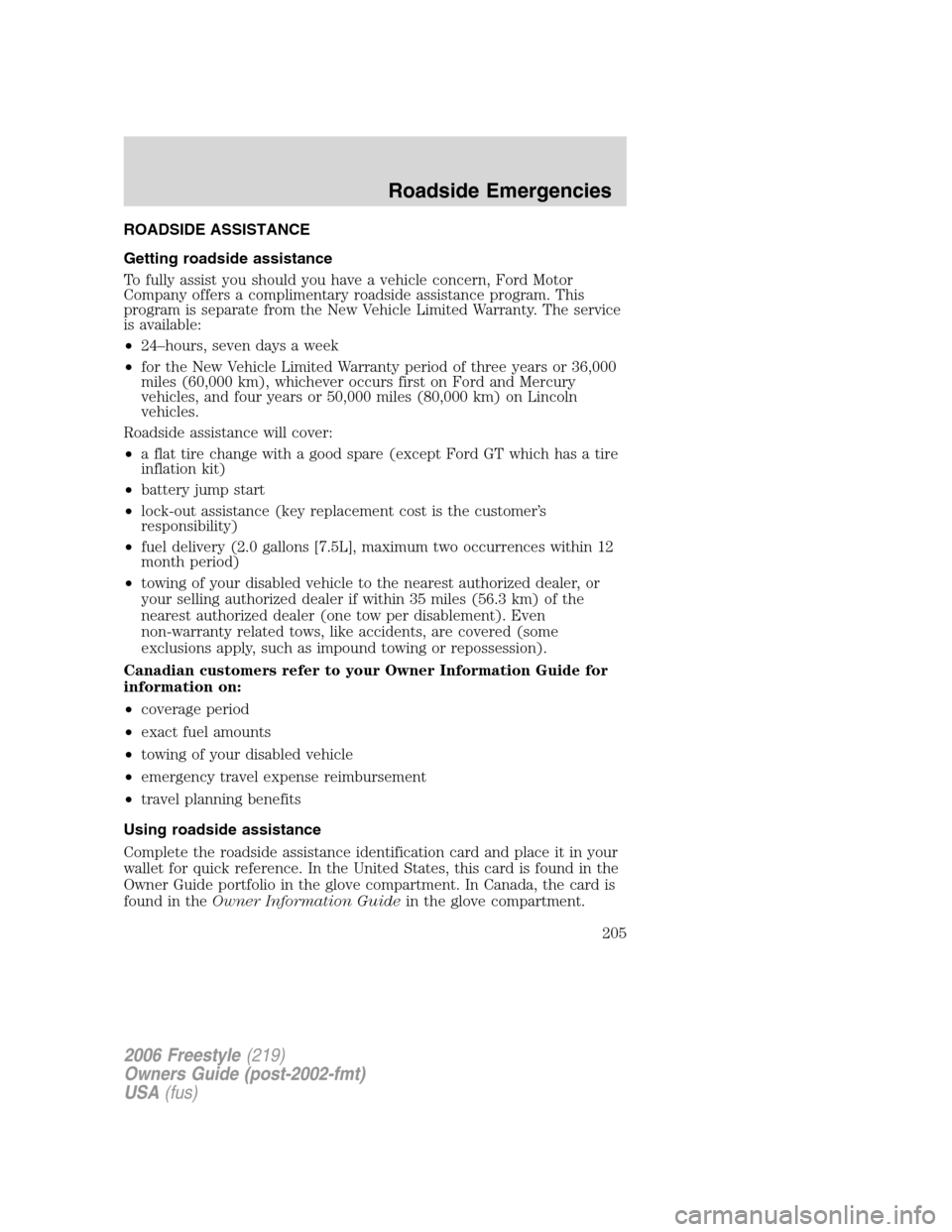
To fully assist you should you have a vehicle concern, Ford Motor
Company offers a complimentary roadside assistance program. This
program is separate from the New Vehicle Limited Warranty. The service
is available:
•24–hours, seven days a week
•for the New Vehicle Limited Warranty period of three years or 36,000
miles (60,000 km), whichever occurs first on Ford and Mercury
vehicles, and four years or 50,000 miles (80,000 km) on Lincoln
vehicles.
Roadside assistance will cover:
•a flat tire change with a good spare (except Ford GT which has a tire
inflation kit)
•battery jump start
•lock-out assistance (key replacement cost is the customer’s
responsibility)
•fuel delivery (2.0 gallons [7.5L], maximum two occurrences within 12
month period)
•towing of your disabled vehicle to the nearest authorized dealer, or
your selling authorized dealer if within 35 miles (56.3 km) of the
nearest authorized dealer (one tow per disablement). Even
non-warranty related tows, like accidents, are covered (some
exclusions apply, such as impound towing or repossession).
Canadian customers refer to your Owner Information Guide for
information on:
•coverage period
•exact fuel amounts
•towing of your disabled vehicle
•emergency travel expense reimbursement
•travel planning benefits
Using roadside assistance
Complete the roadside assistance identification card and place it in your
wallet for quick reference. In the United States, this card is found in the
Owner Guide portfolio in the glove compartment. In Canada, the card is
found in theOwner Information Guidein the glove compartment.
2006 Freestyle(219)
Owners Guide (post-2002-fmt)
USA(fus)
Roadside Emergencies
205
Page 206 of 288
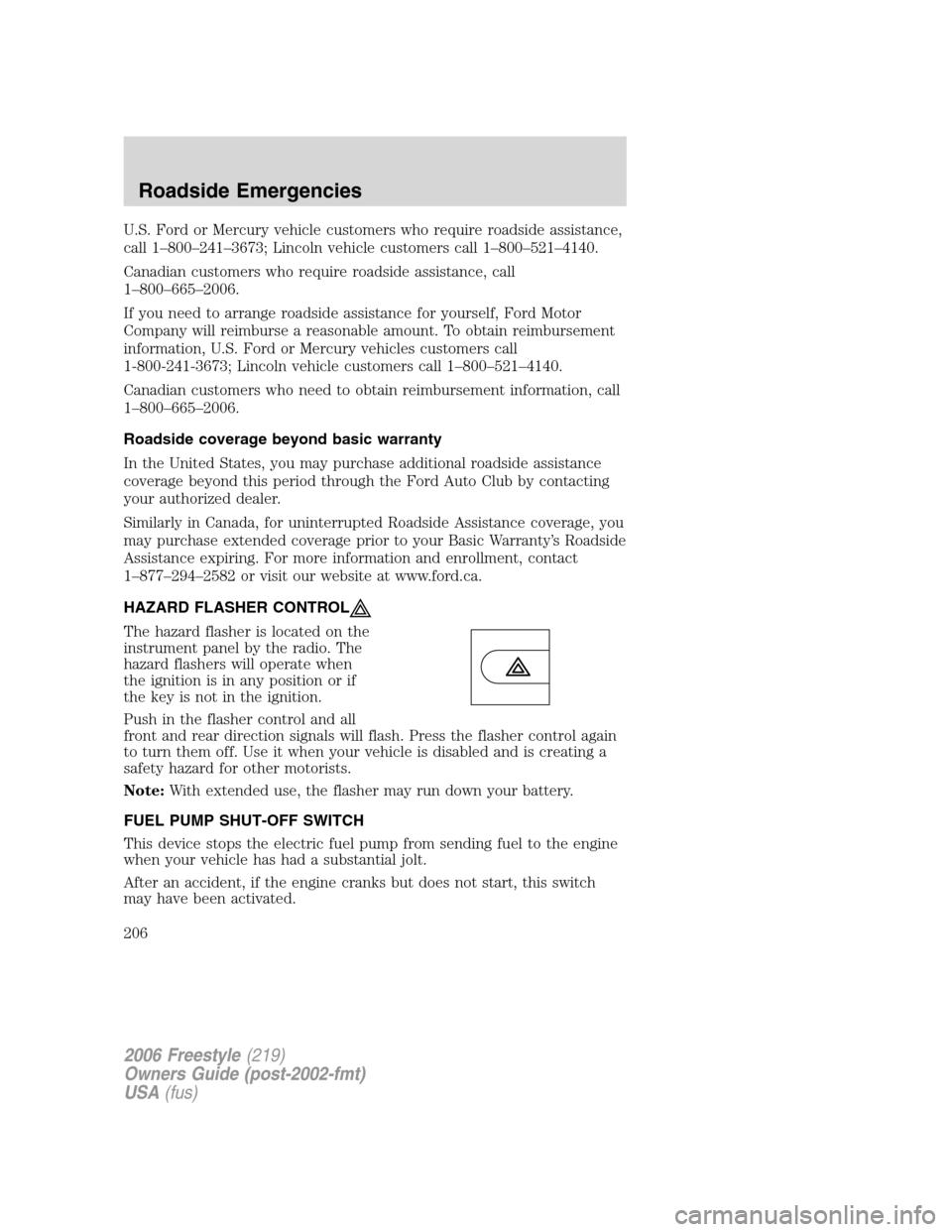
U.S. Ford or Mercury vehicle customers who require roadside assistance,
call 1–800–241–3673; Lincoln vehicle customers call 1–800–521–4140.
Canadian customers who require roadside assistance, call
1–800–665–2006.
If you need to arrange roadside assistance for yourself, Ford Motor
Company will reimburse a reasonable amount. To obtain reimbursement
information, U.S. Ford or Mercury vehicles customers call
1-800-241-3673; Lincoln vehicle customers call 1–800–521–4140.
Canadian customers who need to obtain reimbursement information, call
1–800–665–2006.
Roadside coverage beyond basic warranty
In the United States, you may purchase additional roadside assistance
coverage beyond this period through the Ford Auto Club by contacting
your authorized dealer.
Similarly in Canada, for uninterrupted Roadside Assistance coverage, you
may purchase extended coverage prior to your Basic Warranty’s Roadside
Assistance expiring. For more information and enrollment, contact
1–877–294–2582 or visit our website at www.ford.ca.
HAZARD FLASHER CONTROL
The hazard flasher is located on the
instrument panel by the radio. The
hazard flashers will operate when
the ignition is in any position or if
the key is not in the ignition.
Push in the flasher control and all
front and rear direction signals will flash. Press the flasher control again
to turn them off. Use it when your vehicle is disabled and is creating a
safety hazard for other motorists.
Note:With extended use, the flasher may run down your battery.
FUEL PUMP SHUT-OFF SWITCH
This device stops the electric fuel pump from sending fuel to the engine
when your vehicle has had a substantial jolt.
After an accident, if the engine cranks but does not start, this switch
may have been activated.
2006 Freestyle(219)
Owners Guide (post-2002-fmt)
USA(fus)
Roadside Emergencies
206
Page 207 of 288
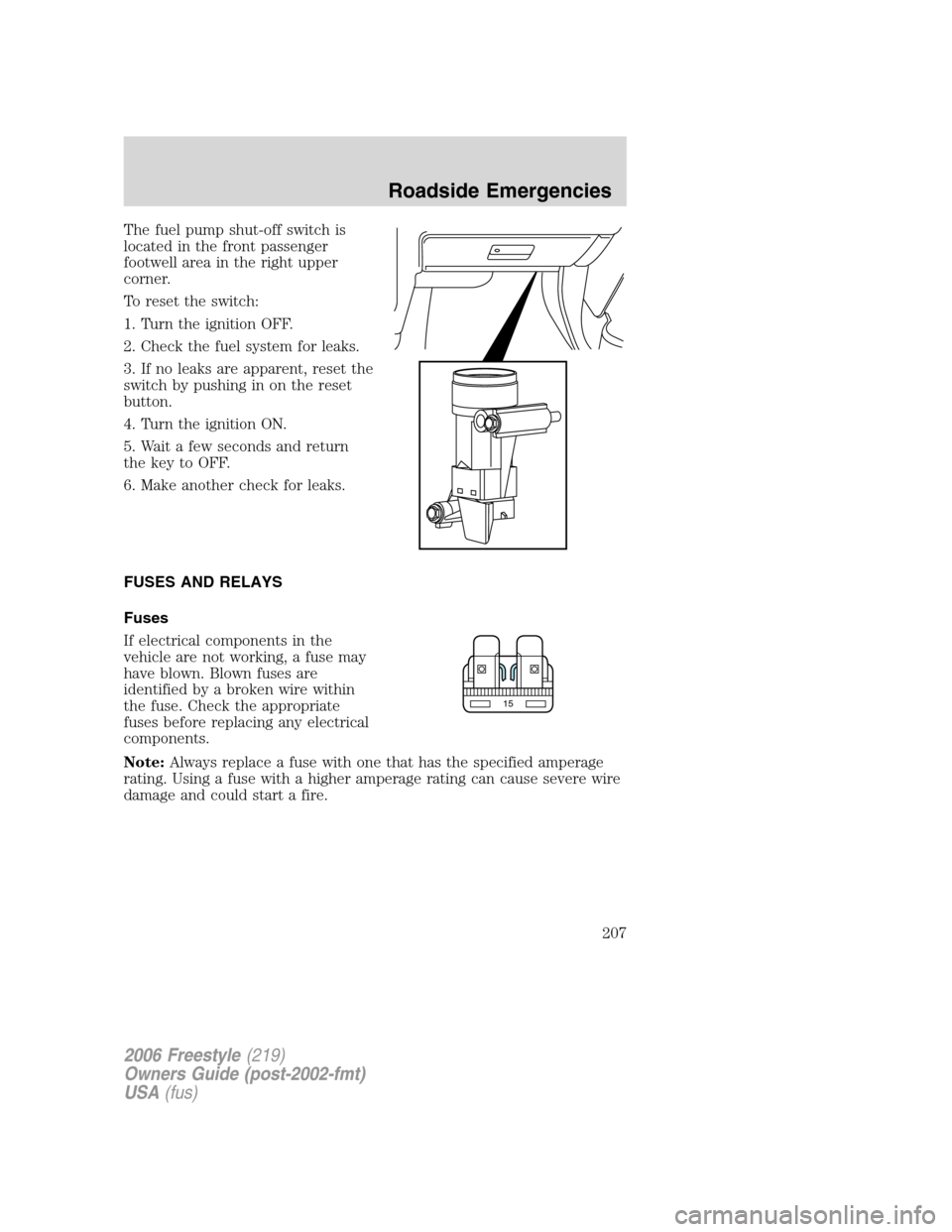
The fuel pump shut-off switch is
located in the front passenger
footwell area in the right upper
corner.
To reset the switch:
1. Turn the ignition OFF.
2. Check the fuel system for leaks.
3. If no leaks are apparent, reset the
switch by pushing in on the reset
button.
4. Turn the ignition ON.
5. Wait a few seconds and return
the key to OFF.
6. Make another check for leaks.
FUSES AND RELAYS
Fuses
If electrical components in the
vehicle are not working, a fuse may
have blown. Blown fuses are
identified by a broken wire within
the fuse. Check the appropriate
fuses before replacing any electrical
components.
Note:Always replace a fuse with one that has the specified amperage
rating. Using a fuse with a higher amperage rating can cause severe wire
damage and could start a fire.
15
2006 Freestyle(219)
Owners Guide (post-2002-fmt)
USA(fus)
Roadside Emergencies
207
Page 210 of 288
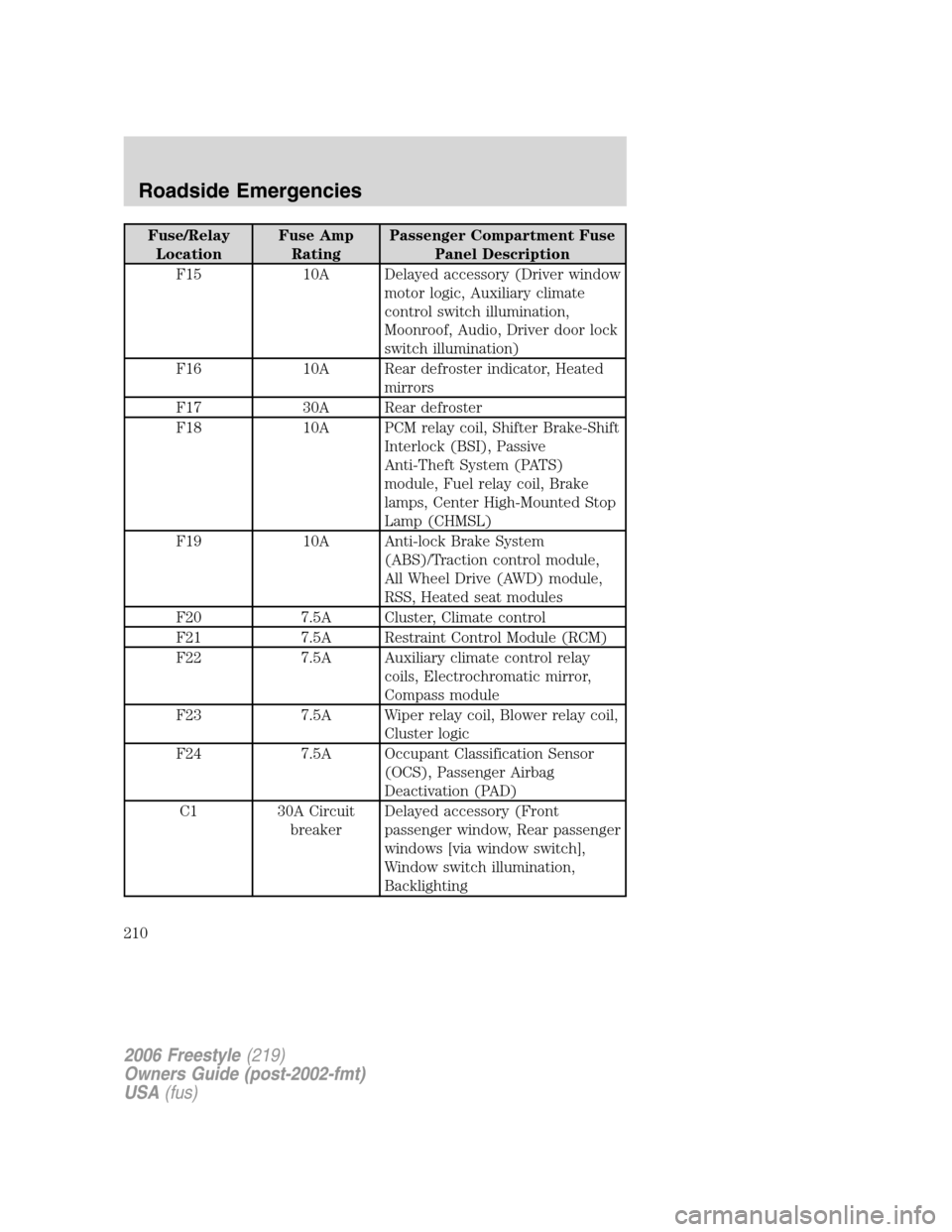
Fuse/Relay
LocationFuse Amp
RatingPassenger Compartment Fuse
Panel Description
F15 10A Delayed accessory (Driver window
motor logic, Auxiliary climate
control switch illumination,
Moonroof, Audio, Driver door lock
switch illumination)
F16 10A Rear defroster indicator, Heated
mirrors
F17 30A Rear defroster
F18 10A PCM relay coil, Shifter Brake-Shift
Interlock (BSI), Passive
Anti-Theft System (PATS)
module, Fuel relay coil, Brake
lamps, Center High-Mounted Stop
Lamp (CHMSL)
F19 10A Anti-lock Brake System
(ABS)/Traction control module,
All Wheel Drive (AWD) module,
RSS, Heated seat modules
F20 7.5A Cluster, Climate control
F21 7.5A Restraint Control Module (RCM)
F22 7.5A Auxiliary climate control relay
coils, Electrochromatic mirror,
Compass module
F23 7.5A Wiper relay coil, Blower relay coil,
Cluster logic
F24 7.5A Occupant Classification Sensor
(OCS), Passenger Airbag
Deactivation (PAD)
C1 30A Circuit
breakerDelayed accessory (Front
passenger window, Rear passenger
windows [via window switch],
Window switch illumination,
Backlighting
2006 Freestyle(219)
Owners Guide (post-2002-fmt)
USA(fus)
Roadside Emergencies
210