2006 FORD FREESTAR snow chains
[x] Cancel search: snow chainsPage 199 of 320

How temperature affects your tire pressure
The Tire Pressure Monitoring System (TPMS) monitors tire pressure in
each pneumatic tire. The pressure in each tire is dependent upon several
factors, one of them being the contained air temperature (temperature of
the air inside the tire). As the contained air temperature increases, the
tire pressure also increases. While driving in a normal manner, a typical
passenger tire inflation pressure may increase approximately 2 to 4 psi
(14 to 28 kPa) from a cold start situation. This increase in tire pressure
is due to an increase in the contained air temperature. Contained air
temperature is dependent upon several factors such as rate of tire
rotation, tire deflection, amount of braking, etc. In a similar manner, the
tire pressure will decrease if the contained air temperature decreases.
For example, if the vehicle is stationary over night with the outside
temperature significantly lower than the daytime temperature, the tire
pressure may decrease approximately 3 psi (20.7 kPa) for a drop of 30°
F (16.6° C) in ambient temperature. This lower pressure value may be
detected by the TPMS as being significantly lower than the cold pressure
indicated on your vehicles Safety Compliance Certification Label, and
activate the TPMS warning for low tire pressure. If the low tire pressure
warning light is ON, visually check each tire to verify that no tire is flat.
If one or more tires are flat, repair as necessary. Check air pressure in
the road tires. If any tire is underinflated, carefully drive the vehicle to
the nearest location where air can be added to the tires. Turn the
ignition to the OFF position. Inflate all the tires to the recommended
inflation pressure.
The Tire Pressure Monitoring System is NOT a substitute for
manually checking tire pressure. The tire pressure should be
checked periodically (at least monthly) using an accurate tire gauge,
seeInspecting and inflating your tiresin this chapter. Failure to
properly maintain your tire pressure could increase the risk of tire
failure, loss of control, vehicle rollover and personal injury.
SNOW TIRES AND CHAINS
Snow tires must be the same size and grade as the tires you
currently have on your vehicle.
The tires on your vehicle have all weather treads to provide traction in
rain and snow. However, in some climates, you may need to use snow
tires and chains. If you need to use chains, it is recommended that steel
wheels (of the same size and specifications) be used as chains may chip
aluminum wheels.
2006 Freestar(win)
Owners Guide (post-2002-fmt)
USA(fus)
Tires, Wheels and Loading
199
Page 200 of 320
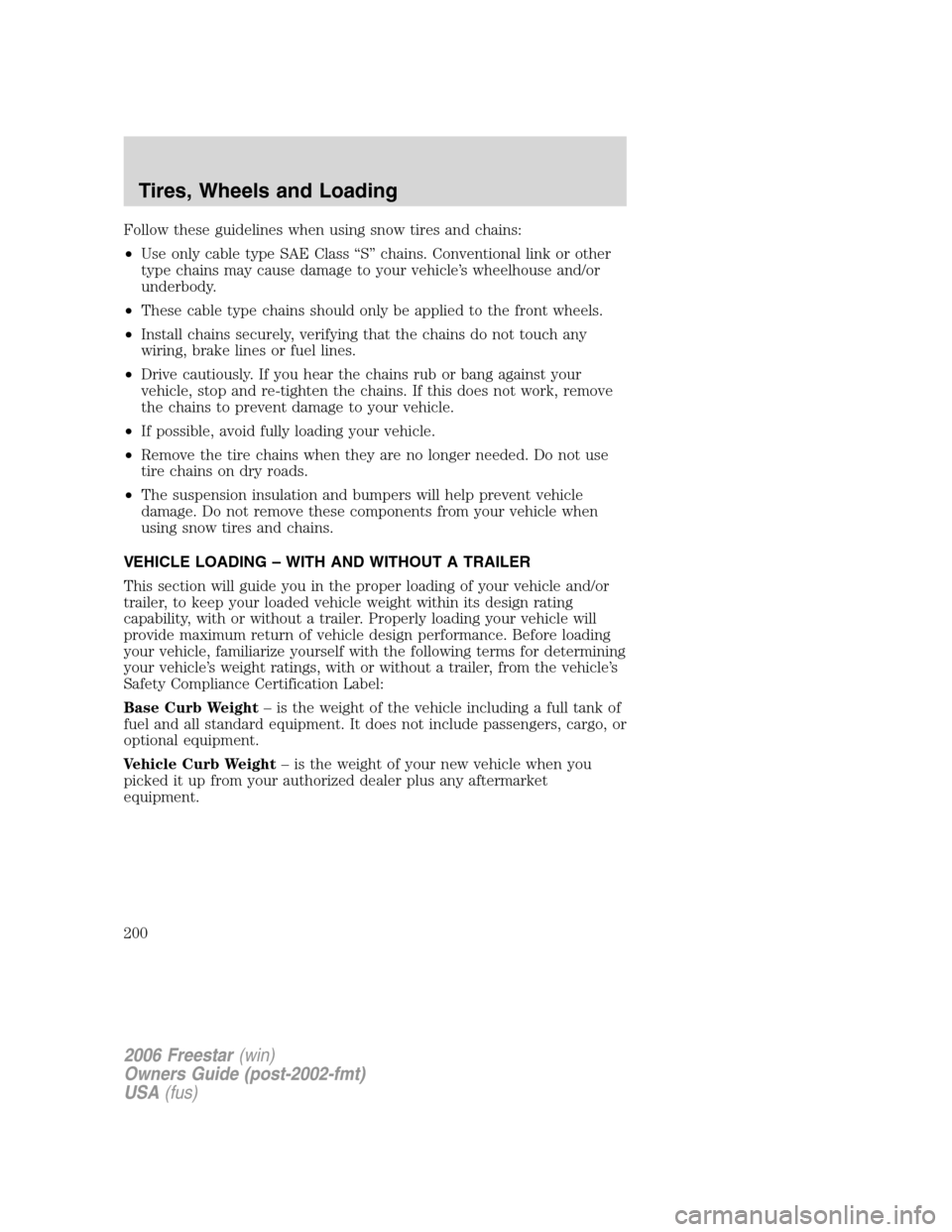
Follow these guidelines when using snow tires and chains:
•Use only cable type SAE Class “S” chains. Conventional link or other
type chains may cause damage to your vehicle’s wheelhouse and/or
underbody.
•These cable type chains should only be applied to the front wheels.
•Install chains securely, verifying that the chains do not touch any
wiring, brake lines or fuel lines.
•Drive cautiously. If you hear the chains rub or bang against your
vehicle, stop and re-tighten the chains. If this does not work, remove
the chains to prevent damage to your vehicle.
•If possible, avoid fully loading your vehicle.
•Remove the tire chains when they are no longer needed. Do not use
tire chains on dry roads.
•The suspension insulation and bumpers will help prevent vehicle
damage. Do not remove these components from your vehicle when
using snow tires and chains.
VEHICLE LOADING – WITH AND WITHOUT A TRAILER
This section will guide you in the proper loading of your vehicle and/or
trailer, to keep your loaded vehicle weight within its design rating
capability, with or without a trailer. Properly loading your vehicle will
provide maximum return of vehicle design performance. Before loading
your vehicle, familiarize yourself with the following terms for determining
your vehicle’s weight ratings, with or without a trailer, from the vehicle’s
Safety Compliance Certification Label:
Base Curb Weight– is the weight of the vehicle including a full tank of
fuel and all standard equipment. It does not include passengers, cargo, or
optional equipment.
Vehicle Curb Weight– is the weight of your new vehicle when you
picked it up from your authorized dealer plus any aftermarket
equipment.
2006 Freestar(win)
Owners Guide (post-2002-fmt)
USA(fus)
Tires, Wheels and Loading
200
Page 238 of 320
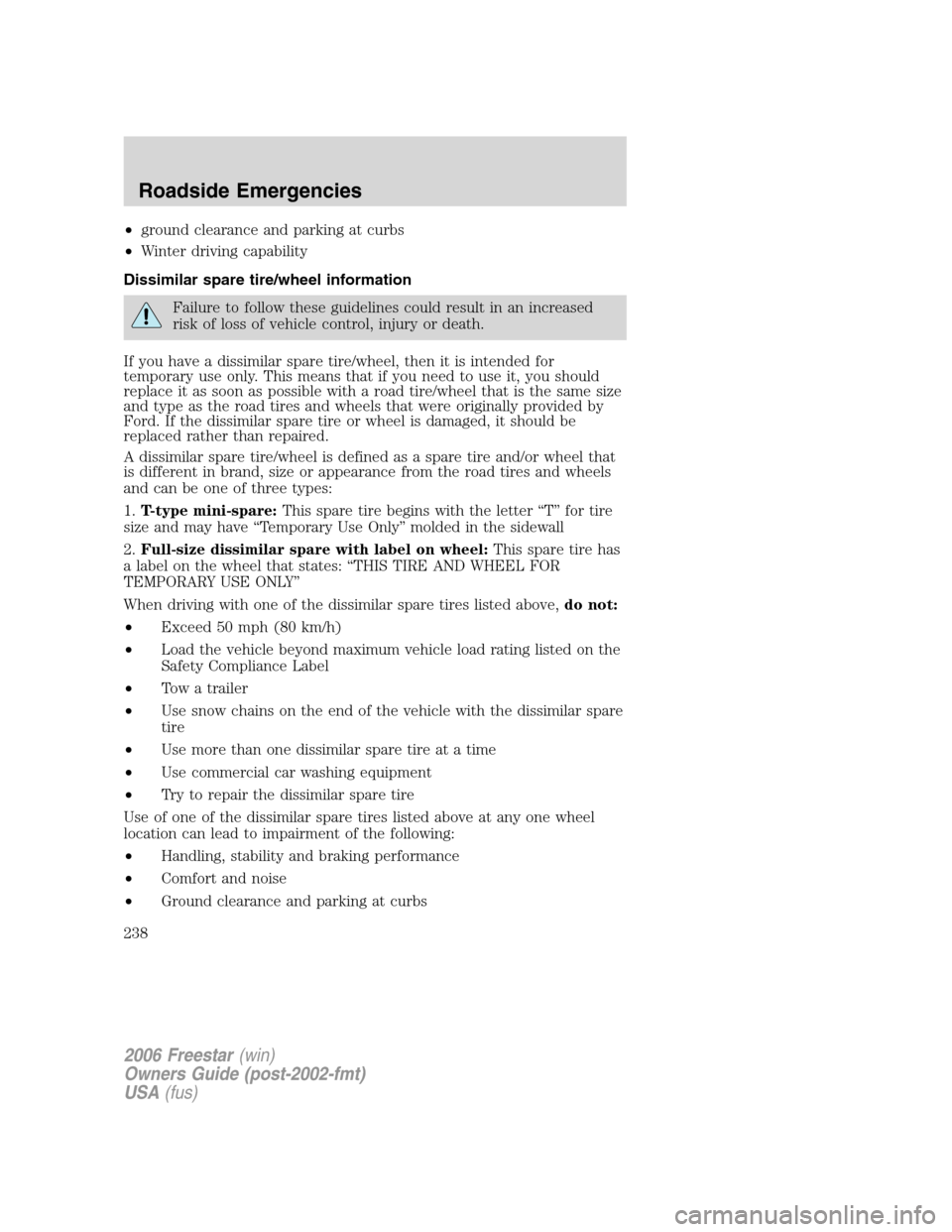
•ground clearance and parking at curbs
•Winter driving capability
Dissimilar spare tire/wheel information
Failure to follow these guidelines could result in an increased
risk of loss of vehicle control, injury or death.
If you have a dissimilar spare tire/wheel, then it is intended for
temporary use only. This means that if you need to use it, you should
replace it as soon as possible with a road tire/wheel that is the same size
and type as the road tires and wheels that were originally provided by
Ford. If the dissimilar spare tire or wheel is damaged, it should be
replaced rather than repaired.
A dissimilar spare tire/wheel is defined as a spare tire and/or wheel that
is different in brand, size or appearance from the road tires and wheels
and can be one of three types:
1.T-type mini-spare:This spare tire begins with the letter “T” for tire
size and may have “Temporary Use Only” molded in the sidewall
2.Full-size dissimilar spare with label on wheel:This spare tire has
a label on the wheel that states: “THIS TIRE AND WHEEL FOR
TEMPORARY USE ONLY”
When driving with one of the dissimilar spare tires listed above,do not:
•Exceed 50 mph (80 km/h)
•Load the vehicle beyond maximum vehicle load rating listed on the
Safety Compliance Label
•Tow a trailer
•Use snow chains on the end of the vehicle with the dissimilar spare
tire
•Use more than one dissimilar spare tire at a time
•Use commercial car washing equipment
•Try to repair the dissimilar spare tire
Use of one of the dissimilar spare tires listed above at any one wheel
location can lead to impairment of the following:
•Handling, stability and braking performance
•Comfort and noise
•Ground clearance and parking at curbs
2006 Freestar(win)
Owners Guide (post-2002-fmt)
USA(fus)
Roadside Emergencies
238
Page 239 of 320
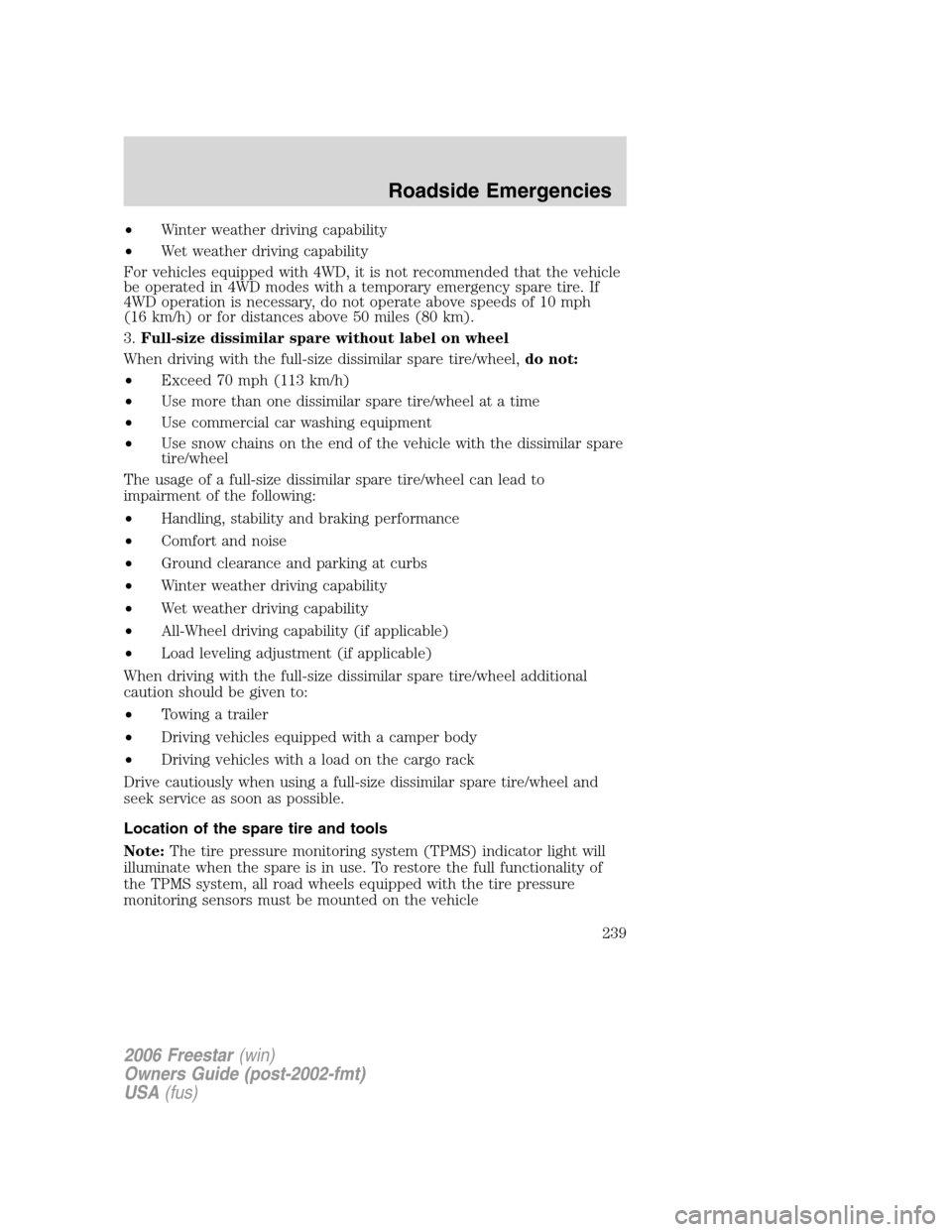
•Winter weather driving capability
•Wet weather driving capability
For vehicles equipped with 4WD, it is not recommended that the vehicle
be operated in 4WD modes with a temporary emergency spare tire. If
4WD operation is necessary, do not operate above speeds of 10 mph
(16 km/h) or for distances above 50 miles (80 km).
3.Full-size dissimilar spare without label on wheel
When driving with the full-size dissimilar spare tire/wheel,do not:
•Exceed 70 mph (113 km/h)
•Use more than one dissimilar spare tire/wheel at a time
•Use commercial car washing equipment
•Use snow chains on the end of the vehicle with the dissimilar spare
tire/wheel
The usage of a full-size dissimilar spare tire/wheel can lead to
impairment of the following:
•Handling, stability and braking performance
•Comfort and noise
•Ground clearance and parking at curbs
•Winter weather driving capability
•Wet weather driving capability
•All-Wheel driving capability (if applicable)
•Load leveling adjustment (if applicable)
When driving with the full-size dissimilar spare tire/wheel additional
caution should be given to:
•Towing a trailer
•Driving vehicles equipped with a camper body
•Driving vehicles with a load on the cargo rack
Drive cautiously when using a full-size dissimilar spare tire/wheel and
seek service as soon as possible.
Location of the spare tire and tools
Note:The tire pressure monitoring system (TPMS) indicator light will
illuminate when the spare is in use. To restore the full functionality of
the TPMS system, all road wheels equipped with the tire pressure
monitoring sensors must be mounted on the vehicle
2006 Freestar(win)
Owners Guide (post-2002-fmt)
USA(fus)
Roadside Emergencies
239
Page 316 of 320
Safety belts (see Safety
restraints) ..........134, 137, 139–141
Safety Canopy ...........................159
Safety defects, reporting ..........263
Safety
restraints ...........134, 137, 139–141
belt minder .............................143
extension assembly ................147
for adults .........................139–141
for children .....................162–163
Occupant Classification
Sensor ......................................135
safety belt maintenance .........147
warning light and
chime ...............................142–143
Safety seats for children ..........169
Safety Compliance
Certification Label ....................308
Seat belts
(see Safety restraints) .............134
Seats ..........................................109
child safety seats ....................169
front seats .......109–110, 112–113
memory seat ...................100, 113
second row seats ....115–116, 119
third row
seats .................119, 127, 131–133
SecuriLock passive anti-theft
system ........................................106
Servicing your vehicle ..............270
Spare tire (see
Changing the Tire) ...........237, 239
Spark plugs,
specifications .....................302, 306
Specification chart,
lubricants ...........................304, 306
Speed control ..............................68
Starting your vehicle ........212–214jump starting ..........................246
Steering wheel
controls ......................................71
tilting .........................................55
T
Tilt steering wheel ......................55
Tire Pressure Monitoring
System (TPMS)
Tires, Wheels and Loading ....194
Tires ...................................180–181
alignment ................................186
care ..........................................184
changing ..................237, 239, 241
checking the pressure ............182
inspecting and inflating .........182
label .........................................193
replacing ..................................188
rotating ....................................186
safety practices .......................185
sidewall information ...............188
snow tires and chains ............199
spare tire .................................238
terminology .............................181
tire grades ...............................181
treadwear ........................180, 185
Towing .......................................206
recreational towing .................211
trailer towing ..........................206
wrecker ....................................252
Transaxle
automatic operation ...............220
fluid, refill capacities ..............303
lubricant specifications ..........306
Transmission
brake-shift interlock (BSI) ....220
fluid, checking and adding
(automatic) .............................296
lubricant specifications ..........304
2006 Freestar(win)
Owners Guide (post-2002-fmt)
USA(fus)
Index
316