•Maneuvering quickly to avoid an accident, pedestrian or obstacle
•Hitting a patch of ice
•Changing lanes on a snow-rutted road
•Entering a snow-free road from a snow-covered side street, or vice
versa
•Entering a paved road from a gravel road, or vice versa
•Hitting a curb while turning
•Cornering at excessive speeds while towing a heavily loaded trailer
(refer toTrailer Towingin this chapter)
The AdvanceTrac�system automatically turns on when the engine is
started. However, the system does not function when the vehicle is
traveling in R (Reverse).
If you are operating the speed control system and road conditions
change causing the AdvanceTrac�to activate, the AdvanceTrac�will
disengage the speed control. When driving conditions permit, you can
return to speed control by pressing RESUME. Refer toSpeed controlin
theDriver controlschapter.
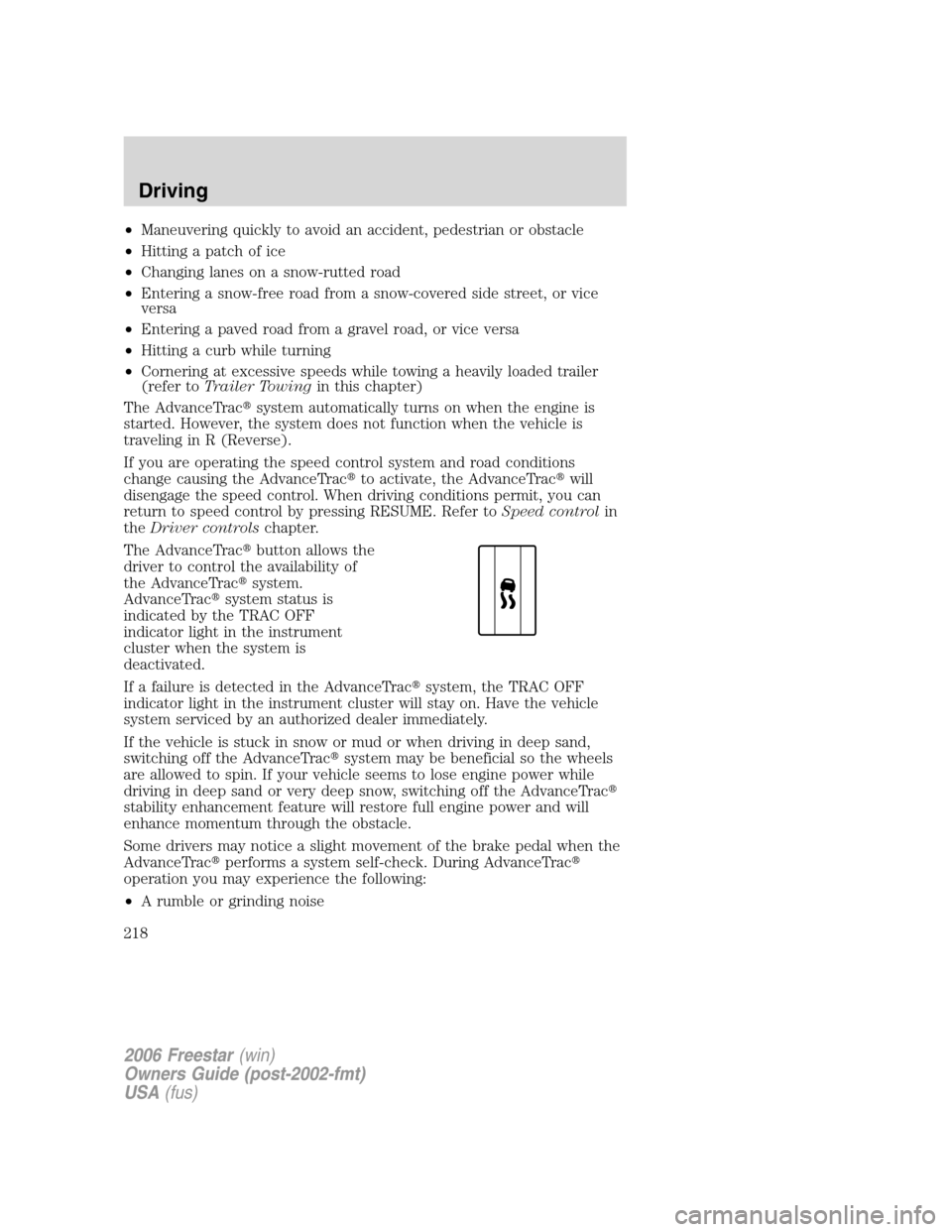
The AdvanceTrac�button allows the
driver to control the availability of
the AdvanceTrac�system.
AdvanceTrac�system status is
indicated by the TRAC OFF
indicator light in the instrument
cluster when the system is
deactivated.
If a failure is detected in the AdvanceTrac�system, the TRAC OFF
indicator light in the instrument cluster will stay on. Have the vehicle
system serviced by an authorized dealer immediately.
If the vehicle is stuck in snow or mud or when driving in deep sand,
switching off the AdvanceTrac�system may be beneficial so the wheels
are allowed to spin. If your vehicle seems to lose engine power while
driving in deep sand or very deep snow, switching off the AdvanceTrac�
stability enhancement feature will restore full engine power and will
enhance momentum through the obstacle.
Some drivers may notice a slight movement of the brake pedal when the
AdvanceTrac�performs a system self-check. During AdvanceTrac�
operation you may experience the following:
•A rumble or grinding noise
2006 Freestar(win)
Owners Guide (post-2002-fmt)
USA(fus)
Driving
218
The RSS is automatically enabled
when the gear selector is placed in
R (Reverse) and the ignition is ON.
The park aid disable switch allows
the driver to disable the RSS only
when the ignition is ON, and the
gear selector is in R (Reverse). The
OFF indicator remains illuminated
when the system is disabled. If the
indicator light illuminates when the RSS is not turned off, it may indicate
a failure in the RSS.
The system defaults toenabledevery time the ignition is turned on.
Press the control to disable or enable the system.
Keep the RSS sensors (located on the rear bumper/fascia) free
from snow, ice and large accumulations of dirt (do not clean the
sensors with sharp objects). If the sensors are covered, it will
affect the accuracy of the RSS.
If your vehicle sustains damage to the rear bumper/fascia, leaving
it misaligned or bent, the sensing zone may be altered causing
inaccurate measurement of obstacles or false alarms.
DRIVING THROUGH WATER
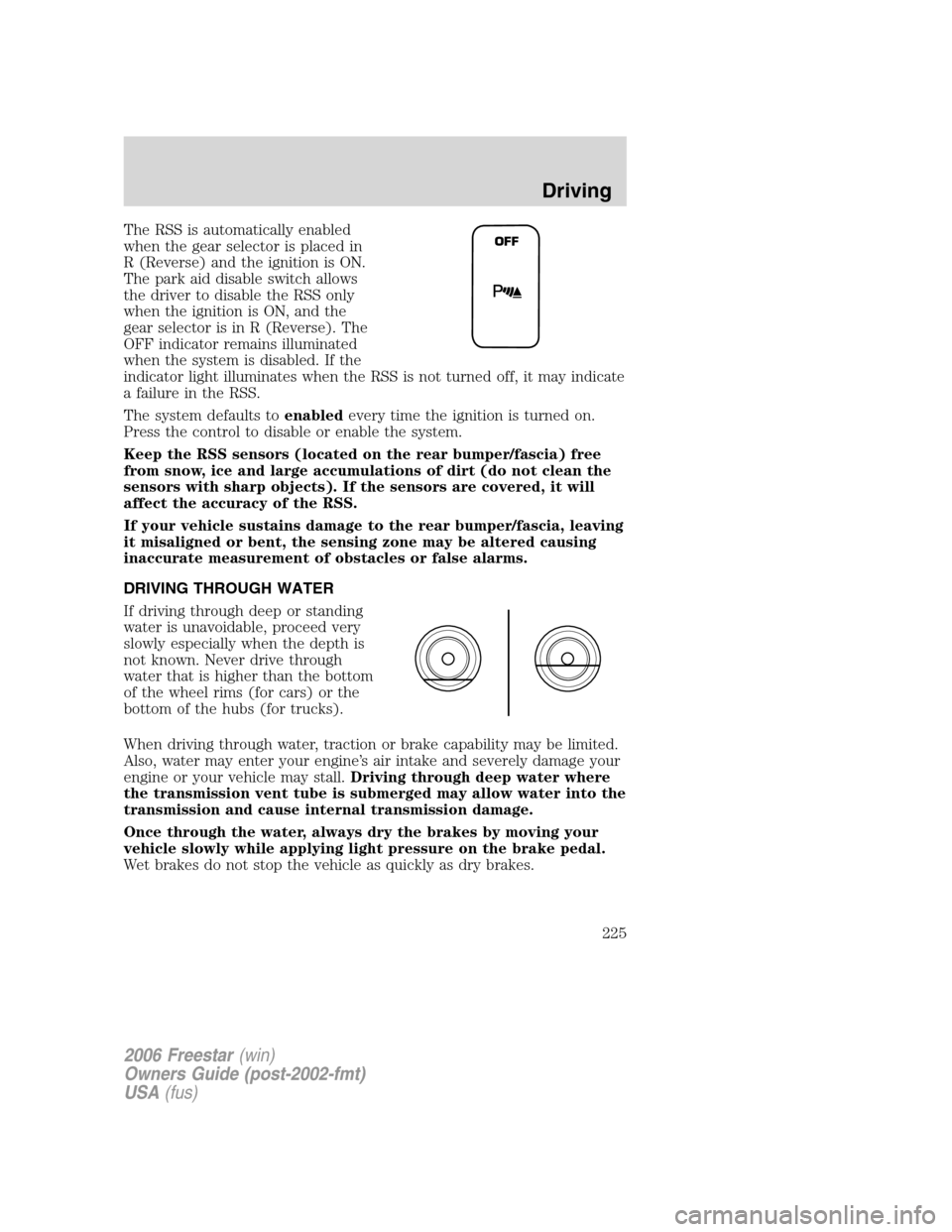
If driving through deep or standing
water is unavoidable, proceed very
slowly especially when the depth is
not known. Never drive through
water that is higher than the bottom
of the wheel rims (for cars) or the
bottom of the hubs (for trucks).
When driving through water, traction or brake capability may be limited.
Also, water may enter your engine’s air intake and severely damage your
engine or your vehicle may stall.Driving through deep water where
the transmission vent tube is submerged may allow water into the
transmission and cause internal transmission damage.
Once through the water, always dry the brakes by moving your
vehicle slowly while applying light pressure on the brake pedal.
Wet brakes do not stop the vehicle as quickly as dry brakes.OFF
2006 Freestar(win)
Owners Guide (post-2002-fmt)
USA(fus)
Driving
225